
What Is a Primary Standard? Understanding Purity, Stability and Intended Use
In analytical titration, a primary standard is a well-characterized substance used as the starting reference for establishing a concentration. Its composition must be known well enough for the measurement, it must remain suitable under the stated handling conditions, and it must take part in a reaction with known stoichiometry. “Primary standard” describes its role in the measurement. A high assay or a grade name alone does not establish that role.

What a primary standard contributes
Think of a titration as a comparison between a known amount of one substance and the amount of solution it reacts with. A primary standard supplies the known side of the comparison. For a solid, the weighed mass and the documented purity or assigned content help establish how much reacting substance is present. A known reaction relationship then connects that amount to the concentration being established.
- Known composition. The relevant content, its basis and any stated uncertainty determine what the mass represents.
- Stability under use conditions. The assigned content must remain applicable through storage and handling. Moisture uptake or decomposition can make mass a poor proxy for reacting content.
- A suitable reaction. The standard has to react in a defined way in the chosen titration, with an endpoint the method can interpret.

A real example with a defined purpose
The NIST certificate for SRM 84L potassium hydrogen phthalate identifies it as an acidimetric primary standard. Its certificate defines the property assigned to that specific material and the conditions of use. A generic bottle bearing the same chemical name does not inherit that certificate or its assigned value. A certificate for a different property would also support a different measurement purpose.
How a standardized solution relates to the reference
A laboratory can establish the concentration of a titrant by comparing it with a suitable primary standard under its method. The resulting standardized solution can then be used for routine measurements within that method's controls. Its working value comes from the comparison and is tied to that solution and its applicable conditions. Some standard solutions can be prepared directly from a suitable primary-standard substance, where the method supports that approach.
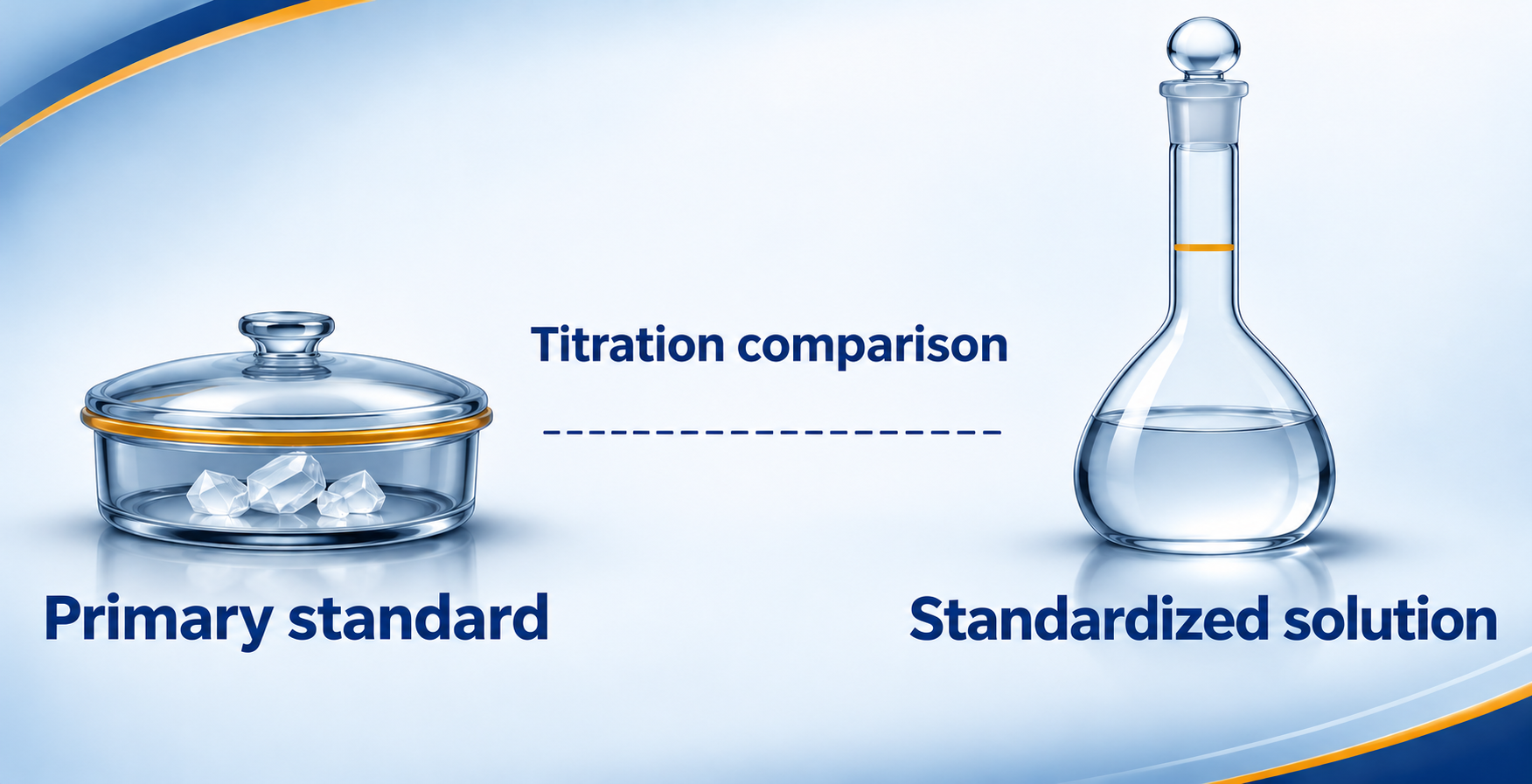
When reading a label or certificate, ask which property is assigned, which material the document covers and which measurement the assignment supports. Those details explain whether the material can serve as the starting reference for the intended titration.
Related Reading
- Why titrant standardization matters. Follow the distinction between a labeled concentration and a method’s working value.
Leave a comment!