
Can HPLC Grade Solvent Be Used for LC-MS?
Understanding the impurity control differences that affect mass spectrometry results

Direct Answer
HPLC grade solvent is generally not recommended for LC-MS applications, especially for trace-level or high-sensitivity analysis. LC-MS instruments, particularly mass spectrometers, are far more sensitive to trace impurities than standard UV or PDA detectors used in HPLC. Impurities that may be negligible in HPLC-UV analysis can cause background noise, ion suppression, or interference in LC-MS detection. For this reason, LC-MS grade solvent is typically recommended when working with mass spectrometry, though the final decision should always be based on the validated method and detector sensitivity requirements.
Why This Question Matters
Many laboratories use both HPLC and LC-MS instruments, and it is common for users to ask whether solvents can be shared between the two applications. Because HPLC grade and LC-MS grade solvents can appear similar and are sometimes priced closely, understanding the technical difference is important before making a substitution.
Key Differences Between HPLC Grade and LC-MS Grade Solvents
| Factor | HPLC Grade | LC-MS Grade |
|---|---|---|
| Primary Detection Method | UV, PDA | Mass spectrometry (MS), often paired with UV/PDA |
| Impurity Control | Controlled for chromatographic applications | Stricter control of trace-level impurities |
| Sensitivity to Contaminants | Lower sensitivity to trace impurities | Higher sensitivity; trace impurities can affect results |
| Typical Application | Routine HPLC analysis | Trace-level analysis, LC-MS/MS, high-sensitivity methods |
| Risk if Substituted | N/A | May introduce background noise or ion suppression if HPLC grade is used |
Note: Exact impurity thresholds and specifications vary by product and manufacturer. Users should always confirm details through the approved product specification or COA.
Why LC-MS Is More Sensitive to Solvent Impurities
Mass spectrometry detectors can identify compounds at extremely low concentrations, sometimes far below what UV or PDA detectors can distinguish from background noise. Because of this sensitivity, even trace-level impurities in the solvent can:
- Generate background noise that interferes with low-level analyte detection
- Cause ion suppression or ion enhancement, which can distort quantification
- Introduce unexpected peaks that are difficult to distinguish from real analytes
- Reduce overall method reproducibility, especially for trace or ultra-trace analysis
These effects are generally less noticeable in standard HPLC-UV methods, which is why HPLC grade solvent is considered adequate for many routine chromatographic applications but not necessarily for LC-MS.
When Might HPLC Grade Be Acceptable for LC-MS?
In some cases, HPLC grade solvent may be used for LC-MS applications, particularly when:
- The method does not require ultra-trace sensitivity
- Preliminary or non-critical testing is being performed
- The laboratory has validated the method using HPLC grade solvent and confirmed acceptable background levels
However, this should not be assumed as a general rule. Any decision to use HPLC grade solvent for LC-MS work should be based on method validation data and laboratory-specific requirements, not on cost or convenience alone.
When Should You Use LC-MS Grade Instead?
LC-MS grade solvent is generally recommended when:
- The method involves mass spectrometry detection, especially LC-MS/MS
- Trace-level or ultra-trace analysis is required
- The laboratory follows regulated or validated methods that specify LC-MS grade solvent
- Background noise or ion suppression has been observed with lower-grade solvents
Practical Considerations Before Substituting Solvent Grades
- Check your validated method. If LC-MS grade is specified, substituting HPLC grade may require re-validation.
- Review the product specification or COA. Compare documented impurity levels between the two grades before deciding.
- Consider your detection sensitivity. The lower the required detection limit, the more important solvent purity becomes.
- Run a system suitability test. If considering a substitution, testing background noise and baseline stability with the specific instrument is advisable.
- Consult your laboratory's technical team if unsure whether HPLC grade is acceptable for a specific LC-MS method.
Users should always verify actual product values through the approved product specification or COA rather than relying on general assumptions.
Related RCI Labscan Products
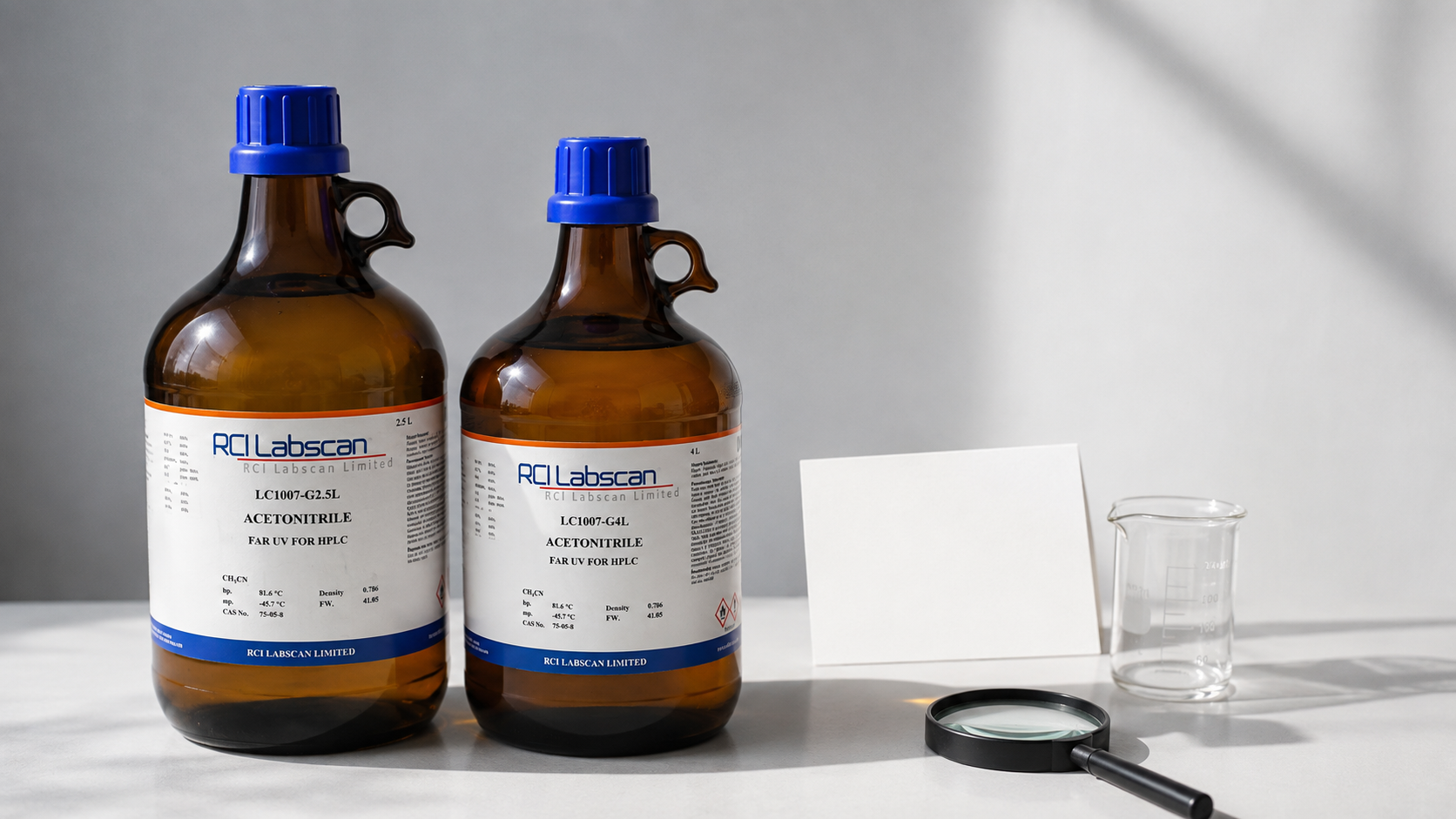
RCI Labscan offers both HPLC grade and LC-MS grade solvents to support a range of chromatographic and mass spectrometry applications. For product specifications, COA requests, or grade-related questions, customers may contact RCI Labscan or an authorized local distributor.
FAQ
Can I use HPLC grade Acetonitrile for LC-MS analysis?
HPLC grade Acetonitrile is generally not recommended for sensitive LC-MS applications because it may not meet the stricter impurity control required for mass spectrometry detection. LC-MS grade Acetonitrile is typically preferred for trace-level or high-sensitivity methods.
What happens if I use HPLC grade solvent in LC-MS by mistake?
Using HPLC grade solvent in LC-MS may result in background noise, ion suppression, or unexpected peaks, which can affect data quality, especially for trace-level analysis. The impact depends on the specific method and required sensitivity.
Is LC-MS grade solvent always more expensive than HPLC grade?
Pricing can vary by supplier, product, and region. Users should check current pricing with their supplier, as this article does not provide specific pricing information.
Do all LC-MS methods require LC-MS grade solvent?
Not necessarily. Some LC-MS methods with lower sensitivity requirements may tolerate HPLC grade solvent, but this should be confirmed through method validation rather than assumed.
How can I tell if a solvent is suitable for my LC-MS method?
The best way to confirm suitability is to review the product specification or COA, and, where possible, test the solvent using your specific instrument and method to check for background noise or interference.
Explore related products:
Related article:
- HPLC Grade vs LC-MS Grade
- What is HPLC Grade Solvent?
- Understanding Chemical Grades: Choosing the Right Solution with RCI Labscan
Leave a comment!