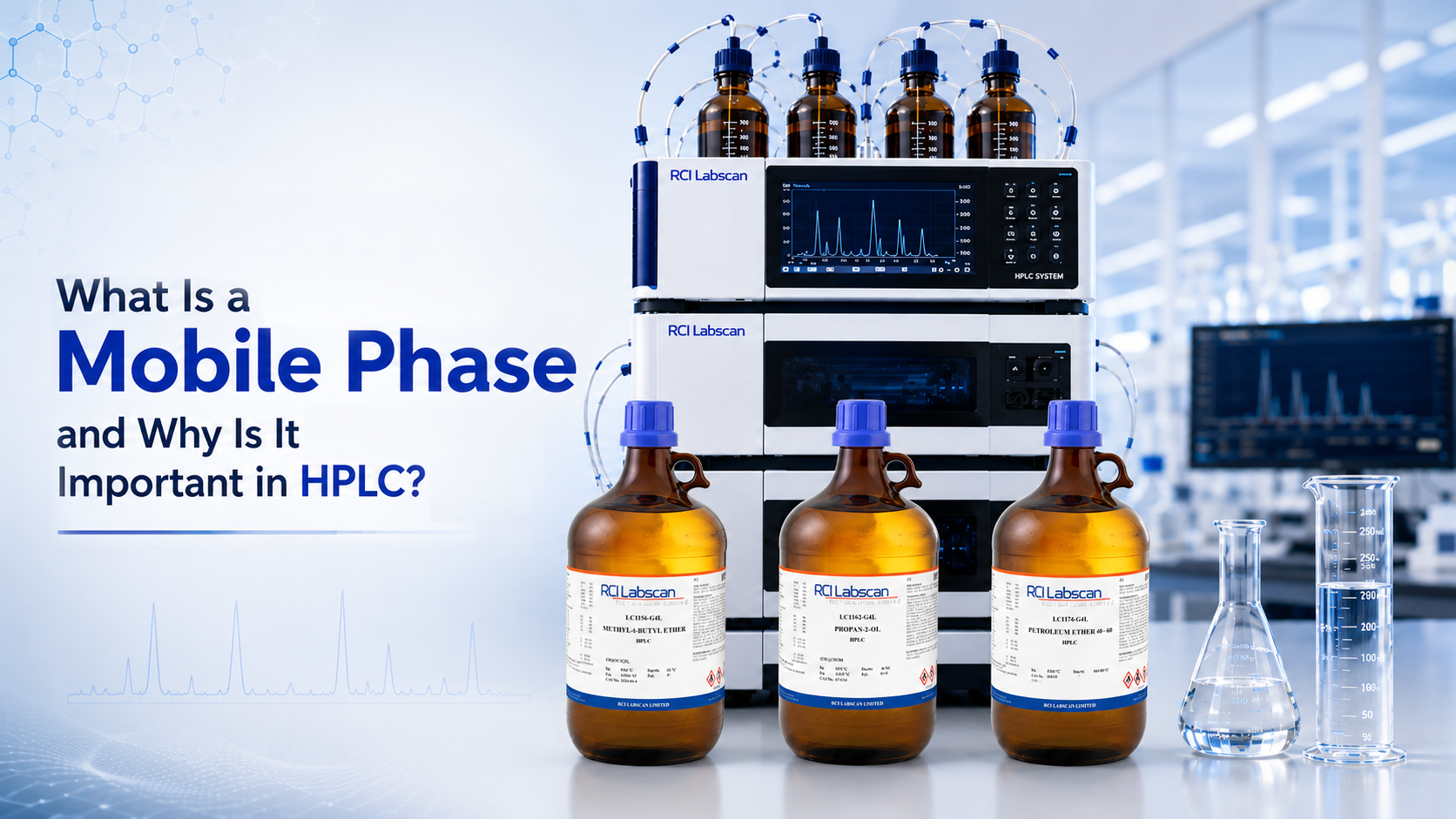

What Is a Mobile Phase and Why Is It Important in HPLC?
(A Practical Guide to Understanding the Role of the Mobile Phase in High Performance Liquid Chromatography)
Direct Answer
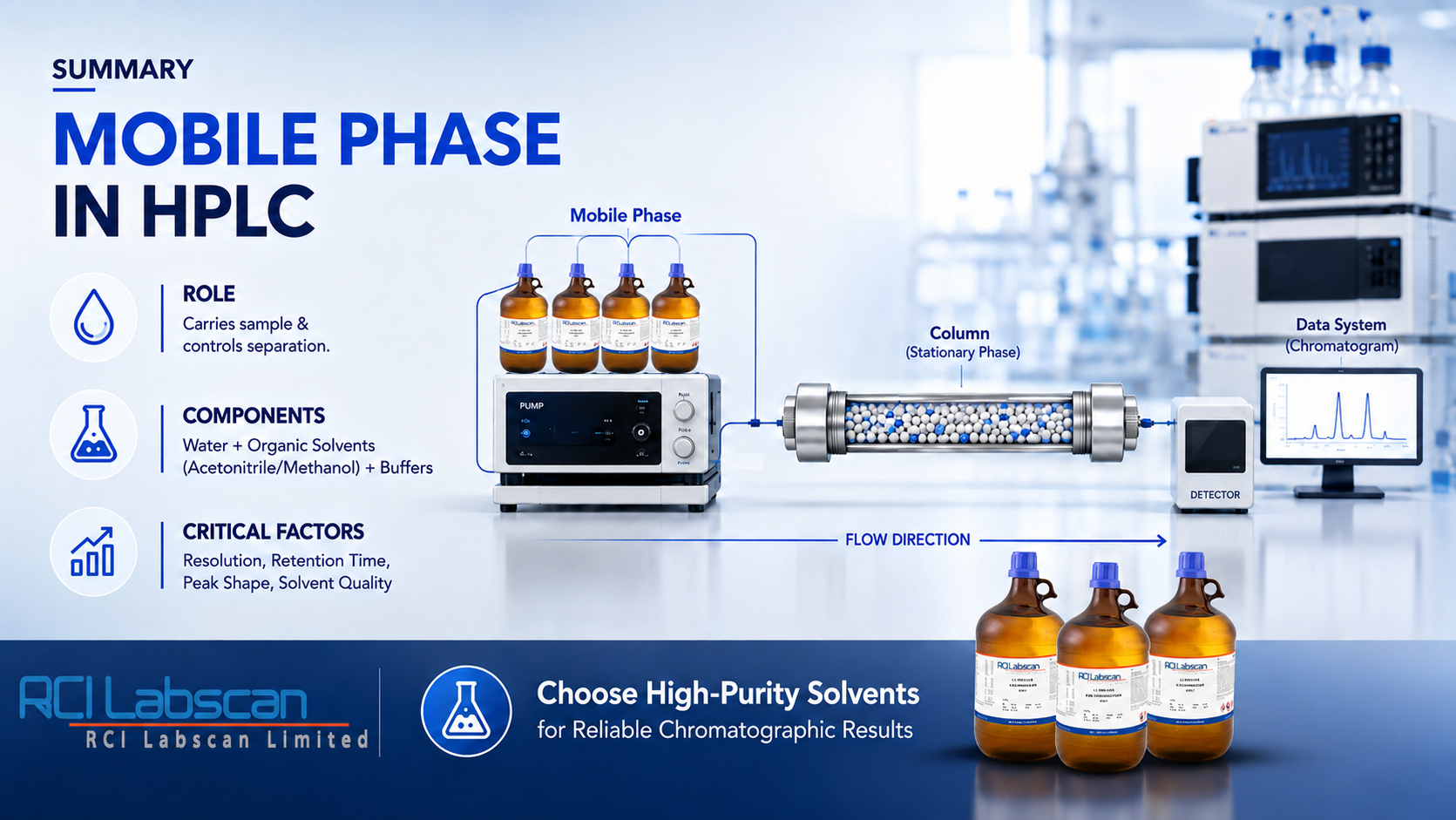
The mobile phase is the liquid solvent or mixture of solvents that carries the sample through the chromatographic column in High Performance Liquid Chromatography (HPLC). It is one of the most important factors affecting chromatographic performance because it influences retention time, separation efficiency, peak shape, resolution, and detector response.
Selecting an appropriate mobile phase requires consideration of the analytical method, stationary phase, detector type, and target compounds. Laboratories should always follow validated analytical methods and verify solvent quality through the relevant Product Specification, Safety Data Sheet (SDS), and Certificate of Analysis (COA).
What Is a Mobile Phase?
In HPLC, the mobile phase is the liquid that transports the sample through the chromatographic system. As the sample moves through the column, different compounds interact differently with the stationary phase, causing them to separate before reaching the detector.
The composition of the mobile phase directly affects how quickly compounds travel through the column and how well they are separated.
Most HPLC mobile phases consist of:
- Water
- Organic solvents (such as Acetonitrile or Methanol)
- Buffer solutions
- Acidic or basic modifiers (depending on the analytical method)
The exact composition depends on the analytical application and validated method.
Why Is the Mobile Phase Important?
The mobile phase is not simply a carrier liquid. It is an essential part of the chromatographic system and significantly influences analytical performance.
An appropriately selected mobile phase may help achieve:
- Good chromatographic resolution
- Stable retention times
- Symmetrical peak shapes
- Improved sensitivity
- Stable detector baselines
- Consistent analytical performance
Conversely, an unsuitable mobile phase may result in poor separation, excessive backpressure, unstable baselines, or inconsistent analytical results.
Main Components of an HPLC Mobile Phase
A typical HPLC mobile phase may contain several components depending on the analytical method.
| Component | Purpose |
|---|---|
| Water | Primary solvent for aqueous mobile phases |
| Organic Solvent | Controls elution strength and analyte retention |
| Buffer | Maintains stable pH during analysis |
| Acid or Base Modifier | Improves peak shape and ionization of analytes |
| Additives | Enhance chromatographic performance for specific applications |
The selection and concentration of each component should follow the validated analytical procedure.
Common Organic Solvents Used in HPLC
The two most commonly used organic solvents in reversed-phase HPLC are Acetonitrile and Methanol.
Acetonitrile
Acetonitrile is commonly selected because it offers:
- Lower viscosity
- Lower system backpressure
- Strong elution strength
- Lower UV cutoff
- Good compatibility with many reversed-phase methods
Methanol
Methanol is also widely used because it provides:
- Good solvent strength for many applications
- Different chromatographic selectivity
- Compatibility with water and common HPLC buffers
- A practical choice for many routine analytical methods
The choice between Acetonitrile and Methanol depends on the analytical method, target compounds, detector requirements, and validated procedure.
Isocratic vs Gradient Mobile Phase
HPLC methods generally use one of two mobile phase modes.
Isocratic Elution
An isocratic method maintains the same mobile phase composition throughout the analysis. It is commonly used when:
- Sample composition is relatively simple
- Compounds have similar retention characteristics
- Routine analysis is required
Gradient Elution
A gradient method gradually changes the mobile phase composition during the analytical run. Gradient methods are often selected when:
- Samples contain compounds with a wide range of polarities
- Better separation is required
- Shorter analytical run times are desired
- Complex mixtures need improved resolution
The choice between isocratic and gradient methods depends entirely on the analytical objectives.
Factors That Affect Mobile Phase Selection
Selecting an appropriate mobile phase involves evaluating several analytical factors:
1. Stationary Phase
The chemistry of the HPLC column influences how analytes interact with the mobile phase.
2. Detector Type
Different detectors may require different solvent properties. For example, UV/PDA detectors require consideration of UV cutoff, while LC-MS methods require solvents with low levels of volatile impurities.
3. Target Compounds
The chemical properties of the analytes determine the appropriate solvent composition, pH, and organic modifier.
4. Buffer Compatibility
Buffers should remain soluble throughout the analysis and be compatible with both the analytical method and the detector.
5. Solvent Quality
The quality of the solvent may affect baseline stability, peak shape, retention time reproducibility, instrument cleanliness, and analytical sensitivity. Laboratories should always select solvents that meet the quality requirements of their analytical methods.
Why Does Solvent Grade Matter?
Using the correct solvent grade is essential for reliable chromatographic performance.
| Solvent Grade | Typical Application |
|---|---|
| HPLC Grade | Routine HPLC analysis |
| LC-MS Grade | LC-MS applications requiring tighter impurity control |
| AR Grade | General laboratory analysis |
| Reagent Grade | General laboratory use where chromatographic performance is not required |
Higher-quality solvents help reduce unwanted impurities that may interfere with chromatographic analysis.
Good Practices for Preparing an HPLC Mobile Phase
To obtain consistent analytical performance, laboratories should follow good preparation practices, including:
- Use high-purity solvents suitable for the analytical method.
- Prepare mobile phases using clean containers.
- Filter the mobile phase when required by laboratory procedures.
- Degas the mobile phase before analysis if applicable.
- Clearly label prepared mobile phases.
- Follow the storage conditions recommended by the laboratory and solvent manufacturer.
- Review the Product Specification, SDS, and COA before use.
Common Problems Caused by an Improper Mobile Phase
An unsuitable or contaminated mobile phase may contribute to several chromatographic problems, including:
- Poor chromatographic resolution
- Broad or tailing peaks
- Unstable baseline
- Unexpected peaks
- Variable retention times
- Increased system backpressure
- Reduced analytical sensitivity
- More frequent instrument maintenance
When troubleshooting HPLC performance, laboratories should evaluate the mobile phase together with other factors such as the column, instrument condition, sample preparation, and analytical method.
Frequently Asked Questions (FAQ)
What is a mobile phase in HPLC?
The mobile phase is the liquid solvent that transports the sample through the HPLC column and enables chromatographic separation.
What solvents are commonly used in an HPLC mobile phase?
Water, Acetonitrile, and Methanol are among the most commonly used solvents. Buffers and other modifiers may also be added depending on the analytical method.
Why is mobile phase quality important?
Mobile phase quality can influence retention time, peak shape, detector response, baseline stability, and overall analytical reproducibility.
Can I use general laboratory solvents for HPLC?
General-purpose laboratory solvents may not meet the purity requirements for chromatographic analysis. Laboratories should use HPLC Grade or higher-quality solvents when specified by the analytical method.
Should I use HPLC Grade or LC-MS Grade solvents?
The appropriate solvent grade depends on the analytical technique. HPLC methods typically require HPLC Grade solvents, while LC-MS methods often require LC-MS Grade solvents because of stricter impurity control.
Related RCI Labscan Products
RCI Labscan offers a range of high-purity solvents suitable for chromatographic applications, including:
- Acetonitrile HPLC
- Methanol HPLC
- Water HPLC
- LC-MS Grade Solvents
- HPLC Solvents
For product information, packaging options, Certificates of Analysis (COA), or Safety Data Sheets (SDS), customers may contact RCI Labscan or an authorized local distributor.
Explore Related Articles:
- Acetonitrile vs Methanol: Which Solvent Should You Choose for HPLC?
- What Is HPLC Grade Solvent?
- Understanding Chemical Grades: Choosing the Right Solution with RCI Labscan
Leave a comment!