
Why Chloride Matrices Can Complicate ICP-MS Measurements
Chloride can complicate inductively coupled plasma mass spectrometry (ICP-MS) because chloride-containing samples can form molecular ions in the plasma that overlap an analyte's measurement channel. One familiar case is arsenic at nominal m/z 75. The overlap can add signal even when the interfering ion contains no arsenic. Its significance depends on the sample matrix, the instrument and the measurement mode.

Why two ions can reach the same measurement channel
ICP-MS measures ions by their mass-to-charge ratio, written m/z. The nominal mass of a singly charged arsenic-75 ion, 75As+, is 75. A singly charged molecular ion containing argon-40 and chlorine-35, 40Ar35Cl+, also has nominal m/z 75 because 40 and 35 sum to 75. The ions have different exact masses. A system measuring them together at unit mass resolution can register the molecular ion in the arsenic channel. US EPA Method 200.8, section 4 and Table 2 documents this overlap in the context of its own method.
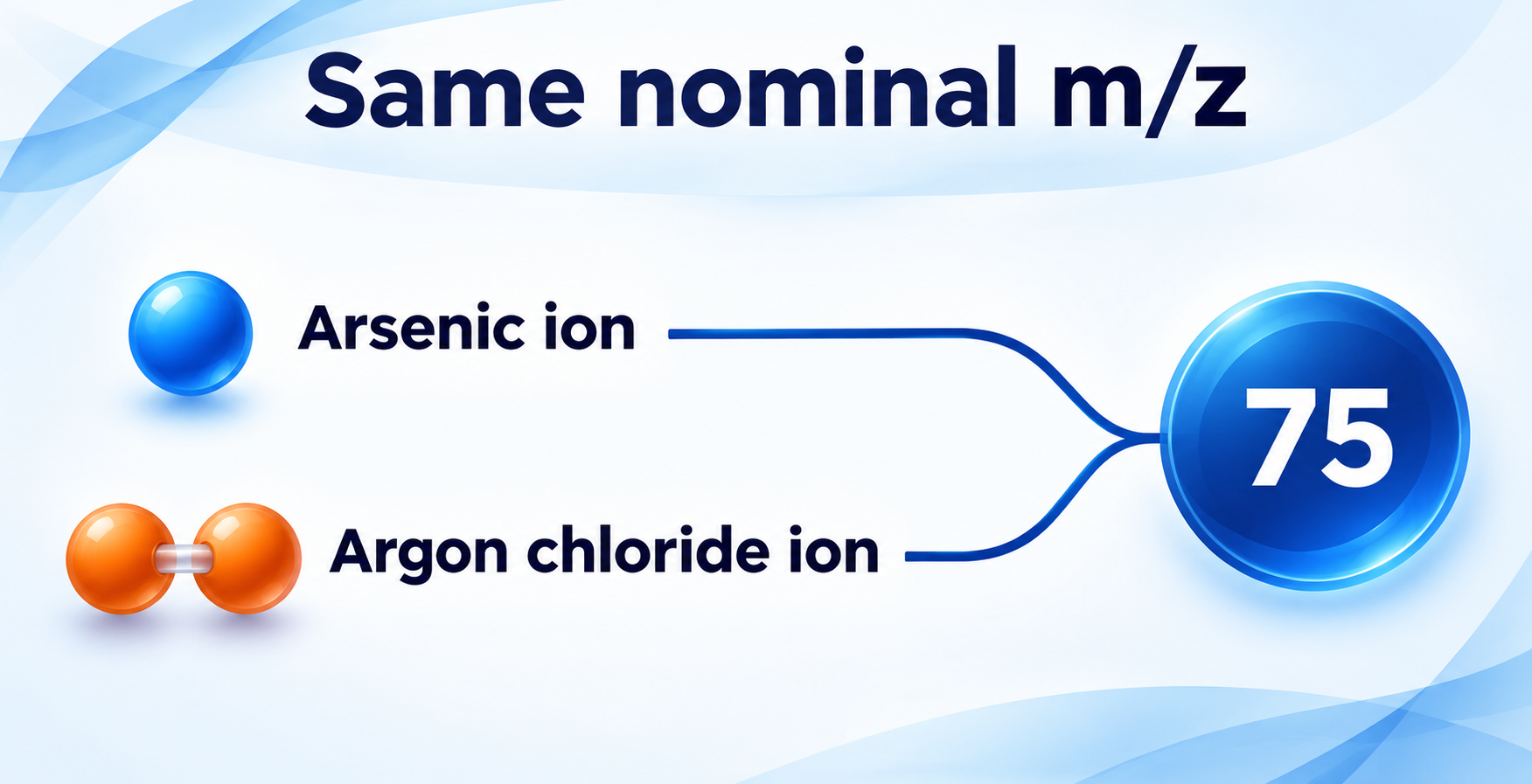
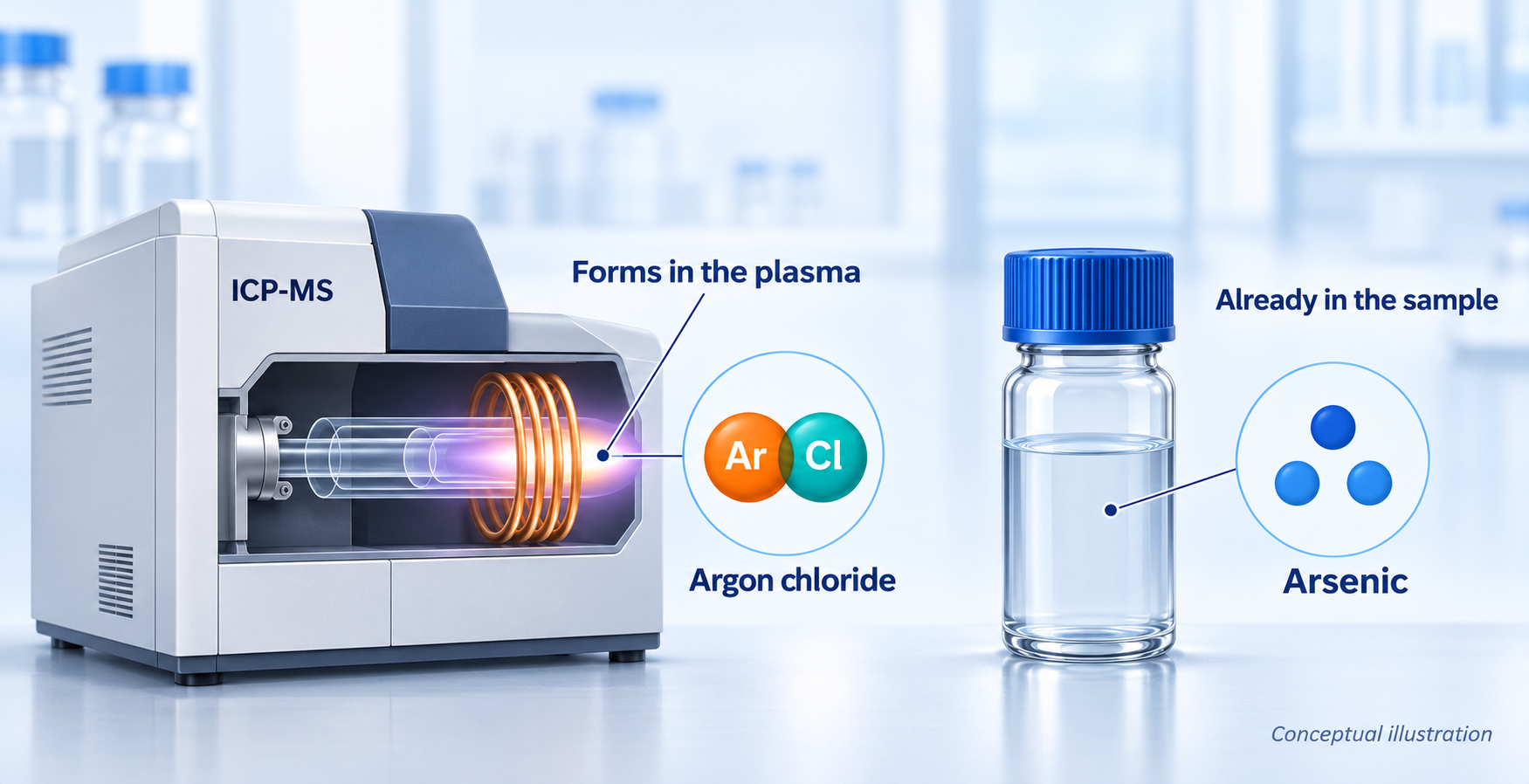
Argon is part of the plasma, while the chlorine can originate from the sample matrix or a chloride-containing input. The example does not predict how much interference a particular sample will produce. An instrument's resolving capability or a method's interference-control mode can change what reaches the reported signal. The laboratory's evidence for the relevant matrix and mode establishes how the interference is handled.
Separate spectral overlap from contamination
If arsenic enters from a reagent, vessel or another preparation input, actual arsenic contributes to the signal. With argon chloride overlap, another species contributes signal at the arsenic channel. These mechanisms can coexist. Reagent impurity documentation helps assess the former, while it cannot establish that a chloride-containing sample is free from the latter. A preparation blank that does not represent the sample's chloride load cannot by itself exclude sample-matrix interference.
Questions to bring back to the laboratory
- Which element and measurement channel is the laboratory discussing, and under which method and instrument mode?
- Where does chloride enter the workflow, and do the available controls represent that source?
- Is the concern an elemental impurity in a supplied reagent, a spectral overlap in a particular matrix, or a change in response across samples?
These questions help a distributor request the right evidence. A lot-specific certificate or specification addresses the supplied reagent and only the characteristics it documents. The laboratory's method evidence addresses whether a given matrix can be measured under its conditions. Keep those two requests distinct when a customer reports an unexpected signal.
Related Reading
- Trace-metal contamination and preparation blanks. See what preparation blanks can reveal about contamination from vessels, water and reagents.
Leave a comment!