
Solvent Exchange During Sample Preparation: Avoiding Analyte Loss and Precipitation
Solvent exchange changes the liquid environment around an analyte before measurement. It can help connect an extraction step with the next analytical stage, but it does not guarantee analyte recovery or complete removal of the original solvent. The important questions are whether the analyte remains available, whether the final composition is suitable, and whether the method's evidence covers the exchange.
Distinguish exchange, dilution and concentration
Dilution adds solvent and changes concentration without necessarily removing the original medium. Concentration reduces liquid volume, usually with the aim of increasing analyte concentration. Solvent exchange changes the medium; evaporation followed by reconstitution is one approach, while other workflows can transfer analytes between liquid phases. These operations can overlap, but the terms do not establish the same mass balance.
The FDA researchers' solvent-exchange recovery study examines a liquid–liquid transfer context and the role of partitioning. It demonstrates why recovery depends on the exchange scenario. That bounded research model is not a universal recovery prediction for evaporation, every analyte or every matrix.
In evaporation and reconstitution, the intended result is a suitable final solution containing a known, adequately recovered analyte amount. A smaller final volume alone cannot establish that result.
Follow the analyte, not just the disappearing solvent
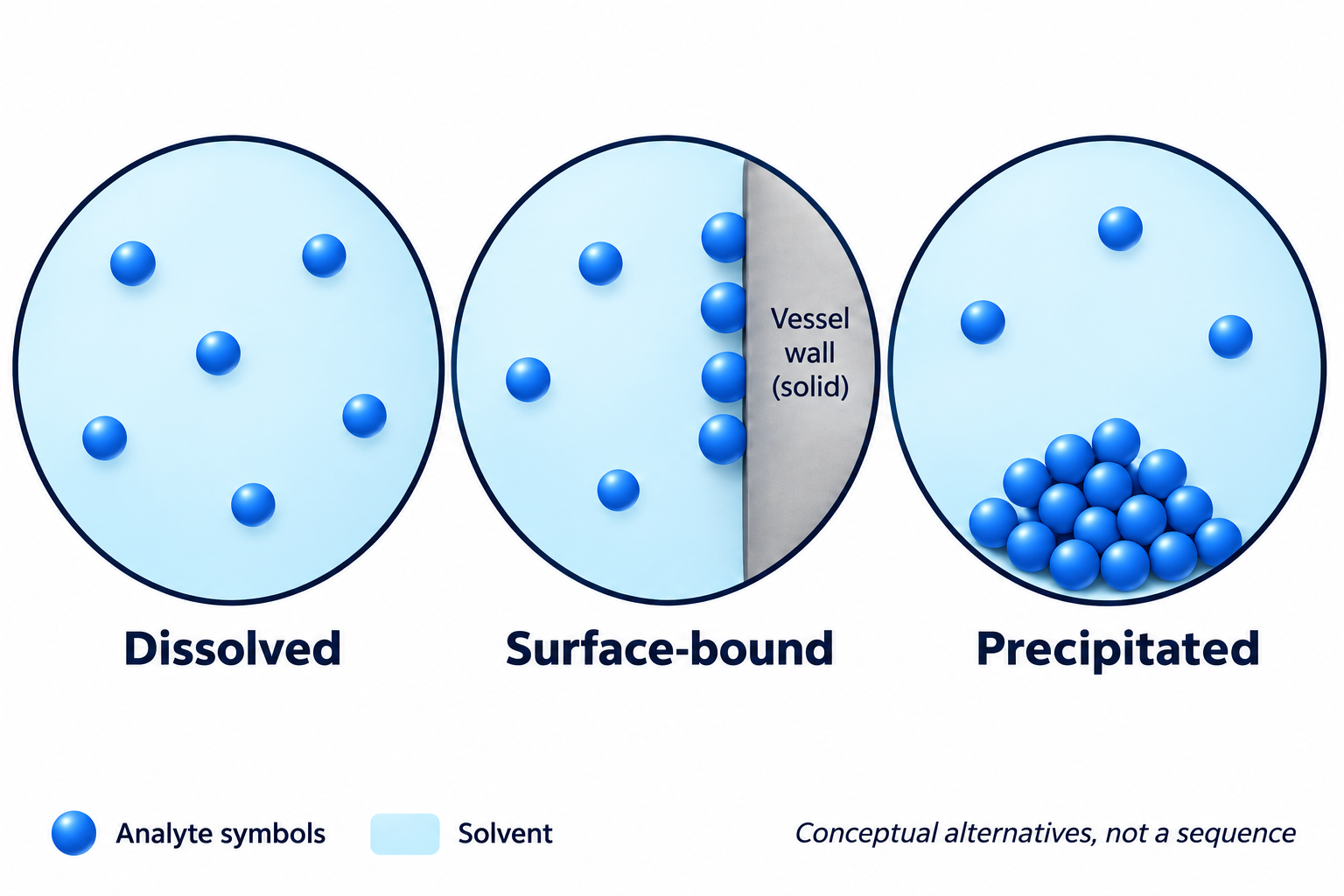
Several analyte fates are possible. Some compounds may be lost through volatility, some may degrade under the exposure conditions, and others may bind to the vessel or resist redissolution. The Biotage sample-preparation discussion identifies these as challenges associated with evaporation. Which mechanism matters depends on the analyte and workflow.
Keep recovery separate from concentration. Conceptually, the final dissolved concentration depends on the analyte amount still available in solution divided by the final solution volume. Reducing volume can be accompanied by analyte loss. A strong detector response after concentration does not prove that the original amount was quantitatively retained.
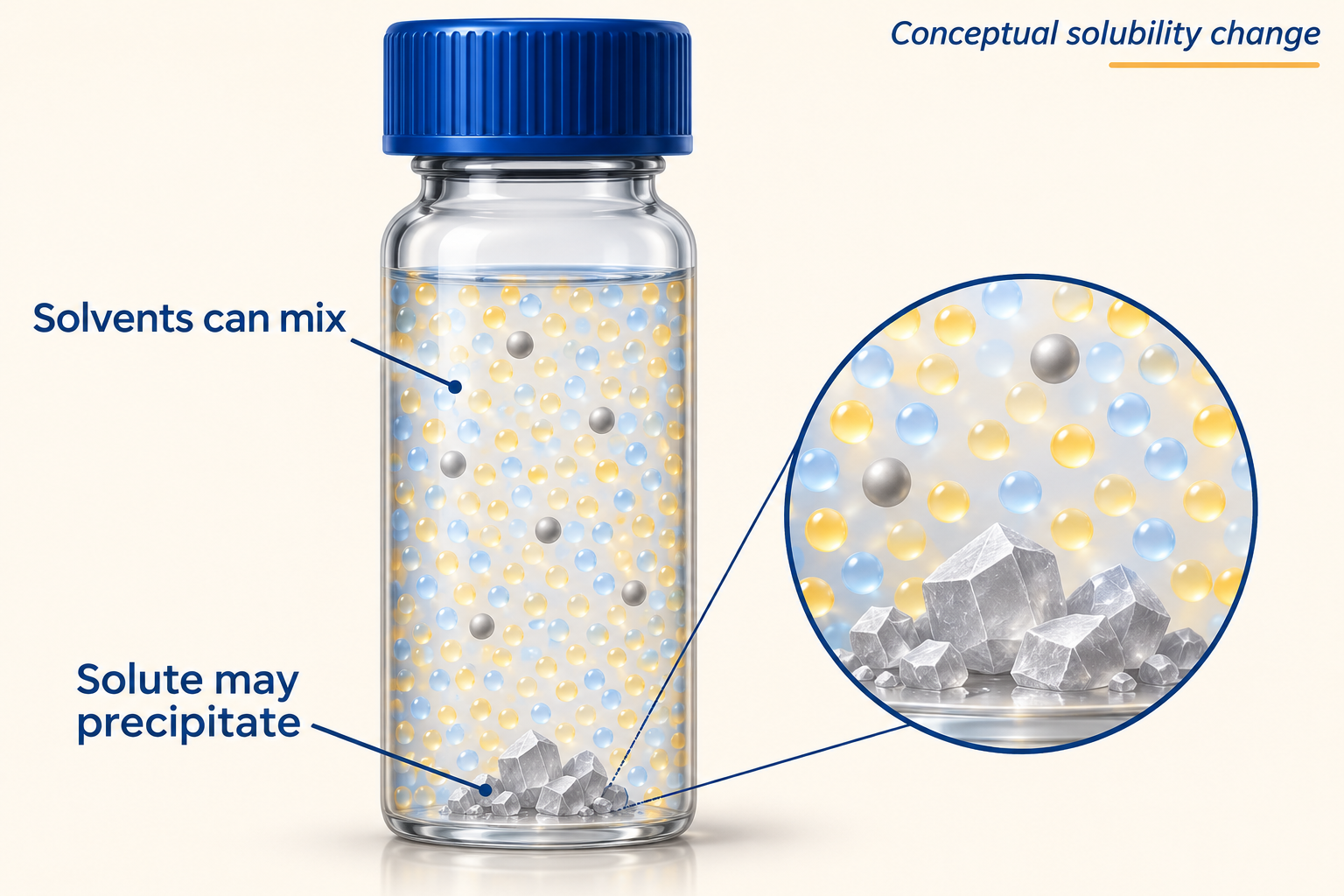
Why precipitation can appear during an exchange
Changing solvent composition changes the environment that supports dissolution. An analyte, salt or co-extracted matrix component that was soluble earlier may become less soluble in the new mixture. Concentration can also increase the amount of dissolved material per unit volume. A clear original extract therefore does not guarantee a clear final preparation.
The Agilent sample-preparation handbook treats solvent choice and subsequent preparation as part of the analytical workflow. The relevant question is not simply whether two solvents mix, but whether the complete sample remains appropriate for the next stage.
Visible solids do not identify their composition. They may involve matrix material, analyte or both. Removing solids without understanding the analyte distribution can alter the amount presented for analysis. Use the method's investigation and sample-disposition process rather than assuming that filtration or additional solvent restores the original recovery.
Final-solvent suitability and recovery are different questions
A preparation can retain analyte but still be unsuitable for the separation or detector. It can also give an apparently convenient final solvent while losing some analyte during the exchange. Waters' high-organic-diluent study illustrates the relationship between sample solvent and chromatographic behavior in a specific UHPLC context. Its conditions are not a general remedy for another method.
This is why injection-solvent focusing and preparation-stage recovery should not be treated as the same diagnosis. Better peak shape after a solvent change does not, by itself, prove that sample preparation preserved the analyte amount.
What evidence makes an exchange defensible?
Review the exact analytes, representative matrix, vessel, final composition and method conditions. Ask whether available recovery and stability evidence includes the exchange stage and the relevant handling interval. A control introduced after an exchange cannot describe losses that occurred before its addition.
Biotage's evaporation and reconstitution study discusses analyte solubility, vessel interactions and differing responses to conditions. Its application-specific results support testing the intended workflow, not borrowing a temperature, gas setting, keeper solvent or recovery expectation for unrelated samples.
- Define which preparation stage the recovery evidence actually covers.
- Check whether the studied analytes and matrix represent the samples of interest.
- Keep final volume, final composition and residual original solvent as separate record fields where relevant.
- Distinguish loss during preparation from changes in detector response caused by the final matrix.
- Apply the method's established criteria and quality controls; do not invent a universal acceptable recovery.
Common interpretation traps
Does a visually dry residue prove complete solvent removal?
No. Appearance is not a measurement of residual solvent or final composition. If either affects the analytical decision, use the evidence and controls specified for that method.
Does a clear reconstituted sample prove complete recovery?
No. Analyte can be lost or remain associated with surfaces without producing visible solids. Clarity answers a different question from analyte mass balance.
Can a published exchange condition be copied into another method?
It can inform method development, but it does not establish suitability for another analyte panel, matrix, vessel or analytical system. Follow the approved method and equipment guidance; this conceptual comparison provides no evaporation recipe or operating settings.
When an exchange is proposed or investigated, ask the analytical method owner to review recovery, final-solution behavior and downstream compatibility together. That evidence is more useful than assuming that replacing one solvent with another is chemically neutral.
Leave a comment!