
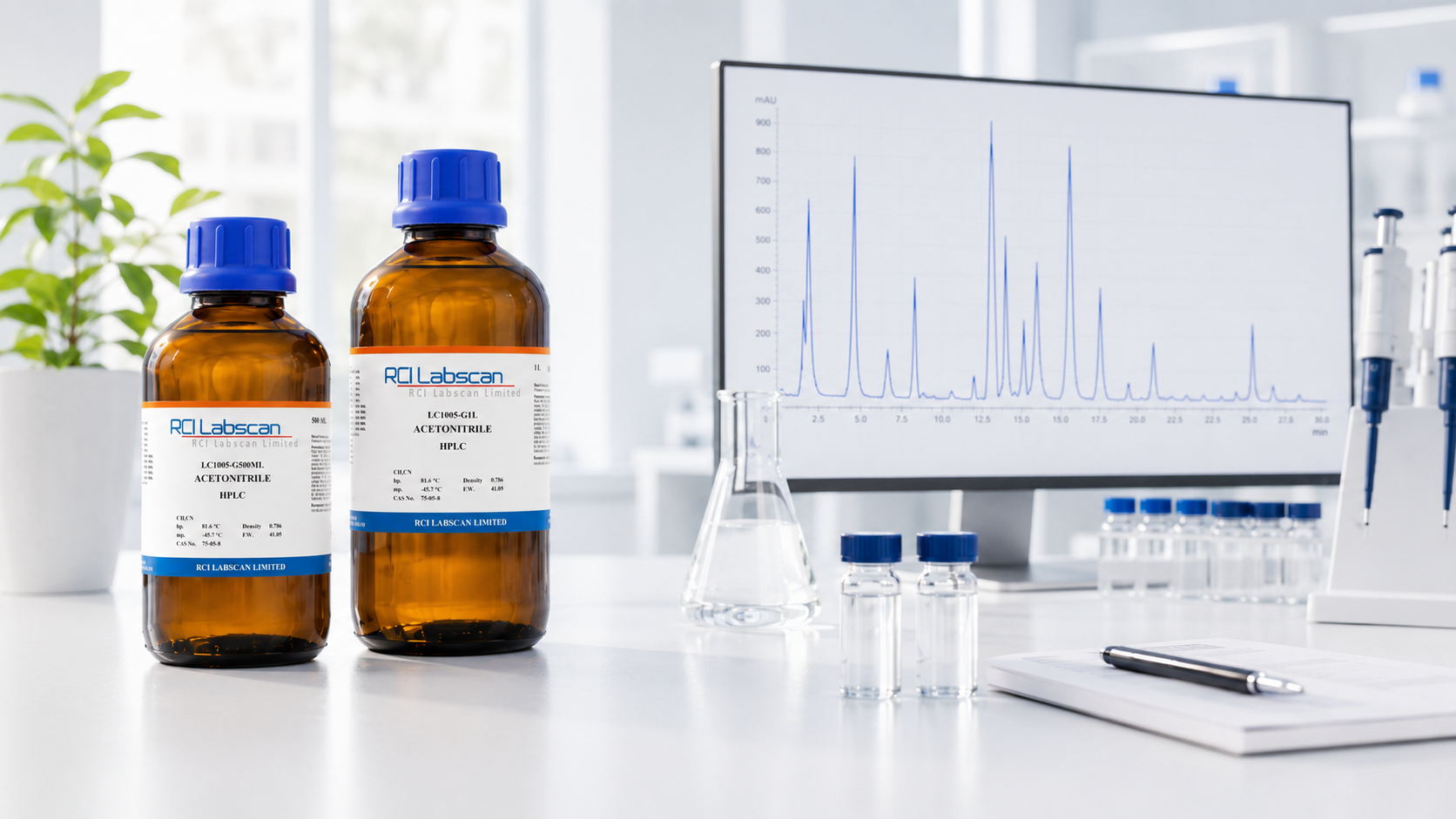
How to Choose Acetonitrile for HPLC Solvents

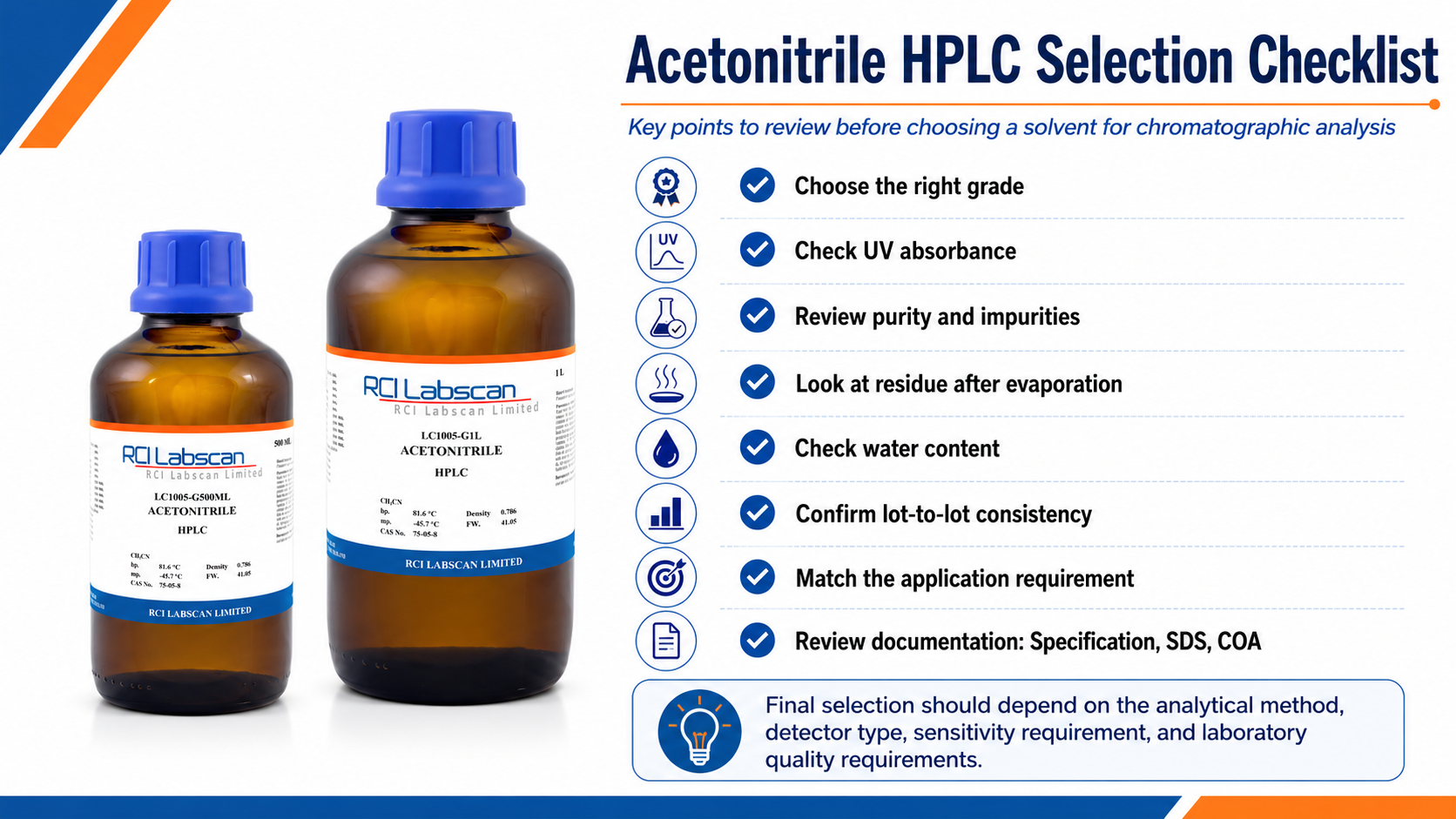
To choose Acetonitrile for HPLC, select a solvent grade that is specifically designed for chromatographic analysis. Key factors include high purity, low UV absorbance, low residue, consistent lot-to-lot quality, suitable water content, and reliable documentation such as specification, SDS, or COA. For routine HPLC analysis, HPLC grade Acetonitrile is commonly used, while more sensitive techniques such as LC-MS may require LC-MS grade solvent.
Why Acetonitrile Is Commonly Used in HPLC
Acetonitrile is one of the most widely used organic solvents in HPLC mobile phases. It is valued for its low viscosity, strong elution strength, good miscibility with water, and compatibility with many reversed-phase HPLC methods.
Because HPLC analysis depends on a stable mobile phase, the quality of Acetonitrile can directly affect baseline stability, peak shape, retention time, and overall analytical reliability.
Key Factors When Choosing Acetonitrile for HPLC
When selecting Acetonitrile for HPLC, users should consider not only the chemical name but also the solvent grade, quality parameters, documentation, and intended analytical method.
Important factors include:
- Solvent grade
- Purity
- UV absorbance
- Residue after evaporation
- Water content
- Lot-to-lot consistency
- Application requirements
- Product documentation
- Packaging suitability
1. Choose the Right Grade
For HPLC analysis, users should select Acetonitrile HPLC grade rather than general laboratory grade solvent.
HPLC grade Acetonitrile is produced and controlled for chromatographic applications. In contrast, general solvent may contain impurities or quality variations that can affect HPLC results.
Using the correct grade helps reduce the risk of baseline noise, unwanted peaks, retention time shifts, or inconsistent analytical performance.
2. Check UV Absorbance
UV absorbance is important when using UV or PDA detectors. Acetonitrile with high UV absorbance may increase background noise or interfere with detection, especially at lower wavelengths.
A suitable HPLC grade Acetonitrile should have low UV absorbance in the wavelength range relevant to the analytical method.
Users should check the product specification to confirm whether the solvent is appropriate for their method and detector requirements.
3. Consider Purity and Impurities
High-purity Acetonitrile helps reduce unwanted peaks, baseline drift, and interference from unknown contaminants.
Important quality factors may include:
- High assay or purity
- Low residue after evaporation
- Controlled impurities
- Low absorbance
- Consistent performance between lots
However, users should always verify actual product values from the approved product specification or Certificate of Analysis.
4. Look at Residue Level
Residue after evaporation can be important in HPLC because non-volatile residues may accumulate in the system or affect sensitive analysis.
Low-residue solvent helps support cleaner chromatographic performance and may reduce contamination risk in the HPLC system.
For regulated laboratories or sensitive methods, users should review the residue specification before purchase.
5. Check Water Content
Water content can affect mobile phase composition, retention time, and method reproducibility.
For methods that require precise mobile phase preparation, consistent water content in Acetonitrile can help maintain stable analytical conditions.
Users should check whether the water content specification is suitable for their method requirements.
6. Consider the Application
Different applications may require different solvent grades.
| Application | Recommended Consideration |
|---|---|
| Routine HPLC analysis | HPLC grade Acetonitrile |
| UV detection | Low UV absorbance |
| Gradient elution | Low baseline drift and consistent quality |
| Pharmaceutical QC | Reliable specification and documentation |
| Trace-level or MS detection | Consider LC-MS grade Acetonitrile |
| Method development | Consistent lot-to-lot quality |
The final selection should always depend on the analytical method, detector type, sensitivity requirement, and laboratory quality requirements.
HPLC Grade vs LC-MS Grade Acetonitrile
HPLC grade Acetonitrile is suitable for chromatographic analysis, especially when using common HPLC detectors such as UV or PDA.
LC-MS grade Acetonitrile usually requires stricter control of impurities that may interfere with mass spectrometry detection. Therefore, if the method uses LC-MS or requires trace-level sensitivity, LC-MS grade may be more suitable.
HPLC grade should not automatically be assumed to replace LC-MS grade in sensitive mass spectrometry applications. Users should follow their validated method and review product documentation before selecting the solvent grade.
When Should You Use Acetonitrile HPLC?
Acetonitrile HPLC is commonly used for:
- HPLC mobile phase preparation
- Reversed-phase HPLC
- Gradient elution methods
- Pharmaceutical analysis
- Food and beverage testing
- Environmental analysis
- Quality control testing
- Research and analytical laboratory work
The suitability of Acetonitrile HPLC depends on the analytical method, required sensitivity, detector type, and laboratory quality requirements.
Documentation to Check Before Purchase
Before choosing Acetonitrile for HPLC, users may check whether the supplier can provide relevant documentation, such as:
- Product specification
- Safety Data Sheet
- Certificate of Analysis
- Packaging information
- Product grade information
This is especially important for regulated laboratories, quality control work, or repeated purchasing.
Related RCI Labscan Products
RCI Labscan provides high-purity solvents for analytical laboratory applications, including Acetonitrile HPLC and other commonly used HPLC grade solvents.
For product availability, packaging options, or documentation requests, customers may contact RCI Labscan or local authorized distributors.
FAQ
What grade of Acetonitrile should I use for HPLC?
For HPLC analysis, HPLC grade Acetonitrile is recommended because it is controlled for chromatographic applications and helps reduce interference from impurities.
Can I use general Acetonitrile for HPLC?
General Acetonitrile is not recommended for HPLC analysis because it may contain impurities or quality variations that can affect baseline stability, peak shape, or analytical results.
Is Acetonitrile better than Methanol for HPLC?
Acetonitrile and Methanol are both commonly used in HPLC. Acetonitrile often provides lower viscosity and different elution strength, while Methanol may be preferred in some methods depending on separation requirements.
When should I use LC-MS grade Acetonitrile instead of HPLC grade?
LC-MS grade Acetonitrile should be considered when using mass spectrometry detection or when the method requires very low impurity levels for high-sensitivity analysis.
Why is UV absorbance important in Acetonitrile HPLC?
Low UV absorbance helps reduce background interference when using UV detection, especially at lower wavelengths.
Explore related products:
- Acetonitrile HPLC
- Acetonitrile LC-MS
- View all HPLC grade products
- View all LC-MS grade products
- Methanol HPLC
- Methanol LC-MS
Related articles:
Leave a comment!