COA vs Specification: What Is the Difference?
Understanding two essential quality documents in laboratory chemical purchasing

Direct Answer
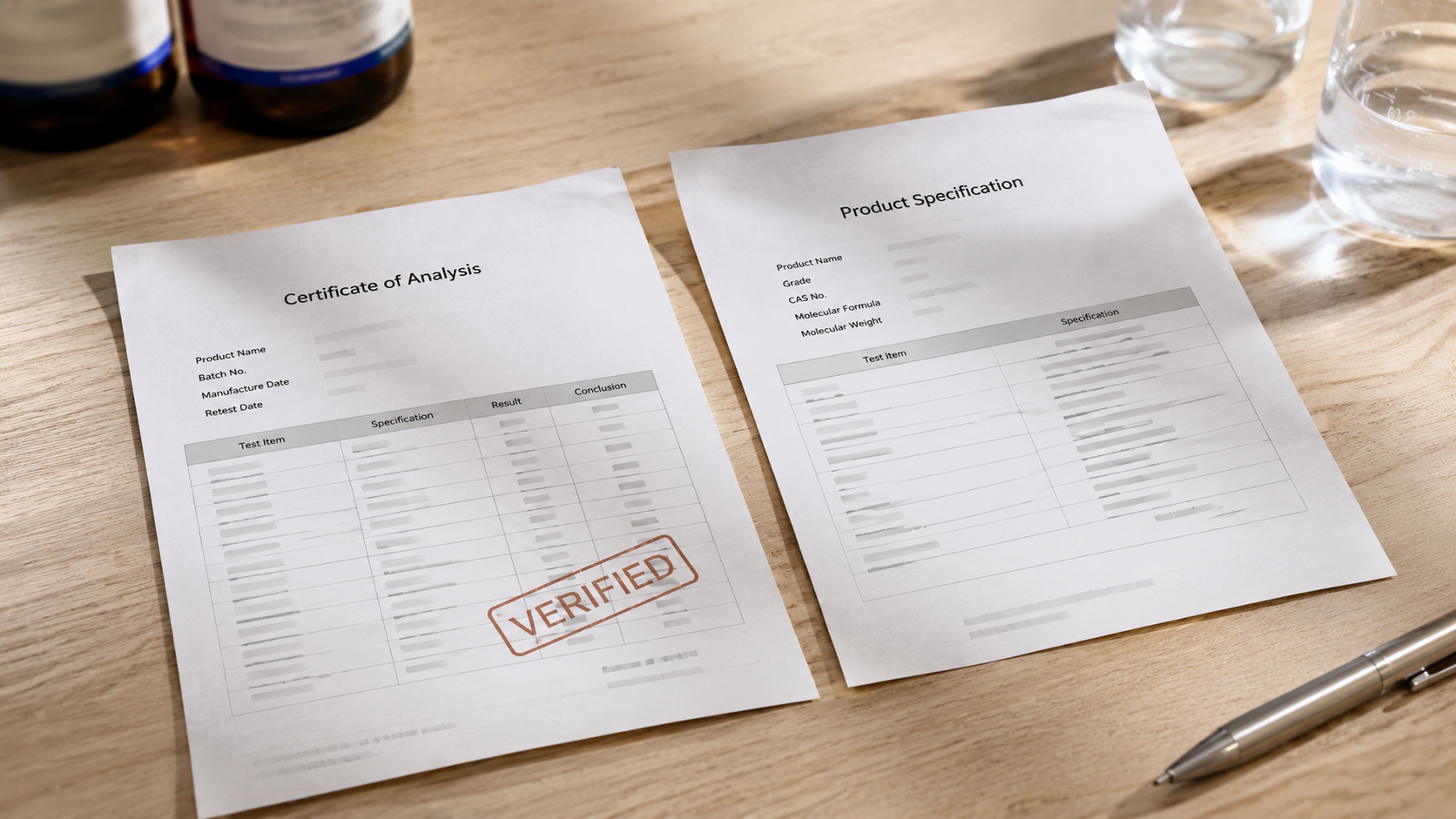
A Certificate of Analysis (COA) is a document that reports the actual, batch-specific test results for a particular lot of a product, confirming that it meets defined quality parameters at the time of testing. A Product Specification, on the other hand, describes the general quality standards and acceptable value ranges that a product is expected to meet across all batches. In short, a specification sets the expected standard, while a COA shows the actual results for a specific batch measured against that standard. Both documents are useful for different purposes, and laboratories often need to review both before purchasing or using a chemical product.
What Is a Certificate of Analysis (COA)?
A Certificate of Analysis is a document issued for a specific batch or lot of a product. It lists the actual test results obtained during quality control testing, such as assay, purity, water content, or other relevant parameters, along with the corresponding batch or lot number.
Because a COA reflects real, batch-specific data, it is often used to confirm that a particular shipment or container meets the required quality before it is used in analytical work, especially in regulated or quality-sensitive laboratories.
What Is a Product Specification?
A Product Specification describes the general quality standards that a product is designed and controlled to meet. It typically includes acceptable ranges or limits for parameters such as purity, water content, residue, or other relevant properties, but it does not report actual results for a specific batch.
A specification serves as a reference standard, helping users understand what to expect from the product in general, regardless of which lot they receive.
COA vs Specification: Key Differences
| Factor | Certificate of Analysis (COA) | Product Specification |
|---|---|---|
| Type of Data | Actual test results for a specific batch | General acceptable ranges or limits for the product |
| Batch-Specific? | Yes, tied to a specific lot number | No, applies generally across all batches |
| Purpose | Confirms a specific batch meets quality requirements | Defines the expected quality standard for the product |
| When It Is Issued | Typically provided per batch or upon request | Generally available as a standing product document |
| Common Use Case | Verifying a received shipment before use | Reviewing expected quality before purchase or method planning |
Note: Exact document formats and available parameters vary by product and manufacturer. Users should always confirm details directly with the supplier or through the approved product documentation.
Why the Difference Matters
Understanding the difference between these two documents helps laboratories use them correctly:
- Before purchase or method planning, a specification helps confirm whether a product's general quality standard is suitable for the intended application.
- After receiving a shipment, a COA helps confirm that the specific batch received actually meets the required quality parameters.
Using only a specification without checking the COA may overlook batch-specific variations, while relying only on a COA without understanding the specification may make it harder to compare products from different suppliers.

When Should You Request a COA?
A COA is typically requested when:
- Verifying the quality of a specific batch before use in analytical work
- Supporting regulatory or quality documentation requirements
- Investigating unexpected analytical results that may be related to reagent quality
- Maintaining traceability records for audits or quality systems
When Should You Review a Product Specification?
A product specification is typically reviewed when:
- Selecting a chemical or solvent grade for a new method or application
- Comparing products from different suppliers before purchase
- Confirming general suitability of a product before requesting a COA for a specific batch
- Building documentation for method validation
Practical Considerations
- Request both documents when possible. Reviewing the specification first helps confirm general suitability, while the COA confirms the actual batch quality.
- Check the batch or lot number. Ensure the COA provided matches the specific batch or container received.
- Compare COA results against the specification. This confirms that the batch falls within the expected range.
- Retain documentation for regulated work. Both COA and specification may be required for audits or quality system records.
Users should always verify actual product values through the approved product specification or COA rather than relying on general assumptions.
Related RCI Labscan Products
RCI Labscan provides product specifications and Certificates of Analysis to support quality verification for laboratory chemicals and solvents. For specification details or COA requests, customers may contact RCI Labscan or an authorized local distributor.
FAQ
Is a COA the same as a specification?
No. A specification defines the general expected quality range for a product, while a COA reports the actual test results for a specific batch. They serve different but related purposes.
Do I need both a COA and a specification?
In many cases, yes. The specification helps confirm general suitability before purchase, while the COA confirms that the specific batch received meets the required quality.
How do I know which batch a COA belongs to?
A COA should include a batch or lot number that matches the number printed on the product label or packaging. Always confirm this match before relying on the COA for a specific container.
Can a batch fail to meet its own specification?
In principle, products released to customers should meet specification. If a COA shows results outside the specification range, this should be raised with the supplier for clarification before use.
Where can I request a COA or specification for RCI Labscan products?
COA and specification documents can typically be requested directly from RCI Labscan or an authorized local distributor. Availability may vary by product.
Explore related products:
Related article:
- What Is a COA and Which Values Should You Check Before Using Laboratory Chemicals?
- What Is Product Specification and How Should You Read It?
- What Is an SDS? Why Every Laboratory Should Take It Seriously

Leave a comment!