

Reagent Blank vs Method Blank vs Field Blank: What Each Reveals
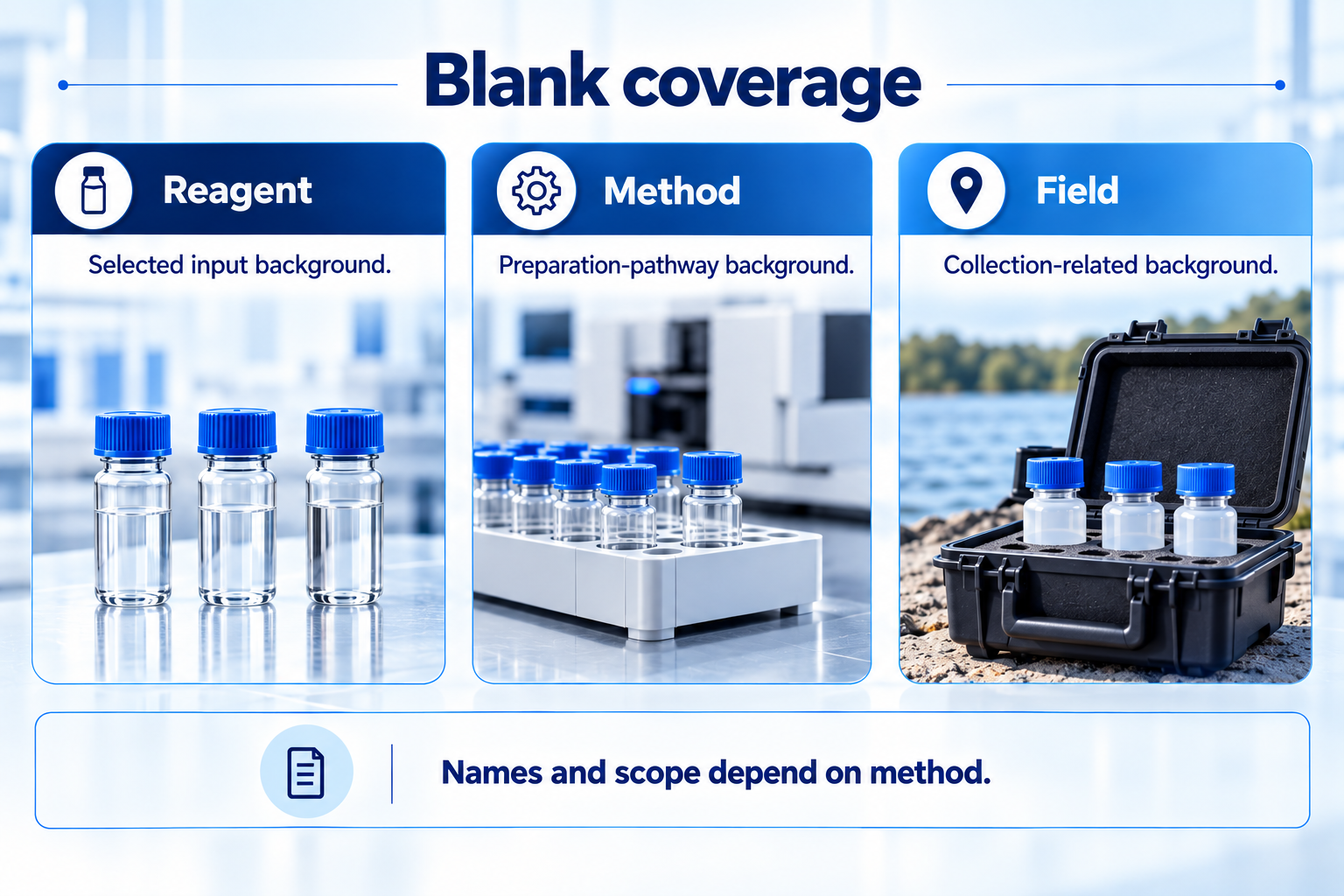
Blanks help reveal signals introduced by materials, preparation or sampling rather than the environmental or laboratory sample being studied. Their useful distinction is the pathway they experience. A reagent-screening blank may examine selected inputs, a method blank may cover laboratory preparation, and a field blank may include collection-site handling. The exact definitions belong to the applicable method.
The names are not a universal hierarchy. Some methods call a full preparation control a “laboratory reagent blank.” Before interpreting any result, ask: what went into this blank, which steps did it experience, and which samples does it represent?
A blank is a control sample, not an empty container
A blank usually contains an appropriate medium, such as reagent water or solvent, and may include method-specified reagents or internal standards. It is measured so that background can be evaluated under defined conditions. An empty vial beside an instrument provides no equivalent evidence.
The USGS guide to field quality-control data explains that blanks are used to estimate contamination-related bias. Spikes and replicates address other questions, such as analytical performance and variability. A blank therefore has a specific job within a wider control plan.
Compare coverage before comparing names
| Label you may encounter | Coverage to establish | Useful question |
|---|---|---|
| Reagent or solvent screening blank | The selected medium and materials included in the screening test | Could these inputs or the measurement pathway contribute a response? |
| Method or preparation blank | The method-defined sample-free matrix carried through preparation and measurement | Could laboratory processing contribute a response? |
| Field blank | The specified collection, handling, transport and analytical steps | Could the sampling pathway contribute contamination? |
This table organizes questions; it does not define mandatory terminology. In EPA Method 200.8, the laboratory reagent blank encounters the glassware, equipment, reagents and other inputs used with samples. Its preparation provisions include the entire preparation scheme, including digestion where applicable. Despite its name, it is not merely a reagent injected directly into the instrument.
EPA's SW-846 Chapter Three describes a method blank processed through the sample-preparation and determinative procedures. These environmental-analysis examples show overlapping control roles. They do not make the two terms interchangeable in every laboratory.
A simple comparison exercise
Imagine a teaching exercise measuring a substance in collected water. The following comparisons are illustrative, not an analytical protocol:
- A screening control examines the selected water or solvent using the defined screening conditions.
- A preparation control experiences the sample-free preparation steps, including the vessels and transfers specified for that control.
- A field control also experiences the defined field-handling pathway before laboratory processing.
If only the preparation control shows a response, an additional preparation-stage contribution is a hypothesis to investigate. If the field control differs from the laboratory controls, sampling or transport deserves attention. Neither pattern proves the source by itself: differences in containers, timing or sequence could also matter.
Method 200.8's field reagent blank explicitly includes shipment, sampling-site exposure, storage, preservation and analysis. Use your actual method's field-control design rather than copying this example into an unrelated workflow.
Record the relationship between controls and samples
A blank result is easier to interpret when its record identifies the medium, reagent lots, container, processing steps and associated samples. Write down exceptions, such as a transfer or storage condition that differed from the intended design. A control cannot represent a step it never experienced.
A chemical CoA supplies information about the tests reported for a lot. It cannot substitute for a blank that evaluates the combined preparation pathway. Likewise, knowing that solvent impurities can affect an analytical result does not establish that a particular observed signal came from the solvent.
USGS emphasizes designing field quality control around the project's objectives and the conditions represented by the controls. For a beginner, the practical lesson is to keep the sample association visible: which location, collection event, preparation batch or sequence does this result inform?
What a blank result does—and does not—prove
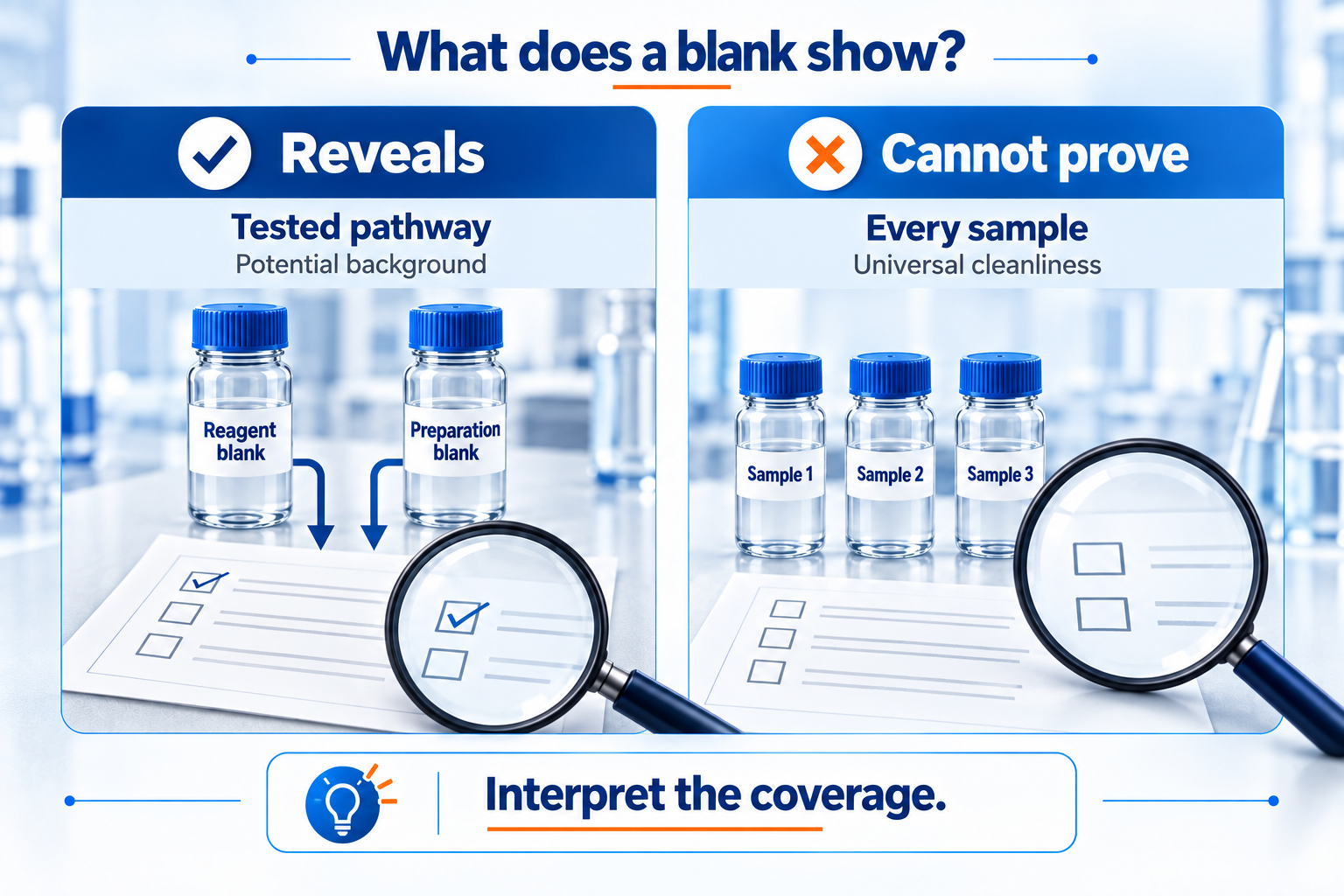
A detected response should be evaluated using the method's identification and control rules. It can prompt an investigation of the covered pathway; it does not automatically identify one contaminated bottle or prove that the sample contains no genuine analyte.
A result reported as not detected means the method did not detect the target under the stated conditions and reporting convention. It is not evidence that every substance is absent. A clean blank also does not prove that extraction recovery is satisfactory or that the sample matrix causes no interference.
These are different evidence needs. Refer sample validity, correction, repeat testing and reporting decisions to the applicable procedure and authorized reviewer. Do not invent a subtraction rule or a common acceptance threshold merely because two controls both carry the word “blank.”
Three questions to use in the laboratory
- Coverage: which inputs and stages does the blank include?
- Association: which samples and conditions does it represent?
- Evaluation: where are its acceptance and corrective-action rules documented?
FAQ
Is a reagent blank always narrower than a method blank?
No. The term “laboratory reagent blank” can denote a full preparation control. Read the method definition and preparation instructions.
Can one field blank replace every laboratory blank?
Do not assume that. Controls may provide different comparisons, and their required combination depends on the method and project.
Does every analytical experiment need all three types?
There is no universal requirement established by these names. Use the controls required for the analytical purpose and documented procedure.
When you understand a blank's coverage, you can explain what its result contributes to the evidence. That is more useful than memorizing three labels without knowing what happened to the control sample.
Leave a comment!