What Is a COA and Which Values Should You Check Before Using Laboratory Chemicals?
(A Practical Guide to Understanding Certificate of Analysis for Laboratory Chemicals)
Direct Answer
A Certificate of Analysis (COA) is a quality assurance document issued by the chemical manufacturer for a specific production batch (lot) of a product. It contains the actual analytical test results measured for that batch and compares those results against the manufacturer's established specifications.
Before using any laboratory chemical, users should review the COA to verify that the product meets the required quality standards for their application. Depending on the chemical and its intended use, important values may include purity, assay, water content, residue after evaporation, UV absorbance, trace metal content, identification tests, appearance, and batch information.
Rather than relying only on the product label or chemical grade, laboratories should always confirm the actual analytical values shown on the COA before performing critical analytical work.
What Is a Certificate of Analysis (COA)?
A Certificate of Analysis (COA) is an official document issued for a specific manufacturing lot of a chemical product. It records the analytical testing performed on that batch and confirms whether the material complies with the manufacturer's quality specifications.
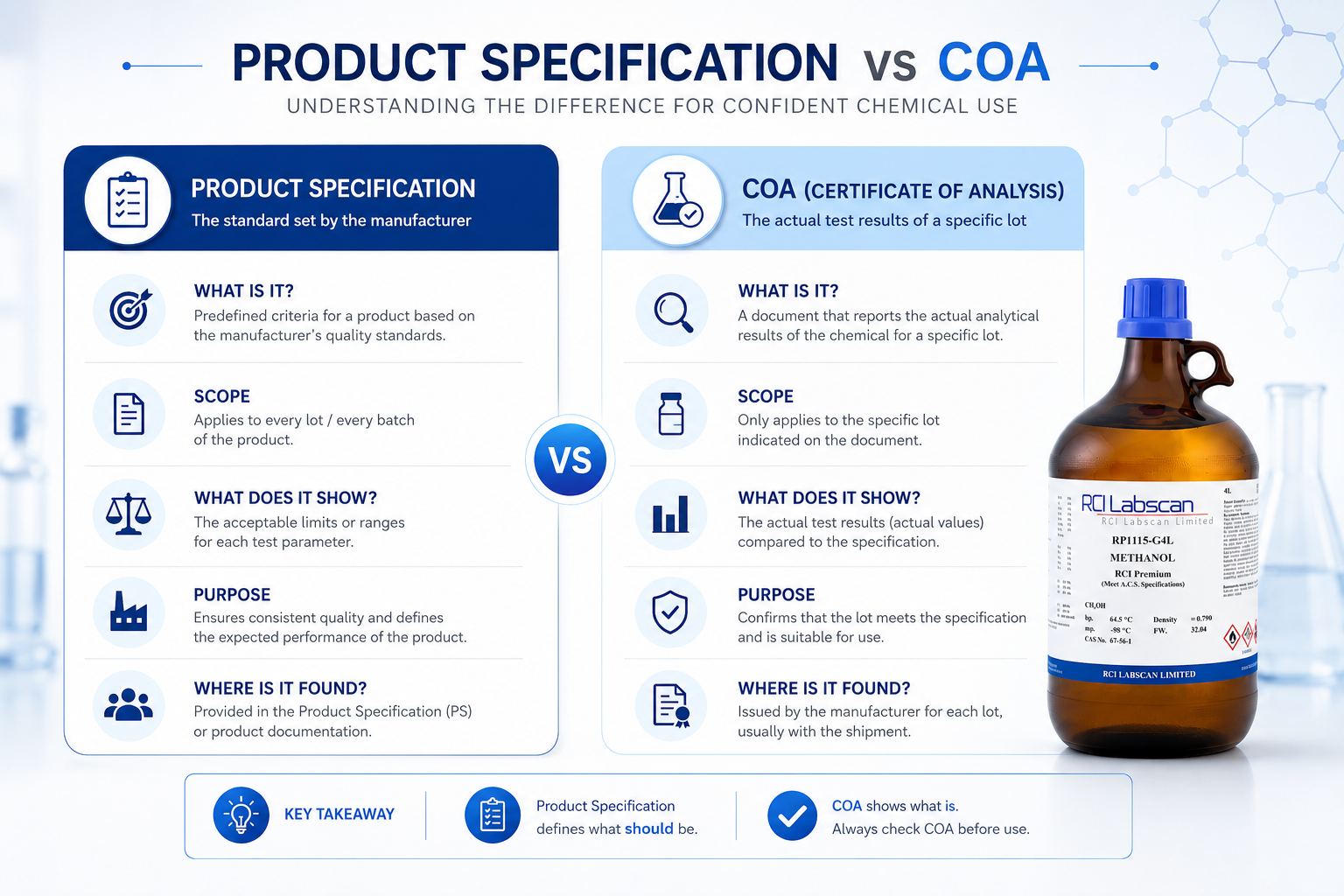
Unlike a general product specification, which describes the acceptable quality limits for all production batches, a COA reports the actual measured values for the individual lot supplied to the customer.
Because every production lot may have slightly different analytical results while still meeting specifications, the COA provides important evidence of lot-specific quality.
Why Is the COA Important in Laboratory Work?
Laboratory results depend heavily on the quality and consistency of the chemicals being used. If a chemical contains excessive impurities or does not meet the required specification, it may affect analytical accuracy, method performance, or instrument reliability.
For this reason, many laboratories review the COA before using chemicals for:
- Routine laboratory analysis
- Quality control (QC)
- Pharmaceutical testing
- Environmental analysis
- Food testing
- Academic research
- Method validation
- Instrument calibration
- Regulated laboratory environments
Reviewing the COA helps laboratories maintain traceability and supports documentation requirements in quality management systems.
COA vs Product Specification: What Is the Difference?
Many laboratory users confuse the Certificate of Analysis with the Product Specification, although the two documents serve different purposes.
| Document | Purpose |
|---|---|
| Product Specification | Lists the manufacturer's quality requirements or acceptance criteria for the product. (e.g., Purity ≥ 99.9%) |
| Certificate of Analysis (COA) | Reports the actual analytical results for one specific production lot. (e.g., Purity = 99.96%) |
The COA demonstrates that the supplied lot satisfies the specification.
What Information Is Included in a COA?
Although formats vary among manufacturers, most Certificates of Analysis contain several standard sections. Typical information includes:
- Product name
- Product code
- CAS Number
- Batch (Lot) Number
- Manufacturing date
- Expiration or retest date (if applicable)
- Analytical test methods
- Test parameters
- Specification limits
- Actual analytical results
- Pass/Fail status
- Quality approval or authorized signature
These details help laboratories verify product identity, traceability, and quality before use.
Which COA Values Should You Check Before Using Laboratory Chemicals?
The most important values depend on the intended laboratory application:
1. Product Identity
Always verify that the COA matches the product received. Check the product name, product code, CAS Number, grade, and batch number. Using the wrong batch documentation can lead to traceability problems during audits or investigations.
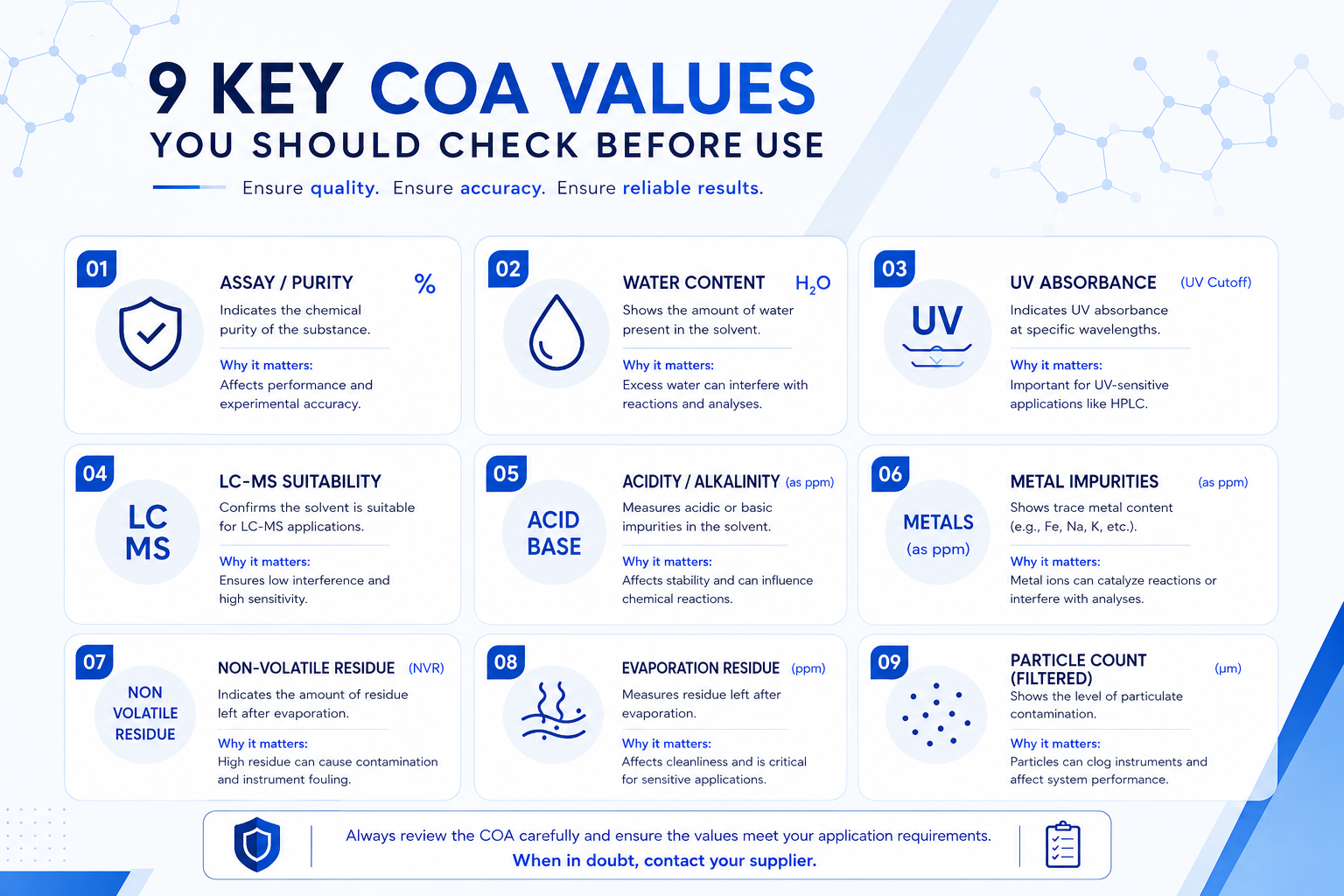
2. Assay or Purity
Purity is often the first parameter laboratories review. It indicates the percentage of the desired chemical present in the product. Higher purity generally means lower levels of unwanted contaminants, which directly influences result reliability.
3. Water Content
Many chemicals absorb moisture from the atmosphere. Excess water may influence standard preparation, moisture-sensitive reactions, Karl Fischer analysis, chromatographic performance, and quantitative analysis. Manufacturers commonly determine water content using Karl Fischer titration.
4. Residue After Evaporation
Residue after evaporation measures the amount of non-volatile material remaining after the solvent evaporates. For HPLC, GC, and spectroscopic applications, excessive residue may contribute to background contamination, instrument fouling, unexpected peaks, and reduced analytical sensitivity.
5. UV Absorbance (UV Cutoff)
For UV-based chromatography, solvent absorbance is an important quality parameter. High UV absorbance may produce baseline noise, reduced detector sensitivity, and poor chromatographic performance. HPLC-grade solvents often include UV absorbance values measured at multiple wavelengths.
6. Trace Metal Impurities
Some analytical applications require extremely low concentrations of metallic contaminants. Trace metals may affect ICP-MS analysis, semiconductor manufacturing, pharmaceutical production, catalyst-sensitive reactions, and electronic chemical applications.
7. Identification Tests
Identification tests confirm that the supplied chemical is the correct substance. Depending on the product, manufacturers may use Infrared spectroscopy (IR), Gas chromatography (GC), HPLC, density measurements, or refractive index.
8. Appearance
Although simple, appearance remains an important quality indicator. Typical observations include clear colorless liquid, white crystalline powder, or free-flowing solid. Unexpected discoloration, precipitation, or visible particles may indicate contamination or storage issues.
9. Batch Number and Traceability
Every COA is linked to one production lot. Laboratories should always confirm that the batch number on the bottle matches the COA, documentation corresponds to the product received, and internal records include the correct lot number.
Which COA Parameters Matter Most for Different Laboratory Applications?
Different analytical methods require different quality characteristics:
| Laboratory Application | Important COA Values |
|---|---|
| HPLC | Purity, UV absorbance, residue after evaporation, water content |
| LC-MS | Purity, trace impurities, residue after evaporation, water content |
| GC | Purity, residue after evaporation |
| ICP-MS | Trace metal content |
| Pharmaceutical QC | Assay, impurities, identification, traceability |
| General Laboratory Use | Identity, purity, appearance |
How to Read a COA Before Using a Chemical
A practical checklist includes the following steps:
- Verify the product name and product grade.
- Confirm the batch number matches the container label.
- Review the assay or purity result.
- Check application-specific parameters such as UV absorbance, residue after evaporation, water content, or trace metals.
- Ensure every reported result complies with the specification.
- Confirm that the COA is approved and issued by the manufacturer.
- Retain the COA for laboratory traceability if required by the quality system.
Common Mistakes When Reading a COA
Many laboratory users make similar mistakes when reviewing Certificates of Analysis. Common examples include:
- Assuming every batch has identical analytical values.
- Looking only at purity while ignoring other critical parameters.
- Using the wrong COA for a different batch number.
- Confusing the Product Specification with the COA.
- Assuming all products with the same chemical name have identical quality.
Why Is COA Important for Quality Systems?
Many quality standards emphasize the importance of documented traceability. Examples include laboratories operating under quality management systems such as ISO/IEC 17025 laboratories, Pharmaceutical quality systems, GMP environments, and ISO 9001 organizations.
Maintaining the appropriate COA helps support material verification, audit readiness, and internal quality documentation.
FAQ
What is a COA?
A Certificate of Analysis (COA) is a document issued by the manufacturer that reports the actual analytical test results for a specific production batch of a chemical product.
Is a COA the same as a Product Specification?
No. A Product Specification defines the required quality limits, while a COA reports the measured results for one individual batch.
Why should laboratories check the COA before using chemicals?
Reviewing the COA helps verify that the supplied chemical meets the required quality standards for the intended laboratory application.
Which COA values are most important?
The most important values depend on the application but commonly include purity, assay, water content, residue after evaporation, UV absorbance, trace metal impurities, identification tests, and batch information.
Why is the batch number important?
The batch number links the chemical container to its analytical test results and supports traceability during audits, investigations, or quality control.
Does every production batch have the same COA?
No. Each production batch receives its own Certificate of Analysis because the analytical results are measured for that specific lot.
Ensure Analytical Reliability with RCI Labscan
A Certificate of Analysis is one of the most important quality documents accompanying laboratory chemicals. Before using any chemical, laboratories should verify product identity, confirm the batch number, and review critical analytical parameters.
RCI Labscan supplies laboratory chemicals for analytical applications together with supporting documentation, including Product Specifications, Safety Data Sheets (SDS), and Certificates of Analysis (COA).
Choose with confidence. Analyze with precision. Trust RCI Labscan.
Explore Related Topics:
- What Is AR Grade?
- What Is HPLC Grade Solvent?
- Understanding Chemical Grades: Choosing the Right Solution with RCI Labscan
- Product Specification vs COA: What's the Difference?
Leave a comment!