


Matrix Effects vs Extraction Recovery in LC-MS: How to Separate Them
A weak LC-MS response can reflect analyte loss during preparation, suppression of the response in the final extract, or both. Compare a standard in solvent, a blank-matrix extract spiked after preparation, and the same matrix spiked before preparation. When the comparisons are properly matched, they separate matrix-related response alteration from preparation recovery.
This distinction changes the investigation. Improving extraction cannot necessarily fix ion suppression; reducing matrix background cannot recover analyte that was already lost. The objective is to identify which contribution limits the method before changing it.
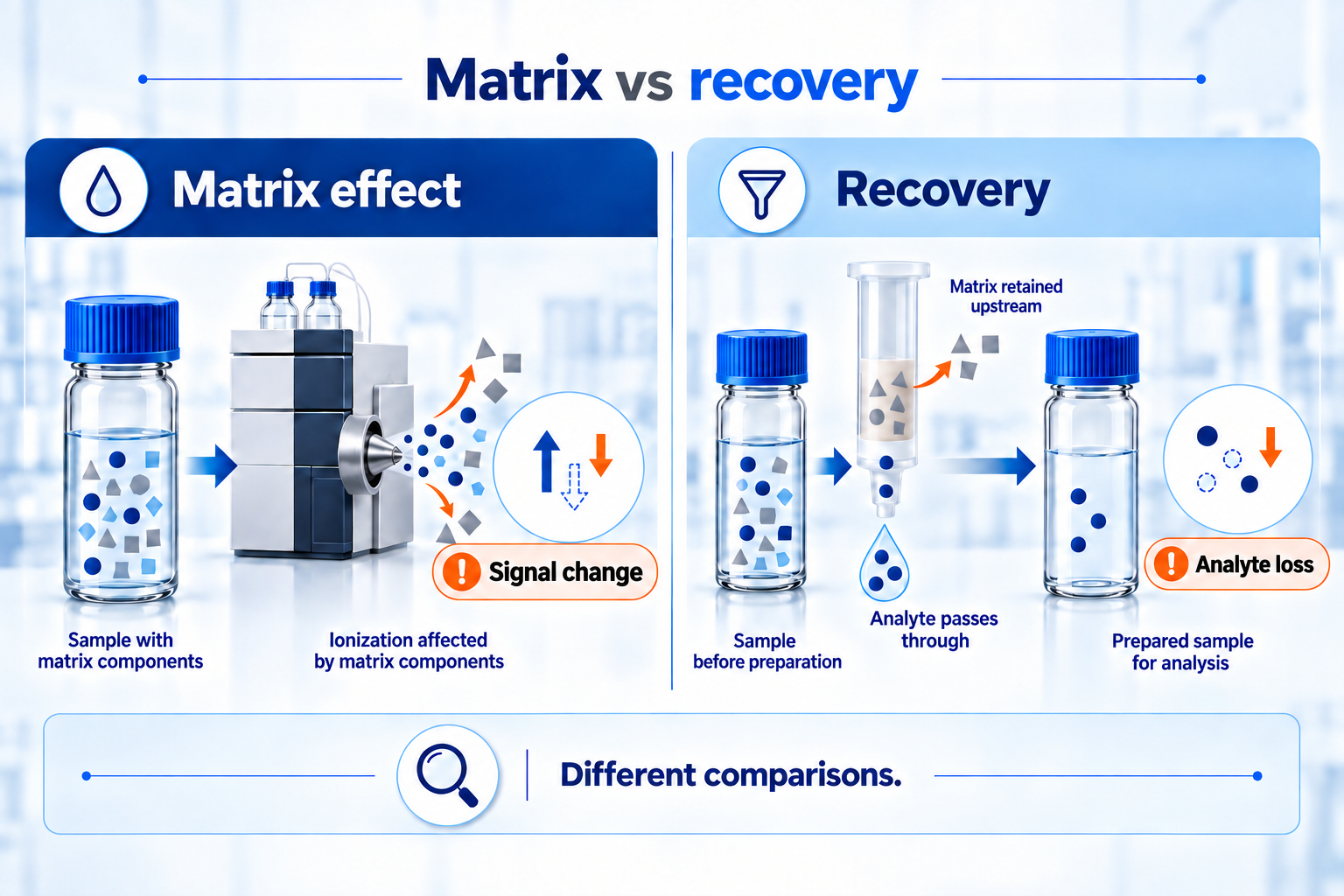
Two effects that can look like the same problem
Matrix effects alter the analyte response because other sample components are present. In electrospray LC-MS, this can include suppression or enhancement associated with coeluting components. Extraction recovery describes how much of the introduced analyte survives the defined extraction and processing steps. It is not simply the response of a prepared sample divided by that of a neat standard.
The primary study by Matuszewski, Constanzer and Chavez-Eng developed practical comparisons for assessing matrix effects and recovery in bioanalytical HPLC-MS/MS. Its central lesson remains useful: selective mass detection does not guarantee that matrix-dependent response effects are absent. Application to another matrix needs its own evidence.
Define three matched preparation sets
| Set | Preparation concept | What its response includes |
|---|---|---|
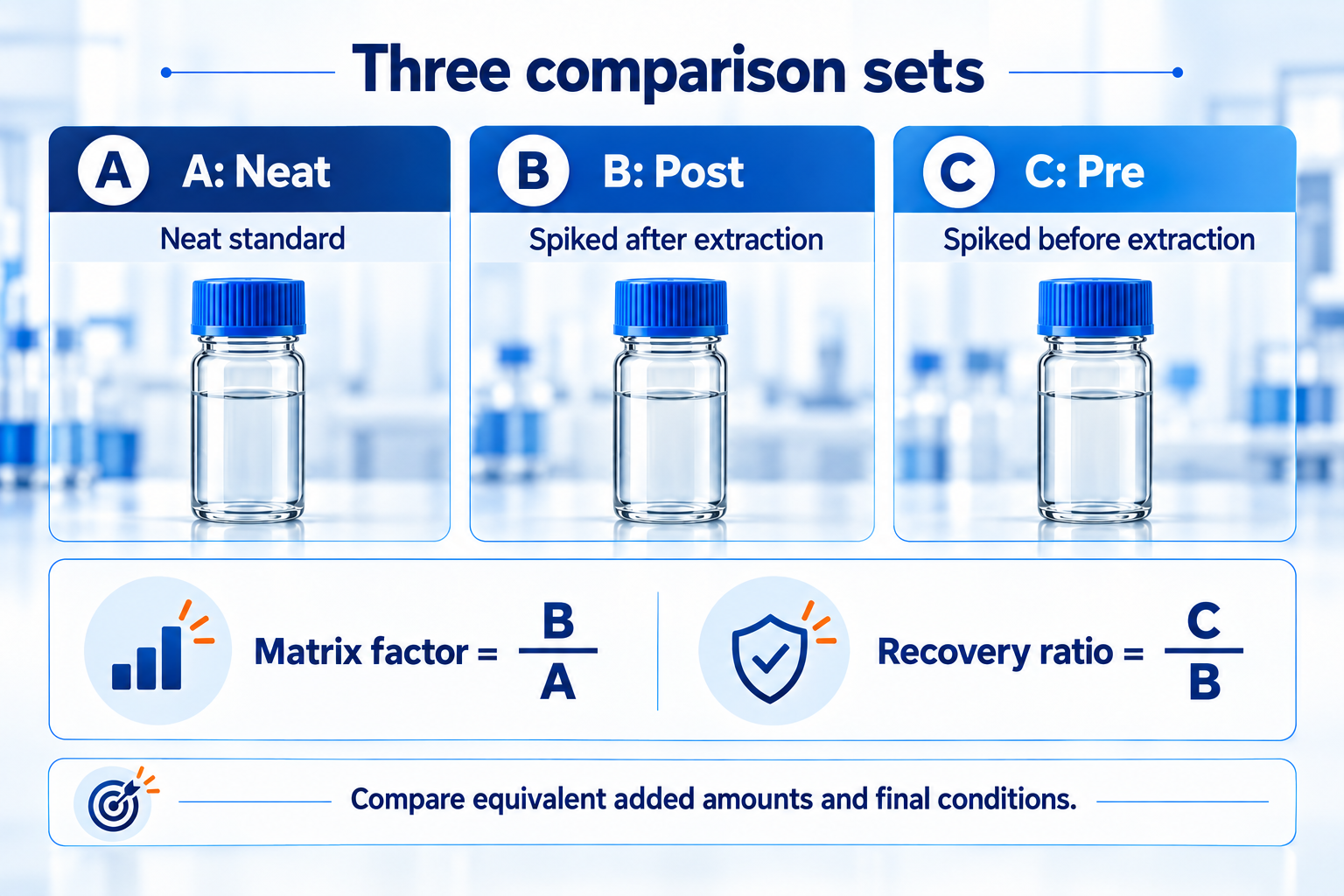
| A: solvent standard | Analyte in the chosen final solvent composition, without extracted sample matrix | Reference response without sample-matrix constituents |
| B: post-preparation spike | Blank matrix taken through preparation, then fortified at the defined endpoint | Response in the resulting extract, without analyte loss in preceding preparation |
| C: pre-preparation spike | Matched blank matrix fortified before the defined preparation pathway | Preparation loss plus response alteration in the resulting extract |
Match the nominal final analyte concentration, final volume, solvent/additive composition and injection conditions. Use equivalent starting matrix amounts for B and C. Account for spike volumes and dilution; the C spike amount should give the same final concentration as A and B if there were no loss. The actual C concentration can then be lower because of preparation loss.
Waters' sample-preparation reference guide illustrates these response comparisons and emphasizes matching the final solutions. Its peptide-specific recipes are not universal study instructions.
Use a defined calculation convention
For matched sets, let A, B and C denote the analyte peak-area responses, or appropriately summarized replicate responses. The following convention keeps the reference for each quantity visible:
- Matrix factor: MF = B/A. Values below 1 indicate suppression; above 1 indicate enhancement under this convention.
- Preparation recovery: RE = C/B × 100%.
- Process efficiency: PE = C/A × 100% = MF × RE, when RE is expressed as a percentage.
These are descriptive quantities, not acceptance criteria. Some reports express matrix effect as 100 × (MF − 1), where zero indicates no response change. Always state the convention: “80% matrix factor” and “−20% matrix effect” can describe the same comparison.
A manufacturer-primary Waters extraction study explicitly separates recovery and matrix-effect measurements. An Agilent study in serum and plasma likewise compares pre- and post-extraction spikes for recovery and post-extraction spikes with neat standards for matrix effects. Their demonstrated results concern those analytes, preparations and matrices; they are not performance guarantees for another method.
Check the endpoint before naming the result
Decide exactly when B is fortified. If B is spiked after extraction but before concentration or reconstitution, C/B isolates a different portion of the pathway from a comparison where B is spiked into the final ready-to-inject extract. Record the endpoint and name the measured recovery accordingly.
Use matrix shown to be suitable for the comparison. Native analyte, unresolved interference or unstable spikes can compromise interpretation. When analyte-free matrix is unavailable, a justified alternative design is needed; do not assume that simple subtraction or a surrogate matrix preserves the same response behavior.
Separate absolute response from internal-standard compensation
An internal standard can help compensate for response variation, but its presence does not show that suppression is absent. A primary enalapril/enalaprilat validation study illustrates IS-normalized matrix-factor assessment. To calculate that factor, determine the analyte and IS matrix factors in appropriately matched post-preparation and neat sets, then divide MFanalyte by MFIS. Equivalent amounts and addition timing are essential.
If the IS is added before preparation in one comparison but after preparation in another, its recovery can enter the ratio. That ratio should not be described as a pure normalized matrix factor without a justified design. Retain absolute analyte responses alongside normalized results so compensation does not conceal the source of a weak signal.
Move from a comparison to a method decision
Investigate relevant matrix variability and analyte levels, not only one convenient extract. Final ICH M10 guidance discusses matrix effects across independent matrix sources and recovery consistency. It concerns bioanalytical assays supporting the specified nonclinical/clinical studies; its requirements should not be imposed automatically on every environmental or industrial LC-MS method.
Use the results to frame a bounded development question: is loss associated with preparation, is matrix response variable, or are both involved? Evaluate any proposed cleanup, chromatography or dilution change through the applicable method-development and validation process.
Also separate matrix effects from contaminated inputs. Solvent impurities, LC-MS solvent quality and mobile-phase additive compatibility remain relevant, but a cleaner grade cannot guarantee removal of sample-matrix effects.
A useful study report specifies the matrices, spike timing, preparation endpoint, matched concentrations, calculation convention, normalization and variability. That evidence lets the analytical reviewer distinguish recovery, matrix factor and overall efficiency without inventing a universal pass limit.
Related RCI Labscan Products
- Acetonitrile, LC-MS — Review the specification and method compatibility; the grade does not establish extraction recovery or removal of matrix effects.
Leave a comment!