
Liquid-Liquid Extraction: How Polarity, pH and Partitioning Work Together
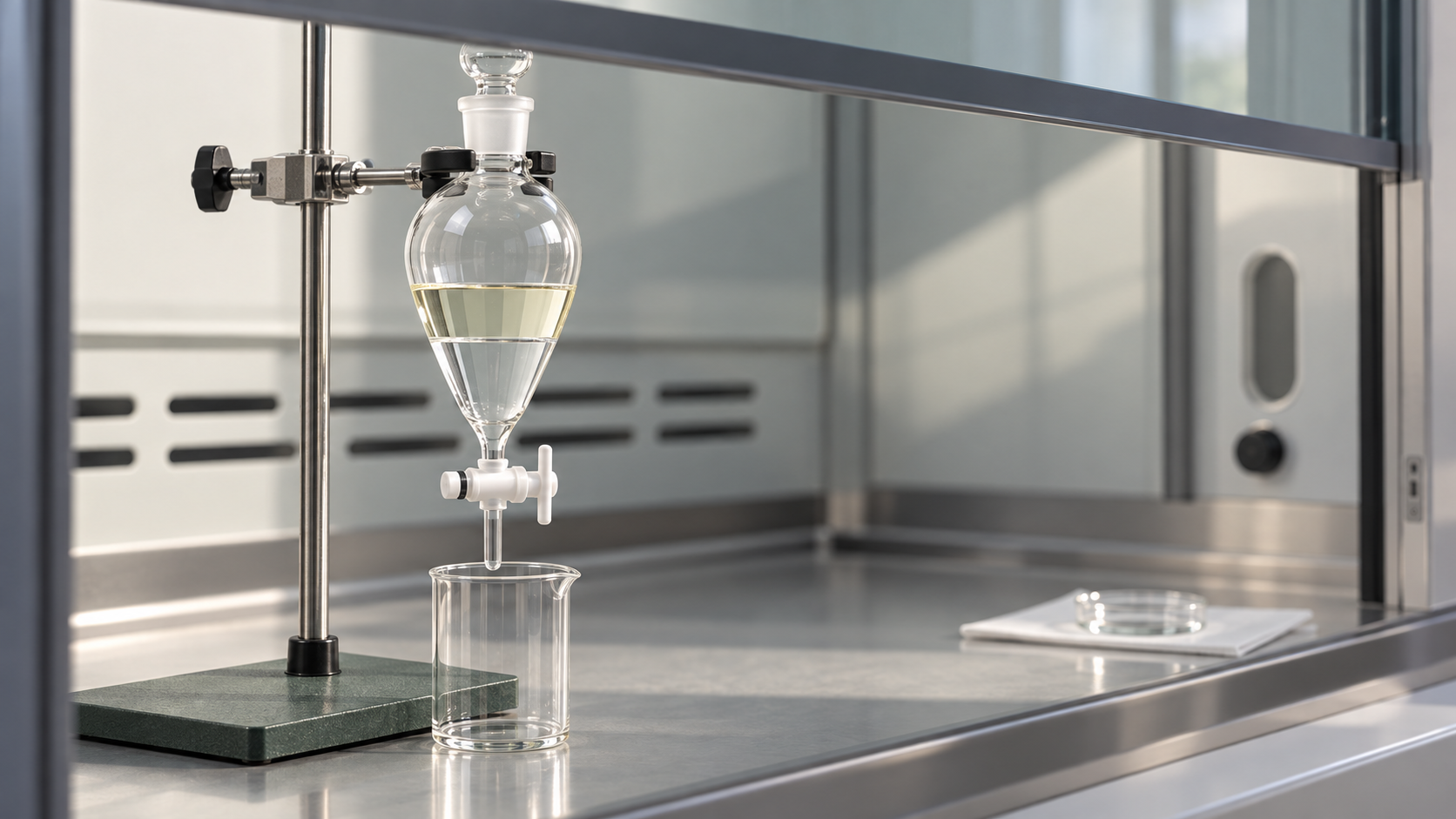
Liquid-liquid extraction separates substances by how they distribute between two liquid phases. The solvent pair determines the environment available to the analyte, while its chemical form influences which phase it favors. For an ionizable substance, aqueous pH can change that form and therefore alter its distribution. However, none of these factors alone guarantees complete extraction.
This is a conceptual introduction for students and new laboratory users. In other words, it explains how to read an extraction method rather than providing instructions for operating a separatory funnel or adjusting a chemical mixture.
Start with two phases, not two solvent names
A conventional aqueous/organic extraction needs a liquid system that forms distinct phases under the relevant conditions. Simply adding an organic solvent to water does not guarantee that result because some solvents mix readily with water. For example, the Royal Society of Chemistry's solvent-extraction primer introduces the role of immiscible solvent pairs.
A phase is a physically distinct region, such as one liquid layer. However, the analyte can be present in both regions at the same time. Therefore, a visible boundary tells you that layers exist, but it does not show that the analyte has moved entirely into one of them.
For background on familiar solvent behavior, see how acetonitrile, methanol and water are used differently. Importantly, solvent identity, miscibility and analytical suitability answer different questions.
Polarity helps explain affinity, but is not a complete prediction
“Like dissolves like” is a useful starting idea because interactions between an analyte and its surroundings influence where it dissolves more readily. However, calling a substance “polar” or “nonpolar” does not establish its extraction behavior in a particular sample. The molecular form, solvent composition and other constituents must also be considered.
Instead, ask what the method actually establishes: which phases are present, which analyte form is involved and what conditions apply? These questions provide more useful information than treating every organic phase as equivalent.
Partition ratio and distribution ratio describe different things
IUPAC defines a partition ratio using the equilibrium concentrations of the same definite chemical form in the two phases. In the aqueous/organic convention, the organic-phase concentration is divided by the aqueous-phase concentration. Therefore, the direction of the ratio must always be stated.
By contrast, the IUPAC distribution ratio uses total analytical concentrations, including the chemical forms present in each phase. This distinction becomes especially important when an analyte can exist in both neutral and ionized forms.
Neither ratio directly tells you what fraction of the original analyte the preparation recovered. Concentration compares amounts per unit volume, whereas recovery concerns the amount transferred and retained through the preparation. In addition, phase volumes and subsequent losses matter. Therefore, read a reported ratio together with its conditions rather than assuming it is an intrinsic property that applies to every extraction.
pH can change the analyte, not just the water
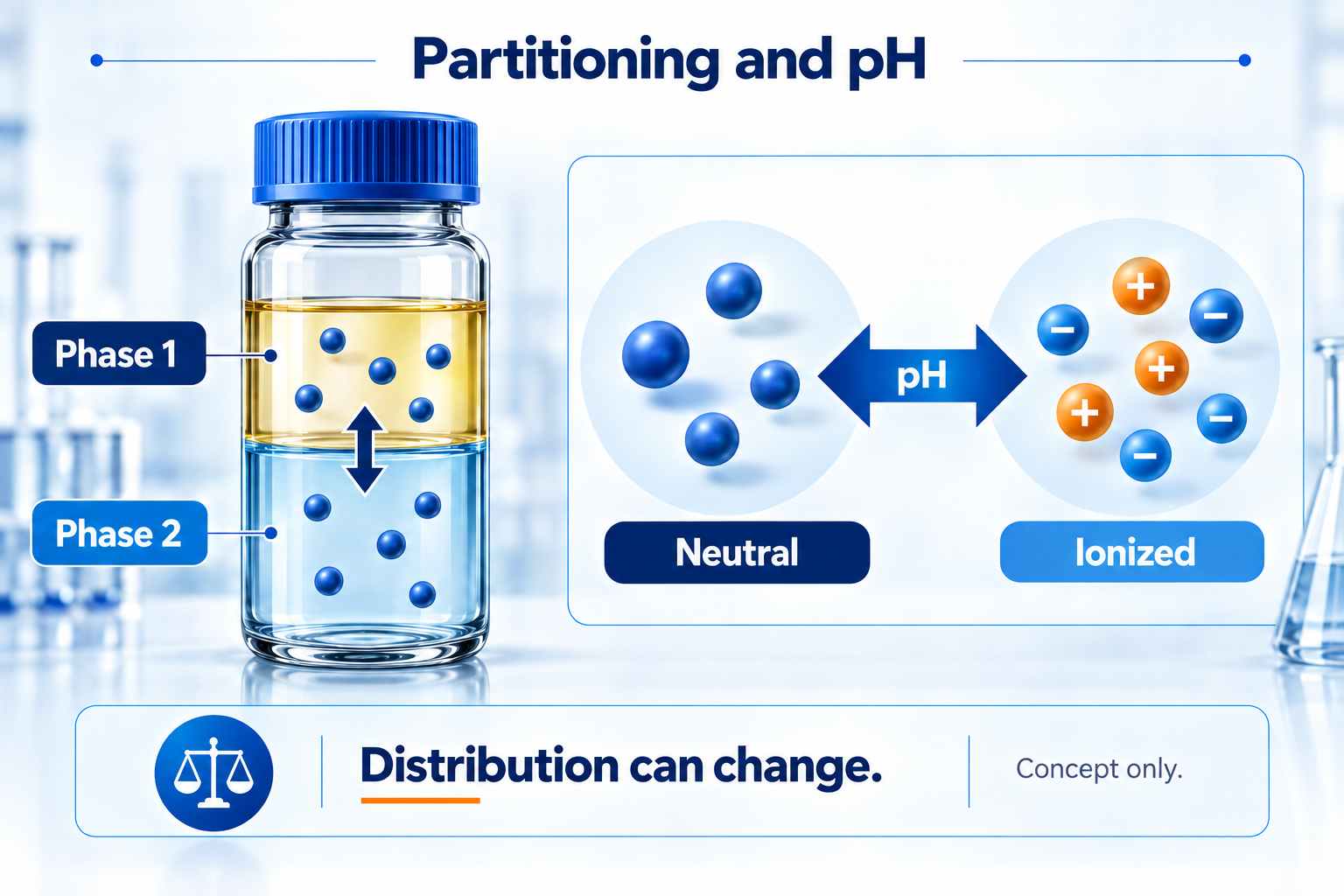
For a simple ionizable organic acid or base, changing aqueous pH changes the balance between neutral and charged forms. This principle provides the conceptual basis of acid-base extraction, introduced in the University of Alberta's separation tutorial.
In a simple model, a weak organic acid becomes more deprotonated as pH rises relative to its acid-dissociation behavior. Conversely, a weak organic base becomes more protonated as pH falls. Charged forms commonly have stronger affinity for the aqueous environment than their corresponding neutral forms. However, this is a tendency rather than a universal “all ions stay in water” rule. Molecular structure, ion pairing and the actual solvent system can also change the outcome.
The important reading question is: does this method intend to measure or isolate a particular chemical form, or the total analyte? A pH change that favors one form may also affect other sample constituents. Therefore, the method and analyte stability must justify that choice; no single target pH applies to all extractions.
Keep three questions separate
| Question | What it helps explain | What it does not establish |
|---|---|---|
| Do distinct phases form? | Whether a two-phase separation is available. | Where all of the analyte resides. |
| Which chemical forms are present? | Why aqueous pH may change distribution. | Complete transfer or chemical stability. |
| What evidence supports the method? | Whether the intended preparation performs adequately for the sample. | Suitability of an untested solvent substitution. |
Solvent documentation adds another part of that evidence. For example, learn how to read a product specification when comparing required quality attributes. However, a grade name cannot replace an extraction method's suitability assessment.
The diagram is not a handling procedure
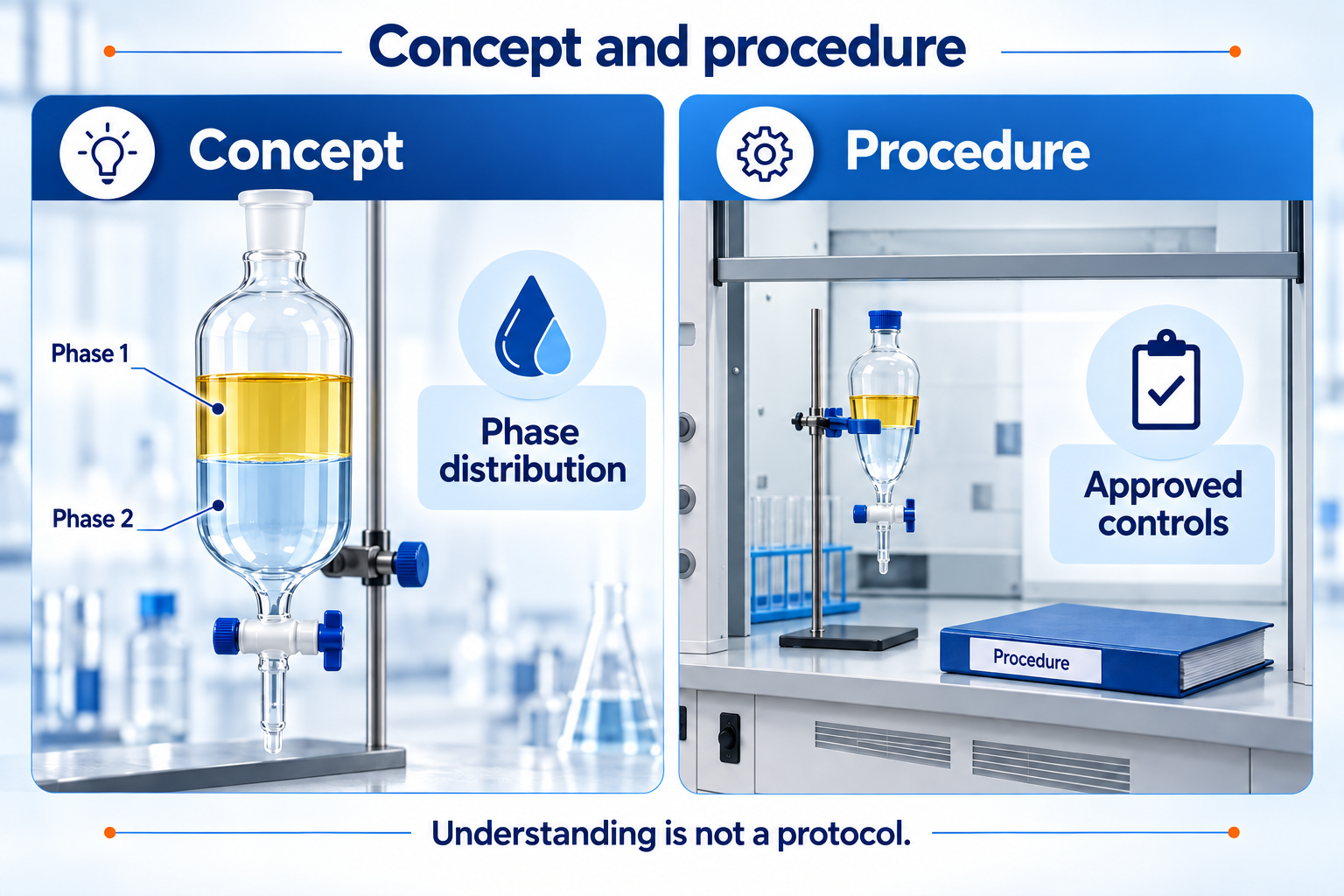
Real liquid-liquid extraction can involve solvent exposure, incompatible mixtures and pressure in closed equipment. For example, EPA Method 3510C explicitly addresses pressure and emulsions within its own defined extraction procedure. Therefore, this example shows why a general diagram cannot substitute for a trained, approved laboratory method.
Do not infer layer identity from “organic” alone or treat a cloudy interface as a clean separation. Instead, before practical work, use the applicable method, solvent SDS, equipment instructions and site safety controls. This article provides no shaking, venting, acid-addition or waste-mixing instructions.
Questions beginners often ask
Does extraction mean the analyte leaves the original phase completely?
No. Distribution describes how material is shared between phases under specified conditions. Therefore, a clear separation of layers does not prove complete analyte recovery.
Can pH fix an unsuitable solvent pair?
Not necessarily. Ionization and phase formation are separate considerations. As a result, a method needs both an appropriate liquid system and evidence that the analyte behaves as intended.
Is the organic layer always on top?
Layer position is not determined by the word “organic.” Instead, it depends on the actual densities of the two phases. Therefore, follow the method's established phase-identification approach.
Key takeaway: First, understand the two phases. Next, consider the analyte's chemical form. Finally, review the evidence for the intended separation. Polarity and pH help explain behavior, but they do not replace method verification or safe handling.
Leave a comment!