

Why Titrant Standardization Matters Even When the Label States a Concentration
A concentration on a titrant label describes the supplied material under its documented conditions. Standardization establishes the working concentration or correction factor used by the laboratory's titration method. Whether and when it is required depends on the method, titrant stability, handling and certificate conditions.

Separate the label value from the working value
A nominal concentration is a target, while a certified assigned value has a stated basis and uncertainty. Neither should be silently replaced by an undocumented factor. Review the certificate, storage requirements, temperature basis and approved procedure first. A ready-to-use solution can reduce preparation work while leaving method-required verification and standardization responsibilities intact.
Metrohm's hydrochloric-acid application note describes standardization against TRIS and discusses changes associated with handling and storage. That is a particular titrant/reference pairing, not a universal instruction to use TRIS for other reactions. The chosen reference must have a suitable assigned value, composition and reaction for the procedure.
Write down the factor convention
In this illustrative convention, factor f = working concentration / nominal concentration. If the established working value is 0.0980 mol/L and the nominal value is 0.1000 mol/L, f = 0.980. The working value is therefore nominal concentration × f = 0.0980 mol/L. These are illustrative values, not a product result or acceptance limit.
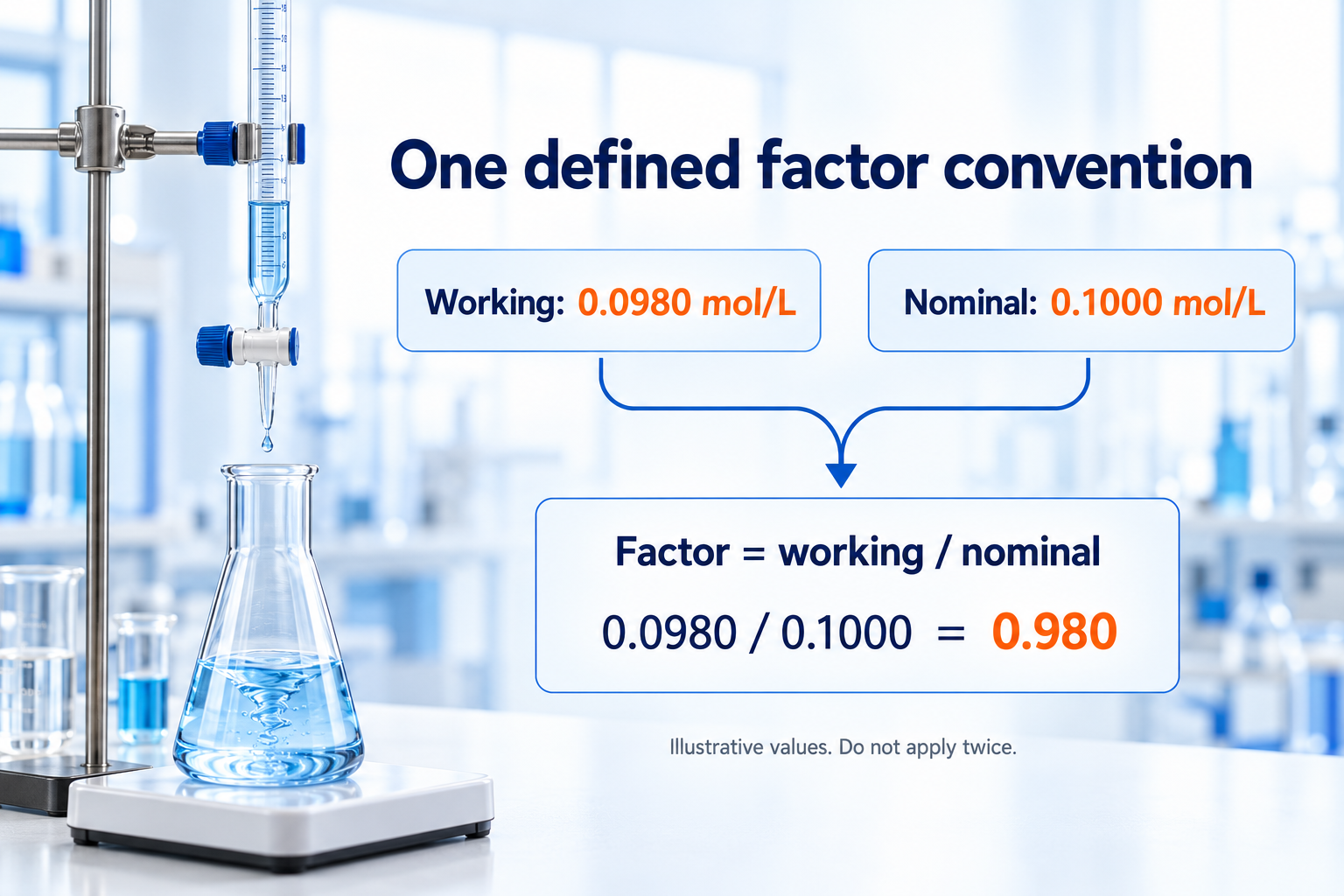
For a reaction whose amount relationship is one mole of titrant per mole of analyte, a blank-corrected titrant volume of 10.00 mL represents 0.0980 mol/L × 0.01000 L = 0.000980 mol of titrant, and the same amount of analyte. The rounded result has three significant figures. A different reaction stoichiometry requires the appropriate conversion. Check how the software defines a factor: some workflows use a reciprocal convention. Applying both the corrected concentration and the factor again would double-correct the result.
Retain the evidence behind the value
| Record | Purpose |
|---|---|
| Reference identity, lot and assigned value | Shows what the concentration is related to. |
| Reference preparation and amount | Preserves the calculation inputs and relevant conditioning. |
| Blank, endpoint and repeat determinations | Allows review of the actual measurement. |
| Factor convention and effective use | Connects the approved value to subsequent results. |

Investigate a changed factor before using it
Review reference preparation, weighing or pipetting, endpoint behavior, burette performance and blank treatment before concluding that the titrant has changed. A repeatable value can still be wrong if the reaction or reference basis is wrong. Preserve the original determinations and document the investigation rather than discarding inconvenient results without a reason.
Set the standardization frequency through the applicable method and a justified stability/handling review. This article supplies no blanket interval or allowable factor range. Do not extend the manufacturer's expiry or the laboratory's authorized use period merely because a standardization result appears satisfactory.
Practical conclusion
Connect the label and certificate to a documented working value, then verify that the calculation uses that value once. Ask the method owner to approve the reference, factor convention, frequency and acceptance criteria. Review Prepared Standard Solutions vs In-House Preparation: A QA and Procurement Checklist for the separate decision about purchased versus internally prepared solutions.
Leave a comment!