

Gravimetric vs Volumetric Solution Preparation: Choosing the Right Basis
Choose the preparation approach by first defining the required quantity: analyte mass per total solution mass, analyte mass per solution volume, or another specified basis. Gravimetric preparation measures masses; volumetric preparation uses measured or defined volumes. Neither approach is universally better. The appropriate choice depends on the required measurand, source material, equipment, uncertainty and validated procedure.
A solution prepared by weighing does not automatically have a concentration in mg/L. Conversely, using a volumetric flask does not eliminate the need for accurate weighing or a valid assigned stock concentration. The preparation operations and the reported concentration basis are related, but they are not interchangeable.
Define what the concentration means
The NIST Guide to the SI distinguishes mass fraction, mass concentration, amount concentration and density. Writing the quantity explicitly prevents a numerical value from being assigned the wrong meaning.
| Quantity | Definition | Example expression | Preparation implication |
|---|---|---|---|
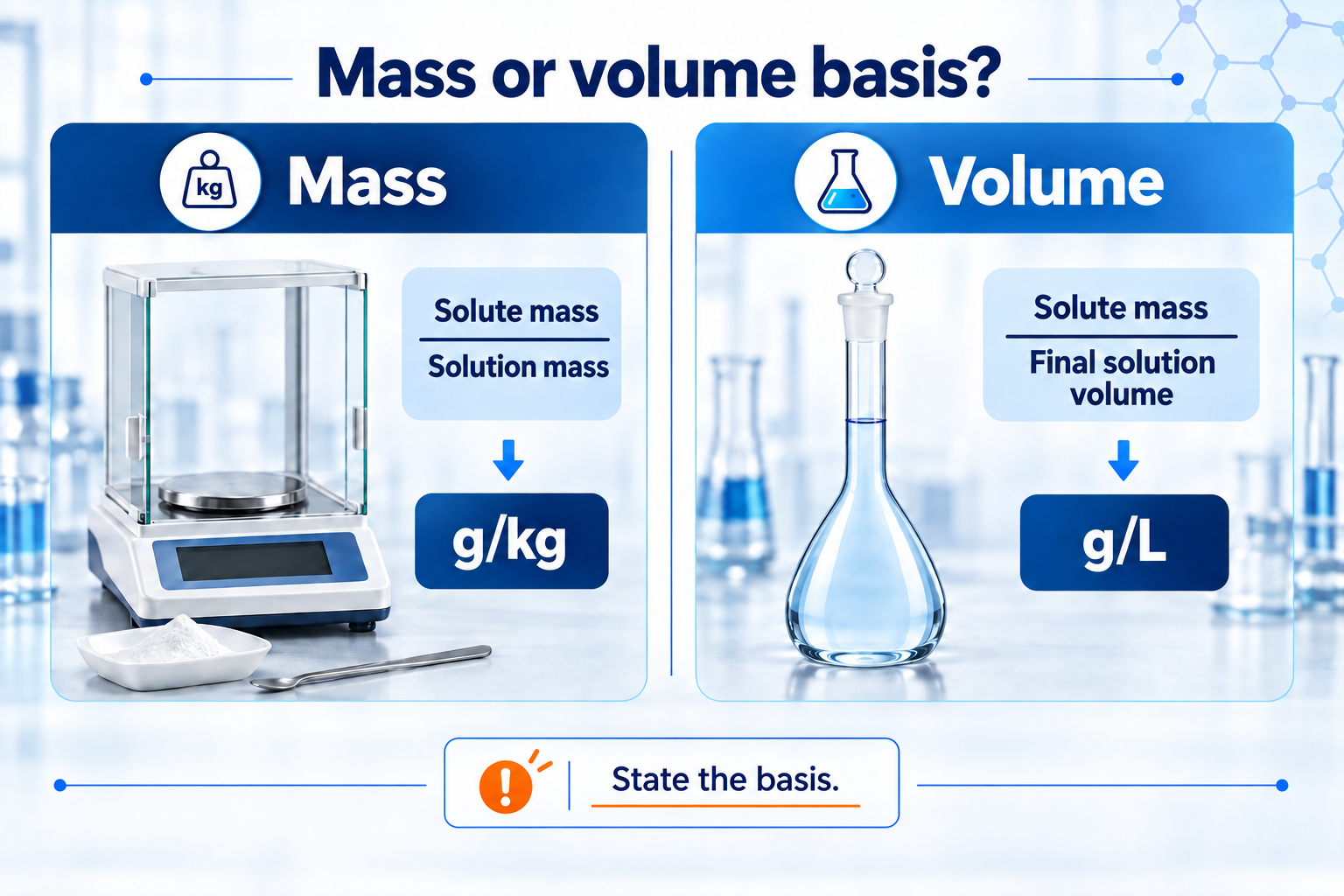
| Mass fraction | Analyte mass divided by total mixture mass | mg/kg or g/g | Track analyte mass and total solution mass |
| Mass concentration | Analyte mass divided by solution volume | mg/L | Establish the final solution volume directly or through a justified density conversion |
| Amount concentration | Amount of substance divided by solution volume | mol/L | Establish amount of substance and final volume on the stated chemical basis |
For mass fraction, the denominator includes the whole solution, not just the solvent added. For mass concentration, the denominator is the final solution volume, not the volume of solvent before dissolving the material. These distinctions remain important when the analyte is a small fraction of the mixture.
What gravimetric preparation establishes
A mass-based preparation can weigh a solid constituent and solvent, or weigh portions of a liquid stock and diluent. The calculation must use the source material's assigned composition or purity on the appropriate basis. Where the source is a stock solution, its total mass is not all analyte; the stock's analyte fraction determines how much analyte is introduced.
For an illustrative mass-fraction calculation, 0.0100 g of an idealized, pure analyte in 100.0000 g of total solution gives 0.000100 g/g, equivalent to 100 mg/kg. The total solution mass is the denominator. This is a definition-based example, not a recipe: actual purity, chemical form, weighing uncertainty, dissolution and stability require method-specific treatment.
NIST's presentation on preparing calibration solutions describes preparation from solid and liquid constituents and the importance of known calibrant composition. It supports the broad preparation principle; it does not provide a universal protocol for every analyte or matrix.
What volumetric preparation establishes
A common mass-concentration workflow weighs the required source material, dissolves it and adjusts the solution to a specified final volume. A dilution workflow instead transfers a defined stock volume and makes up to a defined final volume. Both need the correct source concentration or composition and appropriate handling of transfer, mixing and final volume.
The volume basis introduces conditions that deserve explicit control. Follow the equipment's calibration and operating instructions and the method's temperature conditions, filling technique and mixing procedure. Simply reading a flask's nominal marking does not establish the uncertainty of the completed preparation.
The Eurachem/CITAC uncertainty guide treats calibration-solution preparation as a combination of contributions, including mass, purity and volumetric effects such as filling repeatability and temperature. Its worked examples demonstrate an assessment approach; their numerical values are not acceptance limits for another laboratory.
Convert between bases only with adequate density evidence
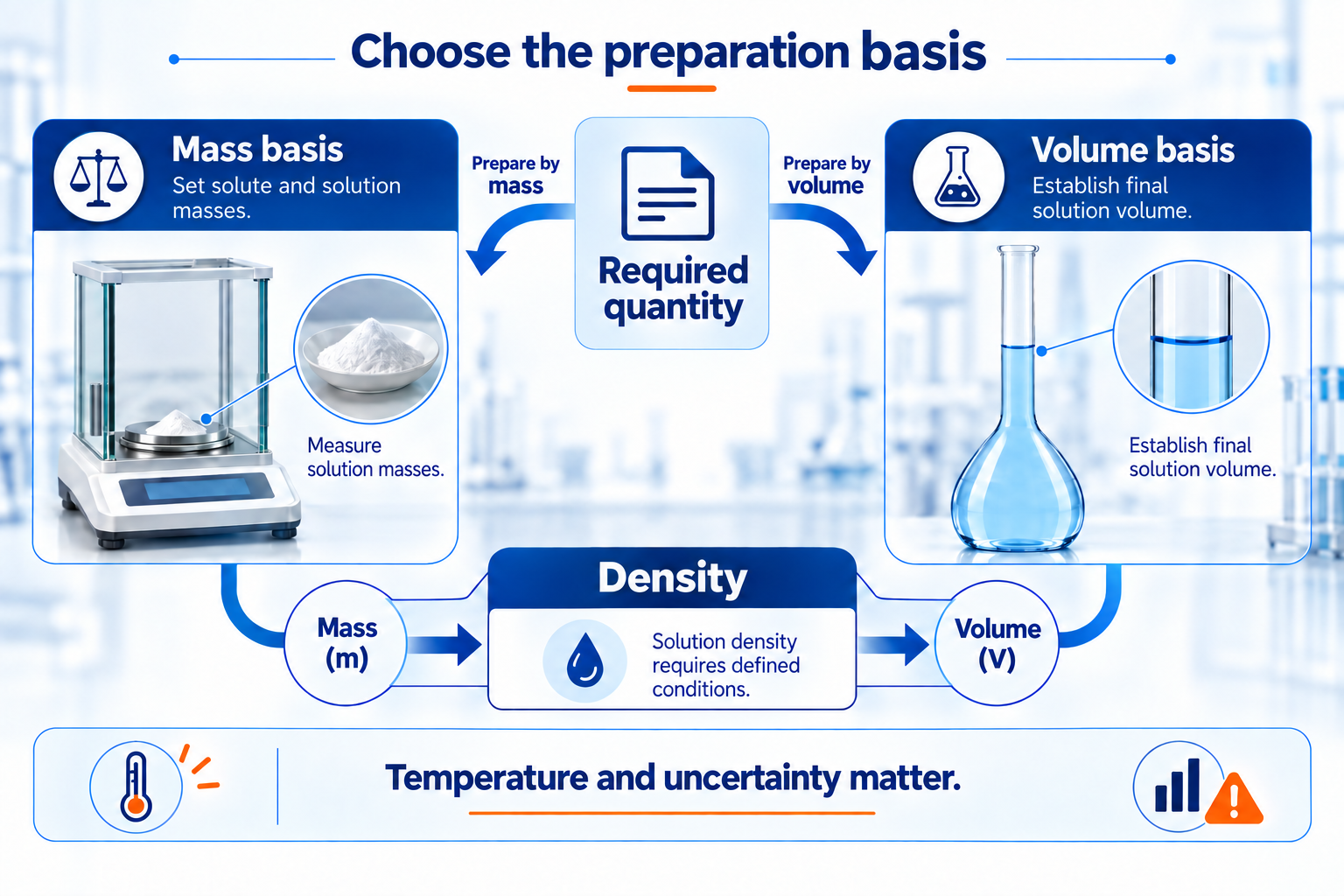
Mass-based preparation can support a volume-based concentration when the final solution density is known under appropriate conditions. From the definitions:
Mass concentration = mass fraction × solution density
For example, a mass fraction expressed in mg/kg multiplied by a solution density in kg/L gives mass concentration in mg/L. This is an algebraic relationship, not permission to substitute a convenient density value.
The relevant density is that of the prepared solution at the stated conditions. A pure-solvent density may not represent a solution containing analyte, other solutes or a different solvent composition. Temperature matters when relating mass to volume. The density value, its applicability and its uncertainty therefore belong in the calculation record.
If density is unavailable or inadequately established for the intended composition, do not silently relabel a mass fraction as mg/L. Report the established quantity or use a justified preparation and measurement approach that provides the required basis.
Choose on method fitness and uncertainty
- Required basis: Identify the quantity and units required by the calibration model, method or reference-material documentation.
- Source material: Check assigned composition, purity basis, chemical form and applicable handling instructions.
- Equipment: Evaluate balance and volumetric capability at the actual working amounts, including relevant calibration and repeatability.
- Conversions: Identify every additional quantity needed, particularly density when moving between mass and volume bases.
- Handling: Consider quantitative transfer, complete dissolution, mixing, evaporation or instability where relevant to the material and procedure.
A balance-based workflow may reduce some volumetric operations but can add a density measurement or conversion if mg/L is required. A volumetric workflow can establish the required volume directly but still needs suitable weighing or stock assignment. Compare the complete uncertainty and practical handling of the proposed procedures, rather than declaring one technique superior from its name.
Use COA and specification information for the distinct evidence each provides. Whether a laboratory should prepare its own standard is a separate quality and procurement question addressed in prepared standards versus in-house preparation.
Document the target quantity, source assignment, measured masses or volumes, any density conversion, calculation and uncertainty rationale. A technical reviewer should be able to trace the reported concentration back to the quantities actually measured and confirm that the preparation fits its intended analytical use.
Leave a comment!