

HPLC Injection-Solvent Mismatch: When Sample Diluent Distorts Peak Shape
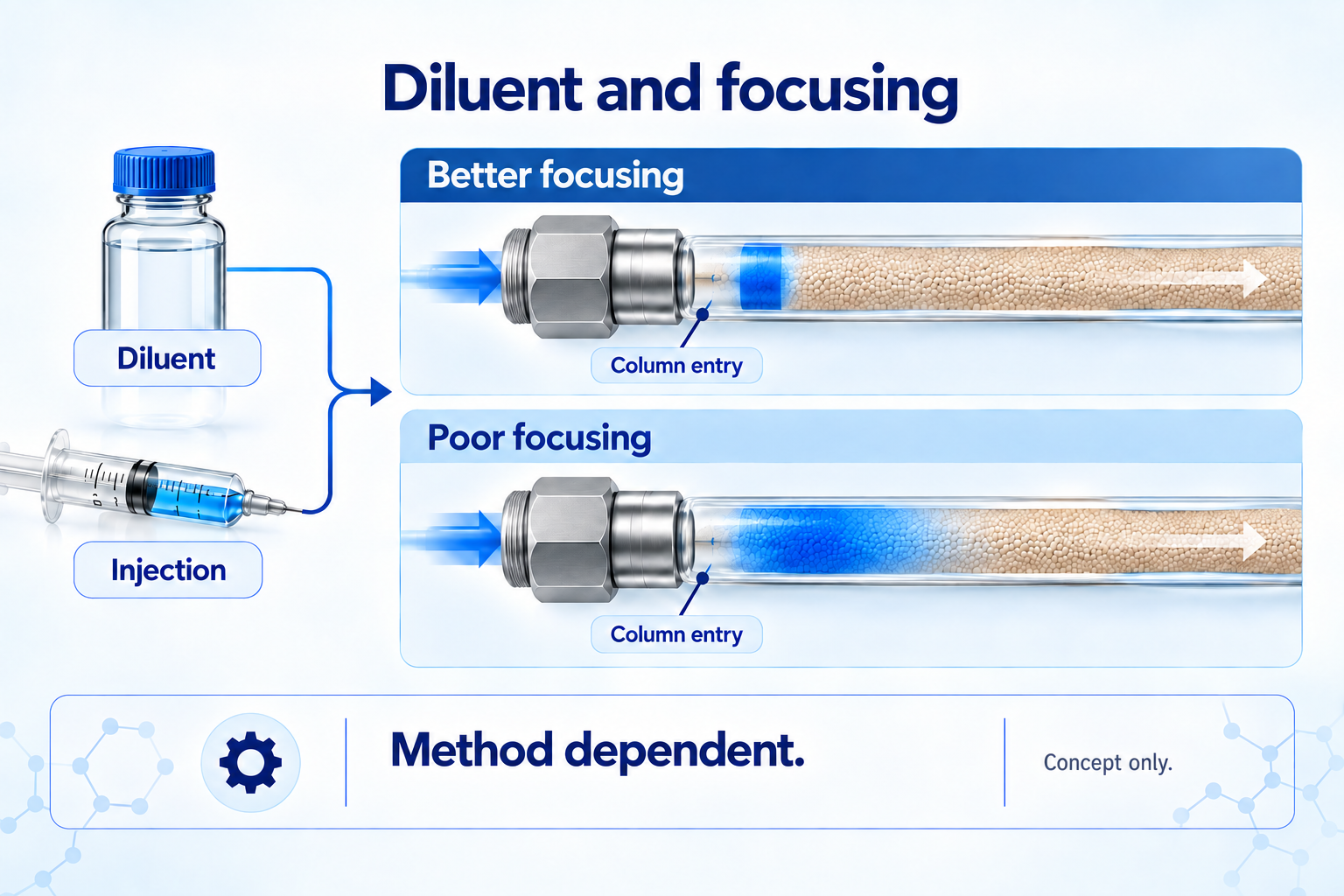
A sample can be fully dissolved yet arrive at the column in a solvent environment that disrupts the separation. In reversed-phase HPLC, a diluent with greater elution strength than the initial mobile phase can reduce focusing of the injected band. The effect depends on injection volume, analyte retention, column and instrument configuration. Broadening, fronting or splitting may result, but peak shape alone does not establish the cause.
The practical objective is to preserve sample solubility and integrity while introducing it in a form compatible with the method. There is no universal organic percentage or injection-volume limit that solves every mismatch.
What changes at the column inlet?
The column normally encounters the starting mobile phase. An injection briefly introduces a plug with the sample diluent's composition. If that plug behaves as a stronger eluent, an analyte may move through the inlet region before it is retained as effectively as intended. A less focused starting band can compromise the final peak.
Agilent's LC handbook discusses sample-solvent and injection-volume effects, including broadening and splitting, in its sample-injection section. Its examples have specific columns and conditions; their numerical volumes are not general limits.
Solvent strength means elution behavior in the particular chromatographic system. It is different from solvent purity. Choosing an appropriate grade, as explained in what HPLC-grade solvent means, does not automatically make the final sample diluent compatible with the starting mobile phase.
Why a method transfer can expose the problem
A diluent that worked on one instrument may behave differently after transfer. Waters' study of high-organic diluents on UHPLC examines how pre-column mixing and dispersion alter injection-solvent effects. Lower-dispersion configurations can make a mismatch more apparent.
This is a reason to record configuration, not a general recommendation to add tubing. Additional volume can create other chromatographic consequences. Column dimensions, injection mode and the configuration covered by the method must remain visible in any comparison.
Early or weakly retained analytes can be particularly informative. In its ziprasidone impurity-method transfer study, Waters distinguishes the response of early and later retained components and reports that reducing injection volume improved shape while reducing sensitivity. That tradeoff is central: a prettier peak is not sufficient evidence that the analytical method still meets its purpose.
Solubility and focusing must both survive the change
Matching the diluent more closely to the starting mobile phase is a useful investigation direction, not permission to dilute every sample with water. A sample-preparation solvent may have been chosen because the analyte or matrix requires it. Reconstitution, dilution or evaporation can introduce recovery and stability questions.
Before selecting a comparison, ask whether the analyte remains dissolved over the relevant preparation and autosampler period; whether the matrix changes; and whether the concentration basis is preserved. Where those conditions cannot be maintained, consult the method owner rather than optimizing peak appearance in isolation. Waters' high-organic study explicitly describes the tension between solubility needs and solvent-strength compatibility.
Do not export reversed-phase rules to HILIC
In hydrophilic interaction chromatography, solvent behavior differs. Waters' HILIC application study shows that sample-diluent composition influences both peak shape and solubility, with aqueous content and stationary-phase chemistry important to the outcome. A change that weakens a reversed-phase injection solvent may strengthen its elution behavior in HILIC.
Specify the separation mode before using terms such as “stronger” and “weaker.” Read the column guidance and actual method rather than applying one solvent-strength hierarchy to every LC separation.
Build an investigation that can distinguish explanations
The following is an evidence framework for a method owner, not an approved replacement procedure. Use the method's established controls and authorization process.
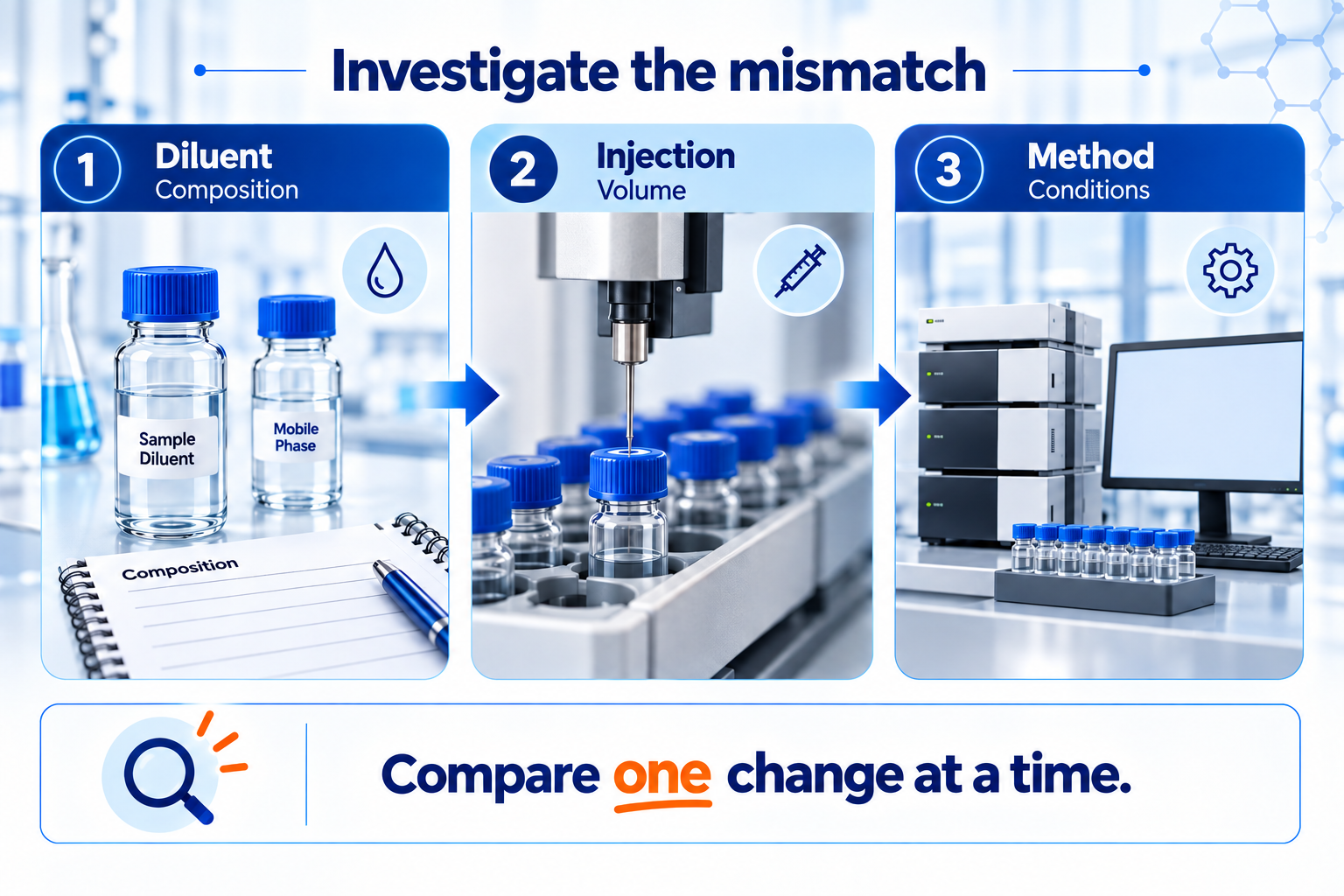
| Comparison question | What to keep visible | What the observation can suggest |
|---|---|---|
| Does the behavior follow diluent composition? | Analyte concentration, preparation history and relevant matrix differences. | A solvent-environment contribution, requiring confirmation. |
| Does it change with injection volume? | Injected mass also changes if concentration is held constant. | Volume, mass and solvent-plug effects may need separating. |
| Are only weakly retained analytes affected? | Retention, separation mode and initial conditions. | A focusing-related pattern worth investigating. |
| Did the issue begin after a configuration change? | Column, injector settings, connections and pre-column configuration. | A transfer or system contribution rather than a simple grade issue. |
Also consider competing explanations. Solvent impurities can affect analytical results, while column condition and system dispersion can affect peak shape. Neither a change of solvent bottle nor a sharper reinjection alone identifies the original mechanism.
Define success before choosing the change
Record the intended comparison, the variables held constant and the alternatives being tested. Evaluate the method's relevant performance attributes, including separation, repeatability and sensitivity, rather than one peak-shape feature. Retain the preparation details so that an apparent improvement can be reproduced and reviewed.
No new acceptance criteria are supplied here. Changes to a controlled method need the applicable technical review and change process before routine use. When selecting chemicals for an investigation, compare the required specification and detector needs without assuming that any named solvent grade resolves mismatch.
Common questions
Does a split peak prove that the diluent is too strong?
No. It is a candidate explanation. Competing sample, column and instrument causes must be evaluated using controlled evidence.
Is the smallest injection always best?
No. Smaller injections can reduce sensitivity, and the permitted choice depends on the method. Volume and injected mass should not be confused.
Should every sample be prepared in the initial mobile phase?
Only when solubility, stability and the intended preparation permit it. Compatibility is an analytical question that must be demonstrated for the actual sample and method.
Practical takeaway: Treat the sample diluent as part of the separation system. Investigate its interaction with initial conditions, injection volume and retention while protecting recovery and the method's analytical purpose.
Related RCI Labscan Products
- Acetonitrile, HPLC — Review the specification and method requirements; a solvent grade alone does not resolve injection-solvent mismatch.
Leave a comment!