What Is Product Specification and How Should You Read It?

Direct Answer
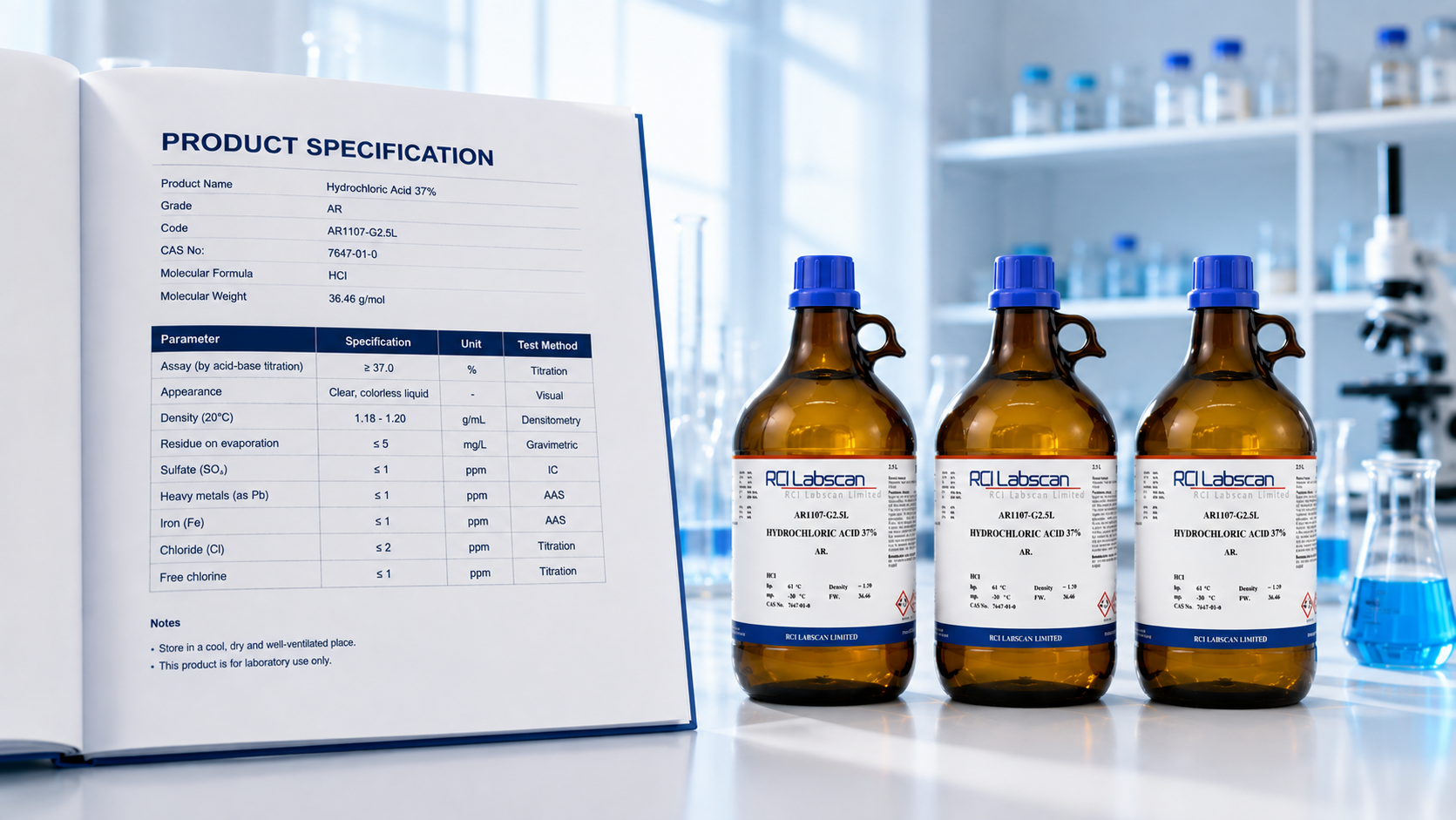
A Product Specification is a document that defines the quality requirements, technical characteristics, and acceptable limits of a product. It helps users understand what a product is designed to meet before purchasing or using it.
For laboratory chemicals and solvents, a Product Specification may include parameters such as purity, appearance, water content, residue after evaporation, UV absorbance, acidity or alkalinity, and other quality requirements.
Understanding how to read a Product Specification is important because the product name or grade alone may not provide enough information to determine whether a product is suitable for a specific laboratory application.
Why Is Product Specification Important?
When selecting laboratory chemicals, users often focus on the product name, grade, or purity percentage. However, these details do not always describe the complete quality requirements of the product.
A Product Specification provides more detailed information about the quality characteristics that a product is expected to meet.
It can help users:
- Compare products from different suppliers
- Select a product suitable for a specific application
- Check quality requirements before purchasing
- Understand acceptable limits for impurities
- Support quality control procedures
- Verify whether a product is suitable for analytical methods
- Maintain consistency between different production lots
For laboratories that require reliable and reproducible results, understanding product specifications can help reduce the risk of selecting an unsuitable chemical or solvent.
What Information Can Be Found in a Product Specification?
The contents of a Product Specification depend on the product type, grade, application, and manufacturer.
For laboratory chemicals and solvents, common information may include:
- Product name
- Chemical name
- Grade
- Assay or purity
- Appearance
- Identification
- Water content
- Acidity or alkalinity
- Residue after evaporation
- UV absorbance
- Specific impurities
- Heavy metals or elemental impurities
- Density
- Refractive index
- Other application-specific parameters
Not every specification will contain all of these parameters. Users should always refer to the actual Product Specification provided by the manufacturer or supplier.
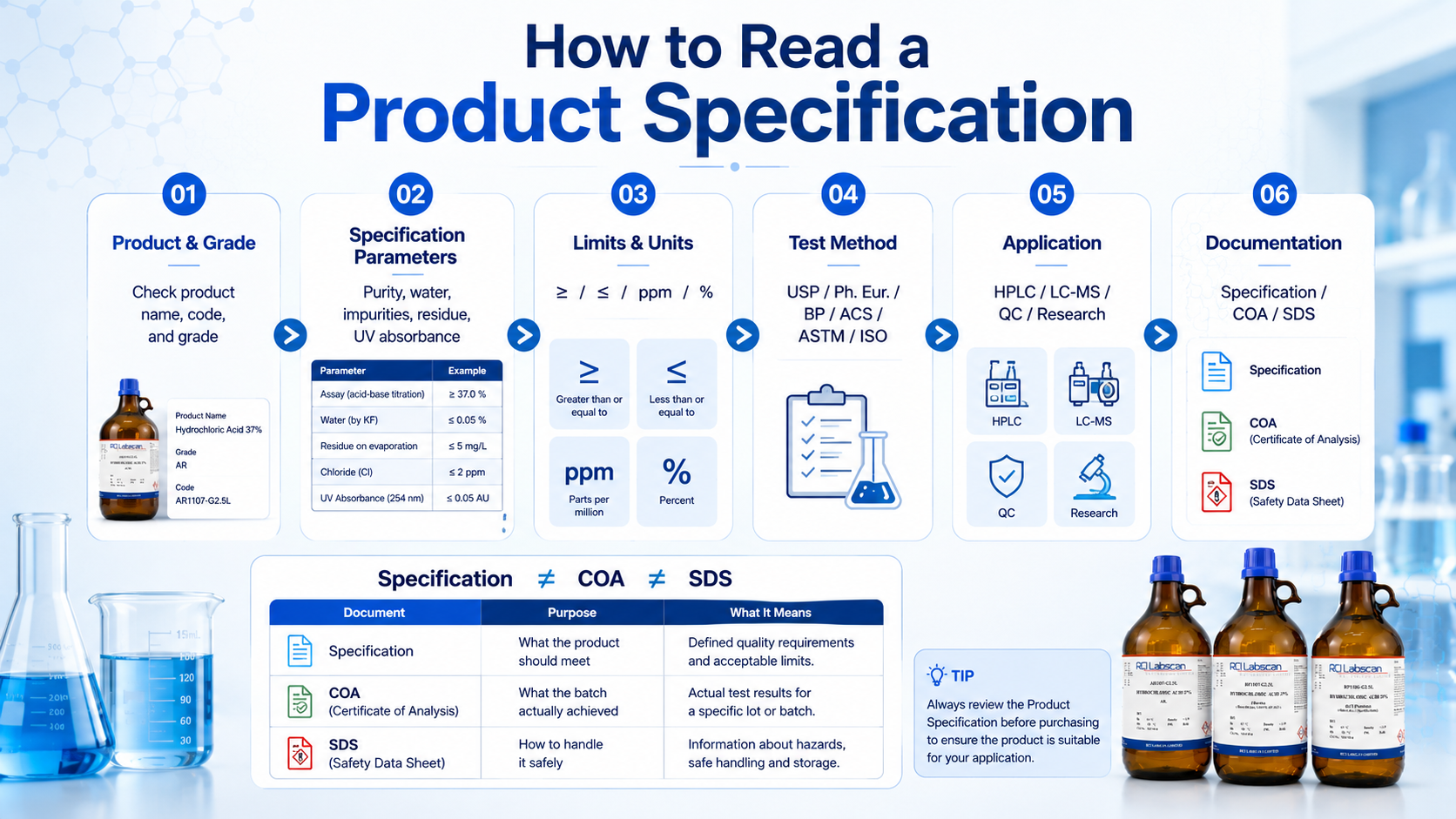
How to Read a Product Specification
Reading a Product Specification may seem complicated at first because it often contains technical terms, numerical limits, units, and test methods.
A practical approach is to read the document from the product information section first, then focus on the quality parameters that are relevant to the intended application.
1. Start With the Product Name and Grade
The first step is to confirm that the Product Specification belongs to the correct product.
Check:
- Product name
- Chemical name
- Product code
- Grade
- Intended application
For example, Methanol may be available in several grades, such as general reagent grade, HPLC grade, or LC-MS grade.
Although the chemical name is the same, the quality requirements may be different depending on the intended application.
Therefore, users should confirm the grade before reviewing individual specification parameters.
2. Check the Specification Parameter
A specification parameter describes a specific characteristic that is controlled for the product.
For example:
| Parameter | What It Indicates |
|---|---|
| Assay / Purity | Amount of the target chemical present |
| Water | Amount of water contained in the product |
| Residue after evaporation | Non-volatile material remaining after evaporation |
| UV Absorbance | Potential UV-absorbing impurities |
| Acidity / Alkalinity | Acidic or basic characteristics |
| Appearance | Physical appearance of the product |
| Density | Mass per unit volume |
| Specific impurities | Concentration of controlled contaminants |
The importance of each parameter depends on the intended application.
For example, UV absorbance may be particularly important for solvents used with UV or PDA detection in HPLC, while water content may be important when precise solvent composition is required.
3. Understand the Specification Limit
One of the most important parts of a Product Specification is the acceptance limit.
A specification may use terms such as:
- ≥ 99.8%
- ≤ 0.01%
- ≤ 10 ppm
- NMT 0.02%
- Not more than 0.02%
- Meets the requirement
- Passes the test
These limits define the acceptable quality range for the product.
For example, if the specification states:
Assay: ≥ 99.8%
this means the assay result must be at least 99.8%.
If the specification states:
Water: ≤ 0.05%
the water content must not exceed 0.05%.
It is important to understand whether a lower or higher value represents better performance because this depends on the parameter being measured.
4. Check the Unit of Measurement
Always check the unit together with the numerical value.
Common units found in laboratory Product Specifications include:
- %
- ppm
- mg/L
- mg/kg
- g/L
- mL/L
- AU
- µS/cm
For example, a specification of ≤ 10 ppm is very different from ≤ 10%.
Understanding the unit helps prevent incorrect interpretation of the specification.
Users should also check whether the value is expressed on a mass basis, volume basis, or another measurement basis when applicable.
5. Understand “Minimum” and “Maximum” Requirements
Specification limits commonly use minimum and maximum requirements.
Minimum requirement
A minimum requirement means the result must be equal to or greater than the specified value.
Example:
Purity: ≥ 99.9%
The product must have a purity of at least 99.9%.
Maximum requirement
A maximum requirement means the result must be equal to or lower than the specified value.
Example:
Water: ≤ 0.05%
The water content must not exceed 0.05%.
Understanding whether the specification is a minimum or maximum limit is essential when evaluating product quality.
6. Check the Test Method When Necessary
Some Product Specifications include a test method or reference standard used to evaluate the parameter.
Examples may include:
- USP
- Ph. Eur.
- BP
- ACS
- ASTM
- ISO
- Internal manufacturer method
The test method is important because different analytical methods may produce different results or have different acceptance criteria.
For regulated or critical applications, users should confirm not only the specification limit but also the applicable test method or standard.
7. Compare the Specification With Your Application
A product should not be selected based only on whether its purity looks high.
The more important question is:
Does the product specification meet the requirements of my application?
For example, a laboratory performing HPLC analysis may need to consider:
- Purity
- UV absorbance
- Residue after evaporation
- Water content
- Specific impurities
- Lot-to-lot consistency
For LC-MS applications, additional attention may be required for trace-level impurities and other parameters that could affect mass spectrometry detection.
The appropriate specification therefore depends on the analytical method, instrument, detector, sensitivity, and laboratory requirements.
Product Specification vs Certificate of Analysis (COA)
Product Specification and Certificate of Analysis (COA) are related but serve different purposes.
A Product Specification defines the required quality criteria that a product is expected to meet.
A COA provides the actual test results for a specific batch or lot.
For example:
| Document | Main Purpose |
|---|---|
| Product Specification | Defines required quality limits |
| Certificate of Analysis (COA) | Shows actual test results for a specific lot |
| SDS | Provides safety, handling, and hazard information |
A simple way to remember the difference is:
Specification = What the product should meet
COA = What this specific batch actually achieved
SDS = How to safely handle the product
These documents should not be treated as interchangeable because each provides different information.
Why Should You Read the Product Specification Before Purchasing?
Reviewing the Product Specification before purchasing can help ensure that the selected product matches the laboratory's requirements.
This can be especially important when:
- Purchasing a chemical for a validated analytical method
- Changing suppliers or brands
- Comparing different product grades
- Purchasing solvents for HPLC or LC-MS
- Working with regulated laboratories
- Establishing internal purchasing specifications
- Investigating analytical variation
- Qualifying a new supplier
For routine purchasing, reviewing the specification in advance can also help prevent situations where a product meets the general description but does not meet the laboratory's specific requirements.
What Should You Check in a Product Specification?
A practical checklist can help users review a Product Specification more efficiently.
| What to Check | Why It Matters |
|---|---|
| Product name | Confirms the correct chemical |
| Product grade | Indicates intended quality/application |
| Purity or assay | Confirms chemical content |
| Key impurities | Helps assess potential interference |
| Water content | Important for moisture-sensitive applications |
| UV absorbance | Important for UV/PDA detection |
| Residue | Helps assess non-volatile contamination |
| Specification limits | Defines acceptable quality range |
| Test method | Shows how the parameter is evaluated |
| Standards or compliance | Helps confirm application requirements |
| Packaging | Supports storage and handling requirements |
| Documentation | Supports purchasing and quality control |
The most important parameters will vary depending on the application. Users should focus on the specifications that can directly affect their analytical method or process.
Example: How to Read a Solvent Specification for HPLC
Consider an HPLC-grade solvent used as a mobile phase.
Instead of looking only at the statement “Purity ≥ 99.9%”, users should review other relevant parameters as well.
For example:
- Assay or purity
- UV absorbance
- Water content
- Residue after evaporation
- Acidity or alkalinity
- Specific impurities
- Appearance
A solvent may have high assay but still require evaluation of other parameters for chromatographic applications.
For HPLC, low UV absorbance and low levels of unwanted impurities can be particularly important because contaminants may contribute to background signals, additional peaks, or changes in chromatographic performance.
Therefore, the Product Specification should always be evaluated in the context of the intended analytical method.
Product Specification Checklist for Laboratory Chemicals
Before purchasing a laboratory chemical, users can ask the following questions:
1. Is this the correct product and grade?
Confirm the chemical name, product code, and grade.
2. Does the specification match my application?
Check whether the controlled parameters are suitable for the intended method.
3. Are the important impurities controlled?
Review the impurity limits that could affect the analysis.
4. Are the specification limits clearly defined?
Check minimum and maximum requirements, units, and acceptance criteria.
5. Is the test method appropriate?
Review the referenced standard or analytical method when required.
6. Can the supplier provide supporting documentation?
Check whether Product Specification, COA, SDS, and other relevant documents are available.
When Is Product Specification Especially Important?
Product Specification becomes particularly important when product quality can directly affect analytical performance, product quality, or regulatory compliance.
Common situations include:
- HPLC and LC-MS analysis
- Pharmaceutical quality control
- Food and beverage testing
- Environmental analysis
- Research laboratories
- Method development
- Production quality control
- Regulated laboratory applications
- Supplier qualification
- Incoming material inspection
In these situations, selecting a product based only on its chemical name or general purity may not provide enough information.
Documentation to Check Before Purchase
Before purchasing laboratory chemicals, users may request or review the following documents:
- Product Specification
- Certificate of Analysis (COA)
- Safety Data Sheet (SDS)
- Product technical information
- Grade information
- Packaging information
- Applicable standards or certifications
For routine or regulated laboratory work, maintaining appropriate documentation can help support traceability, quality control, and purchasing decisions.
Related RCI Labscan Products
RCI Labscan provides laboratory chemicals and high-purity solvents for a range of analytical and laboratory applications.
Product specifications and supporting documentation can help users evaluate whether a particular grade is suitable for their intended application.
For product availability, packaging options, specifications, or documentation requests, customers may contact RCI Labscan or local authorized distributors.
FAQ
What is a Product Specification?
A Product Specification is a document that defines the required quality characteristics and acceptable limits of a product. It helps users understand what quality requirements the product is expected to meet.
Is Product Specification the same as a COA?
No. A Product Specification defines the required quality criteria, while a COA reports the actual test results for a specific batch or lot.
Why should I read the Product Specification before purchasing?
Reading the specification helps confirm that the product's quality parameters, grade, and acceptance limits are suitable for the intended application.
What is the difference between specification and specification limit?
A specification describes the quality parameter being controlled, while the specification limit defines the acceptable range or maximum/minimum value for that parameter.
What does ≥ mean in a Product Specification?
The symbol ≥ means “greater than or equal to.” For example, Assay ≥ 99.8% means the assay must be at least 99.8%.
What does ≤ mean in a Product Specification?
The symbol ≤ means “less than or equal to.” For example, Water ≤ 0.05% means the water content must not exceed 0.05%.
Why are units important when reading a Product Specification?
Units determine how a numerical value should be interpreted. For example, % and ppm represent very different concentrations, so the unit should always be reviewed together with the specification value.
Do all laboratory chemicals have the same Product Specification?
No. Specifications vary depending on the chemical, grade, manufacturer, intended application, and applicable quality standards.
Is a higher purity always better?
Not necessarily. The most important factor is whether the product meets the requirements of the intended application. Other parameters, such as impurities, UV absorbance, water content, or residue, may also be important.
Explore related products:
Related articles:
Leave a comment!