

Laboratory Water Quality: Why Resistivity Alone Is Not Enough
Resistivity is a useful indicator of ionic contamination in laboratory water. It is not a complete test for organic compounds, particles, microorganisms or their by-products. Water is suitable for an application when the relevant quality evidence meets that application's requirements—not simply when a dispenser displays a high resistivity value.
For a student preparing a solution, this distinction matters: the water becomes part of the experiment. Ask what the experiment needs the water to do and which contaminants could affect the result.
What resistivity actually tells you
Conductivity describes how readily water conducts electricity; dissolved ions contribute to that conduction. Resistivity is the reciprocal of conductivity. Under comparable measurement conditions, lower conductivity corresponds to higher resistivity. Merck's water-quality monitoring explanation treats resistivity and organic-carbon monitoring as separate measurements.
Temperature affects the measurement, so check the reported temperature and whether the instrument applies temperature compensation. Compare values using the documented measurement basis. A number copied without its units or temperature information loses important context.
Resistivity does not identify individual contaminants. It cannot tell you the concentration of a particular metal, certify that a named organic compound is absent, or count microorganisms. Think of it as one window onto water quality, rather than a complete certificate.
Several quality dimensions can matter at once
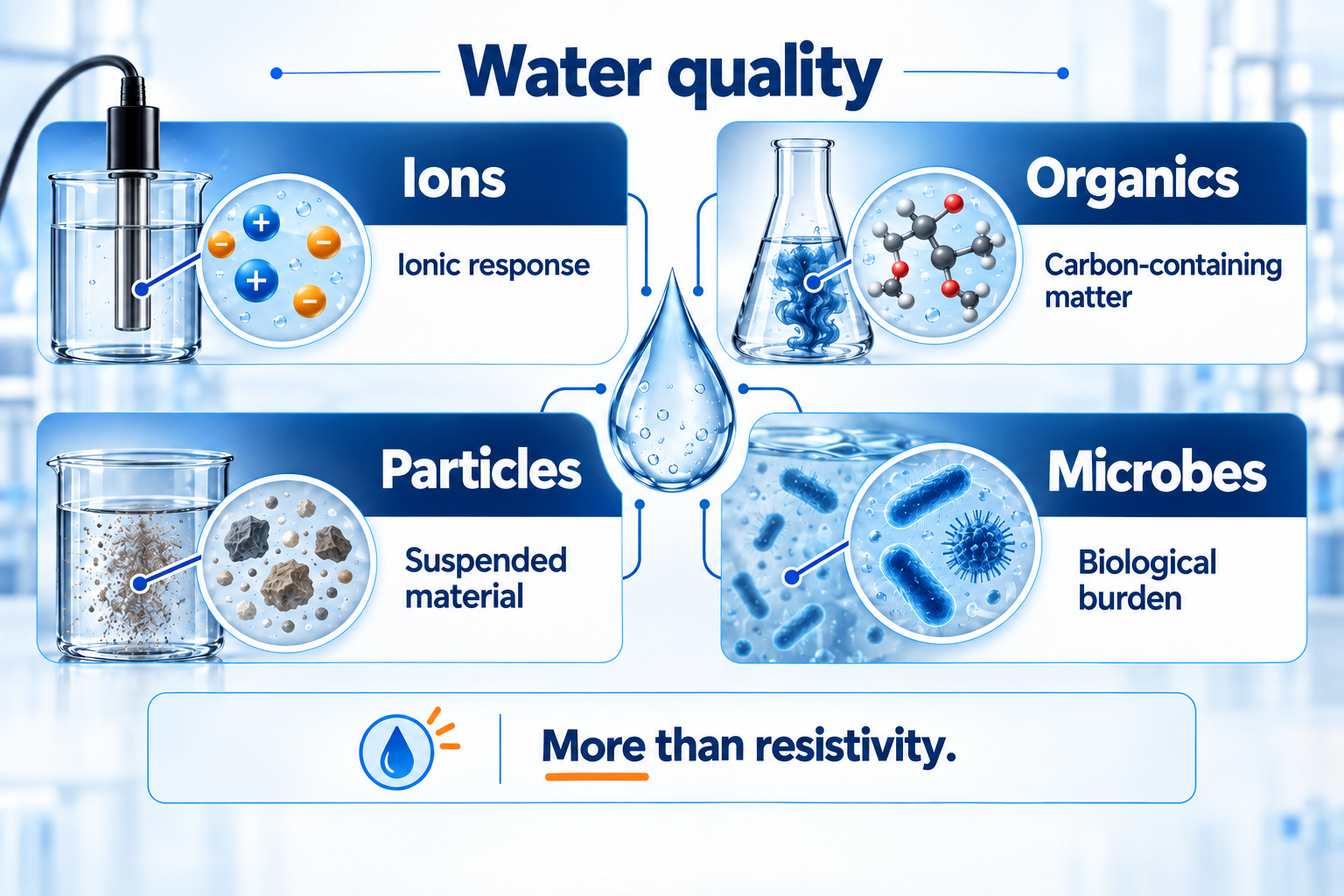
| Dimension | What to investigate | Why the resistivity display is insufficient |
|---|---|---|
| Ionic contamination | Conductivity/resistivity and, where needed, specific-ion or element measurements | A bulk electrical measurement does not identify each ion. |
| Organic contamination | Organic-carbon monitoring and application-relevant analytical background | Organic compounds do not all contribute to conductivity in the same way. |
| Particles | Relevant particle controls or checks for the intended instrument/application | Resistivity is not a particle count. |
| Microbiological quality | The microbiological controls specified for the application | An electrical reading does not establish sterility. |
| Biological by-products | Application-specific evidence, such as endotoxin testing where relevant | Microorganisms and their by-products are different questions. |
Merck's overview of laboratory-water contaminants describes these different contaminant classes. For example, particles may interfere with optical measurements or instrument operation, while biological contamination and by-products can affect biological experiments. These examples explain why the intended use matters; they are not universal limits for every laboratory.
TOC adds information, but it is not an everything test
Total organic carbon, commonly abbreviated TOC, provides an indirect measure of organic content expressed as carbon. It does not identify every organic molecule. Two samples with similar TOC results need not have identical organic compositions.
The public introduction to USP General Chapter <643> explicitly states that TOC is not a replacement test for endotoxin or microbiological control. The chapter concerns pharmaceutical waters; its principle helps explain measurement boundaries, without making pharmaceutical specifications universal for teaching or research laboratories.
Suppose a researcher asks whether water contributes background near a target signal. A satisfactory resistivity or TOC reading alone does not answer that compound-specific question. The applicable analytical procedure may need a representative blank or another suitability check.
Match the evidence to the water's role
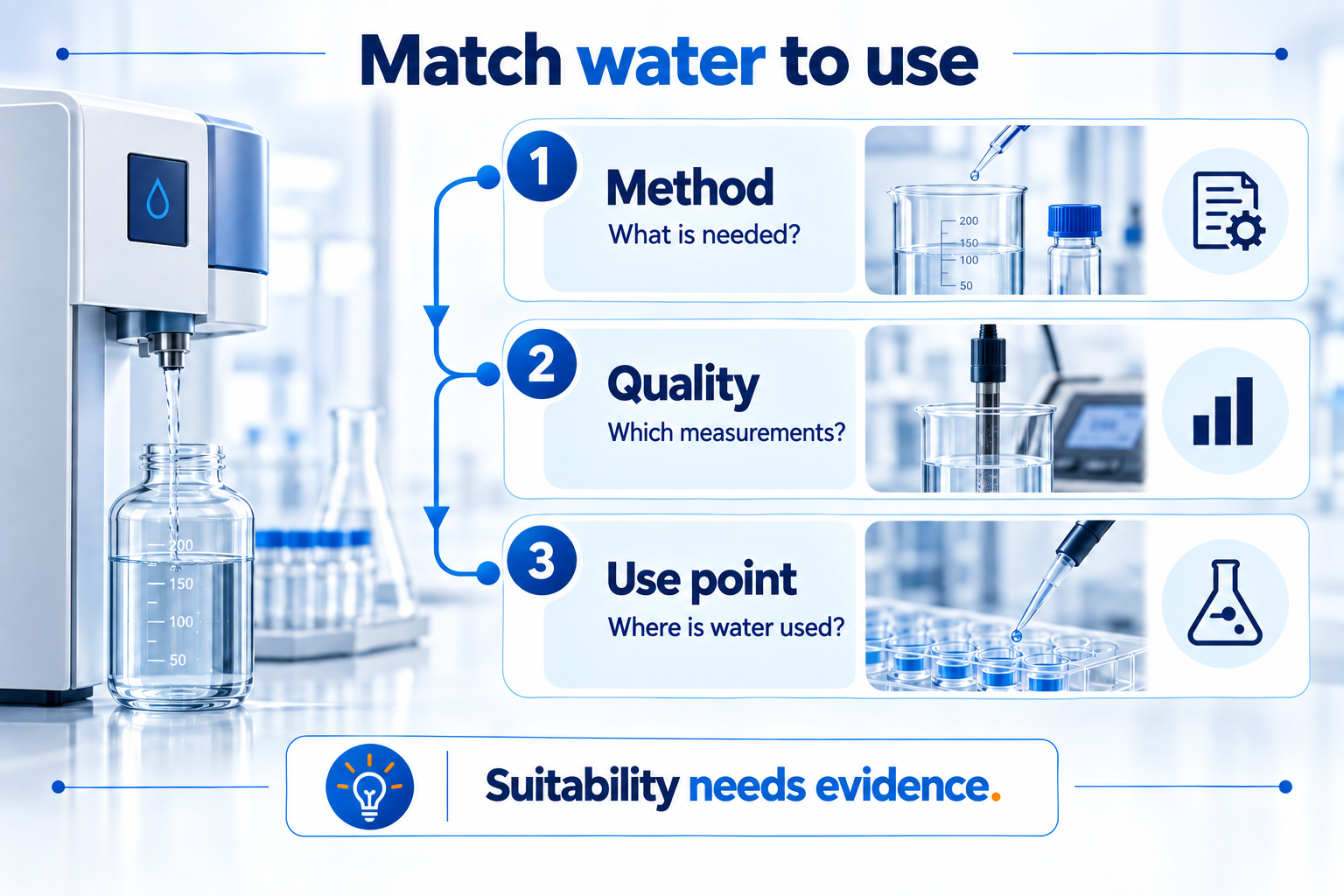
Water used for an initial glassware rinse, a final solution dilution and a sensitive analytical mobile phase can have different requirements. The same laboratory may therefore use more than one water specification or control scheme. Consult the method and equipment instructions instead of assuming that every outlet is interchangeable.
As a concrete example, EPA Method 200.8 defines its reagent-water requirement and separately uses laboratory reagent blanks to evaluate contamination and background. Its requirements apply within that method; this article does not reproduce them as a universal water-grade table.
The broader article on the roles of water, methanol and acetonitrile provides useful chromatography context. Here, the question is the quality of the water itself, rather than which solvent composition a method requires.
The sampling point matters
Distinguish a reading inside a purification system from evidence concerning water in the vessel you actually use. Dispensing, transfer, storage and contact materials add a history after purification. Merck's contaminant overview discusses contamination during storage and contact with containers.
Follow the laboratory's documented collection and storage practices. Record the outlet or source, collection time, vessel and intended use where the procedure requires them. Do not invent a universal storage period or assume that yesterday's reading establishes today's working-container quality.
A beginner's evidence checklist
- Identify the use: name the experiment, analytical method or equipment requirement.
- Read the specification: note the relevant attributes, units and test methods. The guide to reading product specifications explains this distinction.
- Check what was measured: separate the system display, scheduled quality tests and any lot-specific documentation.
- Check where and when: confirm that the evidence is relevant to the water being used.
- Ask about missing dimensions: refer unanswered suitability questions to the instructor or laboratory supervisor.
FAQ
Does high resistivity mean sterile water?
No. Resistivity and sterility address different properties. Use the application's specified microbiological evidence.
Can clear water still contain contaminants?
Yes. Appearance cannot establish ionic, organic or microbiological quality at the levels relevant to a sensitive experiment.
Is there one best water grade for every laboratory task?
No. Apply the relevant standard or procedure and its current requirements. A grade name should lead you to a defined specification, not replace it.
Use resistivity for the information it provides, then connect it with the other evidence your experiment needs. A suitable water supply is demonstrated through relevant measurements and handling controls, not a single impressive display value.
Leave a comment!