

Why Electronic-Grade Chemical Purity Matters Beyond the Assay Value
An assay value describes the amount of a specified chemical measured by a particular test. It does not, by itself, establish the identity and concentration of every impurity, the particle burden, or suitability for a semiconductor process. For distributors and business partners, the useful conversation starts with the customer's application and its documented requirements, then connects those requirements to product, lot and handling evidence.
Electronic-grade selection therefore requires more than comparing the largest percentage on two labels. A material can meet its assay specification while leaving a customer-specific contamination question unanswered.
Why this question is timely
On September 18, 2026, ICIS reported growing specialized outlets for chemicals including isopropanol in Asia's semiconductor industry. Its report distinguished demand for electronic-grade materials from the broader commodity market. This industry context makes application-specific qualification a useful discussion for suppliers; it does not establish any particular supplier's semiconductor capability.
The practical question is: what evidence supports the customer's intended use? A market development cannot answer that question for a product or batch.
Assay and impurity measurements answer different questions
Before comparing assay values, identify their measurement basis. Is the result a mass fraction, a chromatographic result or another defined measure? Which substances does the test respond to? Check the specification's units and method rather than treating different reporting conventions as interchangeable. The existing guide to reading a product specification explains how to separate a test parameter from its acceptance limit.
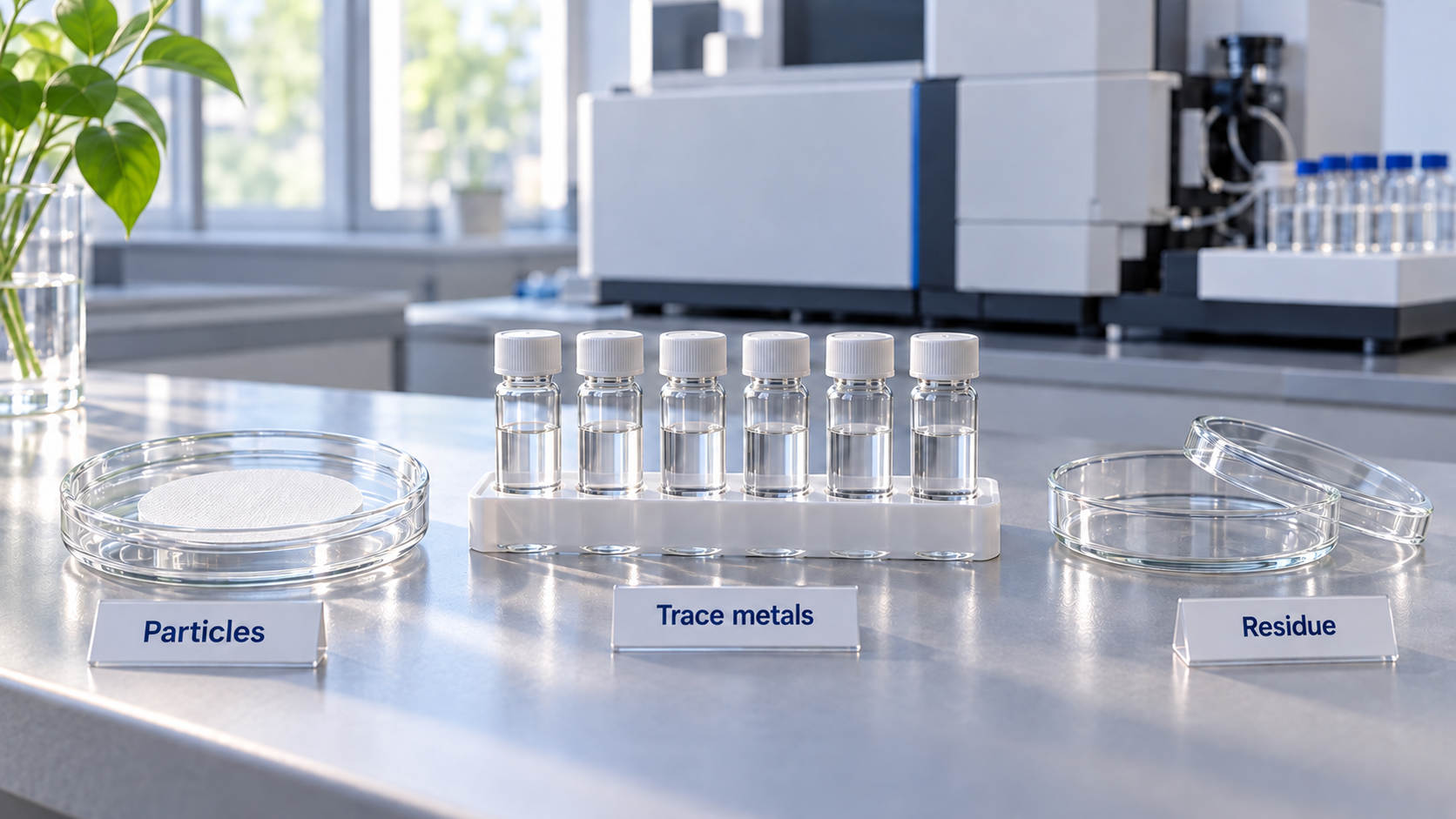
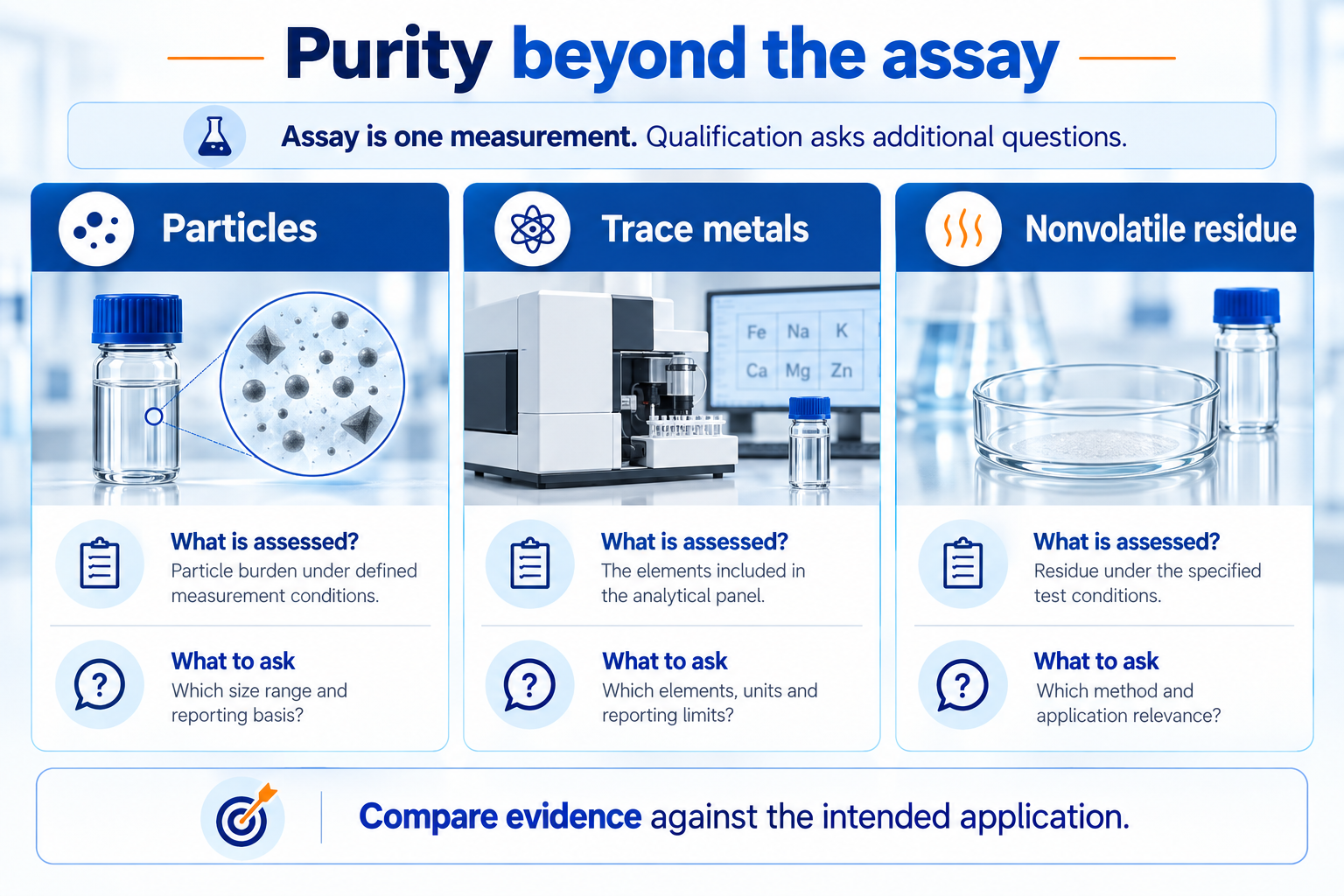
A separate trace-metal panel asks which elements were measured and how low the method can measure them. A particle measurement addresses a different property again. Neither can be reconstructed simply from a bulk assay percentage. SEMI's Liquid Chemicals standards programme covers chemical analysis, contamination, containment materials and distribution systems, reflecting this wider scope of qualification.
| Evidence area | Question for the supplier | Boundary to retain |
|---|---|---|
| Assay or concentration | What does this reported result measure, and on what basis? | It does not replace separate impurity tests. |
| Elemental impurities | Which elements, units and reporting limits are included? | An unlisted element should not be assumed absent. |
| Particles | What size ranges, sampling conditions and reporting basis apply? | Results need comparable measurement definitions. |
| Other chemical attributes | Which water, residue or organic-impurity properties matter to this process? | The relevant attributes depend on the chemical and application. |
| Packaging and delivery | What evidence applies to the delivered container and transfer arrangement? | A bulk test does not automatically describe every downstream contact. |
Compare the scope of the evidence
Two reports can appear similar while covering different analytes or methods. MilliporeSigma's technical discussion of high-purity inorganic materials illustrates why the scope of an elemental panel matters when interpreting purity on a trace-metals basis. Its product information concerns that manufacturer's inorganic materials; it is not a specification for liquid solvents or RCI Labscan products.
A helpful distributor response identifies the missing information explicitly. For example: “The document reports the assay, but we still need the requested elemental panel and its reporting limits.” That wording is more useful than translating “high purity” into an unsupported assurance.
Likewise, a result reported below a detection or quantification limit is a bounded measurement statement. Ask how that reporting limit compares with the customer's requirement. Do not rewrite it as “zero contamination.”
The delivered material has a contact history
Qualification can extend beyond the liquid to the materials that contain and transport it. SEMI lists standards concerning high-purity polymer materials, component particles and liquid chemical distribution. These references identify areas for technical review; the public descriptions do not supply a universal compatibility rule or customer acceptance threshold.
For a proposed supply arrangement, ask which container, closure and transfer components have been assessed. Record whether evidence concerns original packaging, bulk supply or a particular point of sampling. A change to the supply arrangement should be visible to the customer's technical team rather than treated as a purely logistical detail.
A useful qualification handoff
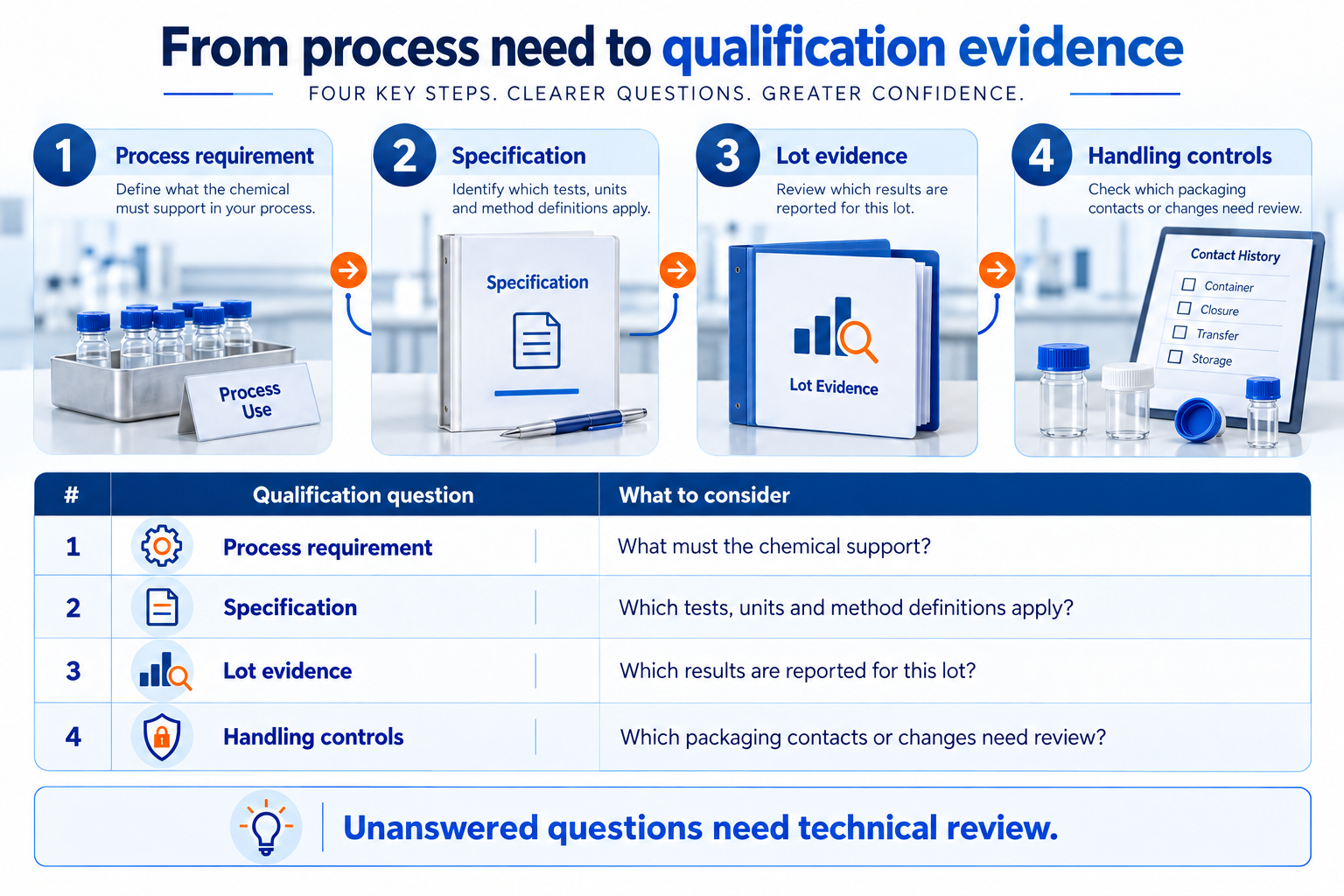
- Describe the use: record the chemical's intended process role and obtain the customer's controlled requirements.
- Identify the exact offering: distinguish chemical identity, concentration, grade, manufacturer and package configuration.
- Collect the relevant documents: obtain the current specification, SDS and lot-specific certificate where available. Review what to check in a CoA before comparing results.
- Map each requirement to evidence: identify the corresponding test, units, analytical coverage and reporting limit; mark unanswered questions clearly.
- Refer qualification decisions to the customer: agree what further testing or technical assessment is needed before making suitability statements.
This checklist is an editorial framework for organizing a conversation, not a qualification protocol. The customer determines the evidence needed for its process. Avoid treating a grade name, an SDS or a marketing description as customer approval.
Questions customers may ask
Does a higher assay automatically mean better electronic-grade suitability?
No. Compare the relevant attributes and their measurement basis against the intended application. The highest displayed percentage may leave the decisive impurity or packaging question unanswered.
Does conformity with a specification prove suitability for every fab?
No. Establish which specification and revision apply, what was actually verified and what additional customer qualification remains necessary. Do not substitute a generic standards reference for that evidence.
What should a business partner promise before technical review?
Promise a clear evidence request and a documented response. Share only verified product information and distinguish confirmed results from outstanding questions. When discussing RCI Labscan materials, request documentation for the exact product and intended application; this article makes no electronic-grade availability or qualification claim.
Assay is one part of the evidence. A stronger supplier conversation connects the customer's process needs to defined tests, traceable lot information and the delivered supply configuration.
Leave a comment!