

Water Content in Solvents: Why Is It Important?
Direct Answer
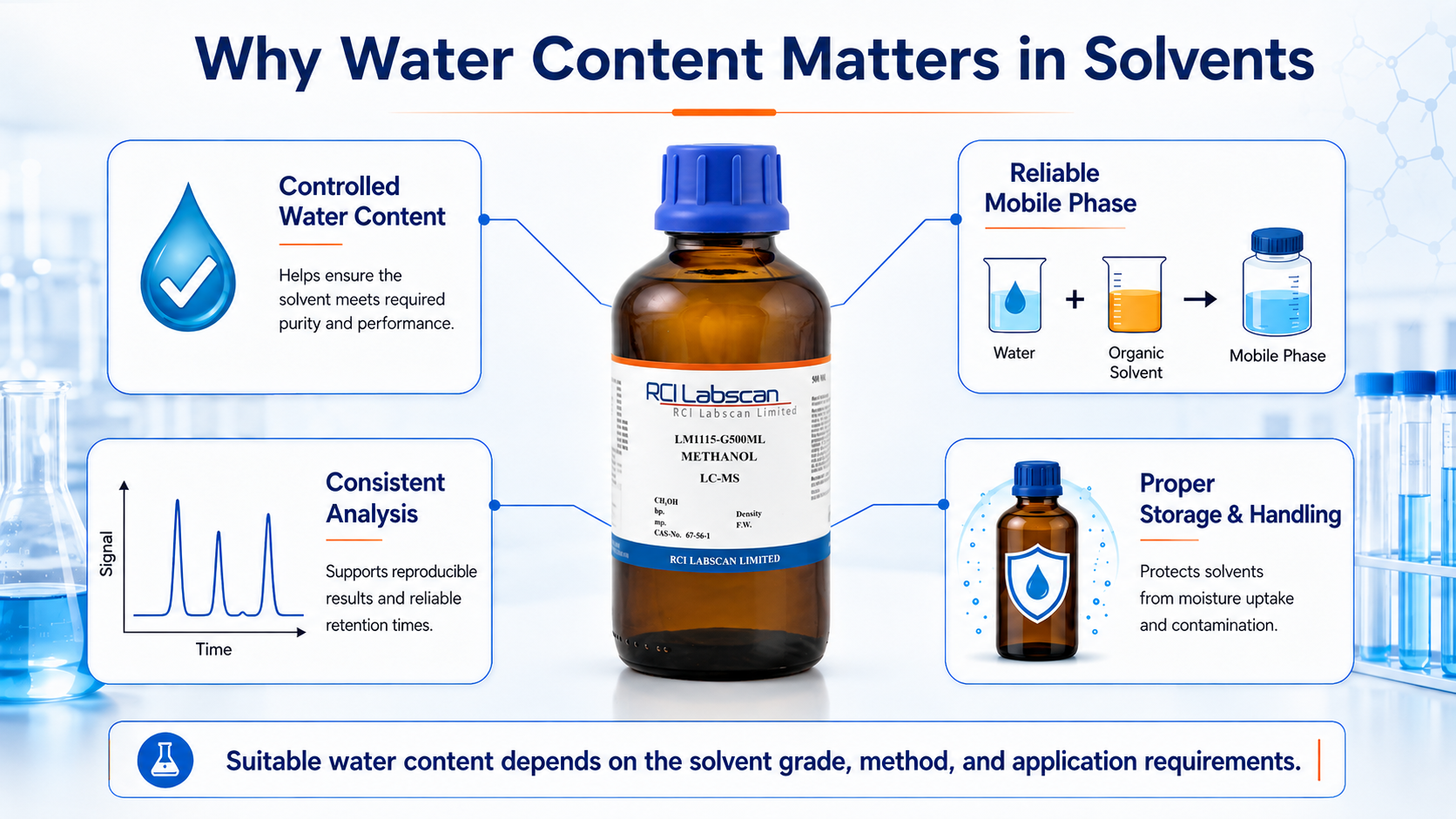
Water content refers to the amount of water present in a solvent. It is important because even a relatively small change in moisture level may alter the actual solvent composition, affect chromatographic retention, reduce method reproducibility, or interfere with moisture-sensitive reactions and analyses.
The acceptable water content depends on the solvent grade, analytical method, detector, sensitivity requirement, and intended application. Laboratories should therefore review the product specification and Certificate of Analysis rather than assuming that every high-purity solvent has the same water-content limit.
What Is Water Content in a Solvent?
Water content is a measurement of the amount of water present in a chemical solvent.
Water may be present as a controlled trace component, may enter during production and packaging, or may be absorbed after the container is opened. Some solvents are more likely than others to take up moisture from the surrounding environment.
Water content is different from overall solvent purity. A solvent may have a high assay value while still containing a measurable amount of water. For this reason, laboratories often review water content as a separate quality parameter.
The actual specification and reporting unit depend on the product, grade, testing method, and manufacturer. Users should check approved product documentation for confirmed values.
Why Can Solvents Contain Water?
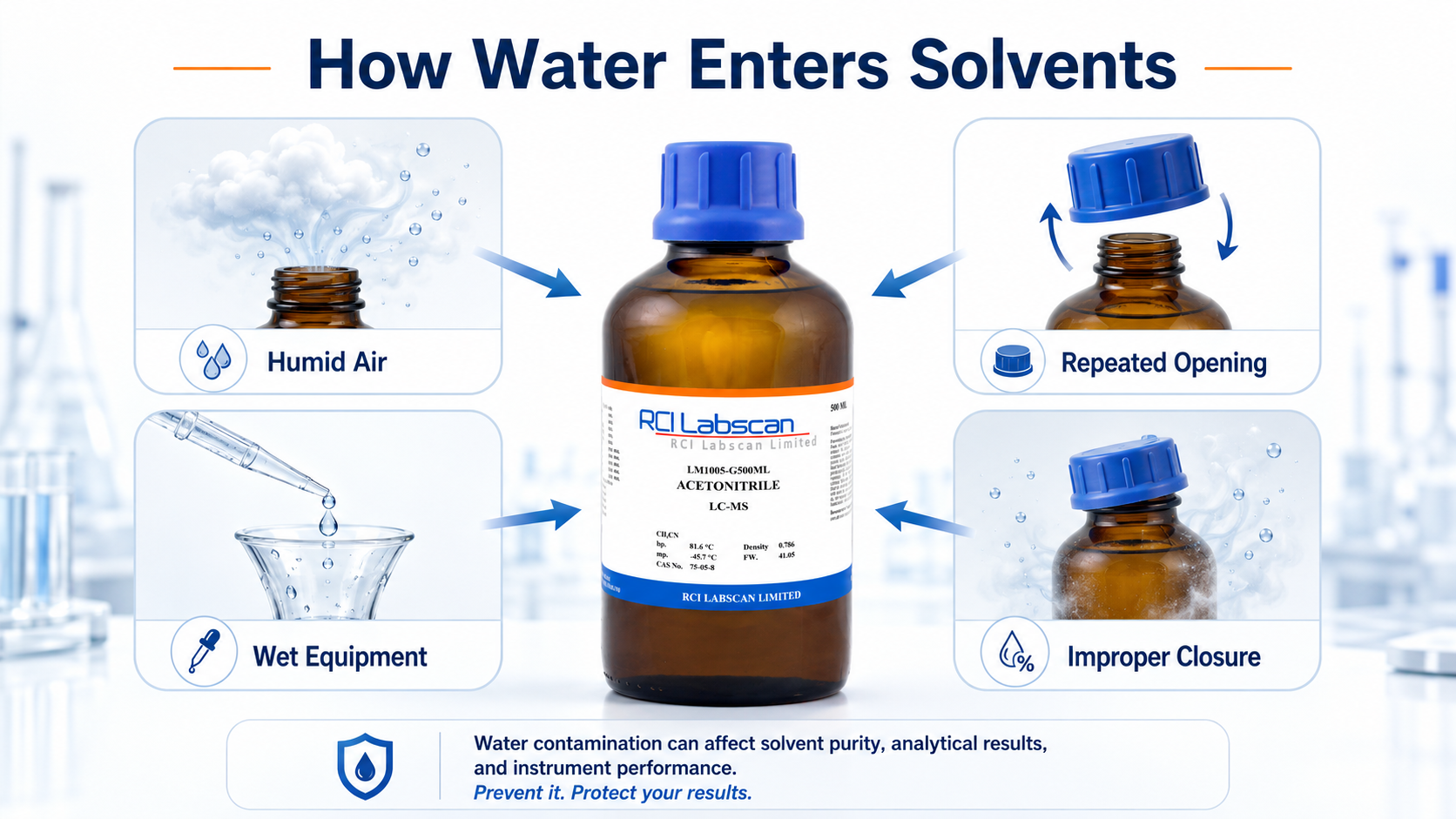
Water may enter or remain in a solvent through several routes, including:
- Raw materials and manufacturing processes
- Purification and filling operations
- Contact with humid air
- Repeated opening of the container
- Improperly sealed caps or closures
- Storage under unsuitable environmental conditions
- Transfer into containers or equipment that are not sufficiently dry
The importance of these factors depends on the solvent and the way it is used. In routine laboratory work, a small variation may have little practical effect. In a tightly controlled or moisture-sensitive method, however, the same variation may become significant.
Why Water Content Matters in Laboratory Analysis
Water is not always an unwanted contaminant. In many analytical methods, water is intentionally mixed with an organic solvent to prepare the mobile phase.
The concern is therefore not simply whether water is present. The more important question is whether the water content is known, controlled, and suitable for the intended method.
Unexpected or inconsistent water content may affect:
- Actual mobile phase composition
- Solvent strength
- Retention time
- Separation selectivity
- Peak shape
- Baseline behavior
- Method reproducibility
- Moisture-sensitive chemical reactions
- Sample preparation and extraction conditions
The degree of impact depends on the analytical procedure and the amount of variation involved.
Effect on Mobile Phase Composition
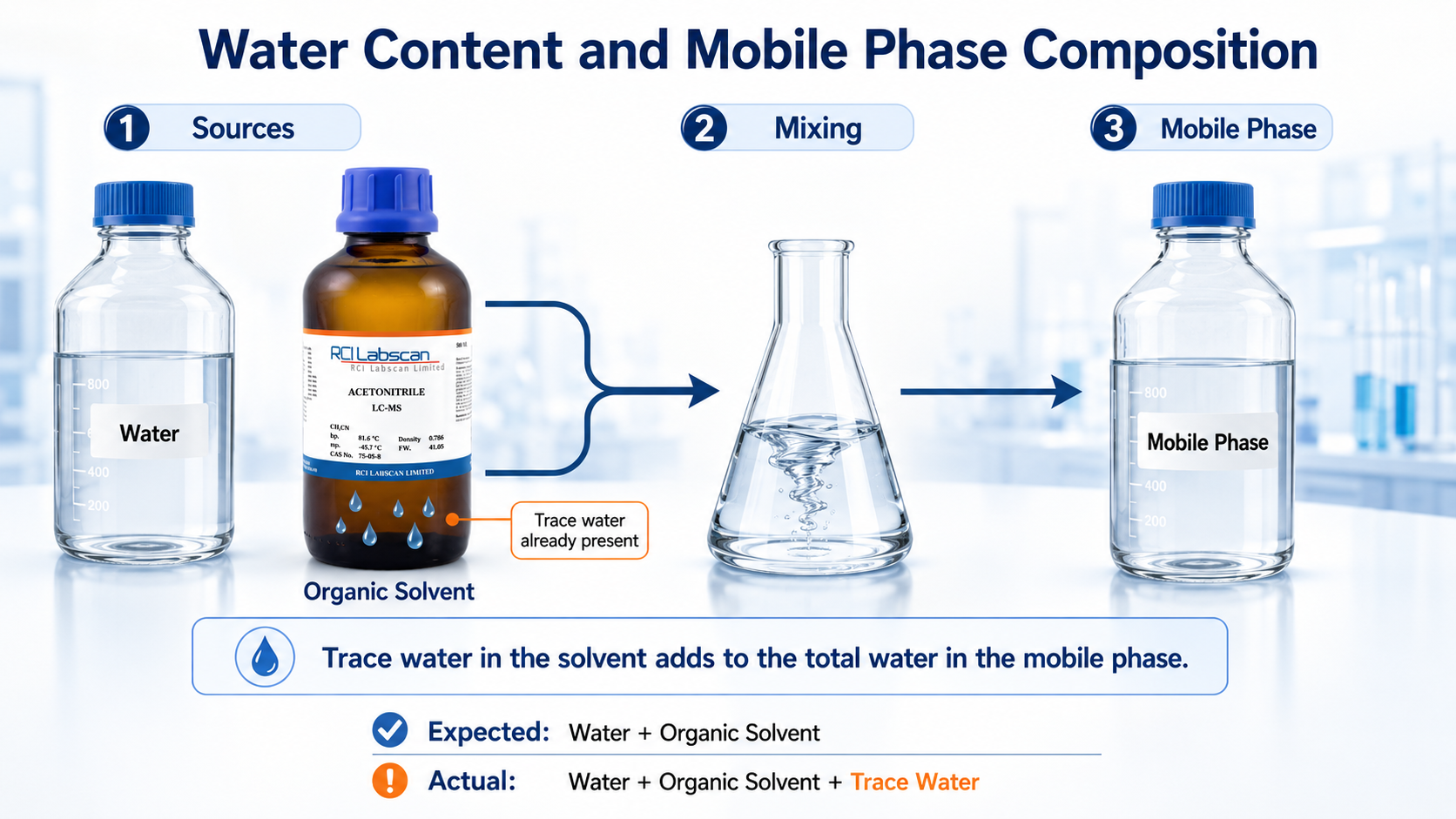
In reversed-phase HPLC, laboratories commonly prepare mobile phases by combining water with organic solvents such as Acetonitrile or Methanol.
When an organic solvent already contains some water, the final mobile phase may contain slightly more water than the calculated preparation ratio suggests.
For example, a laboratory may prepare a mobile phase according to a defined volume ratio. If the water content of the organic solvent changes between containers or lots, the true composition may also change slightly.
In many routine methods, this difference may be too small to cause a noticeable problem. In methods that require highly controlled composition, however, it may contribute to variation.
Laboratories should therefore follow their validated preparation procedure and use a solvent grade that meets the method’s requirements.
Effect on Retention Time and Selectivity
Mobile phase composition influences how analytes interact with the stationary phase.
In reversed-phase chromatography, changing the proportion of water and organic solvent may alter solvent strength. This can affect how long compounds remain in the column and how well they separate from one another.
Unexpected water variation may therefore contribute to:
- Changes in retention time
- Different spacing between peaks
- Reduced separation of closely eluting compounds
- Variation between analytical runs
The effect will not be identical for every method. It depends on the column, analytes, gradient or isocratic conditions, temperature, and mobile phase composition.
Requires Technical/Product Team Review: Application-specific chromatographic effects should be verified against the analytical method and technical references before publication.
Effect on Method Reproducibility
Reproducibility means obtaining sufficiently consistent results when an analysis is repeated under controlled conditions.
If water content varies between solvent containers or lots, it may introduce another source of variation into the method. This can be especially relevant when laboratories:
- Prepare mobile phases manually
- Use sensitive separation conditions
- Compare results across different days
- Transfer methods between laboratories
- Perform regulated QA/QC testing
- Use narrow system-suitability criteria
Consistent solvent quality can help laboratories maintain more stable analytical conditions. However, solvent quality is only one part of method control. Instrument condition, column performance, preparation technique, temperature, and sample handling also affect reproducibility.
Importance in Moisture-Sensitive Applications
Water content may be particularly important in applications that involve water-reactive materials or moisture-sensitive chemistry.
Depending on the method, water may affect:
- Reaction yield or reaction rate
- Reagent stability
- Sample stability
- Extraction efficiency
- Derivatization procedures
- Electrochemical behavior
- Moisture-sensitive synthesis
- Specialized instrumental analysis
A solvent suitable for routine chromatography may not automatically be suitable for a moisture-sensitive reaction.
Users should select the solvent according to the specific application and review technical requirements before use.
Requires Technical/Product Team Review: Any recommendation for moisture-sensitive synthesis, specialized analysis, or application-specific suitability must be checked against approved technical information.
Does Lower Water Content Always Mean a Better Solvent?
Not necessarily.
A lower water-content specification may be important for certain moisture-sensitive applications. However, it does not automatically make a solvent the best choice for every laboratory method.
Solvent selection should consider all relevant quality parameters, including:
- Intended application
- Solvent grade
- Assay or purity
- Water content
- UV absorbance
- Residue after evaporation
- Relevant impurities
- Detector compatibility
- Lot-to-lot consistency
- Product documentation
For example, a chromatography method may require appropriate UV absorbance and low residue in addition to controlled water content. An LC-MS method may require additional control of impurities that could affect mass-spectrometry detection.
The best solvent is therefore the one that meets the complete requirements of the analytical method—not simply the solvent with the lowest reported water value.
How Is Water Content Measured?
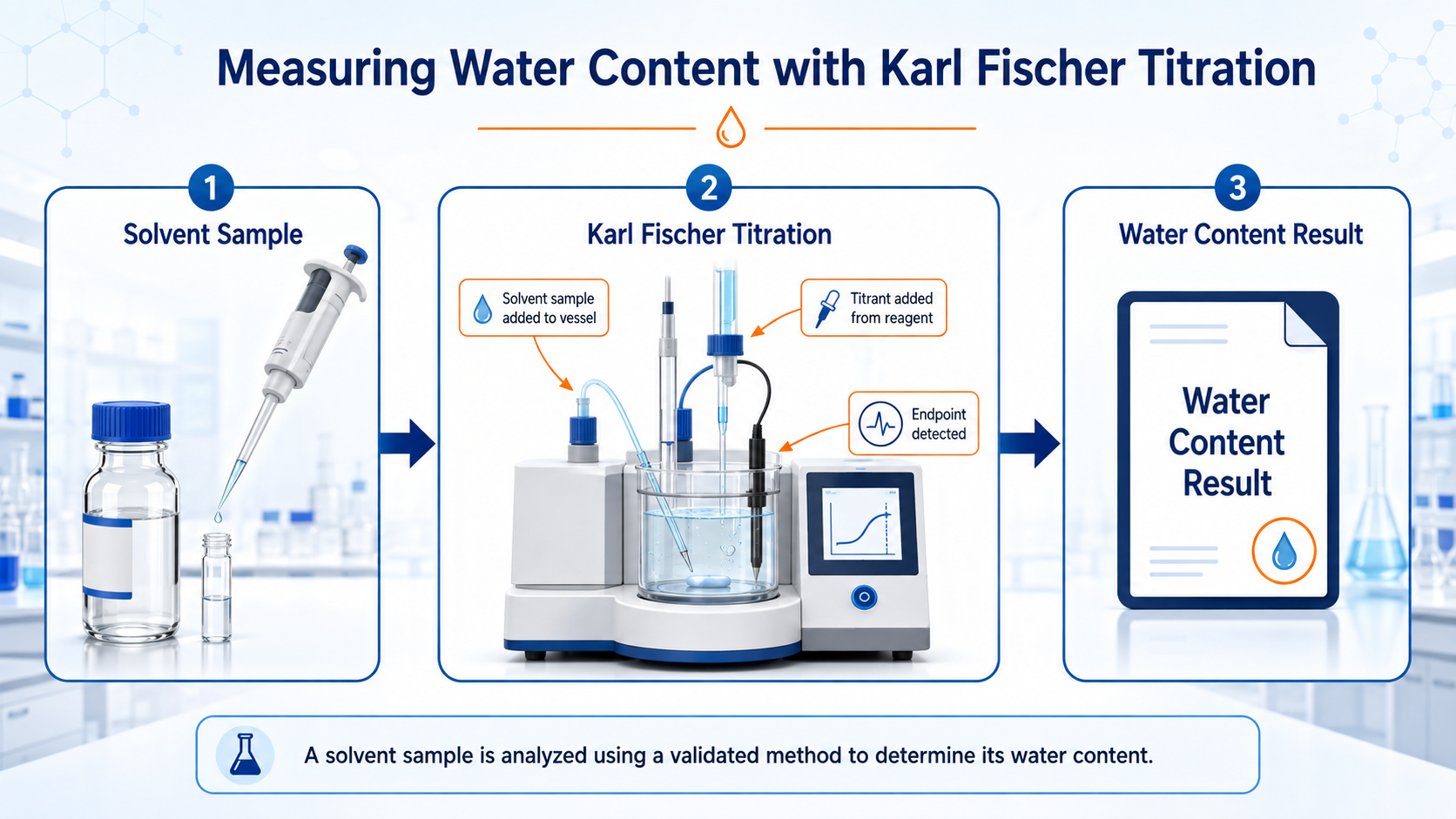
Water content in solvents is commonly measured using a validated analytical procedure. One widely used approach is Karl Fischer titration, which is designed specifically for water determination.
The exact test method may depend on:
- Expected moisture level
- Solvent properties
- Product grade
- Manufacturer’s quality-control procedure
- Applicable specification or standard
Users should review the product specification or Certificate of Analysis to confirm the reported water-content requirement and test result.
Exact water-content values for RCI Labscan products should only be stated when they have been verified against an approved product specification or Certificate of Analysis.
How Storage and Handling May Affect Water Content
The condition of a solvent may change after opening, particularly when the solvent is repeatedly exposed to humid air.
Practical controls may include:
- Closing the container promptly after use
- Avoiding unnecessary exposure to the atmosphere
- Using clean and dry transfer equipment
- Following the storage conditions stated in the SDS and product documentation
- Avoiding return of unused solvent to the original container
- Using appropriate laboratory procedures for moisture-sensitive work
- Monitoring how long opened containers remain in use
Laboratories should also avoid assuming that the original Certificate of Analysis guarantees the condition of the solvent after extended or improper handling. The COA represents the tested product or lot under the manufacturer’s quality system, while subsequent handling remains under the user’s control.
Always review the SDS and follow the laboratory’s approved chemical-handling procedures.
What Should You Check Before Selecting a Solvent?
Before purchasing or using a solvent, laboratories may review the following:
| Checkpoint | Why It Matters |
|---|---|
| Solvent grade | Confirms whether the product is intended for chromatography, general laboratory work, LC-MS, or another application. |
| Water-content specification | Helps determine whether moisture is controlled at a level suitable for the method. |
| Certificate of Analysis | Provides lot-specific test results where available. |
| Product specification | Shows the approved quality requirements for the product. |
| UV absorbance | Important for methods using UV or PDA detection. |
| Residue after evaporation | Helps assess non-volatile material that may remain after the solvent evaporates. |
| Relevant impurities | Some impurities may interfere with the intended analysis. |
| Storage requirements | Helps protect solvent quality after receipt and opening. |
| Method requirements | The validated method should remain the main basis for solvent selection. |
Procurement teams should avoid comparing solvents by chemical name or purity alone. Grade, specification, documentation, intended application, and consistency should also be considered.
Related RCI Labscan Products and Pages
RCI Labscan provides laboratory solvents for different analytical applications, including solvents intended for HPLC and LC-MS workflows.
Before selecting a solvent, users should review the approved product page, specification, SDS, and available COA information. The appropriate solvent grade depends on the analytical method, detector, sensitivity requirement, and laboratory quality system.
For confirmed specifications, packaging information, documentation requests, or product availability, customers may contact RCI Labscan or an authorized local distributor.
Frequently Asked Questions
What does water content in a solvent mean?
Water content is the measured amount of water present in the solvent. It is normally treated as a separate quality parameter from the solvent’s overall assay or purity.
Why is water content important in HPLC solvents?
Water content may affect the actual mobile phase composition. In methods that are sensitive to small composition changes, this may influence retention time, separation selectivity, and reproducibility.
Is water always considered an impurity in a solvent?
No. Water is intentionally used in many mobile phases and laboratory procedures. The important issue is whether its amount is controlled and suitable for the intended application.
Can an opened solvent absorb water from the air?
Some solvents can take up moisture after exposure to humid air. The extent depends on the solvent, environmental conditions, container closure, and handling practices.
Does high-purity solvent always have very low water content?
Not necessarily. Purity and water content may be reported as separate parameters. Users should check the complete product specification rather than relying only on the assay value.
How can I check the water content of a solvent?
Review the product specification and the lot-specific Certificate of Analysis where available. Laboratories may also perform their own testing using a suitable validated method when required by their quality system.
Should I always choose the solvent with the lowest water content?
No. The solvent should meet the complete requirements of the application. Grade, UV absorbance, residue, impurities, documentation, detector compatibility, and method requirements may be equally important.
Can HPLC grade solvent be used for moisture-sensitive reactions?
Not automatically. HPLC grade describes suitability for chromatographic applications and does not guarantee suitability for every moisture-sensitive procedure. Users should review the relevant specification and application requirements.
Explore related products:
- View all HPLC grade products
- View all LC-MS grade products
- Acetonitrile HPLC
- Methanol HPLC
- Acetonitrile LC-MS
- Methanol LC-MS
Related articles:
- What Is HPLC Grade Solvent?
- How to Choose Acetonitrile for HPLC Solvents
- How Do Impurities in Solvents Affect Analytical Results
Leave a comment!