

Serial Dilution Calculations: Tracking Factors Across Multiple Steps
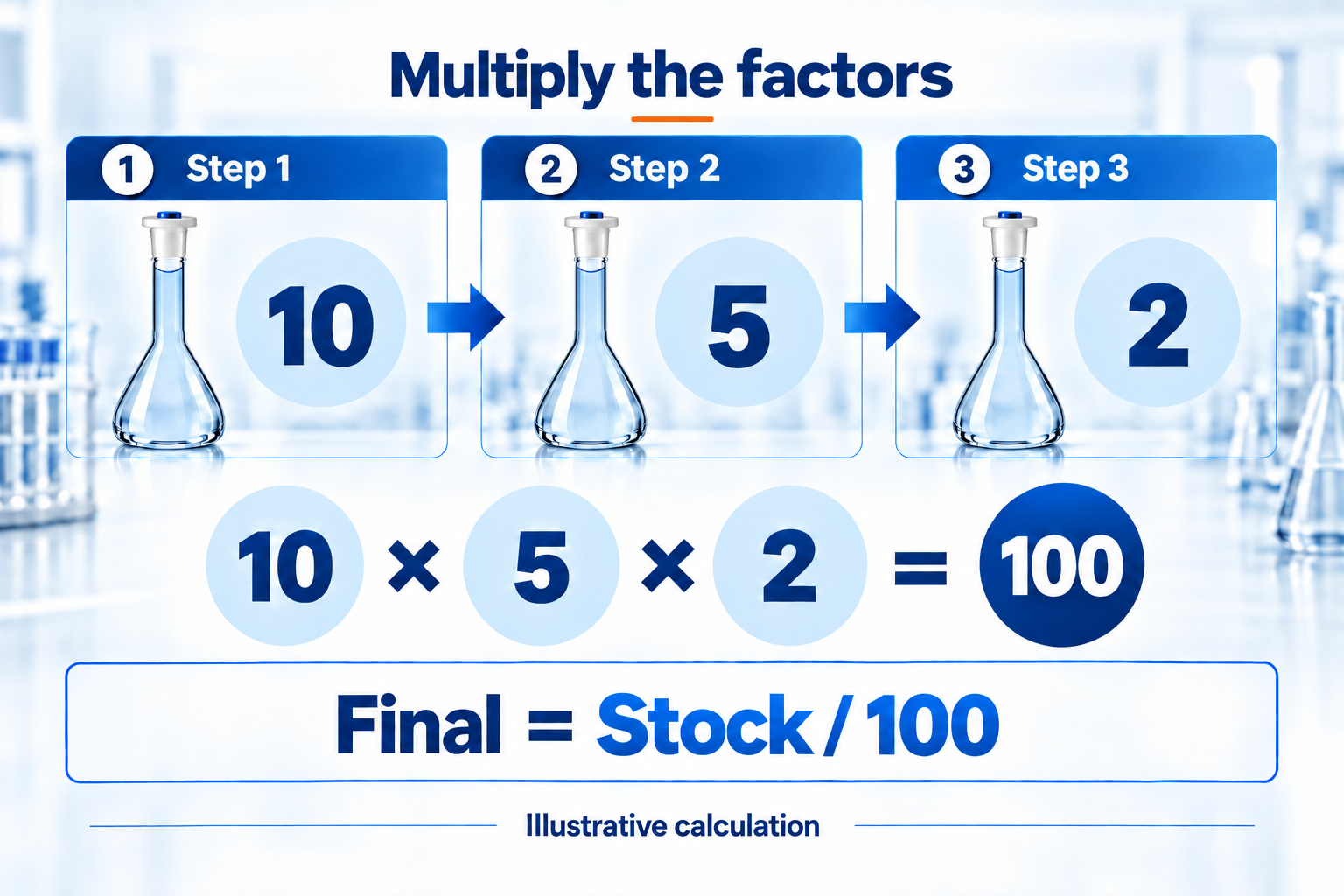
For a serial dilution, calculate each step from the solution actually transferred into that step, then multiply the step dilution factors to obtain the overall factor. A tenfold dilution followed by a fivefold dilution and a twofold dilution gives an overall factor of 100. The final concentration is the original stock concentration divided by 100, provided the analyte is conserved throughout the preparation.
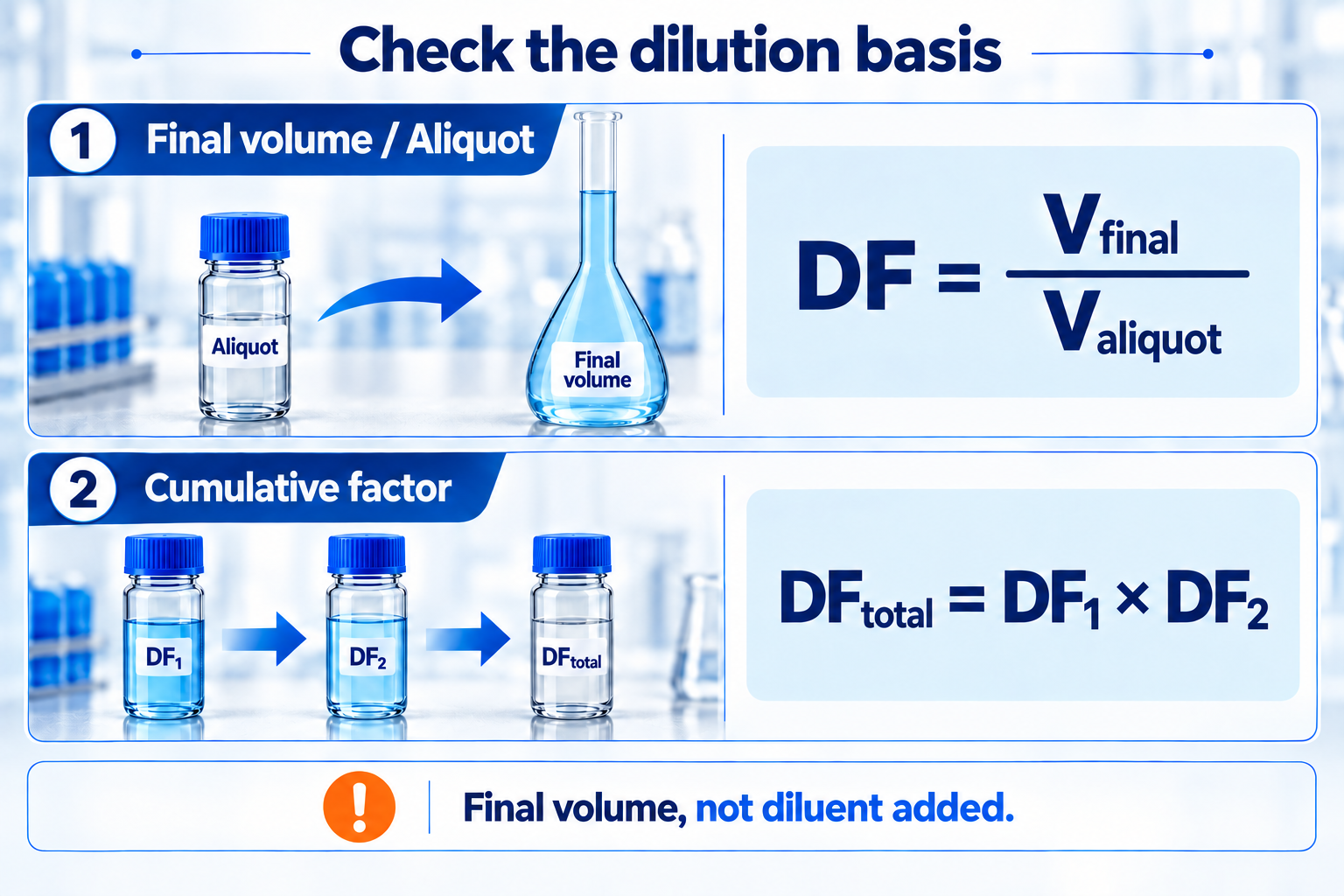
The main calculation trap is confusing the final solution volume with the volume of diluent added. A transfer of 10.00 mL made up to a final volume of 100.00 mL has a dilution factor of 10. It does not mean adding 100.00 mL of diluent to the aliquot.
Write down the concentration and volume relationship
For a conserved analyte expressed on a consistent concentration basis, the amount transferred is equal to the amount in the final diluted solution:
Cbefore × Vtransferred = Cafter × Vfinal
Rearranging gives Cafter = Cbefore × Vtransferred/Vfinal. Here, the dilution factor is defined as DF = Vfinal/Vtransferred, so Cafter = Cbefore/DF. Both volumes must use the same unit.
The Thermo Scientific Orion user guide describes serial dilution as preparing each successive standard from the preceding one and presents the C1V1 = C2V2 relationship. The general arithmetic is useful beyond that guide's specific application; its chemical recipes and instrument procedures are not generic instructions.
This relationship assumes a well-mixed starting solution, quantitative transfer and no analyte loss, reaction or instability during dilution. It tracks the same measurand before and after preparation. A change in chemical form, reporting basis or analyte stability needs separate consideration.
Follow one illustrative chain from stock to final solution
Suppose a stock is assigned a concentration of 1000 mg/L. The following example illustrates arithmetic only; actual preparation volumes, equipment, diluent and handling must follow the applicable method.
| Step | Solution transferred | Aliquot | Final volume | Step DF | Result |
|---|---|---|---|---|---|
| 1 | 1000 mg/L stock | 10.00 mL | 100.00 mL | 10 | 100 mg/L |
| 2 | 100 mg/L Step 1 solution | 5.00 mL | 25.00 mL | 5 | 20 mg/L |
| 3 | 20 mg/L Step 2 solution | 10.00 mL | 20.00 mL | 2 | 10 mg/L |
The cumulative factors relative to the original stock are 10 after Step 1, 50 after Step 2 and 100 after Step 3. Check the final result by both routes: 20 mg/L divided by 2 equals 10 mg/L, and 1000 mg/L divided by 100 also equals 10 mg/L.
Distinguish a chain from independent dilutions
In a serial chain, Step 2 is prepared from Step 1. If the 5.00 mL aliquot in the example were taken directly from the original 1000 mg/L stock and made up to 25.00 mL, its concentration would instead be 200 mg/L. The physical transfer history determines which concentration belongs in the calculation.
Independent dilutions each start from the stated stock or another separately defined source. Their factors are calculated relative to that source; they are not multiplied together simply because the solutions appear in adjacent worksheet rows. Label the source solution for every transfer, including its identifier and assigned concentration.
Also define notation. In this article, “factor 10” means final volume divided by aliquot volume. Some worksheets use the reciprocal fraction 0.1 to multiply the starting concentration. Expressions such as “1:10” can be ambiguous unless the procedure states whether the ratio refers to aliquot-to-final solution or sample-to-diluent. Use explicit volumes alongside the factor.
Keep the physical preparation consistent with the worksheet
- Use equipment and transfer volumes suitable for the method's required uncertainty; a mathematically correct dilution can still be poorly prepared.
- Bring each solution to its specified final volume according to the procedure, then mix adequately before withdrawing the next aliquot.
- Record the actual source, aliquot, final volume, diluent and preparation identifier for every step.
- Check compatibility, stability and storage conditions in the method and source documentation. Arithmetic does not establish that a diluted standard remains suitable.
The Eurachem/CITAC guide to measurement uncertainty includes calibration-solution preparation examples involving weighing, purity and volumetric contributions. A serial chain inherits contributions from earlier steps; multiplying dilution factors does not quantify the final uncertainty. Shared equipment and conditions can create correlated contributions, so do not assume every component is independent.
Check the result before using it
Recalculate each step from its immediate source and independently recalculate the cumulative factor. Confirm that concentration decreases at each dilution, volume units cancel correctly and the final result has the intended reporting unit. Retain useful calculation precision and apply the laboratory's reporting and rounding convention to the final assigned value.
The starting concentration also needs a documented basis. Understanding a COA versus a specification helps distinguish batch evidence from general limits. The separate decision to purchase or prepare a standard is covered in prepared standard solutions versus in-house preparation.
A reliable dilution record lets another person reconstruct the chain without guessing: source concentration, transferred volume, final volume, step factor, cumulative factor and calculated concentration. That record links the arithmetic to the actual preparation.
Leave a comment!