
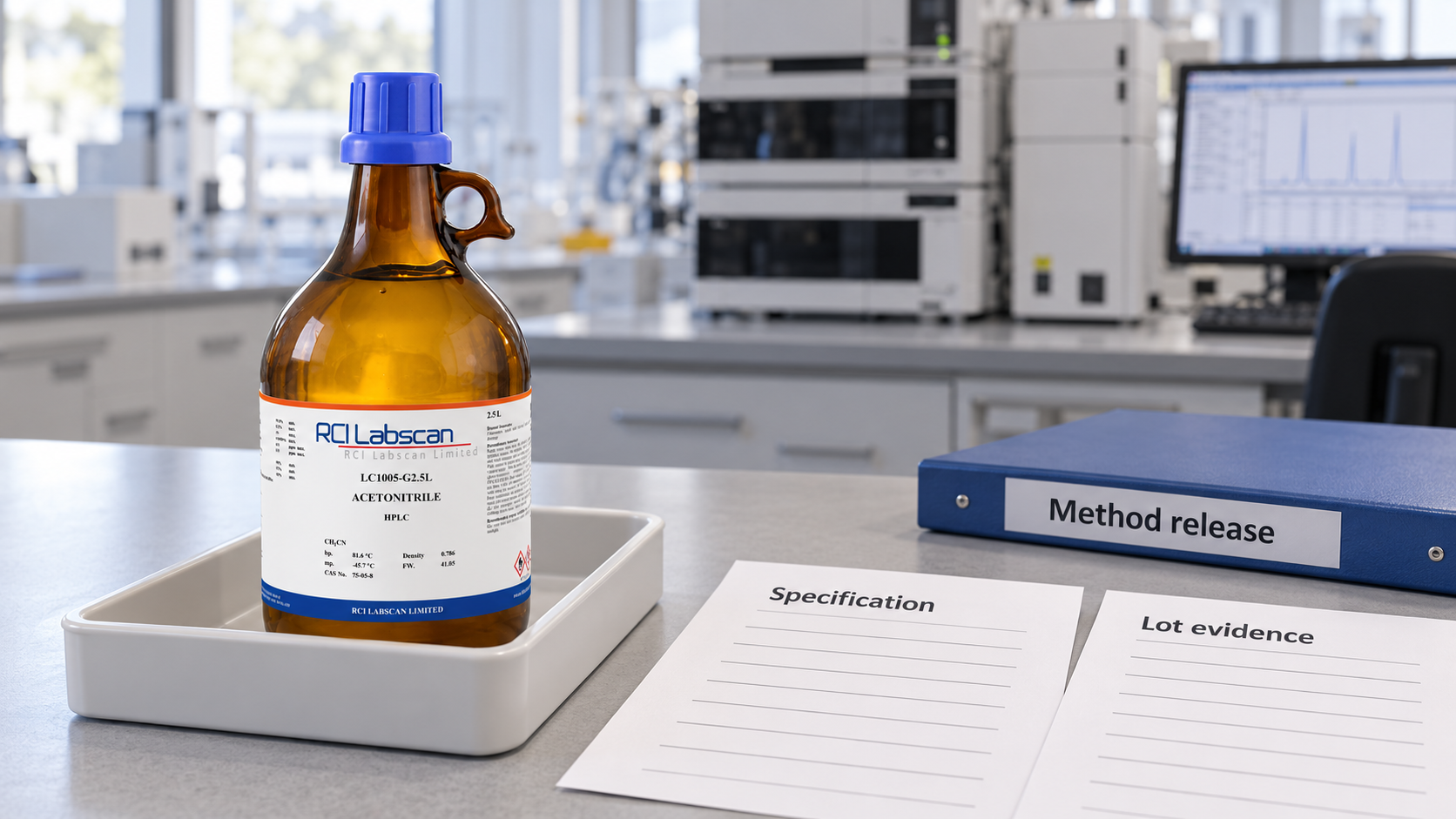
Changing Solvent Supplier or Grade: Evidence to Review Before Method Release
A solvent supplier or grade change should be released through the laboratory's change-review process. Compare documented requirements with the proposed material, then define the evidence needed to show the method still performs as intended. Matching chemical name, assay or grade wording alone is insufficient.

Define exactly what is changing
Record the existing material, proposed supplier and grade, affected method and intended use. A distributor can help obtain documents and communicate differences, but the laboratory retains responsibility for approving method use. Do not describe two products as interchangeable without evidence for the relevant application.
Separate a documentation gap from a demonstrated difference. If a parameter is absent from a specification or COA, ask for clarification rather than treating the missing value as equivalent to zero. For the distinction between a stated requirement and a lot result, review COA vs Specification: What Is the Difference?.
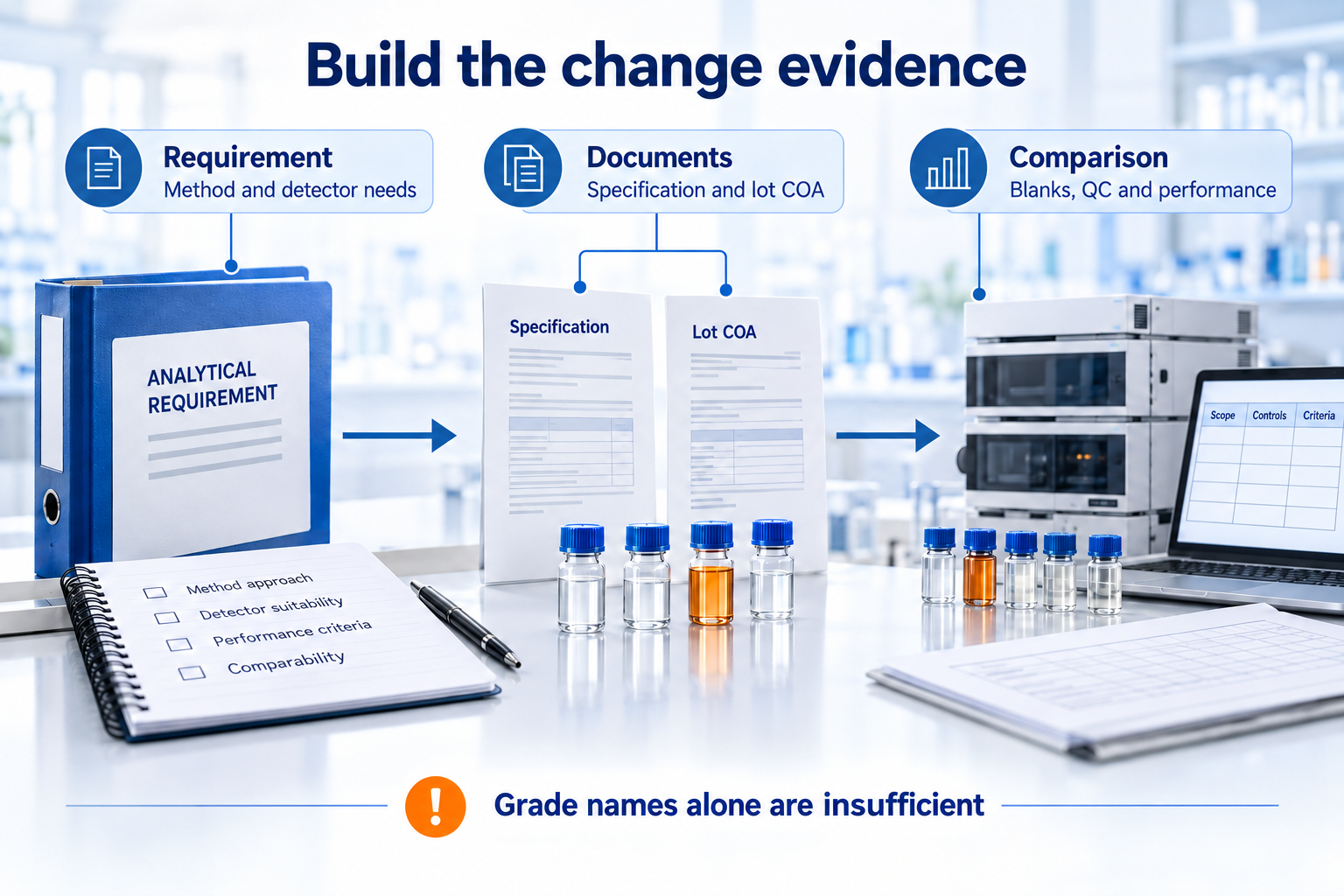
Compare requirements at the level of the method
| Area | Review question |
|---|---|
| Specification and lot COA | Are the relevant parameters, units, methods and limits comparable? |
| Packaging and handling | Could contact materials, moisture exposure or storage affect the use? |
| Method performance | Which blanks, controls and system checks address the plausible effects? |
| Release decision | Who approves the evidence and the authorized scope of use? |
Consider the detector and application. A review of UV background cannot establish suitability for a trace-metal or LC-MS endpoint. Equally, a lower water specification may not answer questions about residue or analyte-specific contamination. Ask which documented attributes matter to the actual measurement before asking which product sounds purer.
Agree the comparison before generating data
Have the method owner define an appropriate comparison covering the intended range, representative matrices and relevant controls. Depending on the use, this may include blank/background behavior, retention or selectivity, sensitivity, precision, recovery or other validated characteristics. These are possible review dimensions, not a mandatory universal experiment.
Keep important conditions comparable so that material effects can be interpreted. Retain material identities, lot information, preparation records and the evaluation criteria. Avoid accepting a change based only on one favorable run or excluding an unfavorable result without a documented investigation.
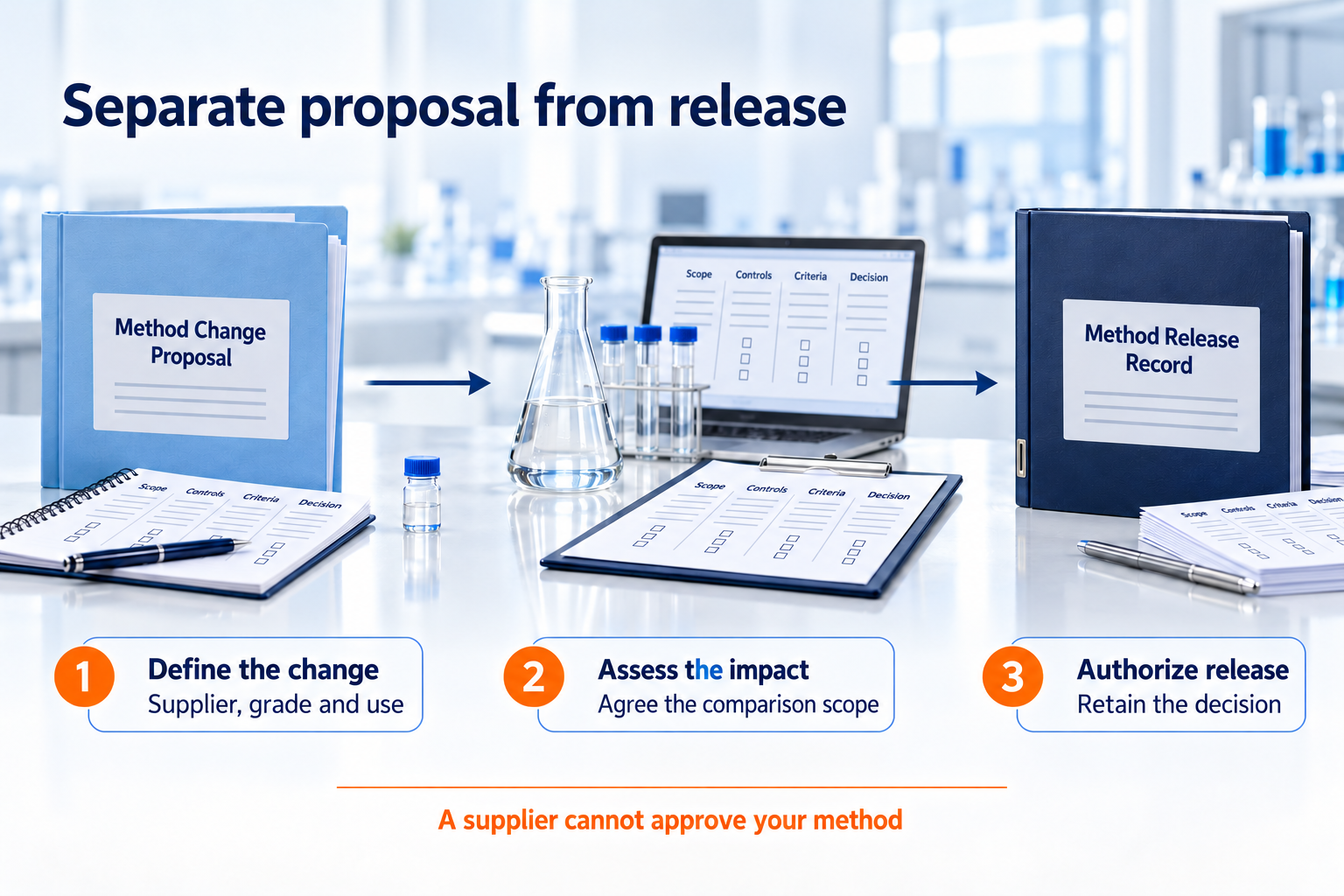
Verification scope follows the risk and governing method
Eurachem's method-validation guidance provides a framework for considering fitness for purpose. Whether a particular change needs limited verification, more extensive validation or another approval depends on the change and the laboratory's governing requirements. This article does not declare that every supplier change requires full revalidation, or that any fixed small test set is always enough.
A supplier's documentation can support a change assessment without approving it. Obtain a clear release decision identifying the methods, uses and conditions covered. Keep unresolved questions visible and maintain the previous authorized arrangement until a responsible person decides otherwise.
Practical conclusion
Build the evidence around the method requirement, not a grade-name comparison. Ask for the exact specification and lot documentation, agree the performance checks and record approval before routine use. The related article on lot consistency extends this to ongoing supply monitoring.
Leave a comment!