
Planning Laboratory Solvent Waste Segregation with SDS and Site Rules
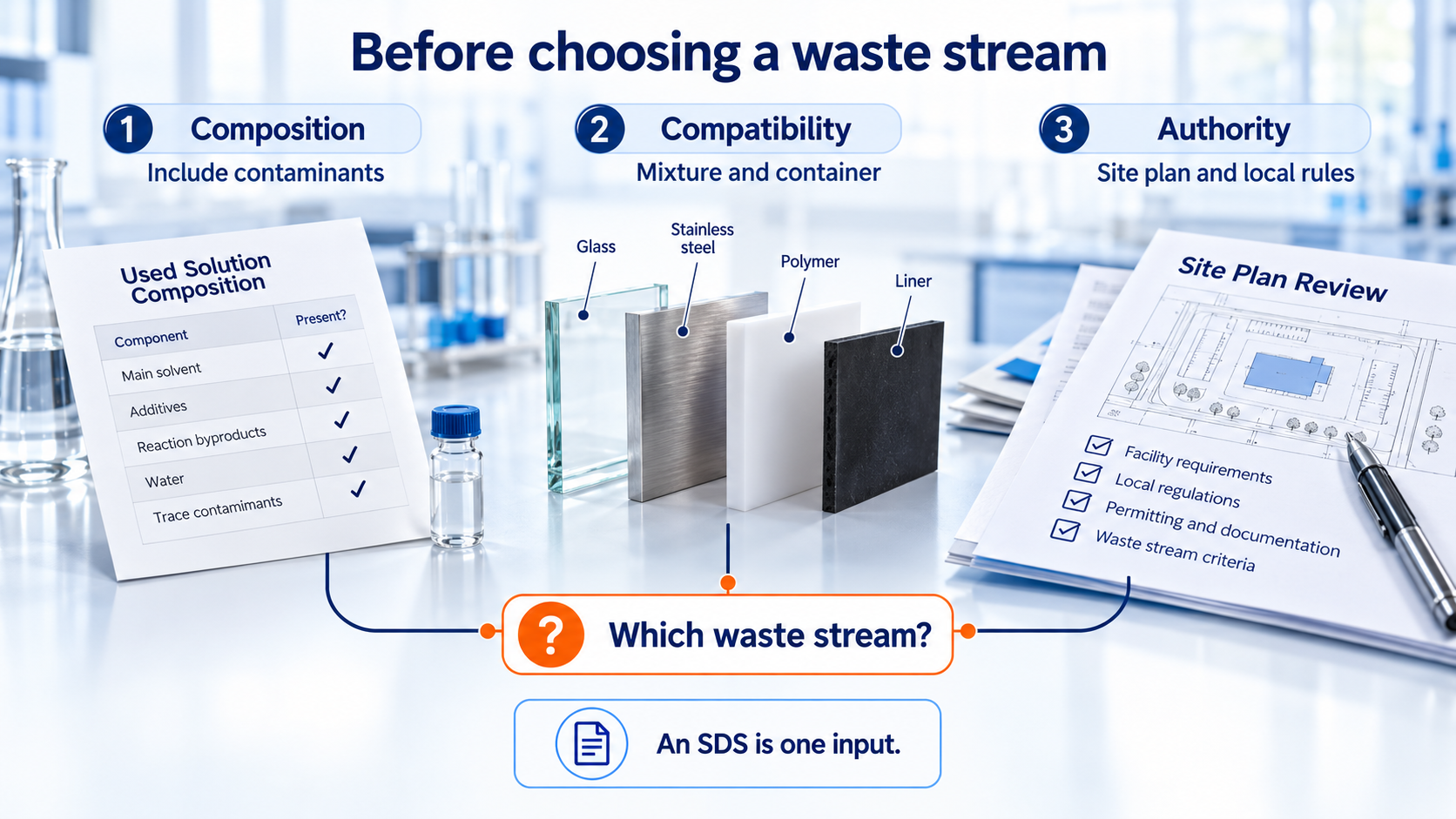
Plan laboratory solvent waste streams before collection starts. Use the expected waste composition, chemical compatibility, container suitability, the current SDSs, the site's approved waste plan and applicable local rules. A generic label such as “organic solvent” is not enough to authorize mixing.

Start with the waste actually produced
Document solvents, water, acids or bases, reactive residues, dissolved contaminants and other inputs that can reach the stream. A fresh-solvent SDS does not fully characterize a used mixture. Process changes can change the waste composition, so review the stream description when the work changes.
SDS stability/reactivity and handling information can identify hazards that need assessment. Disposal information is another input, but it is not a local waste classification or a receiving facility's approval. The laboratory's EHS or waste-management lead must determine the applicable route.
Separate naming conventions from compatibility decisions
| Question | Decision needed |
|---|---|
| What enters the collection? | A documented composition or bounded process description. |
| Can the constituents react? | A competent compatibility assessment of the actual mixture. |
| Is the container suitable? | Material, closure and storage arrangements approved for the waste. |
| Who accepts the waste? | The site-approved classification and collection/disposal route. |
Separating halogenated and non-halogenated solvents may be part of a site's plan, but those two names do not address every reactive contaminant or incompatibility. Do not assume all materials within one broad category can share a container. Avoid creating a universal segregation chart detached from the site's chemistry.
Control uncertainty before addition
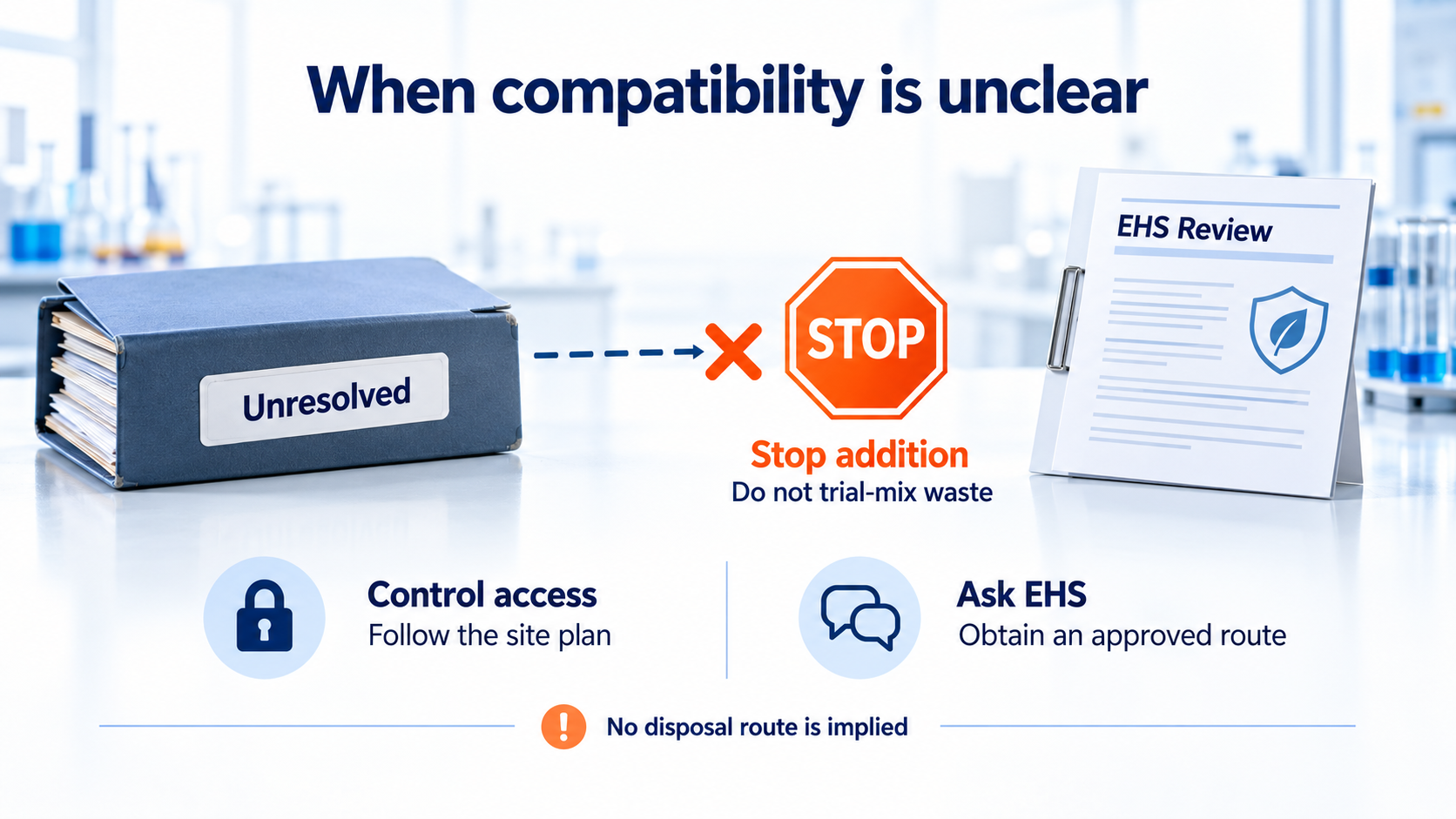
If composition or compatibility is unclear, stop addition and seek the designated EHS decision. Do not trial-mix waste to see whether it reacts. Follow the site's arrangements for an uncertain stream and emergency escalation; this article does not authorize opening, sampling, neutralizing or transferring a suspect waste container.
Make the collection instruction usable
- Identify the approved stream and the processes permitted to contribute to it.
- Make exclusions and the escalation contact visible to users.
- Follow approved labeling, closure, secondary-containment and location requirements.
- Keep the collection record and waste-provider requirements available.
- Review changes before a new reagent, sample type or cleaning solution enters the stream.
OSHA's non-mandatory laboratory recommendations address waste planning and separation of incompatible materials. EPA's academic-laboratory FAQ discusses a specific U.S. regulatory framework. These sources support the need for an organized assessment; their jurisdiction-specific provisions are not presented here as requirements for every country or industrial site.
Do not dispose of laboratory solvent waste by evaporation or assume drain disposal is permitted. Use only the route approved by the responsible site authority under the applicable rules. For the separate question of protecting unused stock, see How to Store Laboratory Solvents Safely and Preserve Quality.
Practical conclusion
Give procurement, laboratory users, EHS and the waste provider the same description of the stream. Resolve composition, compatibility, container and destination before collection. Review the plan when the work changes.
Sources and scope
- OSHA: non-mandatory laboratory chemical-hygiene recommendations
- EPA: academic laboratory waste questions
Leave a comment!