
Standard Addition vs External Calibration: When Matrix Matters
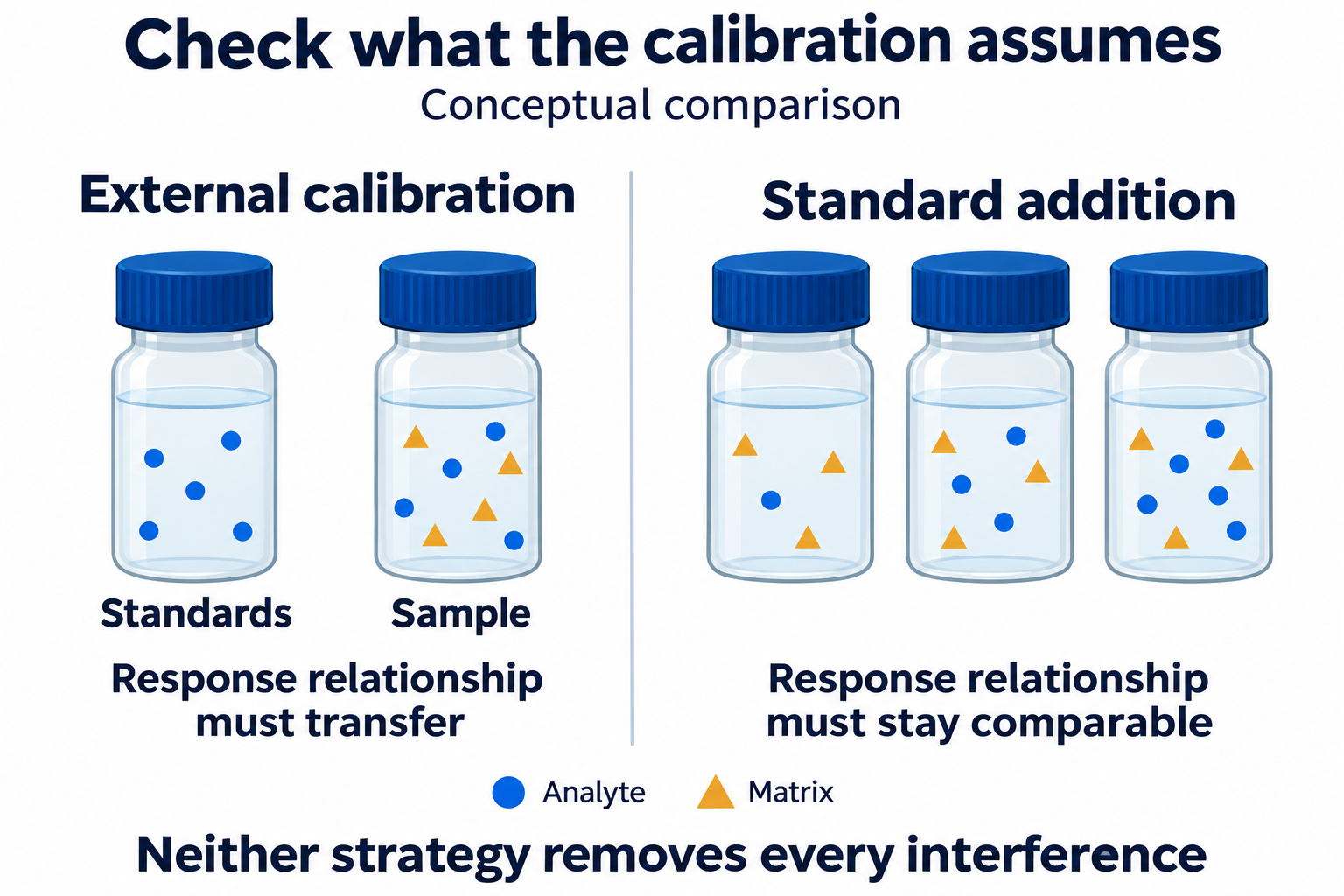
External calibration uses separately prepared standards to relate analyte concentration to response. Standard addition estimates native analyte from the response to known additions within portions of the sample. Standard addition can address a proportional matrix-dependent change in sensitivity when its assumptions hold. It does not remove every interference or repair earlier sample losses.

Identify the matrix problem first
The matrix comprises sample components other than the analyte. These components can affect the response generated by a given analyte concentration. A calibration standard in a simple solvent may then have a different sensitivity from the actual sample. The question is whether the calibration represents the measurement behavior of that sample, rather than whether the regression looks attractive.
The 2025 Eurachem method-validation guide, sections 5.2.2–5.2.3 distinguishes calibration approaches and the need to establish representative behavior. A demonstrated matrix problem may motivate matrix matching, standard addition or another justified approach; this article compares the concepts without selecting a method for a particular sample.
| Feature | External calibration | Standard addition |
|---|---|---|
| Where known analyte levels are represented | In separate calibration preparations | As known additions to portions of the sample |
| Central assumption | The standards represent the sample response relationship | Added and native analyte share the relevant response relationship |
| Main practical burden | Demonstrating calibration suitability across samples | Multiple preparations and measurements for the sample studied |
| Persistent limitation | Unrepresented matrix behavior can bias results | Additive interference and earlier losses can still bias results |
What the negative intercept means
In a simplified linear example, let x be the added analyte concentration in the final measurement solution. Let C be the native analyte contribution in that same solution. After valid correction of additive background, assume response y = k(C + x), with constant nonzero sensitivity k across the additions. The line reaches y = 0 at x = −C.
The negative intercept is a mathematical extrapolation, not a negative physical concentration. Its magnitude estimates the native contribution on the defined final-solution basis. Any conversion to the original sample must retain the preparation and dilution factors. If aliquot or final volumes differ, the simple expression cannot be used without the appropriate model.
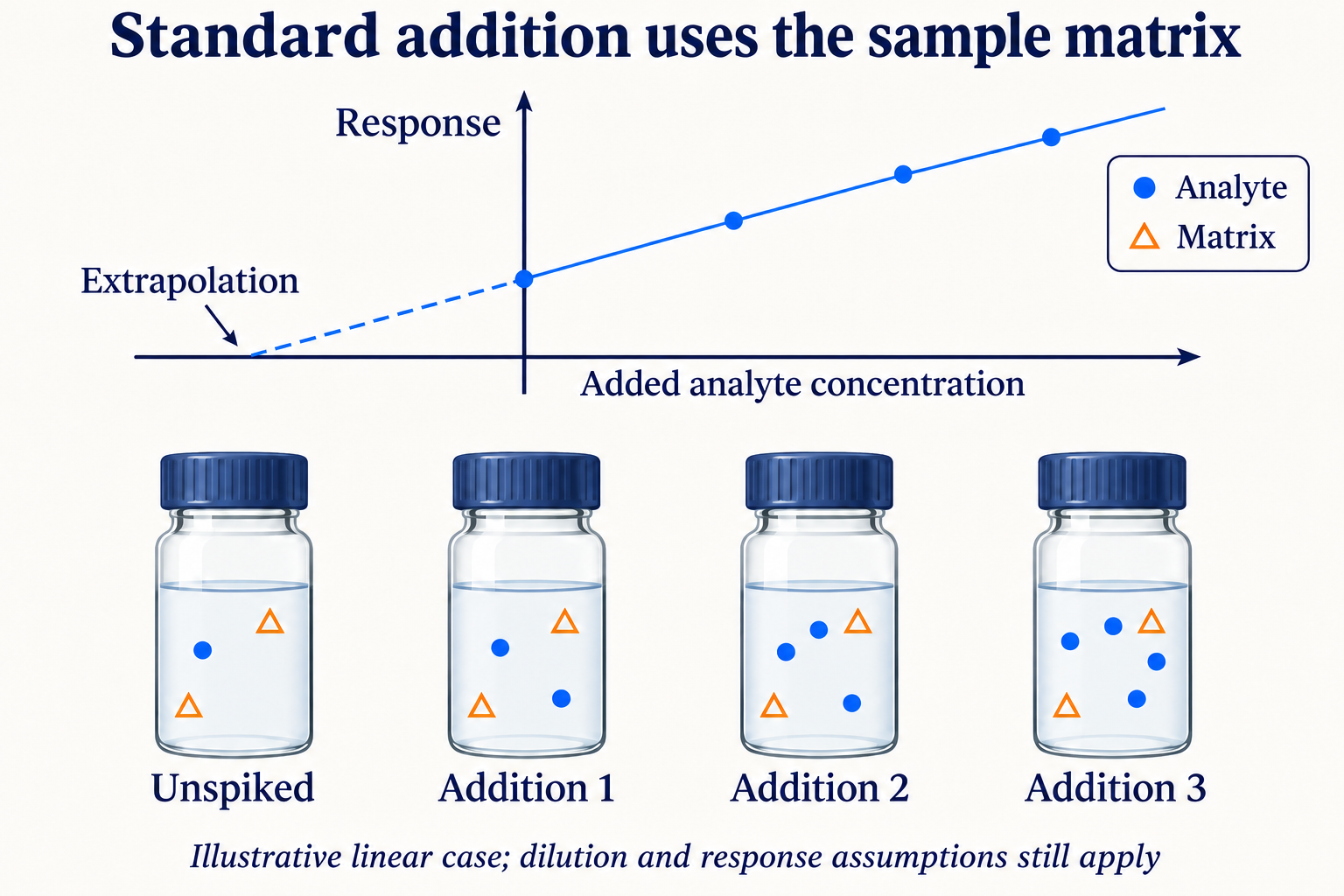
A thought experiment distinguishes slope from offset
Take invented values C = 3 and k = 2 in consistent arbitrary units. Additions x = 0, 1 and 2 give y = 6, 8 and 10. The intercept is −3. If a matrix halves sensitivity to k = 1, the responses become 3, 4 and 5; the intercept remains −3 because the same factor applies throughout.
Now retain k = 2 but add an uncorrected constant interference B = 2. The response becomes y = 2(3 + x) + 2, and the intercept moves to −4. Standard addition has not distinguished that extra signal from native analyte. These are ideal algebraic examples, not observed results, performance specifications or a spiking recipe.
Agilent's standard-additions discussion makes the distinction explicit for ICP-OES: matrix effects may be counteracted, while spectral effects remain; contamination also changes the inferred result. The exact interference behavior still depends on the analytical technique.
Assumptions to take to the method review
- Does the response model describe the addition range without unrecognized curvature?
- Are matrix composition and sensitivity sufficiently comparable across the preparations?
- Does the added analyte behave like native analyte at the stage being evaluated?
- Are blank treatment, preparation volumes and concentration basis documented?
- Is the uncertainty of the extrapolated intercept understood?
An addition made after preparation cannot demonstrate that native analyte survived an earlier extraction or digestion. Nor does a successful addition series establish that a different sample has the same matrix. The sample-specific burden is part of the trade-off.
Choose through evidence, not preference
External calibration can be suitable when representative response is demonstrated. Standard addition can be informative when a characterized matrix changes sensitivity and a defensible addition model is available. Retain the underlying responses, assumptions and dilution basis for qualified method review. Neither approach by itself authorizes reporting or release of real sample results.
Related Reading
- Prepared Standard Solutions vs In-House Preparation: A QA and Procurement Checklist — standards quality and traceability complement calibration design.
Leave a comment!