
Selecting Cuvettes for UV-Vis: Path Length, Material and Solvent Compatibility
Select a UV-Vis cuvette by checking three independent requirements: optical transmission at the measurement wavelength, the required optical path length and geometry, and chemical compatibility with the complete sample solution. A cell can fit the holder yet be unsuitable for the wavelength or solvent. Use the exact cell and instrument documentation rather than choosing by transparency or material name alone.
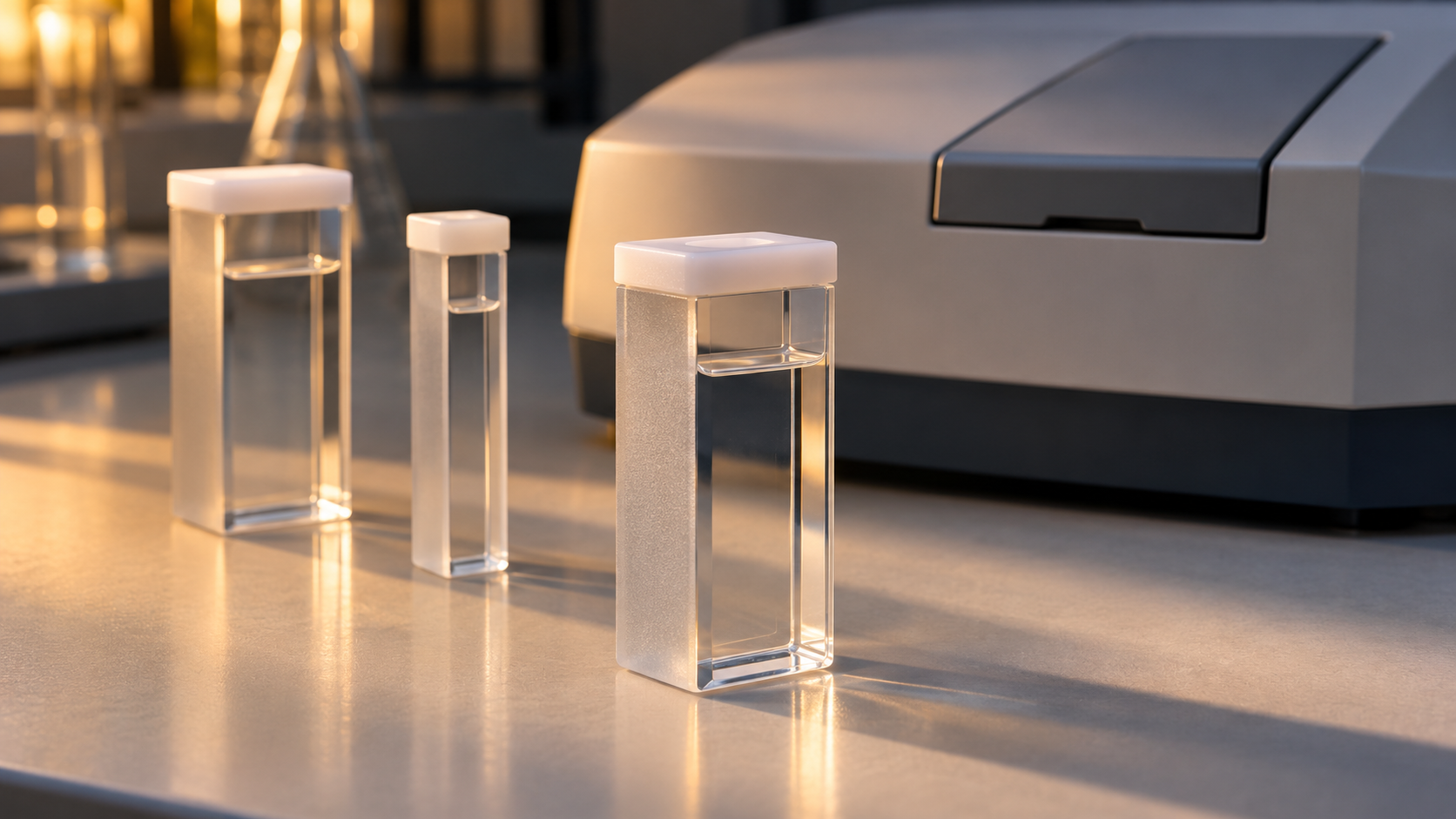
Path length is the distance through the solution
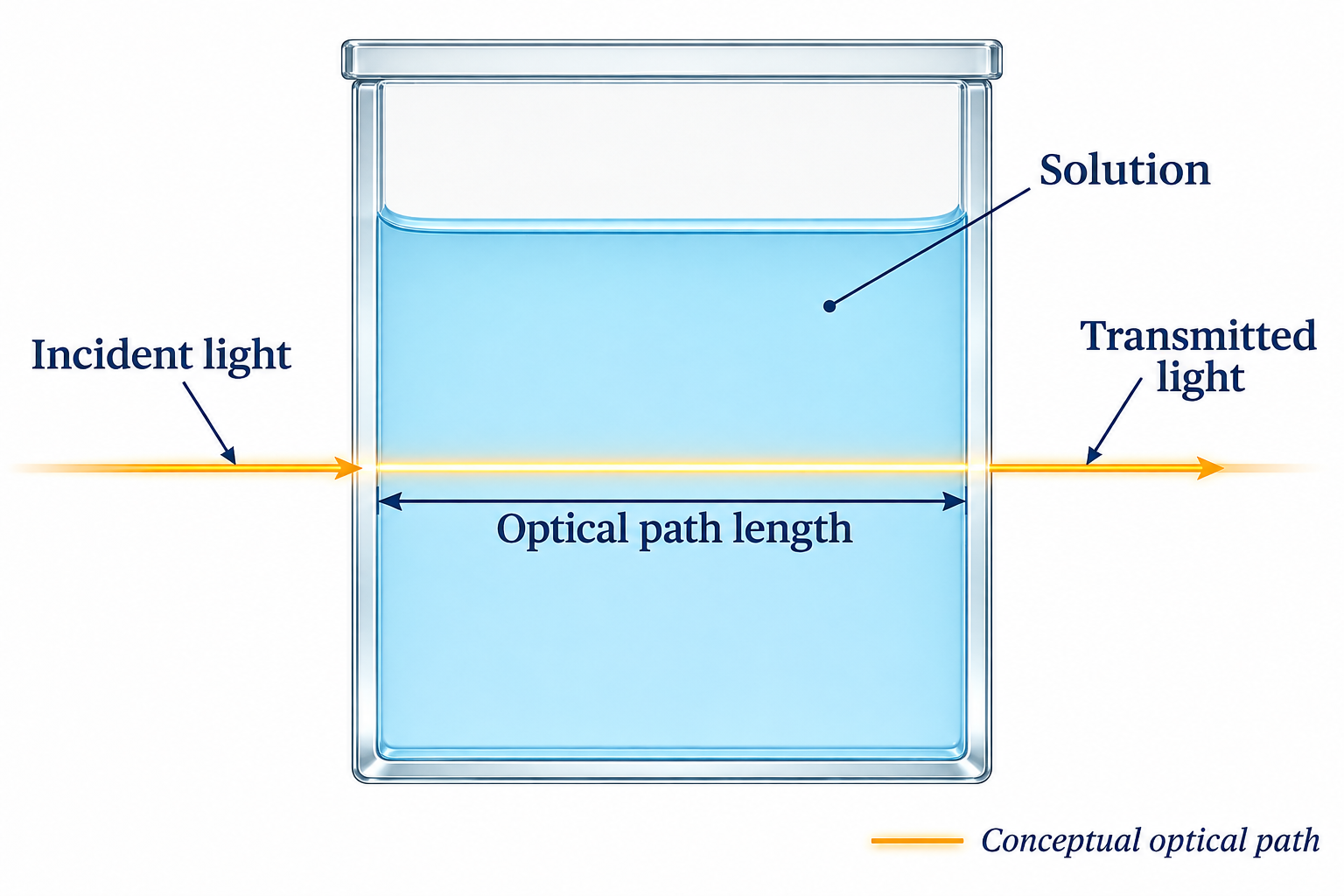
The optical path length is the distance the measurement beam travels through the sample between the inner faces of opposing optical windows. It is not the cuvette's total height or its outside width. The Shimadzu cuvette overview describes common rectangular cells and the availability of different path lengths.
Within the conditions where the Beer–Lambert relationship applies, absorbance is proportional to path length and concentration: A = εlc. Here, ε is the molar absorption coefficient, l is the optical path length and c is concentration, with consistent units. A different path length changes the expected absorbance; the calculation or calibration must use the correct value.
A longer path can help with weak absorption, while a shorter path can reduce excessive absorbance. The useful choice still depends on the method and instrument's measurement range. Changing the cell is an analytical change to evaluate, not an automatic improvement in accuracy.
Check transmission at the actual wavelength
Visible clarity does not establish ultraviolet transmission. Optical glass, quartz and the different cuvette polymers have different usable spectral ranges. Even within a material family, the exact grade and construction matter.
For example, METTLER TOLEDO's glass and quartz cuvette page gives different wavelength ranges for its own cell types. Those manufacturer ranges illustrate why the product-specific specification matters; they should not be assigned to every cell described as glass or quartz. Specialized UV-transparent disposable cells also exist, so plastic alone is not a sufficient optical classification.
The solvent and other sample components also need appropriate transparency in the measurement region. A suitable cell cannot remove absorption originating in the solvent. The intended blank and measurement procedure therefore remain part of the selection.
Chemical compatibility is a separate check
Identify the solvent mixture, additives, concentrations, exposure time and temperature before checking the cell manufacturer's compatibility information. Assess the complete construction, including any closure, bonding or other sample-contact parts. Do not infer compatibility from the cell's optical range.
The BRANDTECH cuvette guide separates material and solvent considerations and qualifies its compatibility information by exposure duration. Its ratings apply to the products and conditions described. They are not a universal permission to place the same solution in another manufacturer's disposable cell.
When the exact mixture is not covered, request clarification from the cell supplier. A chemically clear-looking sample does not demonstrate that the cell has retained its optical properties, and an initially intact cell does not establish longer-term resistance.
Reduced volume does not necessarily mean a shorter path
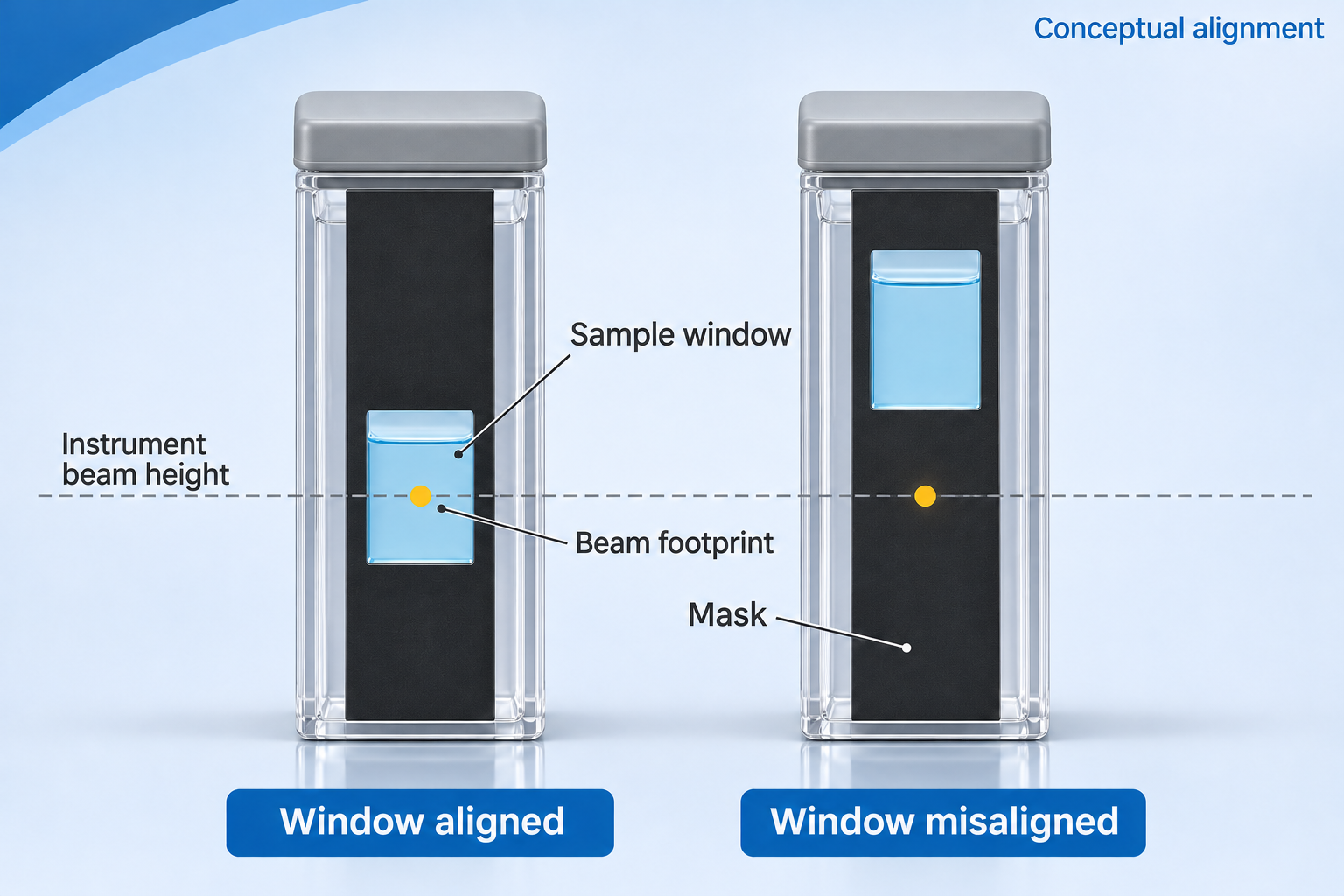
Micro and semi-micro cells can reduce sample volume by narrowing the chamber while retaining a specified optical path length. A smaller volume label therefore does not tell you the path length. The Agilent cell overview shows why aperture, geometry and cell format belong in the instrument compatibility check.
The beam must pass through the intended optical windows and a continuous region of solution. Check the cell's aperture and specified beam-center height against the instrument and holder. The sample level must cover the measurement beam as required by the cell instructions. A mechanically fitting low-volume cell may still place its useful window at the wrong height.
| Record | Question it resolves |
|---|---|
| Method wavelength and cell transmission specification | Is the cell optically suitable in the measurement region? |
| Path length and calculation or calibration basis | Does the reported result use the correct distance through solution? |
| Sample composition and supplier compatibility evidence | Are all sample-contact parts appropriate for the exposure? |
| Cell dimensions, aperture, beam height and minimum fill guidance | Will the beam interrogate the intended solution region in this instrument? |
Check the condition of the optical surfaces
Fingerprints, residue, scratches and bubbles in the beam path can compromise a measurement. Follow the cell manufacturer's handling and cleaning instructions, using the designated handling faces and the method's blanking procedure. A cleaning solvent also needs compatibility assessment; a harsh treatment is not a universal remedy for a damaged window.
The Hellma cuvette catalog provides cell-specific construction and geometry information. Keep that kind of exact documentation with the instrument record, especially when several similar-looking cells are used in one laboratory.
Before ordering a replacement
Specify the cell type, optical material, path length, volume, closure, beam geometry and intended sample chemistry. Compare those requirements with the exact offered cell. A replacement that looks similar can still change the measurement conditions.
Bring the method and instrument details to the cell supplier when an optical or compatibility question remains unresolved. Selecting a documented match is more useful than searching for a universally best cuvette material.
Leave a comment!