
Targeted vs Nontargeted Analysis: What Can a Result Actually Establish?
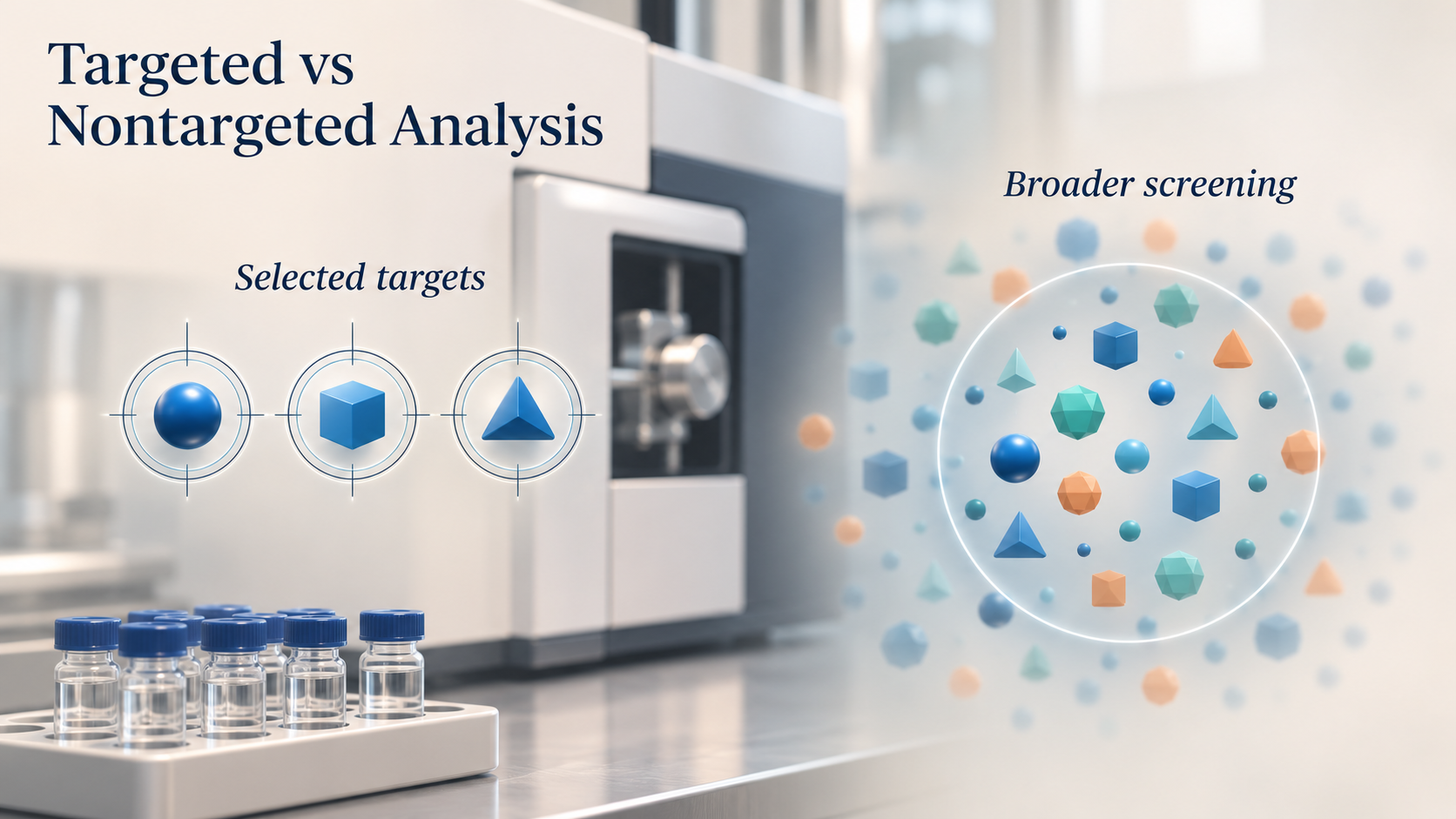
Targeted analysis asks about a defined set of compounds. Nontargeted analysis explores a broader set of detectable chemical features and then investigates their identities. A screened candidate is not automatically a confirmed compound, and a feature intensity is not automatically a concentration. Read the result together with its identification evidence, measurement scope and reporting limits.
Start with the question the experiment was designed to answer
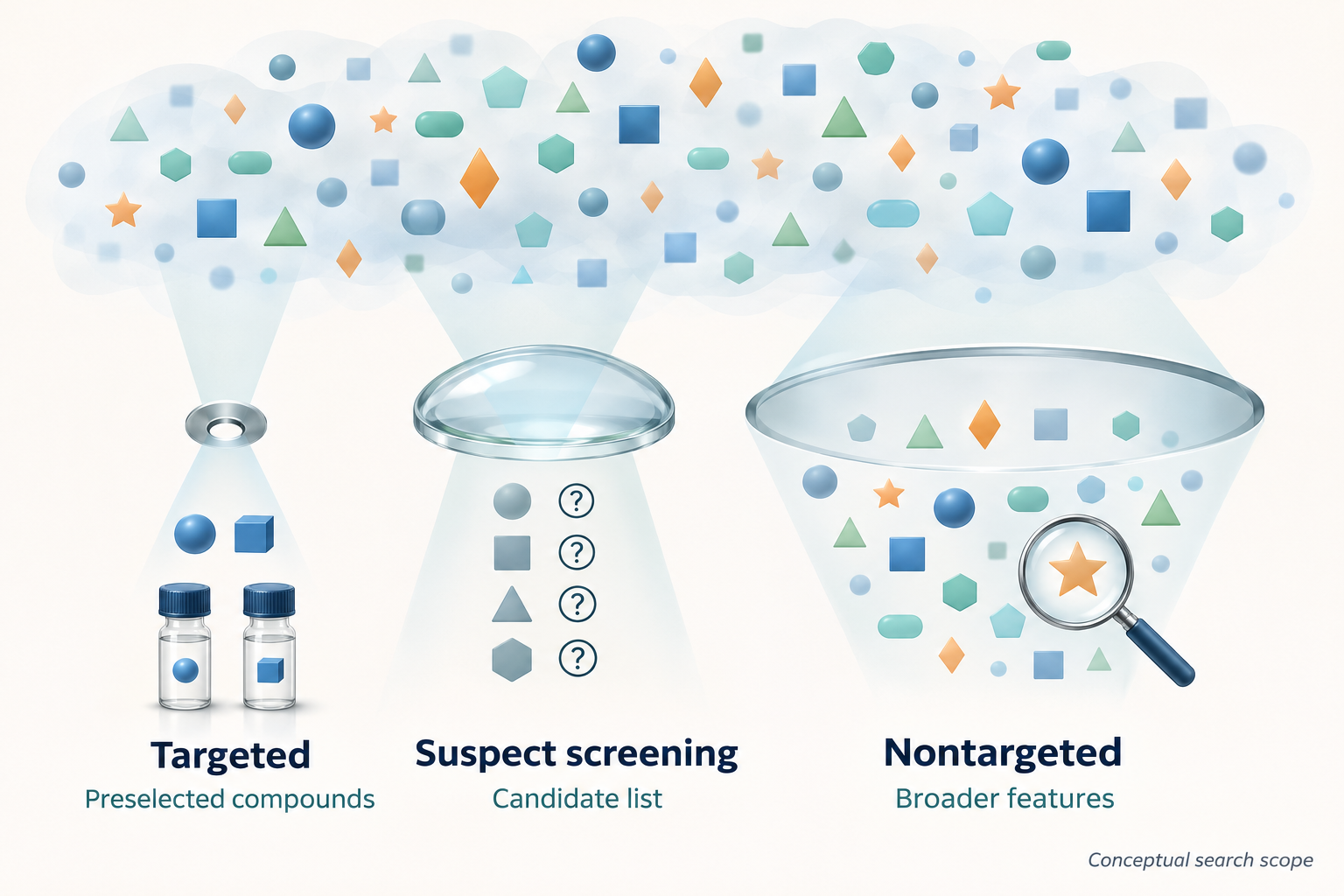
A targeted method selects compounds before analysis and establishes how they will be recognized and, where intended, quantified. A result can therefore answer a focused question about specified analytes under the method's conditions. Targeted work can also be qualitative; the word targeted alone does not establish quantitative validation or reporting capability.
Nontargeted analysis is useful when the question includes chemicals that were not individually selected beforehand. The US EPA's NTA research overview describes broader chemical coverage alongside greater uncertainty about exact structures and concentrations. Broader coverage creates opportunities for discovery, but it does not mean that every compound in a sample becomes detectable or identifiable.
Extraction, chromatographic separation, ionization, mass range and data processing still define a window onto the sample. A compound outside that window may never produce a usable feature. For a research discussion, describing that window is more informative than saying that an experiment tested for everything.
Where does suspect screening fit?
Suspect screening compares observed features with a list or database of plausible chemicals. Unlike a fully established targeted determination, a reference standard may not be available for every suspect. A match can prioritize a candidate for investigation while leaving uncertainty about its structure.
Terminology varies: some authors use nontargeted analysis as an umbrella that includes suspect screening. The EPA researchers' discussion of NTA tools explains this distinction. A report should define its workflow instead of relying on the label alone.
| Reported finding | Useful evidence | Limit to preserve |
|---|---|---|
| Targeted determination | Specified analytes, identity criteria, calibration and relevant quality controls. | Only the established method scope supports the reported conclusion. |
| Suspect or tentative candidate | Database basis, mass and fragmentation evidence, alternatives and confidence scheme. | A plausible match can remain structurally ambiguous. |
| Unassigned feature | Feature definition, blank comparison and reproducibility information. | A feature is not yet a unique chemical identity or a concentration. |
Identification confidence is a separate part of the result
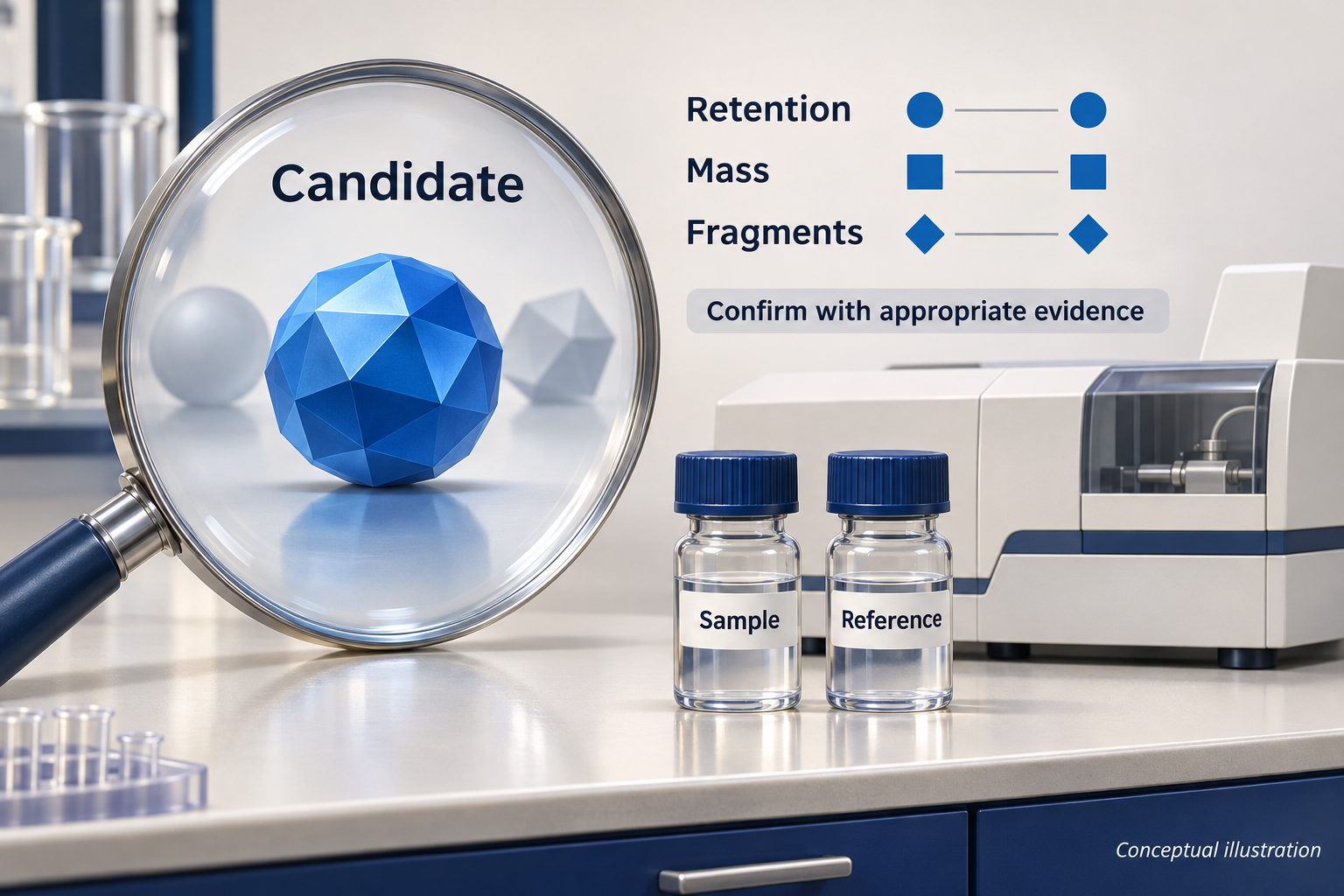
Accurate mass can constrain possible formulas. Fragmentation, isotope information, retention behavior and other relevant measurements can narrow the possibilities further. These observations answer different questions; agreement with one property does not necessarily distinguish structural alternatives.
The NIST PFAS NTA interlaboratory report treats identification confidence as an explicit reporting dimension. Its study-specific scheme should be read as defined, rather than assuming that a level number has the same meaning in every report. Where confirmation uses an authentic reference standard, comparisons need appropriate analytical conditions and the method's identity criteria. A standard's presence in a laboratory does not itself confirm a sample finding.
A recent PFAS example illustrates the distinction
Jiao and colleagues' study, Ion Mobility-Constrained Nontargeted Screening of PFAS in Complex Environmental Matrices Using 18-T FTICR Mass Spectrometry, appears in the September 8, 2026 issue of Analytical Chemistry. Its focus on adding an ion-mobility constraint to screening illustrates why candidate selection can draw on more than mass information. This is a bounded research example, not evidence that all screened candidates have confirmed structures or that the approach is a routine replacement for a laboratory's targeted method. No performance figures or operating conditions are transferred here.
Quantity, background and absence need their own evidence
Relative feature intensity can help prioritize follow-up. It does not supply an analyte-specific concentration without an appropriate quantitative basis. Different compounds can produce different responses, and a structure assignment does not automatically resolve that response uncertainty.
Background also matters. Signals associated with reagents, preparation materials or the analytical system need investigation before they are attributed to the sample. Conversely, a nondetection means the specified workflow did not report that analyte or feature within its applicable limits. It does not prove chemical absence.
Questions to ask when reviewing a report
- Which compounds or chemical space did the workflow cover, and what fell outside its scope?
- Are entries features, formulas, tentative structures or confirmed identities?
- Which confidence scheme and supporting observations were used?
- Were plausible alternatives and blank-related findings considered?
- Are quantities calibrated measurements, estimates or relative responses?
- What additional evidence would answer the next research question?
Use these distinctions to request a clearer analytical explanation. A useful report connects each conclusion to the evidence that supports it and leaves unresolved identity or quantity visible.
Leave a comment!