
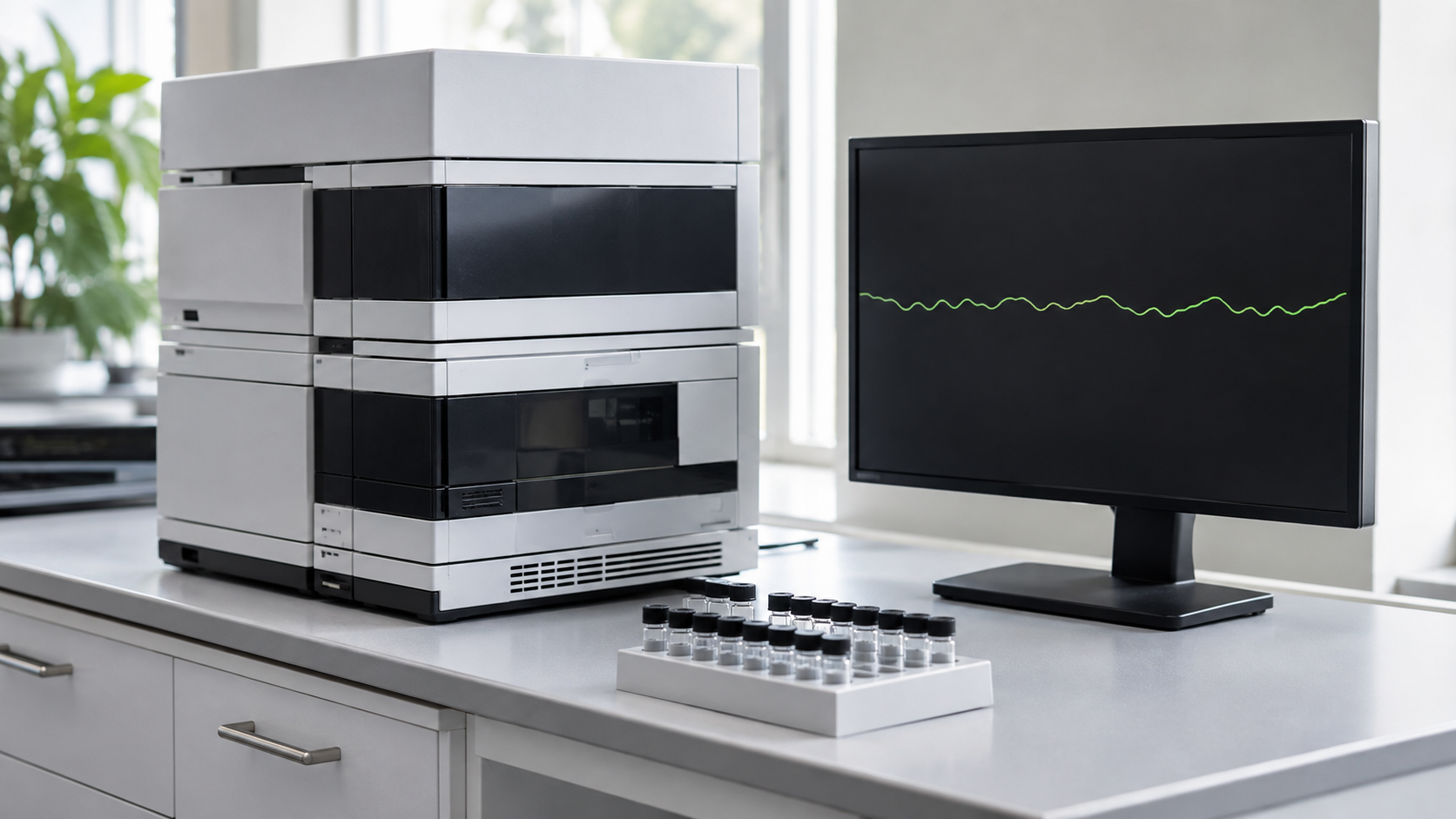

What Causes Baseline Noise in HPLC and How Does Solvent Quality Contribute?
Direct Answer
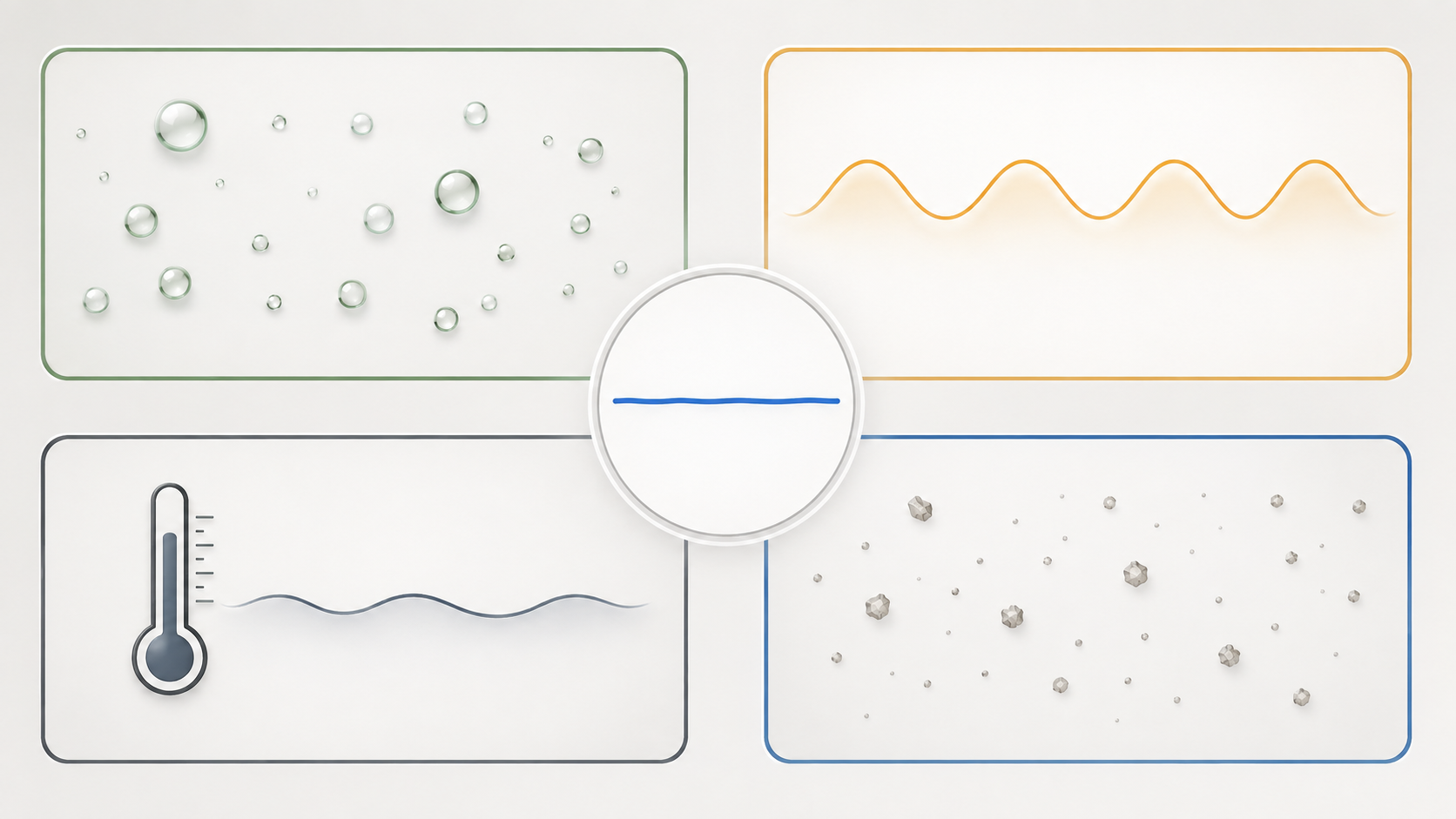
HPLC baseline noise is unwanted short-term fluctuation in the detector signal. It can come from bubbles, pump pulsation, poor mixing, temperature changes, detector contamination, electrical settings, a deteriorated lamp, the column, or the mobile phase. Solvent quality contributes when contaminants, particles, dissolved gases, water impurities, or unsuitable UV absorbance create unstable background or extra signals.
Solvent is only one possible cause. A reliable investigation separates mobile-phase, instrument, column, and sample effects instead of replacing several components at once.
Noise, Drift, and Spikes Are Different Symptoms
| Symptom | Typical appearance | Possible areas to investigate |
|---|---|---|
| Noise | Rapid small fluctuations around the baseline | Bubbles, detector flow cell, pump pulsation, electrical settings, solvent contamination |
| Drift | Slow movement upward or downward | Temperature, equilibration, lamp warm-up, gradient absorbance differences, column bleed |
| Spikes | Sudden narrow positive or negative disturbances | Air bubbles, particles, electrical events, valve switching, detector contamination |
| Ghost peaks | Peak-shaped signals in blanks or no-injection runs | Mobile phase, additives, carryover, column contamination, vials, previous samples |
How Solvent Quality Can Affect the Baseline
Organic impurities
Trace contaminants may absorb at the detection wavelength or elute from the column as peak-shaped signals. Gradient methods can make these contaminants especially visible because retained material may be released as the organic strength increases.
Dissolved gases and bubbles
Changes in pressure or composition can cause dissolved gas to form bubbles. A bubble passing through a detector flow cell may cause noise or spikes. Use the instrument's degassing system and mobile-phase preparation procedure as specified by the manufacturer.
Particles or precipitated additives
Particles can restrict frits, disturb flow, or contaminate the detector. Buffer precipitation may occur when salts meet a high proportion of organic solvent. Confirm solubility across the entire method and follow the instrument and column instructions.
Unsuitable optical background
At low UV wavelengths, solvent and additive absorbance becomes more important. A solvent that is acceptable at one wavelength may give excessive background at another. Review the actual product specification and method wavelength.
Water contamination
Water can introduce organic contamination or microbial by-products. Fresh, method-suitable water and clean reservoirs help control this source.
A Controlled Troubleshooting Sequence
- Define the symptom. Record whether it is noise, drift, spikes, or peak-shaped interference and note when it occurs.
- Check equilibration. Confirm adequate lamp warm-up, column equilibration, temperature stability, and stable flow.
- Check for bubbles. Inspect reservoir levels, solvent lines, degasser status, and pump priming without opening protected instrument areas outside approved procedures.
- Run a no-injection blank. This helps separate mobile-phase and system effects from sample and injection effects.
- Test fresh mobile phase. Replace one component at a time using clean compatible containers.
- Separate column and detector effects. Follow the instrument manufacturer's diagnostic procedure and pressure limits.
- Document the result. Record which change removed or reproduced the problem.
When Solvent Quality Is a Strong Suspect
- The disturbance begins after a solvent bottle or water source is changed.
- A fresh solvent lot improves the no-injection gradient.
- The same feature appears at a consistent gradient composition.
- Blank peaks grow with longer exposure to the aqueous mobile phase.
- Another instrument using the same mobile phase shows a similar background.
These patterns are evidence, not proof. Shared glassware, additives, or preparation practices may create the same apparent lot effect.
Good Practices That Reduce Solvent-Related Noise
- Select a grade appropriate for HPLC, the detector, and the required sensitivity.
- Use clean, compatible reservoirs and keep them covered.
- Prepare fresh mobile phase according to the validated procedure.
- Control additive identity, grade, concentration, and dissolution.
- Follow the approved filtration and degassing procedure where required.
- Do not top up an old mobile phase unless the laboratory procedure permits it.
- Record solvent and additive lot numbers for investigations.
Frequently Asked Questions
Will HPLC-grade solvent eliminate baseline noise?
No. Appropriate solvent quality reduces one source of noise, but bubbles, pumps, temperature, detector condition, columns, and settings can still contribute.
Why does baseline noise become worse during a gradient?
The changing composition can reveal absorbance differences, mixing variation, bubbles, and contaminants that are concentrated and then eluted from the column.
Should I change every mobile-phase component at once?
No. Changing one variable at a time provides stronger evidence about the cause. An urgent operational procedure may require a full replacement, but the investigation should still document the limitation.
Can a clean solvent blank rule out the solvent?
It reduces suspicion but does not rule out every interaction. Some contaminants appear only after passing through a column, mixing with additives, or being concentrated during a gradient.
Key Takeaway
Baseline noise is a system symptom, not a diagnosis. Treat solvent quality as one part of a structured investigation, use no-injection and fresh-mobile-phase controls, and follow the validated method and instrument manufacturer's guidance.
Leave a comment!