
Chemical Concentration Units: Understanding % w/w, % v/v and mol/L
A concentration value is incomplete without its quantity basis. Percent by mass, percent by volume and mol/L describe different relationships. Read the numerator, denominator and documented convention before comparing offers, ordering a replacement or requesting a conversion.

Read what the denominator means
| Notation | Meaning used here | Illustrative interpretation |
|---|---|---|
| % w/w | Mass of component divided by total solution mass, multiplied by 100. | 10% w/w means 10 g component per 100 g solution. |
| % v/v | Under the stated final-volume preparation convention, component volume per final solution volume, multiplied by 100. | 10% v/v means 10 mL component made up to 100 mL final solution under that convention. |
| mol/L | Amount of specified substance per solution volume. | 0.100 mol/L means 0.100 mol in 1 L solution. |
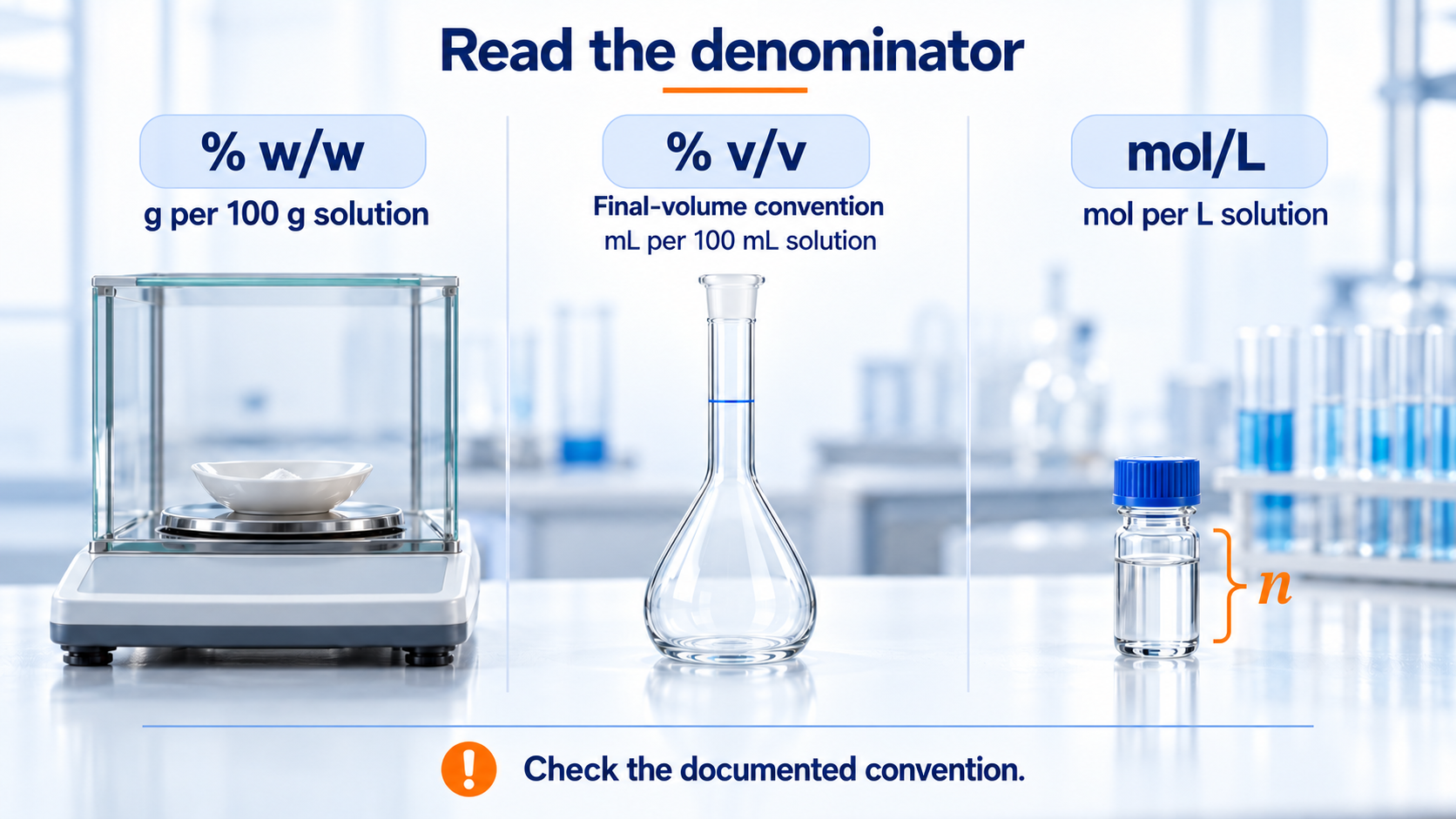
The percent-v/v convention must be confirmed. IUPAC's volume fraction uses constituent volumes before mixing in its denominator; that is not necessarily the final solution volume. Recipes and commercial documents may use a final-volume convention instead. Do not silently equate them when mixing changes volume. The table states its convention explicitly.
A preparation description must match the basis
For an illustrative two-component solution, 10 g of component in a total solution mass of 100 g corresponds to 10% w/w. If there are no other components, the remaining mass is 90 g. This is a mass balance, not a safe chemical-mixing instruction. The order of addition, heat effects, PPE and handling come from an approved procedure.
For a final-volume v/v recipe, “make up to 100 mL” is different from “add 100 mL solvent.” Nor does combining 10 mL with 90 mL necessarily give 100 mL after mixing. Temperature, mixing effects and the procedure's volume definition matter.
Conversions need additional information
To relate mass fraction to a volume-based concentration, use the solution density at the relevant conditions. To convert a component mass to amount of substance, use the molar mass of the specified chemical form. Hydrates, mixtures and purity/assay bases need explicit treatment.
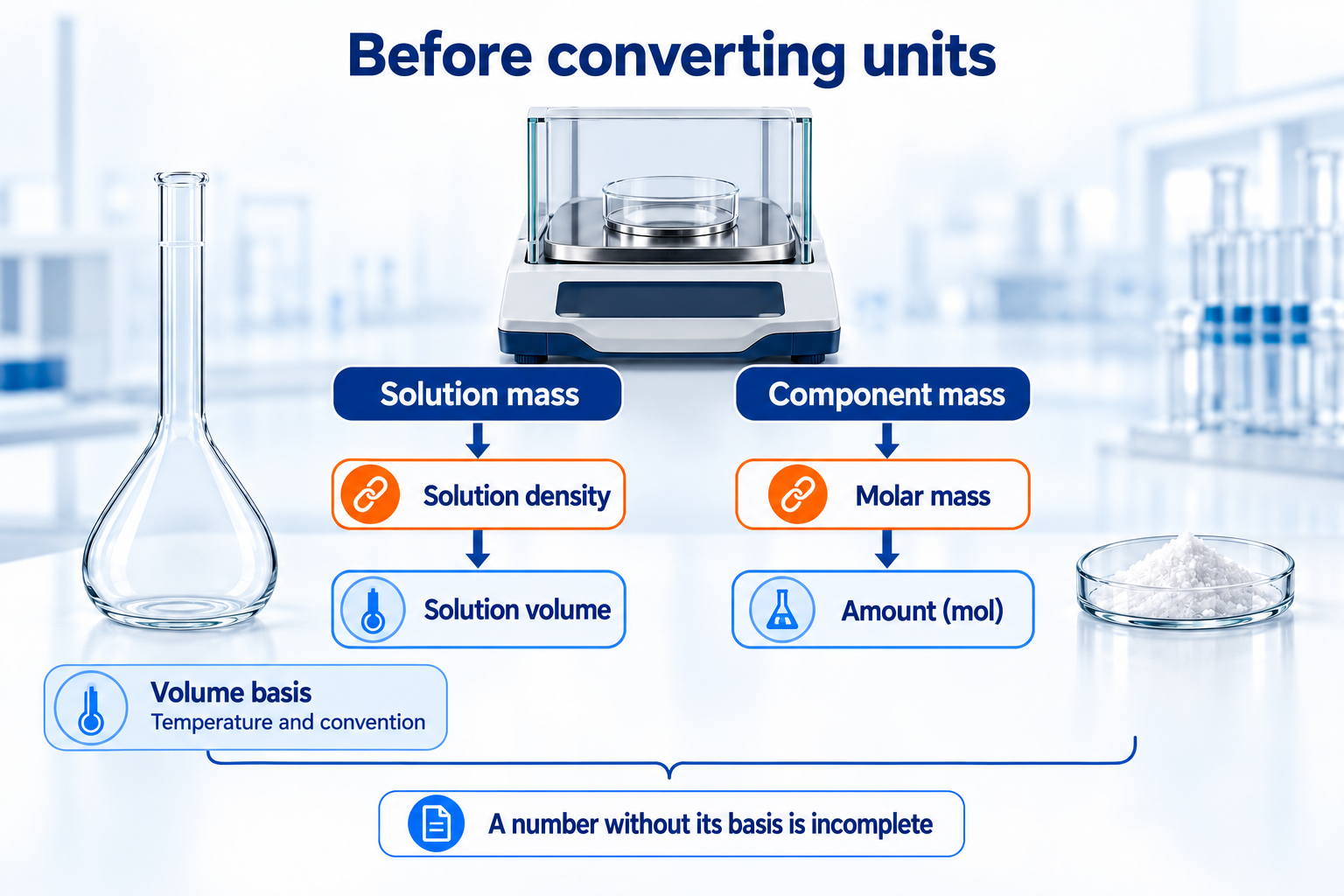
For illustration only, take a mass fraction of 0.100 (10.0% w/w), an assumed solution density of 1.20 kg/L and a specified solute molar mass of 60.0 g/mol. Component mass per liter is 0.100 × 1.20 kg/L = 0.120 kg/L = 120 g/L. Dividing by 60.0 g/mol gives 2.00 mol/L. These assumed values describe no RCI product and do not establish a real solution density or preparation recipe. Without the density and chemical identity, the conversion is not determined.
What should procurement ask the laboratory?
- Which chemical identity and form are required?
- Is the requested percentage based on mass, final volume or another stated convention?
- Which temperature and density apply if a conversion is needed?
- Does the assigned value refer to the component, active substance or another assay basis?
- What tolerance, uncertainty and documentation does the method require?
A request for “10% solution” leaves the basis unresolved. Ask for a complete description instead of selecting a familiar-looking label. Use COA vs Specification: What Is the Difference? to distinguish the product requirement from the reported lot result.
Practical conclusion
Preserve the quantity basis when ordering, comparing and converting. Have the laboratory confirm ambiguous percent notation and the inputs for any conversion. Similar numerical values do not establish equivalent chemical concentrations.
Leave a comment!