
What Are Ghost Peaks and How Are They Related to Solvent Impurities?
Direct Answer
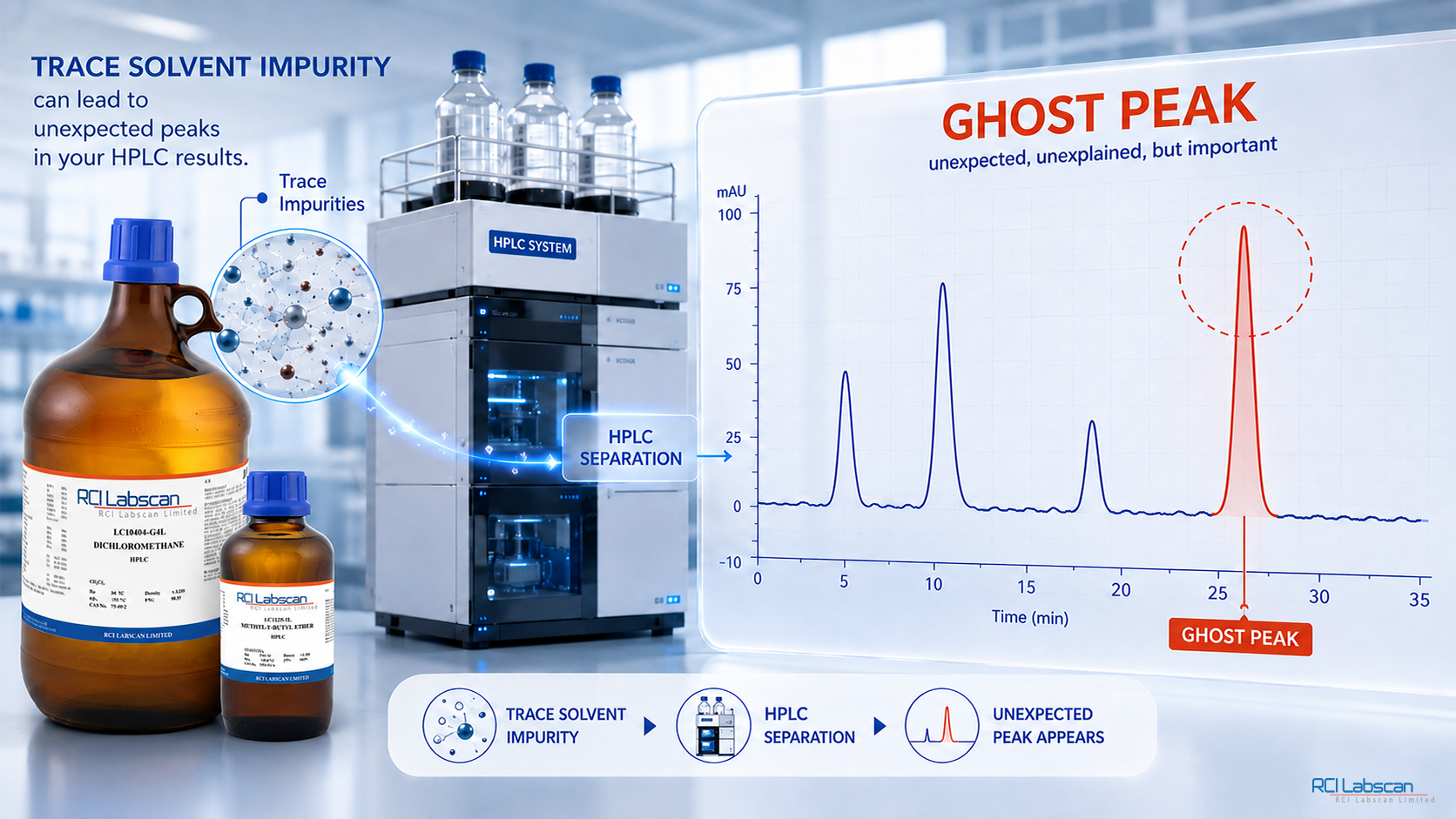
A Ghost Peak is an unexpected chromatographic peak that cannot be linked to the intended sample components.
In HPLC, Ghost Peaks may come from:
- Impurities in the mobile phase or solvents
- Contamination from the HPLC system
- Carryover from a previous injection
- Contaminated sample preparation materials
- Column contamination or strongly retained compounds
- Additives, buffers, or water used to prepare the mobile phase
- Contamination from containers, tubing, filters, or other consumables
Therefore, solvent impurities are one possible source of Ghost Peaks, but they are not the only cause.
This distinction is important because laboratories should identify the actual source before replacing the solvent, column, or other system components.
What Is a Ghost Peak in HPLC?
A Ghost Peak is an unexpected signal that appears in a chromatogram even though the related compound was not intentionally introduced with the sample.
For example, the term is commonly used when a peak appears in a blank injection, mobile-phase blank, or other control run and cannot immediately be linked to the target analyte.
Ghost Peaks can create several problems in chromatographic analysis. They may:
- Be mistaken for an unknown impurity
- Overlap with an analyte peak
- Affect peak integration
- Increase apparent impurity levels
- Reduce confidence in quantitative results
- Make chromatogram interpretation more difficult
- Increase troubleshooting time
In gradient HPLC, the problem can be especially noticeable. This is because very small amounts of impurities may become concentrated or focused at the head of the column. Later, they may elute when the mobile phase becomes stronger. As a result, clear peaks can appear even when the original impurity level is very low.
Why Do Ghost Peaks Occur?
Ghost Peaks can have several possible sources. Therefore, a useful troubleshooting approach is to divide the causes into clear categories.
1. Mobile Phase or Solvent Impurities
Impurities may already be present in the solvents used to prepare the mobile phase.
Depending on their chemical properties and detector response, even trace impurities may produce measurable signals during an HPLC run.
For example, this can be important with UV detection because some organic impurities absorb UV light and may appear as chromatographic peaks.
Potential sources include:
- Organic solvent impurities
- Water impurities
- Mobile phase additives
- Buffer components
- Contamination introduced during mobile phase preparation
In gradient HPLC, these components may also build up on the column before they elute later in the gradient.
2. Carryover from a Previous Injection
A Ghost Peak may also come from material left behind after a previous sample injection.
For example, if a strongly retained compound does not fully elute during one run, it may appear during a later blank injection.
Other possible sources of carryover include:
- Autosampler needle
- Injector valve
- Rotor seal
- Needle wash system
- Sample loop
- Tubing
Therefore, carryover is often suspected when an unexpected peak appears at or near the retention time of a compound found in the previous sample.
3. Column Contamination
Over time, the column can retain compounds from previous analyses or from contaminated mobile phases and samples.
These compounds may later be released when the mobile phase composition changes. As a result, unexpected peaks may appear in later runs.
For this reason, column washing, regeneration, and proper storage are important parts of chromatographic method control.
4. Contamination from Laboratory Materials
Ghost Peaks can also come from materials used during mobile phase or sample preparation.
Potential sources include:
- Glassware
- Solvent bottles
- Filters
- Tubing
- Vials
- Caps
- Plastic components
- Cleaning residues
For example, contamination from a container may enter the mobile phase even when the original solvent itself meets its specification.
How Are Ghost Peaks Related to Solvent Impurities?
The relationship between Ghost Peaks and solvent impurities becomes especially important when an unexpected peak appears during a blank gradient run.
For example, consider a laboratory that prepares a mobile phase using Acetonitrile and water. The solvents appear clear and meet the expected specifications. However, during a gradient HPLC run, an unexpected peak appears even though no sample has been injected.
One possible explanation is a trace impurity in one of the mobile phase components.
During the first stage of the gradient, the impurity may interact with the stationary phase. Later, as the percentage of organic solvent increases, the impurity may elute from the column and appear as a Ghost Peak.
Therefore, solvent impurities can be difficult to identify simply by looking at the solvent. The impurity may be present at a very low level but become visible after chromatographic separation and focusing.
However, this pattern does not prove that the solvent is the source. Other parts of the HPLC system should also be investigated.
Why Are Ghost Peaks More Noticeable in Gradient HPLC?
Gradient HPLC changes the mobile phase composition during the analytical run.
Because the solvent strength changes, some trace components may collect on the column during the early stages of the run. Later, they may elute when the mobile phase becomes stronger.
As a result, an impurity that produces little or no obvious signal under one condition may become visible as a clear peak during a gradient.
Therefore, Ghost Peak investigations in gradient HPLC often include:
- Gradient composition
- Gradient slope
- Initial mobile phase composition
- Equilibration time
- Organic solvent quality
- Water quality
- Mobile phase additives
- Column history
How Can You Tell If a Ghost Peak Comes from the Solvent?
There is no single test that can identify the source of every Ghost Peak. Instead, laboratories usually compare several blank and control conditions.
1. Run a Blank Injection
First, inject an appropriate blank or mobile-phase blank.
If the same unexpected peak appears without a sample containing the target compound, the source may be outside the sample itself.
2. Run the Gradient Without Injection
Next, a no-injection gradient can help show whether the signal comes from the mobile phase or the chromatographic system.
If a peak appears during the gradient without sample injection, mobile phase contamination becomes an important possibility to investigate.
3. Prepare Fresh Mobile Phase
Then, prepare fresh mobile phase using clean containers and freshly opened or properly stored solvents.
If the unexpected peak disappears, contamination in the previous mobile phase or one of its components should be investigated further.
4. Test Different Solvent Sources
If solvent impurity is still suspected, laboratories may compare different solvent lots or suppliers when this comparison is suitable for the method and quality requirements.
For example, if the method uses Acetonitrile, a fresh lot that meets the required specification can be compared with the existing solvent.
In this way, laboratories can check whether the unexpected signal follows a specific solvent lot or source.
5. Check the Water and Additives
However, the organic solvent should not be the only focus.
Water, buffers, acids, salts, and other mobile phase additives may also add background signals or contamination.
Therefore, the complete mobile phase preparation process should be checked.
6. Check the HPLC System
If the Ghost Peak remains after replacing the mobile phase, the HPLC system may need further investigation.
For example, laboratories may check:
- Autosampler
- Injector
- Needle wash
- Pump
- Tubing
- Solvent inlet filters
- Column
- Detector
- Mobile phase reservoirs
Because Ghost Peaks can come from contamination inside the instrument, replacing the solvent alone may not solve the problem.
How Do Solvent Impurities Affect HPLC Results?
Although solvent impurities may be present only at trace levels, they can still become important in sensitive analytical methods.
Potential effects include:
- Unexpected chromatographic peaks
- Increased baseline noise or background
- Interference with analyte peaks
- Incorrect peak integration
- Apparent additional impurities
- Reduced confidence in identification
- Reduced method reproducibility
However, the actual impact depends on the impurity, its concentration, detector sensitivity, chromatographic conditions, and analytical method.
For example, a small background signal that is not important in one method may become significant in a highly sensitive method.
Therefore, solvent selection should be based on the complete requirements of the analytical method rather than on chemical name or assay value alone.
Does High-Purity Solvent Eliminate Ghost Peaks?
Not necessarily.
Although an appropriate high-purity solvent can help reduce the risk of solvent-related contamination, it cannot guarantee that Ghost Peaks will never occur.
A Ghost Peak can still come from:
- Water
- Additives
- Glassware
- Filters
- Mobile phase bottles
- Autosampler components
- Column contamination
- Carryover
- Instrument components
Therefore, solvent quality should be considered as one part of overall chromatographic system control.
In addition, a high-purity solvent is most useful when its specification is suitable for the intended analytical application and when the solvent is properly stored, handled, and prepared.
What Should You Check When You See a Ghost Peak?
A systematic troubleshooting process can help laboratories find the source more efficiently.
| Checkpoint | Why It Matters |
|---|---|
| Blank injection | Determines whether the signal appears without the target sample |
| No-injection gradient | Helps investigate mobile phase or system-related contamination |
| Fresh mobile phase | Helps determine whether the existing mobile phase is contributing to the peak |
| Solvent lot | Different lots may help identify lot-specific contamination |
| Water source | Water can contribute to mobile phase background |
| Mobile phase additives | Acids, buffers, and other additives may introduce signals |
| Glassware and bottles | Cleaning residues or contamination may enter the mobile phase |
| Autosampler | Carryover may produce peaks after previous injections |
| Column | Retained compounds can appear in later runs |
| Instrument components | Tubing, filters, valves, and other parts may contribute contamination |
| Gradient conditions | Changes in solvent strength can influence when impurities elute |
| COA / Product Specification | Helps confirm solvent quality requirements and lot-specific results |
Overall, changing one variable at a time makes troubleshooting more reliable than changing several conditions at once.
How Can Laboratories Reduce the Risk of Solvent-Related Ghost Peaks?
To reduce the risk of solvent-related Ghost Peaks, laboratories may use several practical controls:
- Select a solvent grade appropriate for the analytical method
- Use solvents with suitable impurity specifications
- Check the Certificate of Analysis where available
- Use clean and properly prepared mobile phase containers
- Avoid unnecessary exposure of solvents to the laboratory environment
- Prepare mobile phases using clean and dry equipment
- Follow appropriate storage conditions
- Replace old or contaminated mobile phases
- Use appropriate filtration procedures when required by the method
- Maintain the HPLC system according to the instrument manufacturer's recommendations
- Establish suitable column washing and equilibration procedures
- Include blank or system-suitability checks when required
In addition, good solvent handling is important because solvent condition can change after opening or improper storage.
Does the Solvent Grade Matter?
Yes.
Different analytical applications require different levels of control over solvent quality.
For example, an HPLC method may require control of parameters such as:
- Assay or purity
- UV absorbance
- Residue after evaporation
- Water content
- Relevant impurities
- Lot-to-lot consistency
For LC-MS applications, additional requirements may also apply because trace contaminants can add background signals or interfere with sensitive detection.
Therefore, the solvent grade should be selected according to the validated method, detector, sensitivity requirements, and laboratory quality system.
In other words, the goal is not simply to choose the solvent with the highest stated purity. Instead, laboratories should select a solvent that meets the complete requirements of the analytical application.
How Should You Troubleshoot Ghost Peaks Step by Step?
When a Ghost Peak appears, laboratories can use the following systematic sequence:
- Start with a blank injection to check whether the unexpected peak appears without the target sample.
- Next, check the system without sample injection to see whether the peak still appears.
- Then, prepare fresh mobile phase using clean containers and suitable solvents.
- After that, check the water, organic solvents, and additives individually where appropriate.
- Compare solvent lots if the method and quality requirements allow this type of test.
- Inspect glassware, reservoirs, filters, and other consumables for possible contamination.
- Investigate autosampler carryover if the peak may be linked to an earlier injection.
- Evaluate column contamination and equilibration as another possible source.
- Check the HPLC system and maintenance status if the peak remains.
- Finally, compare chromatograms after each controlled change to help identify which variable affects the Ghost Peak.
This sequence can help separate solvent-related contamination from instrument-, column-, or carryover-related problems.
Key Takeaway
In short, Ghost Peaks are unexpected chromatographic signals that cannot be linked to the intended sample.
Solvent impurities are one important possible source of Ghost Peaks, especially in gradient HPLC. However, they are not the only cause.
Therefore, when an unexpected peak appears, laboratories should consider the entire analytical system, including:
- Solvent quality
- Water quality
- Mobile phase additives
- Sample preparation
- Autosampler carryover
- Column contamination
- Glassware and consumables
- HPLC instrument components
Overall, using a suitable solvent grade, controlling mobile phase preparation, and following a systematic troubleshooting process can help reduce unexpected chromatographic signals and improve confidence in analytical results.
Frequently Asked Questions
What is a Ghost Peak in HPLC?
A Ghost Peak is an unexpected chromatographic peak that cannot be linked to the intended components of the injected sample. For example, it may come from solvent impurities, mobile phase contamination, carryover, column contamination, or the HPLC system.
Are Ghost Peaks always caused by solvent impurities?
No. Solvent impurities are only one possible cause. Other sources include carryover, column contamination, instrument contamination, sample preparation, additives, water, and laboratory materials.
Can solvent impurities cause Ghost Peaks in a blank injection?
Yes. If a trace impurity in the mobile phase is detected by the system, it may produce a peak even when no target sample is injected. This can be especially relevant during gradient HPLC.
Why are Ghost Peaks common in gradient HPLC?
Gradient elution changes the strength of the mobile phase. As a result, trace impurities can become concentrated or focused on the column and then elute when the mobile phase becomes stronger.
How can I determine whether a Ghost Peak comes from the solvent?
First, start with controlled blank and no-injection experiments. Then, prepare fresh mobile phase, check the solvent lot, test the water and additives, and compare the results. Together, these checks can help determine whether the mobile phase is contributing to the peak.
Can HPLC-grade solvent prevent Ghost Peaks?
Using an appropriate HPLC-grade or higher-purity solvent can help reduce solvent-related contamination. However, it cannot remove every possible cause of Ghost Peaks. The complete HPLC system and mobile phase preparation process must also be controlled.
Can water cause Ghost Peaks?
Yes. Water used in the mobile phase can contain trace contaminants that may add background signals or unexpected peaks, especially in sensitive chromatographic methods.
Should I replace the column when I see a Ghost Peak?
Not necessarily. Column contamination is only one possible cause. Therefore, solvent, mobile phase, carryover, and instrument components should also be investigated before replacing the column.
Can Ghost Peaks affect quantitative analysis?
Yes. For example, if a Ghost Peak overlaps with an analyte or impurity peak, it may affect peak integration and may lead to inaccurate quantitative results.
What should I check before selecting an HPLC solvent?
Consider the solvent grade, assay or purity, UV absorbance, relevant impurities, residue after evaporation, water content where relevant, lot-to-lot consistency, Certificate of Analysis, and analytical method requirements.
Related RCI Labscan Products and Pages
RCI Labscan provides laboratory solvents for different analytical applications, including solvents intended for HPLC and LC-MS workflows.
Before selecting a solvent, users should review the approved product specification, Certificate of Analysis, SDS, and intended application requirements.
- View All HPLC Grade Products
- View All LC-MS Grade Products
- Acetonitrile HPLC
- Methanol HPLC
- Acetonitrile LC-MS
- Methanol LC-MS
For confirmed specifications, packaging information, documentation requests, or product availability, customers may contact RCI Labscan or an authorized local distributor.
Related Articles
- What Is HPLC Grade Solvent?
- How to Choose Acetonitrile for HPLC Solvents
- How Do Impurities in Solvents Affect Analytical Results?
Leave a comment!