
Why Is Acetonitrile Commonly Used in HPLC?
Direct Answer
Acetonitrile is widely used in high-performance liquid chromatography (HPLC) because it combines several useful properties: it mixes with water, has relatively low viscosity, provides strong elution in many reversed-phase separations, and has low absorbance in the short-wavelength UV region when a suitable chromatography grade is used. These characteristics can support manageable system pressure, sensitive UV detection, and efficient method development.
However, acetonitrile is not automatically the best solvent for every method. The final choice should reflect analyte solubility, separation selectivity, detector, column limits, buffer compatibility, safety controls, waste requirements, and the validated procedure.
What Role Does Acetonitrile Play in HPLC?
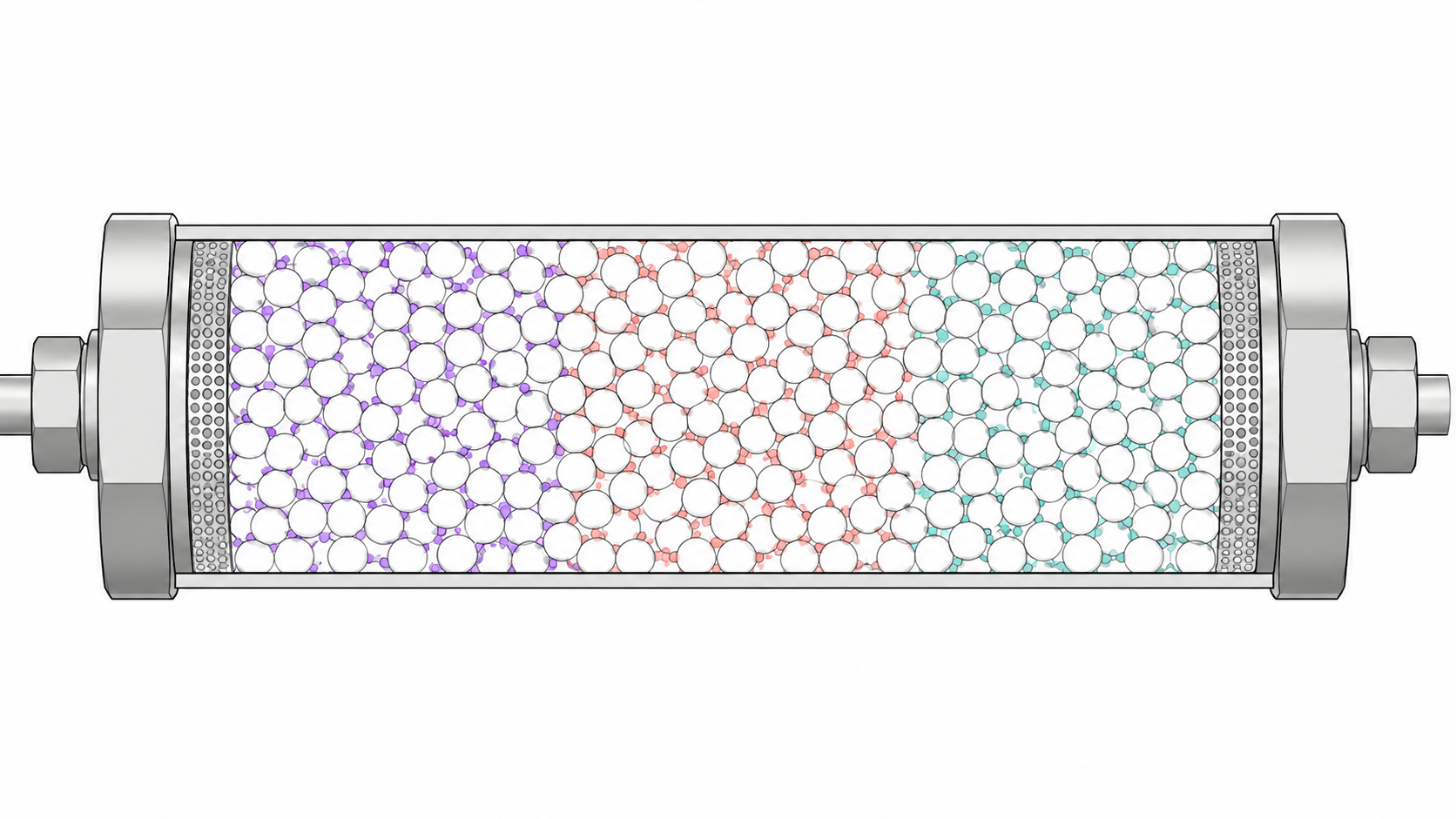
In reversed-phase HPLC, the mobile phase commonly contains water or an aqueous buffer together with an organic modifier. The organic component changes how strongly analytes are retained by the stationary phase. Increasing the organic proportion usually shortens retention for compounds retained by hydrophobic interactions, although the exact response depends on the method and sample.
Acetonitrile is a polar aprotic solvent. It is miscible with water and can be blended over the compositions used in many reversed-phase methods. Analysts use it in isocratic mobile phases, where the composition remains constant, and in gradients, where the organic proportion changes during the run.
Five Reasons Acetonitrile Is Common in HPLC
1. Low viscosity can help control backpressure
Mobile-phase viscosity contributes to the pressure required to move liquid through an HPLC column. Water–acetonitrile mixtures often produce lower pressure than comparable water–methanol mixtures under the same system conditions. This can be useful with small particles, long columns, or higher flow rates.
Pressure is still influenced by composition, temperature, column dimensions, particle size, flow rate, frit condition, and system plumbing. A solvent change should therefore be evaluated on the actual instrument rather than assumed to reduce pressure in every situation.
2. Low UV absorbance supports short-wavelength detection
Every solvent absorbs ultraviolet light below a certain wavelength. HPLC-grade acetonitrile is commonly chosen for UV methods because its absorbance is comparatively low in the short-wavelength region. A cleaner optical background can improve baseline stability and signal-to-noise when analytes are monitored at low wavelengths.
Solvent grade matters. An ordinary reagent may meet a general purity value yet contain UV-absorbing impurities that are important to a chromatographic detector. Analysts should review the product specification, lot-specific Certificate of Analysis (COA), and a representative mobile-phase blank.
3. It often provides useful elution strength
In many reversed-phase water–organic systems, acetonitrile provides greater elution strength than methanol at the same nominal organic percentage. This can shorten retention or allow a lower organic proportion for a comparable retention range. It may also help wash strongly retained components from a column when the column manufacturer and method permit it.
Elution strength is not a universal conversion factor. A method cannot normally be changed from methanol to acetonitrile by substituting the same percentage and keeping every other setting unchanged.
4. It offers different selectivity from methanol
Acetonitrile and methanol do not interact with analytes and stationary phases in exactly the same way. Changing between them can change resolution, peak order, and peak shape—not just retention time. That difference makes acetonitrile valuable during method development, but it also means that any substitution requires re-optimization and appropriate verification or validation.
5. It is suitable for gradient operation when quality is controlled
Gradient HPLC can concentrate trace impurities from a weak mobile phase and release them as the organic proportion rises. A chromatography-grade acetonitrile with controlled UV absorbance and gradient performance helps reduce solvent-derived baseline features. Clean reservoirs, compatible filters, appropriate degassing, and good system hygiene remain essential.
Acetonitrile vs Methanol at a Glance
| Consideration | Acetonitrile | Methanol |
|---|---|---|
| Viscosity and pressure | Often gives lower pressure in aqueous mixtures | Often gives higher pressure in comparable aqueous mixtures |
| Short-wavelength UV background | Often favorable with HPLC-grade material | May absorb more strongly at short wavelengths |
| Reversed-phase elution | Often stronger at the same organic percentage | May require a different percentage for similar retention |
| Selectivity | Distinct, method-dependent interactions | Distinct, method-dependent interactions |
| Method substitution | Changing either solvent requires evaluation of pressure, retention, resolution, peak shape, baseline, and sample compatibility | |
When Might Acetonitrile Be a Poor Choice?
- Insufficient sample solubility: the sample may precipitate when it meets the mobile phase.
- Poor selectivity: methanol or another permitted modifier may separate critical peaks better.
- Buffer precipitation: a high organic proportion can reduce the solubility of some salts.
- Detector or application mismatch: a method may require a different solvent or a grade tested for LC-MS, fluorescence, or another specialized use.
- Safety or sustainability constraints: acetonitrile is flammable and hazardous; facilities must manage exposure, storage, waste, and emergency response according to the SDS and applicable rules.
How to Choose Acetonitrile for an HPLC Method
- Start with the validated method. Follow the stated solvent, grade, and preparation instructions unless a controlled method change is approved.
- Match the grade to the detector. HPLC-grade material may be appropriate for routine UV work, while highly sensitive LC-MS methods may require a grade characterized for mass-spectrometric background and metal control.
- Read the current specification. Review tests relevant to the method, such as water, residue after evaporation, acidity or alkalinity, UV absorbance, and gradient suitability where reported.
- Review the lot COA. Confirm identity, lot number, test results, and status before use.
- Check the blank. A mobile-phase or solvent blank under representative conditions can reveal background that a single headline purity value cannot predict.
- Confirm compatibility. Check the column instructions, seal and tubing compatibility, buffer solubility, sample solvent, and detector requirements.
Practical Handling Points
Prepare mobile phase in clean, compatible containers using documented procedures. Keep solvent containers closed when they are not connected to the system, protect them from contamination, and label prepared mixtures with the required identity, composition, preparation information, and use period. Follow the SDS for ventilation, personal protective equipment, ignition control, spill response, storage, and disposal.
When opening a new lot, laboratories may compare a representative blank and system-suitability result with an established reference. This separates solvent concerns from other sources of change such as a contaminated reservoir, worn seal, aged column, unsuitable vial, or sample-preparation error.
FAQ
Is acetonitrile always better than methanol for HPLC?
No. Acetonitrile often offers lower pressure and favorable short-wavelength UV performance, but methanol may provide better selectivity, solubility, or method economics. The chromatographic result determines the better choice.
Can reagent-grade acetonitrile be used for HPLC?
A general reagent grade may not be tested for UV absorbance, gradient background, or other chromatographic criteria. Use the grade required by the method and confirm the supplier specification and blank performance.
Can HPLC-grade acetonitrile be used for LC-MS?
Not automatically. LC-MS can be sensitive to trace organic background, particles, and metals. Review the LC-MS method and the product specification rather than assuming that one grade covers both applications.
Why can changing from methanol to acetonitrile change peak order?
The solvents have different chemical properties and therefore change analyte–mobile-phase and analyte–stationary-phase interactions. A change can alter selectivity as well as overall retention.
Key Takeaway
Acetonitrile is popular in HPLC because its low viscosity, UV transparency, useful elution strength, and distinct selectivity work well in many reversed-phase methods. These advantages are method-dependent. Choose the appropriate grade, confirm compatibility and documentation, and verify performance with the actual chromatographic system.
Related Reading
- How to Choose Acetonitrile for HPLC Solvents
- Acetonitrile vs Methanol: Which Solvent Should You Choose for HPLC?
- How Do Impurities in Solvents Affect Analytical Results?
- What Is a Mobile Phase and Why Is It Important in HPLC?
Explore RCI Labscan laboratory products or contact RCI Labscan for current product specifications and application guidance.
Leave a comment!