

Prepared Standard Solutions vs In-House Preparation: A QA and Procurement Checklist
How to compare total risk, documentation, flexibility, and ongoing control
Direct Answer
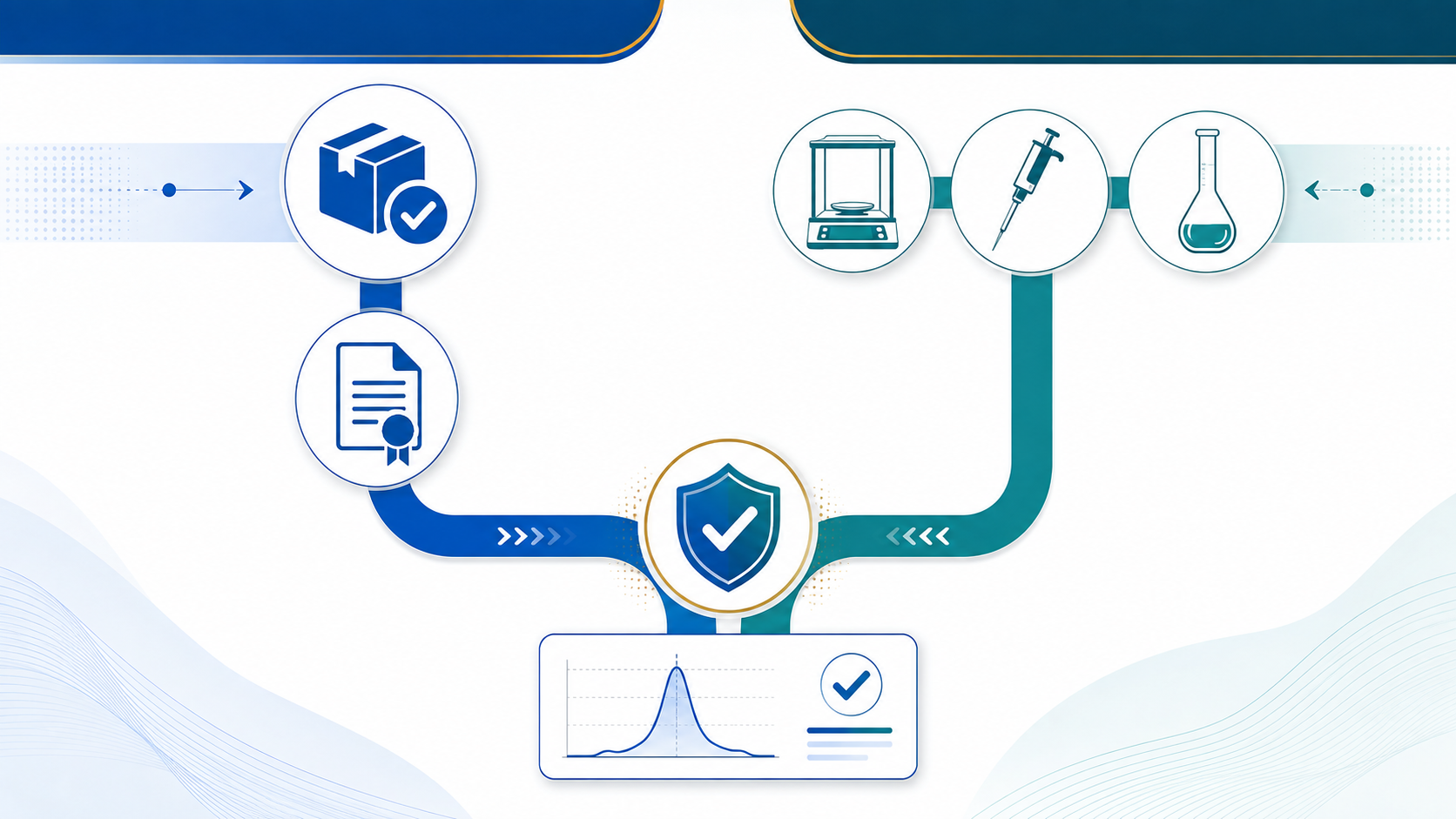
Choose between a prepared standard solution and in-house preparation by comparing the full measurement requirement—not purchase price alone. A prepared solution can reduce preparation steps and provide supplier documentation. In contrast, in-house preparation offers more flexibility in concentration and volume. Therefore, the right choice depends on required uncertainty, traceability, stability, competence, equipment, workload, waste, and the controls needed to keep every preparation fit for purpose.
Two Valid Routes to a Working Standard
Laboratories often need pH buffers, volumetric solutions, calibration standards, or other solutions with assigned values. They can purchase a ready-to-use or ready-to-dilute solution, or prepare one internally from a suitable starting material. Both routes can support quality results when the laboratory understands and controls their risks.
However, laboratories should compare equivalent outcomes. A bottle price alone does not represent the cost of material, analyst time, purified water, calibrated balances and volumetric equipment, verification, documentation, storage, and disposal. Conversely, a commercial product does not remove the laboratory's responsibility to verify suitability, lot identity, validity, and correct use.
Side-by-Side Decision Table
| Decision factor | Prepared standard solution | In-house preparation |
|---|---|---|
| Concentration options | Offers available product concentrations or planned dilution options | Allows the laboratory to tailor concentration within the validated procedure |
| Preparation effort | Reduces weighing and dilution steps | Requires trained staff, equipment, calculations, and records |
| Documentation | Supplier specification and lot certificate may support review | The laboratory generates and approves the preparation record and supporting data |
| Traceability | The laboratory reviews the supplier's documented traceability chain | The laboratory establishes traceability through qualified materials, calibrated equipment, and documented calculations |
| Uncertainty and bias | Review assigned value, uncertainty or tolerance, and intended use | Evaluate contributions from purity, weighing, volume, temperature, transfer, and analyst technique |
| Stability | Follow unopened and post-opening instructions | The laboratory justifies preparation validity and storage conditions |
| Waste and inventory | May create unused expired volume if the package is too large | Allows smaller preparations but may create repeated setup waste |
| Change control | Review supplier, formulation, specification, or packaging changes when necessary | Review changes to procedure, material, equipment, or preparer when necessary |
When a Prepared Solution May Be the Better Fit
- The solution is used routinely and an appropriate documented product is available.
- Preparation errors would have a significant impact on reportable results.
- The laboratory has limited analyst time or lacks appropriate preparation equipment.
- Consistency across sites, shifts, or users is important.
- A supplier's specification, certificate, and stability information meet the laboratory's needs.
- The package size can be consumed within the approved use period.
However, a prepared solution still requires receipt inspection, lot-to-certificate matching, storage control, contamination prevention, and change management. In other words, “ready to use” describes preparation convenience, not automatic fitness for every method.
When In-House Preparation May Be the Better Fit
- The laboratory needs an unusual concentration, matrix, or small volume.
- The solution must be prepared immediately before use.
- A validated method already defines the complete preparation and standardization process.
- The laboratory has qualified materials, calibrated equipment, trained personnel, and an approved uncertainty approach.
- Commercial packaging would create excessive waste or inventory risk.
In-house preparation should include more than a recipe. For example, the procedure should specify material acceptance, calculations, equipment, relevant environmental conditions, independent checks, labeling, storage, validity, and handling of failed or expired preparations.
A QA Checklist for Prepared Solutions
- Confirm that the intended use matches the product description and specification.
- Review the assigned value, concentration or pH, tolerance, uncertainty where applicable, and reference temperature.
- Match the certificate to the exact lot received.
- Check how precisely the supplier describes and documents the traceability claim.
- Verify unopened expiry, storage, and post-opening instructions.
- Assess whether the container material, closure, and package size suit the intended use pattern.
- Decide whether the laboratory needs verification before first use or during the use period.
- Ensure that the change-control process covers supplier and specification revisions.
A QA Checklist for In-House Preparation
- Confirm that the starting material is suitable, in date, and linked to its lot documentation.
- Include assay, moisture, density, or other correction factors where required.
- Verify that the balance, volumetric apparatus, thermometer, and water system meet the target uncertainty requirements.
- Use independent checks or electronic controls for calculations.
- Define the order of addition, dissolution, cooling, and final volume in the procedure.
- Specify whether the preparation requires standardization or verification.
- Justify the label content, storage condition, and validity scientifically.
- Maintain records that trace every used preparation to its preparer, date, materials, equipment, and result.
Understanding Traceability Without Overclaiming
Metrological traceability applies to a measurement result. NIST describes it as a documented unbroken chain of calibrations to a specified reference, with each link contributing to measurement uncertainty. Therefore, buying a material or calibrating one instrument does not automatically make every later laboratory result traceable.
Procurement should also avoid treating “NIST traceable” as a standalone quality badge. Instead, ask what value is traceable, to which reference, through which documentation, and with what uncertainty or tolerance. QA can then determine whether that chain and the laboratory's own measurement process meet the requirements for the intended use.
Build a Total-Cost Comparison
A useful business case should include:
- Purchase cost and shipping constraints
- Analyst preparation and review time
- Starting materials and purified water
- Equipment calibration, maintenance, and cleaning
- Verification, standardization, and investigation workload
- Inventory, expiry, post-opening loss, and disposal
- Risk and impact of preparation failure or inconsistent results
As a result, the least expensive route on paper may not deliver the lowest risk or lowest total cost over a year of use.
RCI Labscan Examples
For example, RCI Labscan lists prepared buffer standard solutions including Buffer Solution pH 4.01, Buffer Solution pH 7.0, and Buffer Solution pH 10.01. These products can serve as starting points for a prepared-solution assessment. Before approval, confirm the current specification, lot certificate, value at the working temperature, packaging, storage, and suitability.
FAQ
Are prepared standard solutions always more accurate?
No. Accuracy and fitness depend on the assigned value, documentation, uncertainty or tolerance, stability, handling, and the measurement procedure. In-house preparations can also meet the requirement when the laboratory controls them properly.
Does a certificate remove the need for incoming checks?
No. The laboratory should still confirm product identity, lot match, packaging condition, validity, storage requirements, and acceptance against its own specification.
Can cost per liter decide the choice?
No. Cost per liter is only one factor. In addition, laboratories should consider labor, equipment, verification, waste, investigations, and the risk of an unsuitable preparation.
Should the laboratory verify a purchased solution?
The quality system, method, regulatory context, and supplier qualification status should determine how much verification the laboratory performs.
Conclusion
Prepared and in-house solutions are not competing ideas; instead, they offer two controlled routes to a required measurement input. First, define the intended result. Next, compare documentation and uncertainty and include the full lifecycle cost. Finally, choose the route that the laboratory can keep under control.
Leave a comment!