Choosing Anhydrous Solvents for Moisture-Sensitive Workflows
A practical purchasing guide to water limits, packaging, handling, and fit for purpose
Direct Answer
Choose an anhydrous solvent by matching the solvent identity and water specification to the actual sensitivity of the method or reaction. Then check how the water value is measured, whether the limit applies at release, what packaging is supplied, and how the solvent will be opened, transferred, and stored. The word anhydrous is not enough on its own: suitability depends on a documented specification and on controlling moisture after the bottle is opened.
Why Water Control Is a Workflow Requirement
Many laboratories use low-moisture solvents for reactions, sample preparation, synthesis, extraction, or instrumental work in which water can change the outcome. Water may consume a moisture-sensitive reagent, alter reaction selectivity, change a material's surface chemistry, or create variability between preparations. In other workflows, a small amount of water may have no meaningful effect.
This is why procurement should not start with the broad question, “Do we need an anhydrous grade?” A better question is, “What maximum water contribution can this solvent make without compromising the validated procedure?” That requirement should come from the method owner, technical team, or risk assessment.
Five Checks Before Selecting an Anhydrous Solvent
1. Confirm the Correct Solvent and Chemical Form
Verify the chemical name, CAS number, concentration where applicable, and any stabilizer or inhibitor requirements. Two products with similar names can behave differently, and a stabilized grade should not be treated as interchangeable with an unstabilized grade unless the method allows it.
2. Translate “Dry Enough” into a Numerical Requirement
Water content is often reported as a mass fraction such as parts per million. For a liquid, 10 ppm by mass means 10 milligrams of water per kilogram of solvent. The operational impact still depends on the volume used, the solvent density, the reaction scale, and other sources of moisture. A lower number is not automatically better value if the workflow does not need it.
3. Check the Test Method and Lot Documentation
Review the current product specification and the certificate of analysis for the supplied lot. Confirm the water test method, acceptance limit, reported result format, and any notes about sampling. Karl Fischer titration is widely used for water determination, but the exact procedure, sampling practice, and reporting limit matter. Do not compare numbers from different suppliers as if they are equivalent until the methods and units are understood.
4. Evaluate Packaging and Expected Consumption
Package size affects how many times a container is opened and how much headspace is exchanged with the room. A large bottle may have a lower unit cost but become a poor choice when the laboratory uses only a small amount each week. Consider compatible closures, septum or dispensing options where validated, container material, delivery size, and the planned period of use after opening.
5. Confirm the Laboratory Can Preserve the Specification
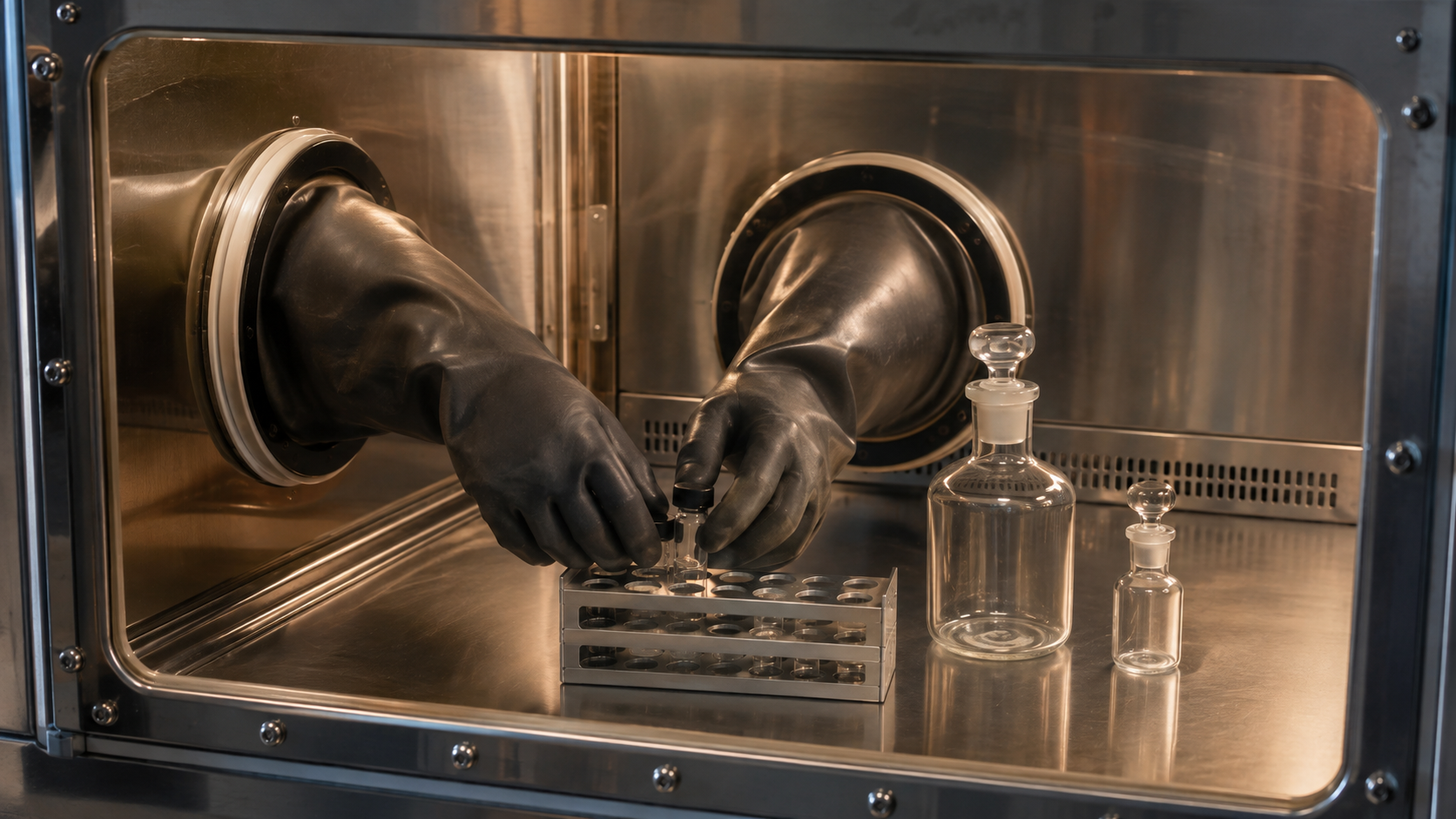
Even a correctly released solvent can absorb moisture during routine handling. The laboratory should define how the container is opened, whether transfers occur under a dry atmosphere, which tools are permitted, how long the bottle may remain open, and when remaining material should be requalified or discarded. Follow the current SDS, product documentation, and site procedure.
A Risk-Based Selection Table
| Selection question | What to verify | Why it matters |
|---|---|---|
| How sensitive is the workflow? | Maximum allowable water contribution and evidence from development or validation | Prevents buying a grade that is either inadequate or unnecessarily stringent |
| What does the specification promise? | Water limit, units, test method, and release criteria | Makes supplier comparisons meaningful |
| What does the lot document show? | Correct product code, lot number, water result, and approval status | Connects the received container to documented quality |
| How will it be used? | Package size, opening frequency, transfer method, and post-opening period | Controls moisture introduced after receipt |
| What other properties matter? | Assay, residue, stabilizer, metals, spectral background, or application-specific tests | A water limit alone does not establish overall suitability |
Comparing Examples Without Assuming Interchangeability
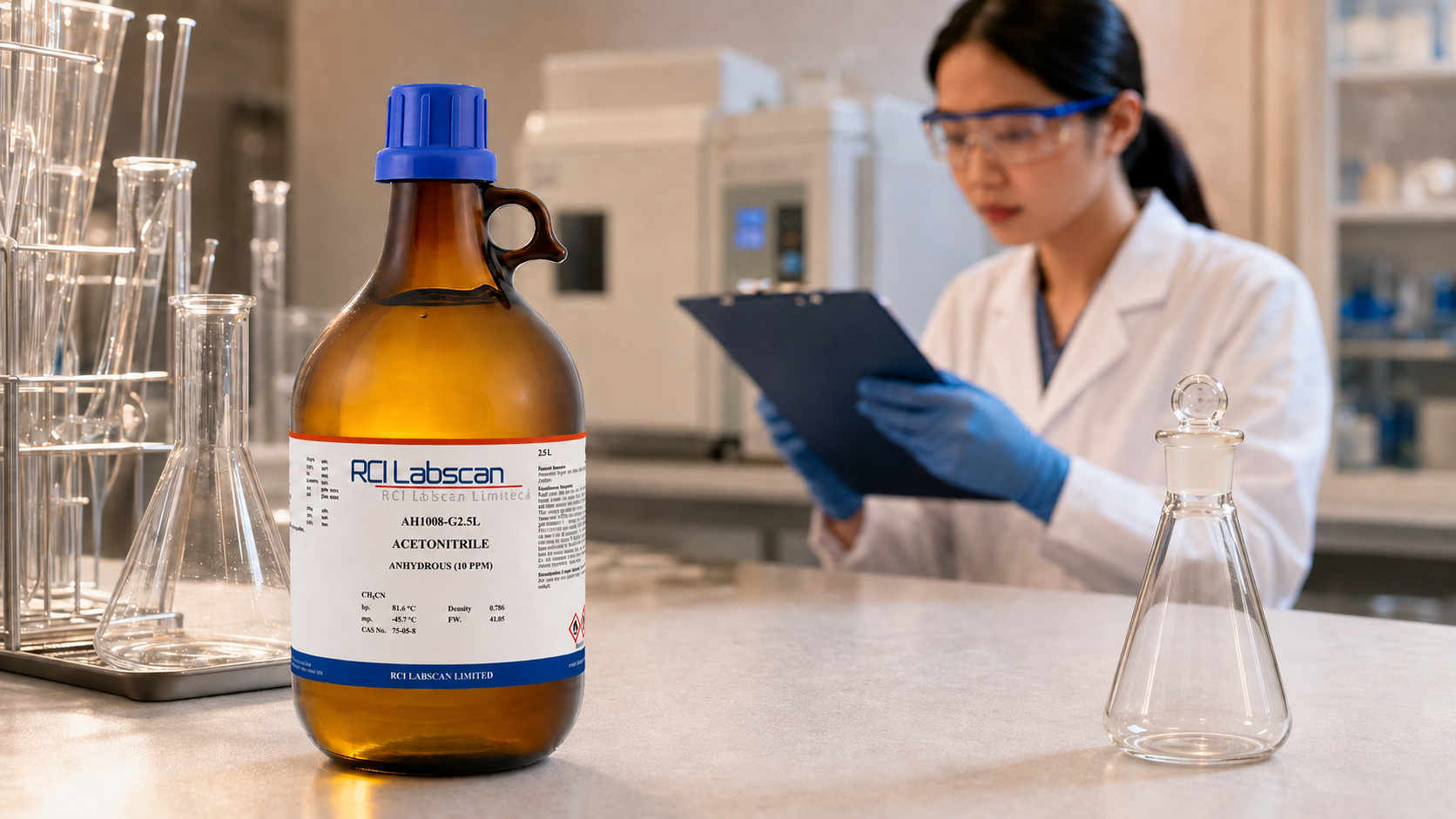
RCI Labscan lists several low-moisture products for anhydrous applications, including Acetonitrile, Anhydrous (10 ppm), n-Hexane 99%, Anhydrous, and Diethyl Ether, Anhydrous (50 ppm). These examples illustrate why buyers must review the individual specification rather than treating “anhydrous” as a single universal grade.
The products differ in solvent identity, published moisture designation, physical hazards, and possible applications. They should never be substituted for one another simply because they share the anhydrous label. For every purchase, confirm the current specification, SDS, packaging options, and lot documentation with the supplier.
Handling Practices That Protect the Purchase
- Plan the transfer before opening: prepare dry, compatible equipment and the receiving vessel.
- Minimize exposure: close the container promptly and avoid leaving caps or closures on potentially wet surfaces.
- Prevent cross-contamination: do not return unused solvent to the original bottle.
- Record first opening: document the date, user, and any laboratory-defined post-opening limit.
- Use suitable storage: follow the SDS and manufacturer instructions for temperature, ventilation, ignition control, segregation, and container compatibility.
- Investigate unexpected results: include water pickup, transfer tools, and bottle history in the review rather than assuming a supplier defect.
Common Purchasing Mistakes
- Selecting the lowest water number without defining the application's real need
- Comparing ppm values without checking whether the units and methods are equivalent
- Ignoring stabilizers, assay, residue, spectral background, or elemental impurities
- Buying a package that will be opened too many times before it is consumed
- Assuming the release specification will remain unchanged after poor handling
- Approving a supplier change without a technical comparability review
FAQ
Does anhydrous mean absolutely no water?
No. In commercial laboratory products, anhydrous usually indicates a controlled low-moisture grade with a defined specification. Review the numerical limit and test method for the exact product.
Is a 10 ppm solvent always better than a 50 ppm solvent?
Not automatically. The correct choice is the grade that meets the workflow's validated requirement, including properties other than water. The two values may also belong to different solvents and applications.
Can an unopened specification be assumed after the bottle is opened?
No. The supplier's release result describes the tested lot under defined conditions. Moisture can enter during opening, transfer, or storage, so the laboratory must control and document post-opening use.
Should procurement define the water limit?
Procurement should capture and verify the requirement, but the acceptance limit should be set or approved by the method owner, technical group, or quality function.
Conclusion
An anhydrous solvent is a controlled input, not a guarantee that the entire workflow is dry. A sound purchase connects a method-based water requirement to the current product specification, lot documentation, package size, and a realistic handling plan. This approach protects both analytical performance and purchasing value.
Leave a comment!