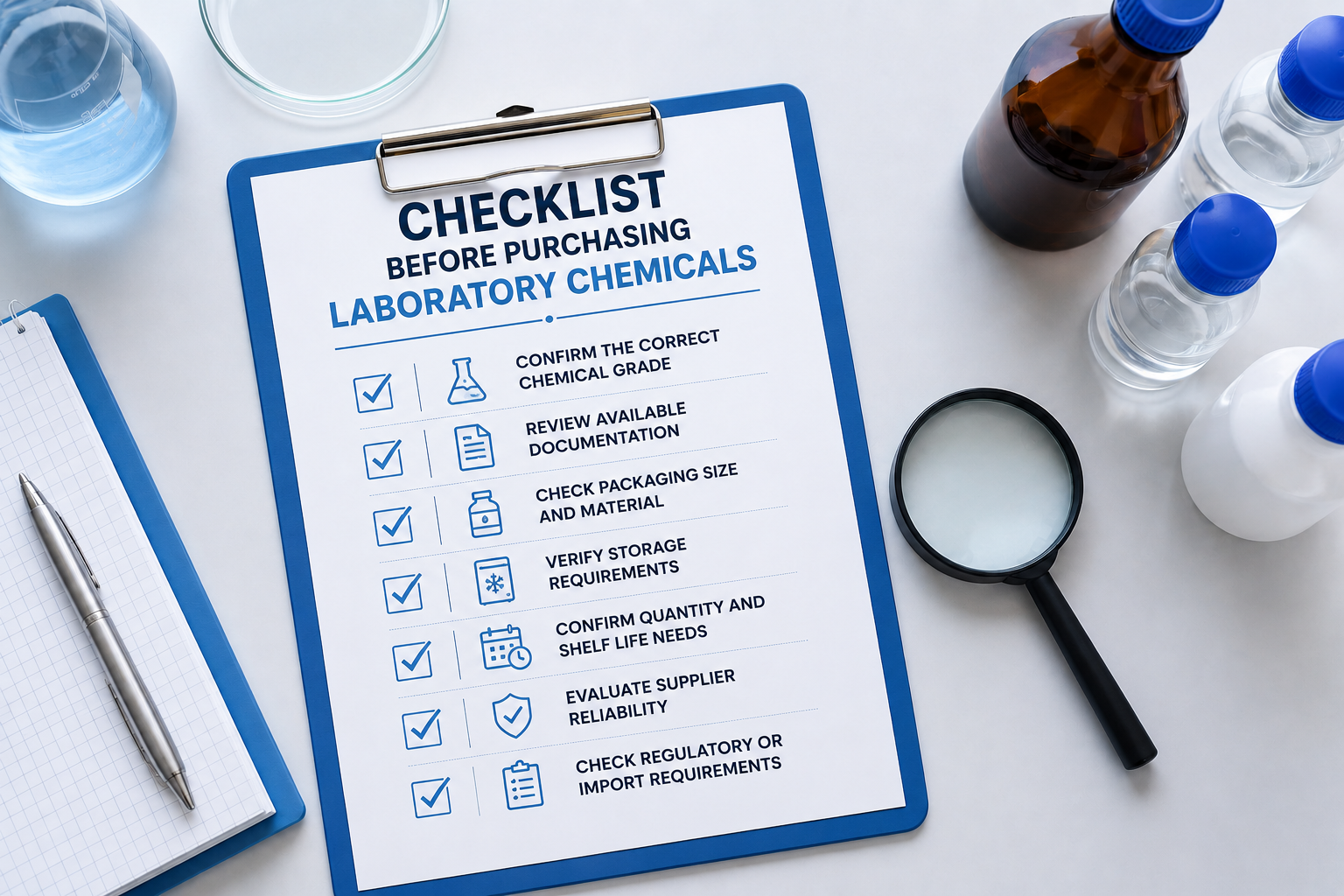
Checklist Before Purchasing Laboratory Chemicals
A practical guide to help procurement teams and lab users order with confidence

Direct Answer
Before purchasing laboratory chemicals, users should confirm the correct chemical grade for their application, review available documentation such as SDS, COA, and product specification, check packaging size and material suitability, and verify supplier reliability and lead time. Taking these steps helps reduce the risk of receiving an unsuitable product, delays in analytical work, or compliance issues in regulated laboratories.
Why a Purchasing Checklist Matters
Laboratory chemical purchases are not always straightforward. The wrong grade, missing documentation, or unsuitable packaging can lead to delays, wasted budget, or inaccurate analytical results. A simple checklist helps procurement teams and lab users make confident, well-informed purchasing decisions, especially when ordering from a new supplier or for a new application.
1. Confirm the Correct Chemical Grade
Different applications require different chemical grades, such as general laboratory grade, AR grade, ACS grade, HPLC grade, or LC-MS grade. Using an unsuitable grade may affect analytical accuracy or method compliance.
Before ordering, confirm:
- The grade required by your method or protocol
- Whether the application involves general use, analytical testing, or sensitive instrumentation
- Whether the supplier's grade definition matches your laboratory's requirements
2. Review Available Documentation
Documentation helps confirm that a product meets your laboratory's quality and compliance requirements. Common documents to request include:
- Safety Data Sheet (SDS)
- Certificate of Analysis (COA)
- Product specification sheet
For regulated laboratories or quality-sensitive applications, documentation should be reviewed and retained as part of standard procurement practice.
3. Check Packaging Size and Material
Packaging affects storage, handling, and usage efficiency. Consider:
- Whether the packaging size matches your typical usage volume
- Glass versus plastic packaging suitability for the specific chemical
- Whether the packaging supports safe handling and storage in your facility
Choosing an appropriate packaging size can also help reduce waste from unused chemical that expires before use.
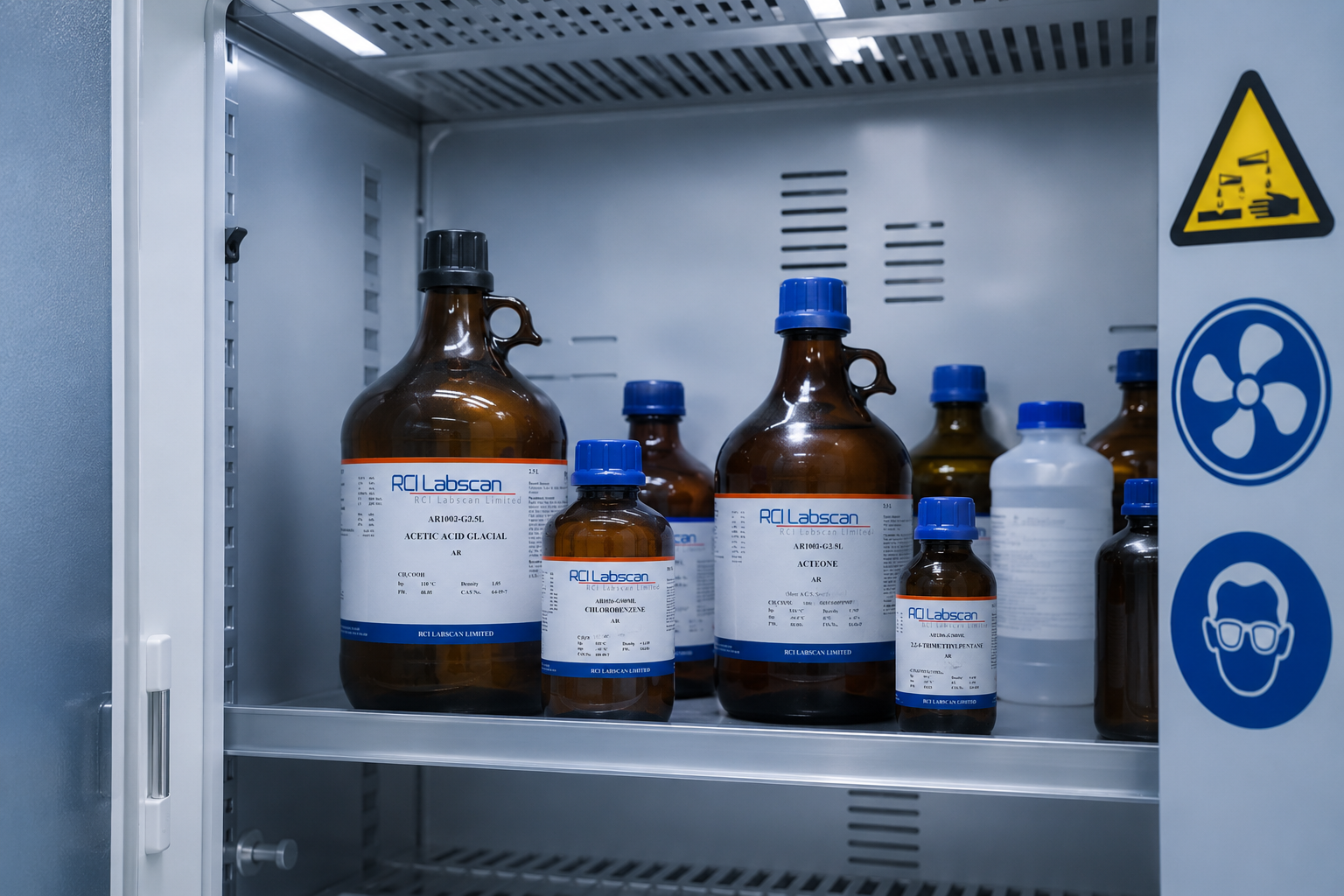
4. Verify Storage Requirements
Some chemicals require specific storage conditions, such as temperature control, ventilation, or separation from incompatible substances. Before ordering, check:
- Whether your facility can meet the storage conditions listed on the SDS
- Available storage space and safety equipment
- Local regulations related to storage of the specific chemical class
5. Confirm Quantity and Shelf Life Needs
Ordering an appropriate quantity helps avoid both shortages and unnecessary waste. Consider:
- Expected consumption rate for the application
- Shelf life or expiry considerations relevant to your usage timeline
- Whether smaller, more frequent orders may be more practical than bulk purchasing
6. Evaluate Supplier Reliability
Supplier consistency affects both product quality and project timelines. Before purchasing, consider:
- Whether the supplier can provide consistent lot-to-lot quality
- Availability of technical support for product-related questions
- Lead time for delivery, especially for time-sensitive laboratory work
7. Check Regulatory or Import Requirements
For certain chemical classes, additional documentation or permits may be required, depending on local regulations. Users should confirm any applicable requirements with their procurement or compliance team before placing an order.
Quick Purchasing Checklist Summary
- Confirmed the correct chemical grade for the application
- Reviewed SDS, COA, and product specification
- Checked packaging size and material suitability
- Verified storage requirements and facility capability
- Confirmed appropriate order quantity and shelf life
- Evaluated supplier reliability and lead time
- Checked any applicable regulatory or import requirements
Related RCI Labscan Products
RCI Labscan offers a range of laboratory chemicals across multiple grades and packaging options, supported by product documentation such as SDS and COA. For product specifications, packaging options, or purchasing inquiries, customers may contact RCI Labscan or an authorized local distributor.
FAQ
What is the most important factor to check before buying laboratory chemicals?
There is no single most important factor; however, confirming the correct chemical grade and reviewing documentation such as SDS and COA are commonly considered essential first steps before purchasing.
Do I always need a Certificate of Analysis (COA) before purchasing?
For many analytical or regulated applications, a COA helps confirm product quality for a specific batch. Requirements may vary depending on the laboratory's internal quality procedures.
How do I know what packaging size to order?
Packaging size should match expected usage volume and shelf life considerations. Ordering a size that will be used within an appropriate timeframe helps avoid waste from expired chemicals.
What should I check if I'm switching to a new supplier?
When switching suppliers, review the new supplier's product specification, documentation practices, and lead time, and compare them with your current requirements to confirm consistency.
Are there special requirements for ordering hazardous chemicals?
Yes, hazardous chemicals may be subject to additional documentation, storage, or transport requirements depending on local regulations. Users should review the SDS and consult their procurement or safety team before ordering.
Explore related products:
Related article:
- Understanding Chemical Grades: Choosing the Right Solution with RCI Labscan
- How to Choose Acetonitrile for HPLC Solvents
Leave a comment!