
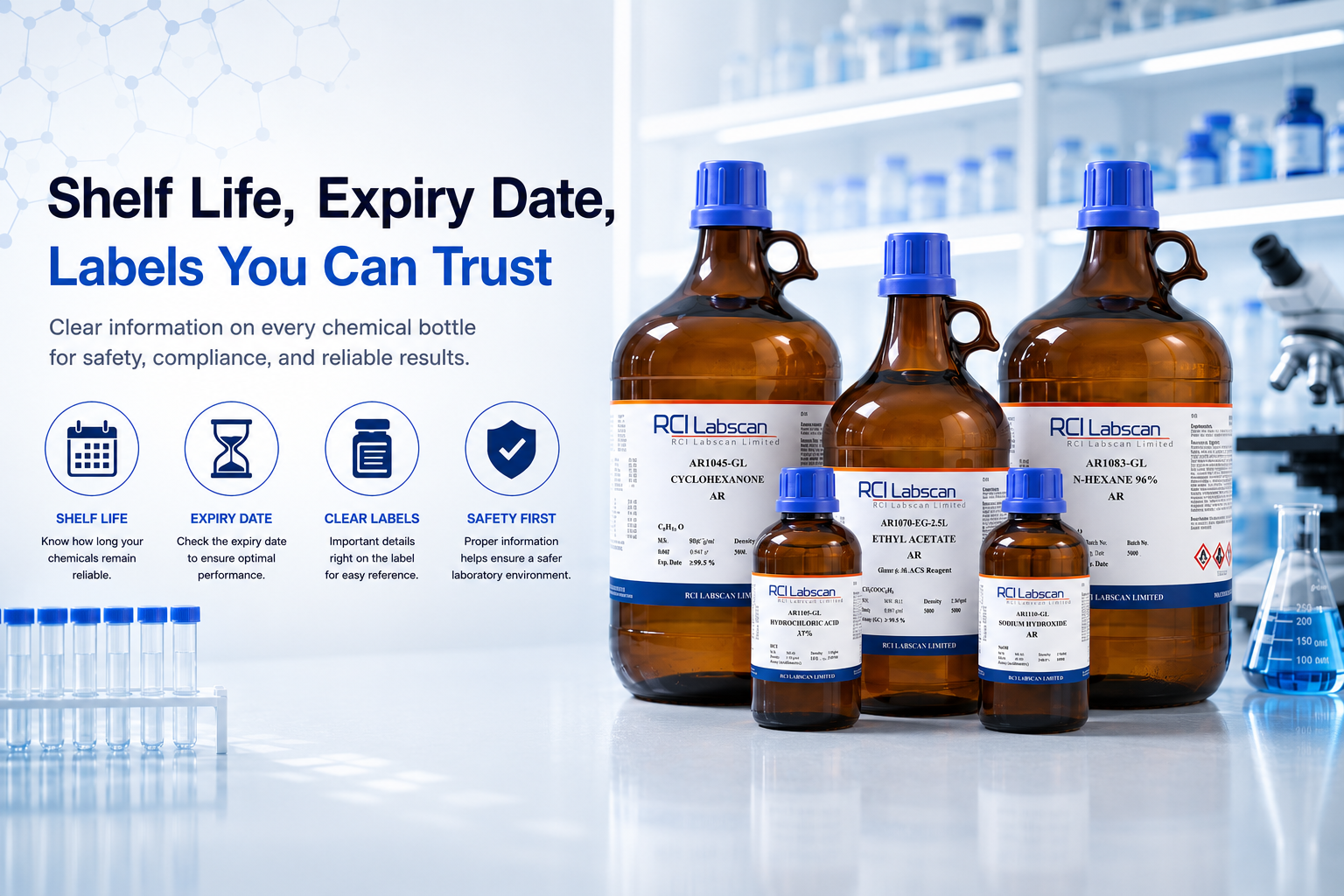
Shelf Life vs Expiry Date: What's the Difference for Laboratory Chemicals?

Direct Answer
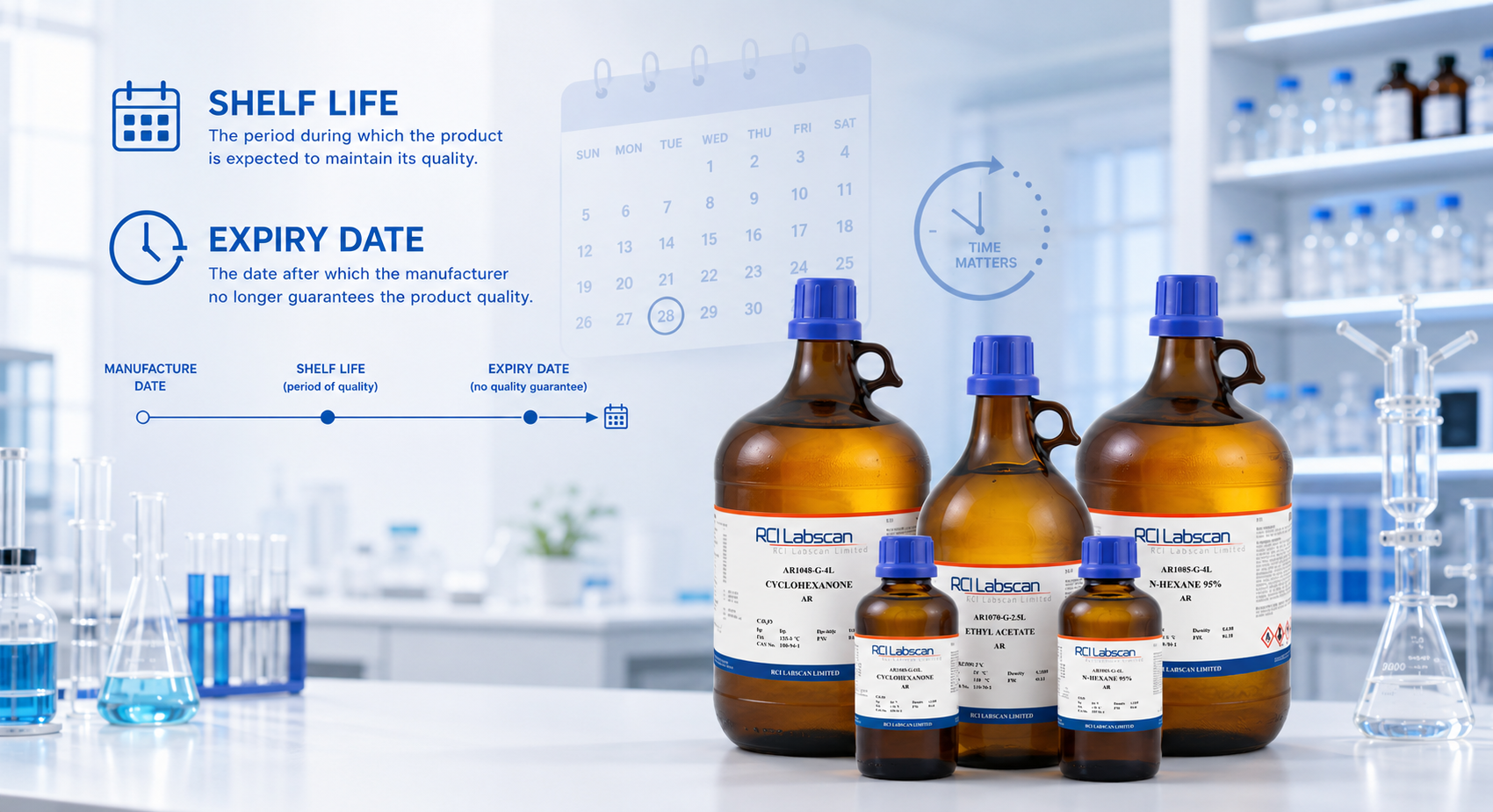
Shelf Life and Expiry Date are related but not identical. Shelf Life refers to the period during which a chemical product is expected to maintain its specified quality when stored under recommended conditions. Expiry Date is the specific calendar date after which the manufacturer no longer guarantees that the product will continue to meet its original specifications.
Understanding the difference helps laboratories manage inventory, maintain analytical quality, and reduce the risk of using chemicals beyond their intended service life.
Why Understanding Shelf Life and Expiry Date Matters
Chemical quality directly affects laboratory accuracy, reproducibility, and safety. Even if a chemical appears unchanged, its purity or performance may gradually decline over time depending on storage conditions and chemical stability.
Understanding the difference between Shelf Life and Expiry Date helps laboratories:
- Maintain analytical reliability
- Improve inventory management
- Reduce chemical waste
- Support regulatory compliance
- Minimize the risk of using degraded chemicals
Shelf Life vs Expiry Date: Key Differences
| Factor | Shelf Life | Expiry Date |
|---|---|---|
| Definition | Expected period during which a product maintains its specified quality under recommended storage conditions | Specific date after which the manufacturer no longer guarantees product performance |
| Format | Time period (e.g., 2 years, 5 years) | Calendar date (e.g., 31 December 2028) |
| Determined by | Stability studies | Manufacturing date plus established Shelf Life |
| Purpose | Indicates expected product stability | Defines the manufacturer's guaranteed period |
| Storage Impact | May be shortened by improper storage | Based on recommended storage conditions |
Note: Shelf Life and Expiry Date are established under recommended storage conditions. Improper storage may reduce product quality before the stated expiry date.
What Is Shelf Life?
Shelf Life is the length of time that a chemical is expected to remain within its approved quality specifications when stored according to the manufacturer's recommendations.
Shelf Life may be established through:
- Stability testing
- Long-term storage studies
- Accelerated stability studies
- Product performance evaluation
- Quality control data
During the stated Shelf Life, the manufacturer expects the product to continue meeting its published specifications when handled and stored correctly.
What Is an Expiry Date?
The Expiry Date is the final date specified by the manufacturer for the guaranteed quality of the product.
It is generally calculated based on:
- Manufacturing Date
- Established Shelf Life
- Product stability data
For example:
| Manufacturing Date | Shelf Life | Expiry Date |
|---|---|---|
| January 2026 | 3 Years | January 2029 |
After the Expiry Date, the manufacturer may no longer guarantee that the product fully meets its original specifications.
Can Chemicals Be Used After the Expiry Date?
The answer depends on the laboratory's quality requirements, internal procedures, and applicable regulations.
Some laboratories may:
- Dispose of expired chemicals immediately.
- Evaluate expired chemicals before further use.
- Perform additional testing to confirm suitability.
- Restrict expired chemicals to non-critical applications.
For regulated laboratories, pharmaceutical quality control, or validated analytical methods, laboratories should always follow internal quality procedures and applicable regulations.
An expired chemical should never be assumed to remain suitable simply because its appearance has not changed.
What Factors Affect Shelf Life?
Several factors can influence how long a chemical maintains its quality.
These include:
- Temperature
- Humidity
- Exposure to light
- Air exposure
- Moisture contamination
- Container integrity
- Frequency of opening
- Chemical stability
Following the manufacturer's recommended storage conditions helps maximize product stability throughout its Shelf Life.
Why Proper Storage Is Important
Even before the Expiry Date, poor storage conditions may reduce chemical quality.
Examples include:
- Leaving bottles open for extended periods
- Exposure to direct sunlight
- Storage above recommended temperatures
- Contamination during repeated use
- Using damaged or improperly sealed containers
Proper storage helps preserve product quality and analytical performance.
Should Laboratories Continue Using Expired Chemicals?
The decision depends on:
- Laboratory quality requirements
- Type of chemical
- Intended application
- Regulatory obligations
- Internal quality management procedures
For example:
| Laboratory Application | Recommended Consideration |
|---|---|
| Pharmaceutical QC | Follow validated procedures and internal quality policies |
| Environmental testing | Follow laboratory quality system requirements |
| Food testing | Verify laboratory procedures before use |
| Research laboratories | Evaluate suitability according to internal practice |
| Educational laboratories | Follow institutional safety policies |
Laboratories should never rely solely on visual inspection when determining whether an expired chemical remains suitable for use.
How Should Laboratories Manage Chemical Shelf Life?
Good laboratory inventory management includes:
- Recording the date received
- Recording the date first opened
- Monitoring expiry dates regularly
- Applying First-In, First-Out (FIFO) principles
- Following recommended storage conditions
- Removing expired products according to laboratory procedures
A well-managed inventory helps reduce waste while supporting laboratory quality systems.
Documentation to Review Before Using Laboratory Chemicals
Before using or purchasing laboratory chemicals, users should review relevant product documentation, including:
- Product Specification
- Safety Data Sheet (SDS)
- Certificate of Analysis (COA)
- Product Label
- Storage Instructions
These documents provide important information regarding quality specifications, storage conditions, and safe handling requirements.
Related RCI Labscan Products
RCI Labscan supplies high-quality laboratory chemicals together with supporting documentation, including Product Specifications, Safety Data Sheets (SDS), and Certificates of Analysis (COA).
For product availability, packaging options, or documentation requests, customers may contact RCI Labscan or an authorized local distributor.
FAQ
What is the difference between Shelf Life and Expiry Date?
Shelf Life refers to the expected period during which a product maintains its specified quality under recommended storage conditions, while the Expiry Date is the specific date after which the manufacturer no longer guarantees product performance.
Does a chemical automatically become unsafe after its Expiry Date?
Not necessarily. However, the manufacturer no longer guarantees that the product meets its original specifications after the Expiry Date. Laboratories should follow their internal quality procedures and applicable regulations before using expired chemicals.
Can improper storage shorten Shelf Life?
Yes. Exposure to excessive heat, moisture, light, or contamination may reduce product quality before the stated Expiry Date.
Should laboratories record the date a chemical bottle is opened?
Yes. Recording the opening date helps laboratories monitor product usage, particularly for chemicals that have a recommended in-use period after opening.
What documents should I review before using laboratory chemicals?
Users should review the Product Specification, Safety Data Sheet (SDS), Certificate of Analysis (COA), product label, and storage instructions before use.
Why is Shelf Life important for laboratory quality?
Understanding Shelf Life helps laboratories maintain analytical accuracy, manage inventory efficiently, reduce waste, and ensure chemicals are used within the manufacturer's recommended quality period.
Conclusion
Understanding the difference between Shelf Life and Expiry Date helps laboratories make better decisions regarding chemical storage, inventory management, and product quality. While Shelf Life indicates the expected period of product stability under recommended storage conditions, the Expiry Date defines the manufacturer's guaranteed period of performance.
Before purchasing or using laboratory chemicals, users should review the Product Specification, Safety Data Sheet (SDS), and Certificate of Analysis (COA), and always follow the manufacturer's storage recommendations and laboratory quality procedures.
Explore Related Products:
Related Articles:
- HPLC vs LC-MS Grade Solvents
- How to Choose Acetonitrile for HPLC Solvents
- Acetonitrile vs Methanol: Which Solvent Should You Choose for HPLC?
Leave a comment!