
LC-MS Grade: What Is It and How Is It Different from HPLC Grade?
(A Practical Guide to Choosing the Right Solvent Grade for LC-MS and HPLC Analysis)
Direct Answer
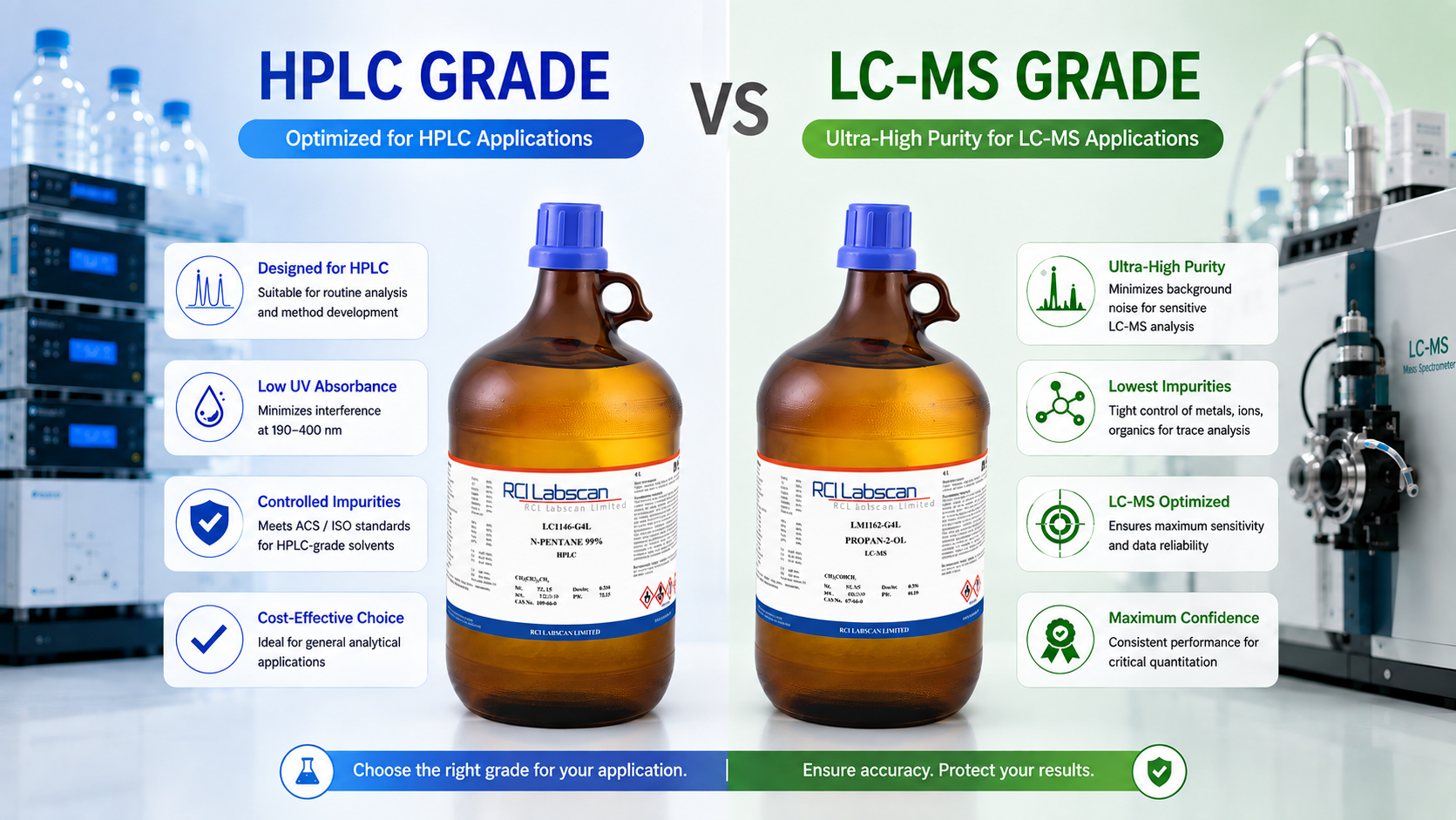
LC-MS grade solvents are high-purity solvents specifically designed for Liquid Chromatography–Mass Spectrometry (LC-MS) applications. They are manufactured with strict control of impurities that may interfere with mass spectrometry detection, including trace contaminants, non-volatile residues, and substances that can contribute to background signals or ion suppression.
HPLC grade solvents, on the other hand, are high-purity solvents designed for High Performance Liquid Chromatography (HPLC). They are primarily controlled for properties that support reliable chromatographic separation, such as purity, low residue, low UV absorbance, and consistent lot-to-lot quality.
In simple terms, HPLC grade solvents focus on chromatographic performance, while LC-MS grade solvents are designed to support both chromatographic separation and highly sensitive mass spectrometry detection.
However, grade specifications can vary between manufacturers. Therefore, laboratories should always review the Product Specification and Certificate of Analysis (CoA) before selecting a solvent for a specific analytical method.
Why the Difference Matters
Choosing the correct solvent grade is important because solvent quality can directly affect analytical performance.
Although both HPLC and LC-MS methods require high-purity solvents, mass spectrometers are highly sensitive to trace contaminants. Even very small amounts of impurities can affect the detected signal.
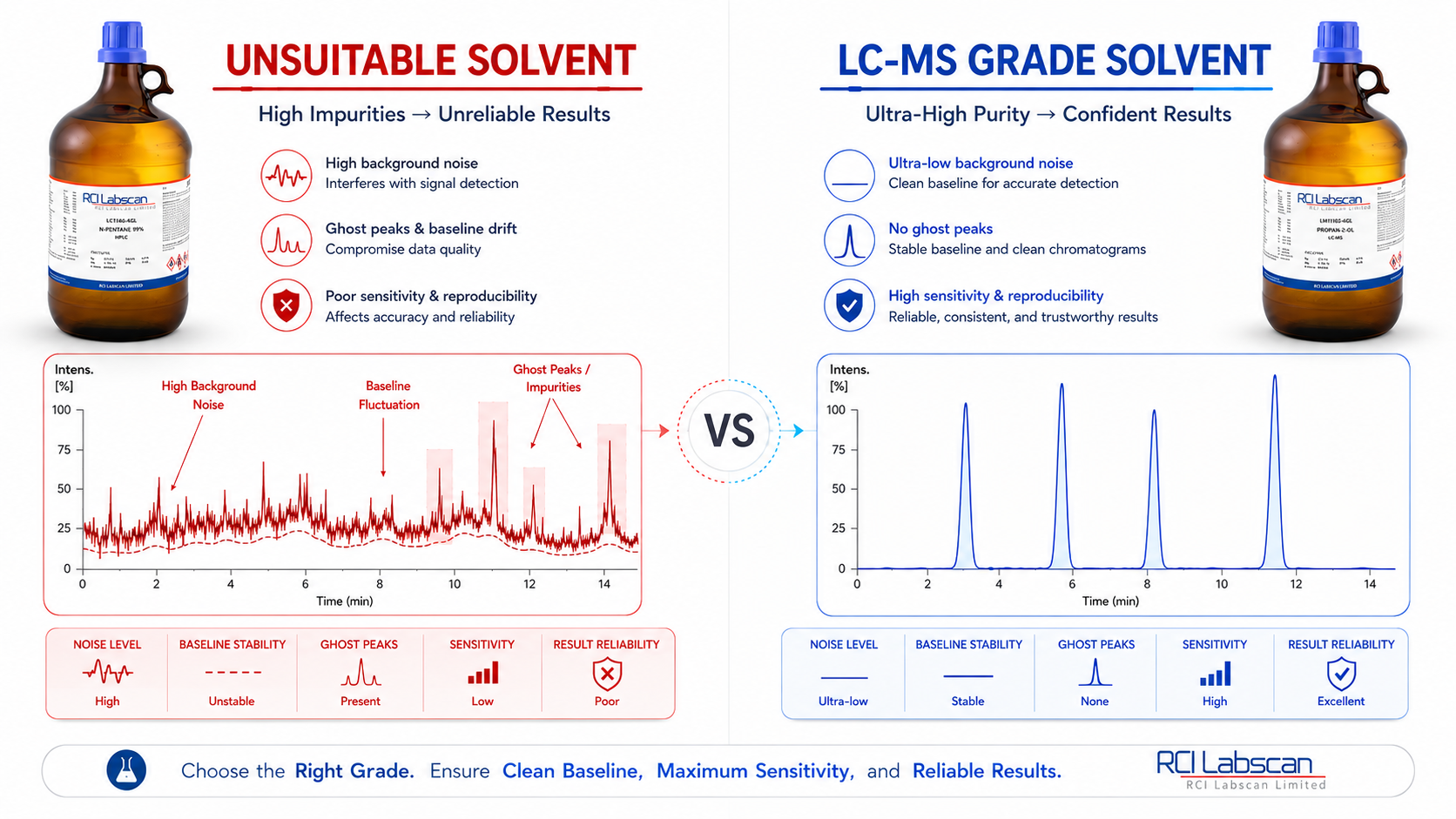
For HPLC analysis, unsuitable solvent quality may contribute to:
- Baseline noise
- Ghost peaks
- Poor peak shape
- Retention time instability
- Poor reproducibility
- Background absorbance, particularly with UV detection
LC-MS analysis can face additional challenges, including:
- Increased background signals
- Ion suppression
- Reduced sensitivity
- Unstable MS response
- Source contamination
- Poor reproducibility in trace-level analysis
Therefore, a solvent that is suitable for HPLC should not automatically be assumed to be suitable for LC-MS.
What Is HPLC Grade Solvent?
HPLC grade solvent is a high-purity solvent intended for High Performance Liquid Chromatography. It is commonly used as a mobile phase component, sample preparation solvent, or for other applications within HPLC workflows.
Typical quality characteristics of HPLC grade solvents include:
- High purity
- Low residue
- Low UV absorbance
- Controlled impurities
- Consistent lot-to-lot quality
- Suitability for chromatographic analysis
These properties help laboratories maintain stable baselines, good peak separation, and reproducible analytical results.
HPLC grade solvents are commonly used in:
- Routine HPLC analysis
- QA/QC testing
- Pharmaceutical analysis
- Food and beverage testing
- Environmental analysis
- Research and method development
- Industrial laboratory testing
What Is LC-MS Grade Solvent?
LC-MS grade solvent is a high-purity solvent designed for Liquid Chromatography–Mass Spectrometry applications. Compared with general HPLC solvents, LC-MS grade solvents typically place greater emphasis on controlling impurities that can affect mass spectrometry detection.
In addition to solvent purity, particular attention is given to contaminants that may generate background signals or interfere with the ionization process.
Important quality characteristics may include:
- High purity
- Low background
- Low non-volatile residue
- Low levels of trace impurities
- Reduced risk of ion suppression
- Consistent performance
- Compatibility with LC-MS and LC-MS/MS applications
LC-MS grade solvents are therefore commonly used in applications requiring high sensitivity, including:
- Pharmaceutical analysis
- Bioanalysis
- Drug residue analysis
- Trace-level analysis
- Proteomics
- Metabolomics
- LC-MS/MS analysis
HPLC Grade vs LC-MS Grade Solvents
The key difference between HPLC grade and LC-MS grade solvents is the level and type of impurity control required for the analytical application.
| Comparison Point | HPLC Grade Solvent | LC-MS Grade Solvent |
|---|---|---|
| Main Application | HPLC analysis | LC-MS / LC-MS/MS analysis |
| Detection Focus | UV, PDA, RI, fluorescence, and other HPLC detectors | Mass spectrometry |
| Purity Requirement | High purity | High purity with tighter control of MS-relevant impurities |
| UV Absorbance | Important for UV/PDA detection | Important, with additional MS compatibility requirements |
| Residue Control | Low residue | Very low / controlled non-volatile residue |
| Background Signal | Controlled to support clean chromatograms | Strictly controlled to minimize MS background |
| Ion Suppression | Generally not a primary concern | Important consideration |
| Typical Applications | Routine HPLC, QA/QC, method development | LC-MS, LC-MS/MS, trace analysis |
| Cost | Generally more suitable for routine analysis | Generally higher due to tighter specifications |
| Recommended Use | HPLC methods without MS | Methods using mass spectrometry |
Note: Specifications can vary by manufacturer and product. Always check the individual Product Specification and CoA rather than relying on the grade name alone.
Why Does LC-MS Require Higher Solvent Quality?
Mass spectrometry can detect compounds at very low concentrations. As a result, even trace contaminants in the mobile phase may affect analytical performance.
For example, contaminants entering the ion source may generate background ions or compete with the analyte during the ionization process.
This can lead to:
Contaminants → Background Signal → Ion Suppression → Reduced Sensitivity
Using an appropriate LC-MS grade solvent helps minimize potential sources of background interference and supports more stable MS signals. This is particularly important for applications involving trace-level detection, quantitative LC-MS/MS, and highly sensitive analytical methods.
Can LC-MS Grade Solvent Be Used for HPLC?
Yes. In general, LC-MS grade solvents can be used for HPLC when the product specification is suitable for the analytical method.
Because LC-MS grade solvents are designed for highly sensitive applications and typically have stringent impurity controls, they are often suitable for HPLC applications as well.
However, using LC-MS grade solvent for routine HPLC analysis may not always be necessary. For example, if a laboratory performs routine HPLC analysis using UV or PDA detection and the method does not require mass spectrometry compatibility, a suitable HPLC grade solvent may provide the required performance at a more economical cost.
Therefore, a higher-grade solvent is not automatically the better choice for every application.
Can HPLC Grade Solvent Be Used for LC-MS?
HPLC grade solvents should not automatically be used for LC-MS.
Although HPLC grade solvents offer high purity, their specifications may not include the same level of control over impurities that are particularly relevant to mass spectrometry.
Using an unsuitable solvent in LC-MS may increase the risk of:
- High background signals
- Ion suppression
- Reduced sensitivity
- Unstable MS response
- Source contamination
- Poor reproducibility
If an analytical method or instrument specification requires LC-MS grade solvent, laboratories should select a product specifically qualified for LC-MS applications.
HPLC Grade or LC-MS Grade: Which One Should You Choose?
The best way to choose a solvent grade is to start with a simple question:
“What instrument are you using, and how sensitive does the analysis need to be?”
Choose HPLC grade solvent when:
- You are performing routine HPLC analysis
- The detector is UV or PDA
- The detector is RI or fluorescence
- Mass spectrometry is not involved
- You are performing routine QA/QC testing
- Cost efficiency is important for routine analysis
- The analytical method specifies HPLC grade solvent
Choose LC-MS grade solvent when:
- You are using LC-MS or LC-MS/MS
- The analysis requires high sensitivity
- You are performing trace-level analysis
- The method is sensitive to ion suppression
- Low background signal is required
- You are performing pharmaceutical or bioanalytical analysis
- You are working with proteomics or metabolomics applications
- The instrument or analytical method specifies LC-MS grade solvent
In addition, laboratories should review the Product Specification and Certificate of Analysis (CoA) before use, particularly when the analytical method has specific requirements for purity or trace impurities.
What About Water and Mobile Phase Additives?
Organic solvents such as methanol and acetonitrile are not the only components that can affect LC-MS performance.
Water and mobile phase additives can also contribute to background signals or contamination if their quality is not appropriate for sensitive MS applications.
Depending on the method, laboratories may consider products such as:
- LC-MS grade water
- LC-MS grade methanol
- LC-MS grade acetonitrile
- Suitable formic acid
- Suitable ammonium formate
- Suitable ammonium acetate
The quality of the entire mobile phase system should therefore be considered rather than focusing on the organic solvent alone.
Common Solvents Available in HPLC and LC-MS Grades
Several commonly used solvents are available in both HPLC and LC-MS grades, depending on the manufacturer and application.
Examples include:
- Acetonitrile HPLC / Acetonitrile LC-MS
- Methanol HPLC / Methanol LC-MS
- Water HPLC / Water LC-MS
- Isopropanol HPLC / Isopropanol LC-MS
However, laboratories should not select a solvent based on the solvent name alone.
A more appropriate approach is to consider:
Solvent → Grade → Specification → Detector → Analytical Method
For example, different grades of acetonitrile may have different specifications for purity, UV absorbance, residue, and trace impurities.
How to Check Solvent Quality Before LC-MS Analysis
Before introducing a solvent into an LC-MS system, laboratories should review the manufacturer's product information and supporting documentation.
Key points to check include:
- Product Grade: Confirm that the product is LC-MS grade or meets the grade specified by the analytical method.
- Product Specification: Review purity requirements and specifications for relevant impurities.
- Certificate of Analysis (CoA): Check the CoA for the actual batch or lot being used.
- Residue and Trace Impurities: Review available information on non-volatile residue and trace-level contaminants.
- Application Compatibility: Confirm that the solvent is suitable for the LC-MS or LC-MS/MS method and instrument.
These checks can help laboratories reduce solvent-related analytical problems and improve confidence in their results.
FAQ
What is LC-MS grade solvent?
LC-MS grade solvent is a high-purity solvent designed for Liquid Chromatography–Mass Spectrometry. It places particular emphasis on controlling impurities that may affect background signal, ion suppression, and MS sensitivity.
What is the difference between LC-MS grade and HPLC grade?
HPLC grade solvents primarily focus on chromatographic performance, while LC-MS grade solvents are designed to support both chromatographic separation and sensitive mass spectrometry detection, with tighter control of MS-relevant impurities.
Is LC-MS grade better than HPLC grade?
Not necessarily. The appropriate grade depends on the application. HPLC grade is often sufficient for routine HPLC analysis, while LC-MS grade is more appropriate for methods using mass spectrometry and requiring high sensitivity.
Can LC-MS grade solvent be used for HPLC?
Yes. LC-MS grade solvents can generally be used for HPLC when their specifications are suitable for the method. However, routine HPLC applications may not require the additional impurity control provided by LC-MS grade solvents.
Can HPLC grade solvent be used for LC-MS?
Not automatically. Laboratories should review the product specification and analytical method before using HPLC grade solvent for LC-MS. For LC-MS and LC-MS/MS applications, LC-MS grade is generally the safer choice.
Which solvent grade should I use for LC-MS/MS?
For LC-MS/MS, laboratories should generally choose LC-MS grade solvent, particularly when the method requires high sensitivity, low background signal, and reliable trace-level detection.
Does LC-MS grade mean the solvent contains no impurities?
No. Even high-purity solvents can contain trace levels of impurities. LC-MS grade indicates that the product meets defined specifications for sensitive LC-MS applications. Laboratories should review the actual Product Specification and CoA for the specific product and batch.
Choose the Right Solvent Grade with RCI Labscan
Choosing the appropriate solvent grade is an important part of achieving reliable analytical performance.
HPLC grade is suitable for many routine HPLC and analytical testing applications, while LC-MS grade is designed for applications requiring high sensitivity and mass spectrometry detection.
Before selecting a solvent, laboratories should consider the analytical method, detector, instrument, purity requirements, and product specifications.
RCI Labscan supports laboratories in research, quality control, pharmaceutical testing, environmental analysis, and industrial applications with high-purity solvents, consistent quality, and technical documentation for analytical applications.
Choose the right grade. Reduce interference. Analyze with confidence.
Explore Related Products:
- View all HPLC Grade products
- View all LC-MS Grade products
- Acetonitrile HPLC
- Methanol HPLC
- Acetonitrile LC-MS
- Methanol LC-MS
Related Articles:
Leave a comment!