
Buffer Capacity vs pH: Why Correct pH Does Not Guarantee a Stable Method
A correct initial pH does not show how strongly a solution will resist a later pH change. Two buffers can begin at approximately the same pH yet respond differently to an acid or base input because their buffer concentrations differ. For laboratory methods, pH measurement and buffer composition answer different questions, and both need to match the procedure.
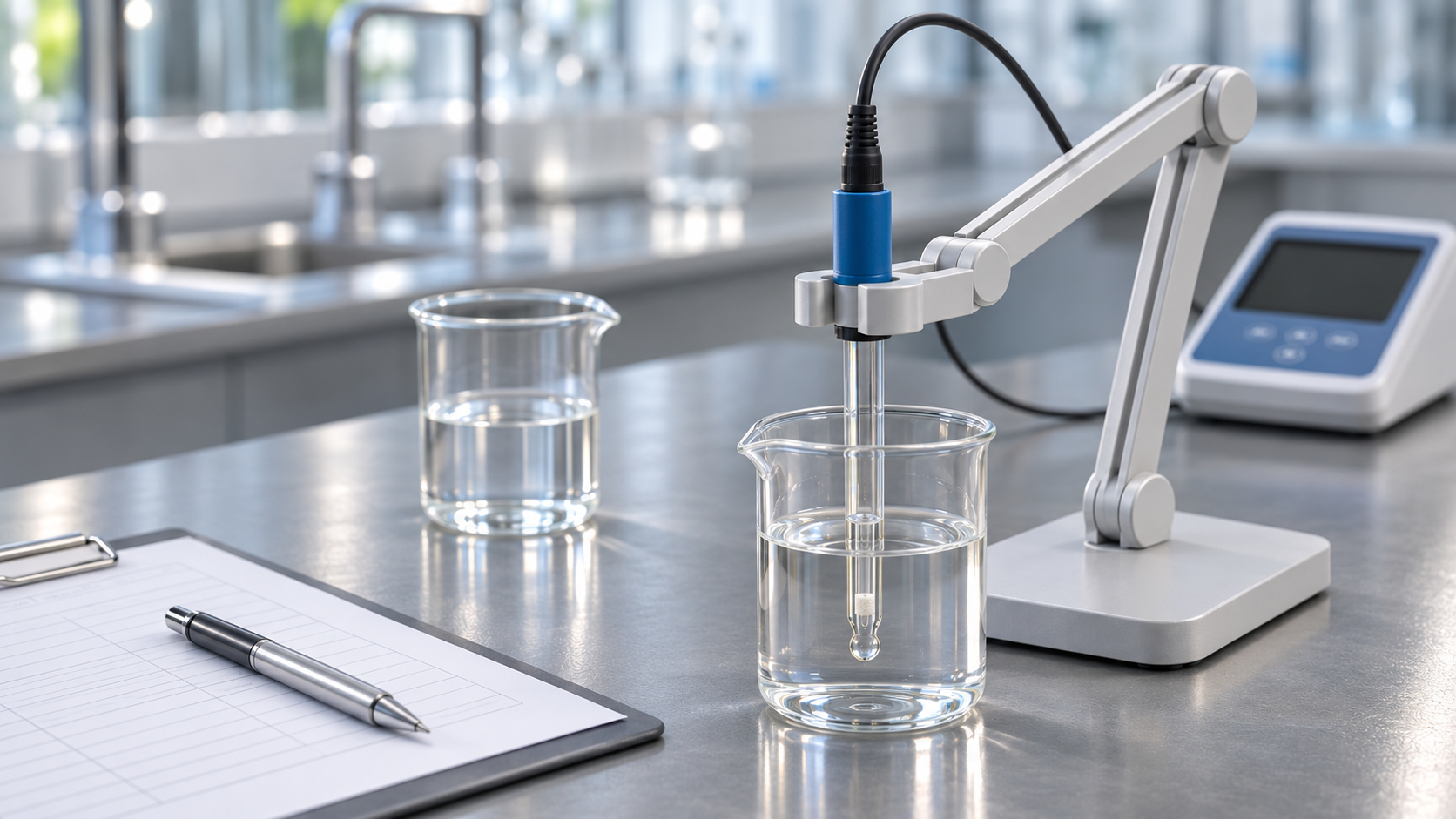
What does pH tell you?
pH describes the acid–base state of a solution under the measurement conditions. More precisely, its definition uses hydrogen-ion activity, which accounts for how ions behave in their chemical environment. A pH value is therefore more than a simple count of hydrogen ions. It also does not state the total amount of buffering material present.
A stable meter display means the reading has stabilized under those conditions. It does not establish that the solution will maintain that pH after its composition changes. Meter calibration remains necessary for reliable measurement, but it is a separate question from buffer capacity.
What does buffer capacity tell you?
A buffer commonly contains a weak acid and its conjugate base, or a weak base and its conjugate acid. The base member can react with added acid, while the acid member can react with added base. This reduces the resulting pH change within the useful capacity of that buffer system.
Buffer capacity describes resistance to pH change. Quantitatively, it relates a small acid or base input per unit solution volume to the pH change it produces. Capacity is finite and depends on the starting composition. A buffer does not hold pH perfectly constant or neutralize unlimited acid or base.
| Question | Relevant information | What it cannot establish alone |
|---|---|---|
| What is the pH now? | A suitable measurement at documented conditions. | Resistance to a later acid or base input. |
| How much does pH resist change? | Buffer identity, component ratio, total concentration and solution conditions. | Performance of the complete analytical method. |
| Is the method consistent? | Application-specific evidence for the analytes, matrix, separation and detection conditions. | Universal suitability of another buffer at the same pH. |
Why can two buffers have the same pH but different capacity?
For a simple weak-acid buffer, a useful dilute-aqueous approximation is the Henderson–Hasselbalch relationship:
pH ≈ pKa + log10([A−]/[HA])
HA represents the weak acid and A− its conjugate base. The brackets represent their equilibrium concentrations. The pKa describes the acid's dissociation equilibrium under the stated conditions. The equation highlights the component ratio, rather than their total concentration. Its concentration form is an approximation that neglects differences in activity effects.
Imagine two idealized solutions of the same buffer pair, at the same temperature and with equal volumes. Both have equal acid and base concentrations within each solution, so the ratio is one. The second solution has more of both components per unit volume. The approximation predicts the same initial pH near pKa, but the second has more material available to respond to a small acid or base input.
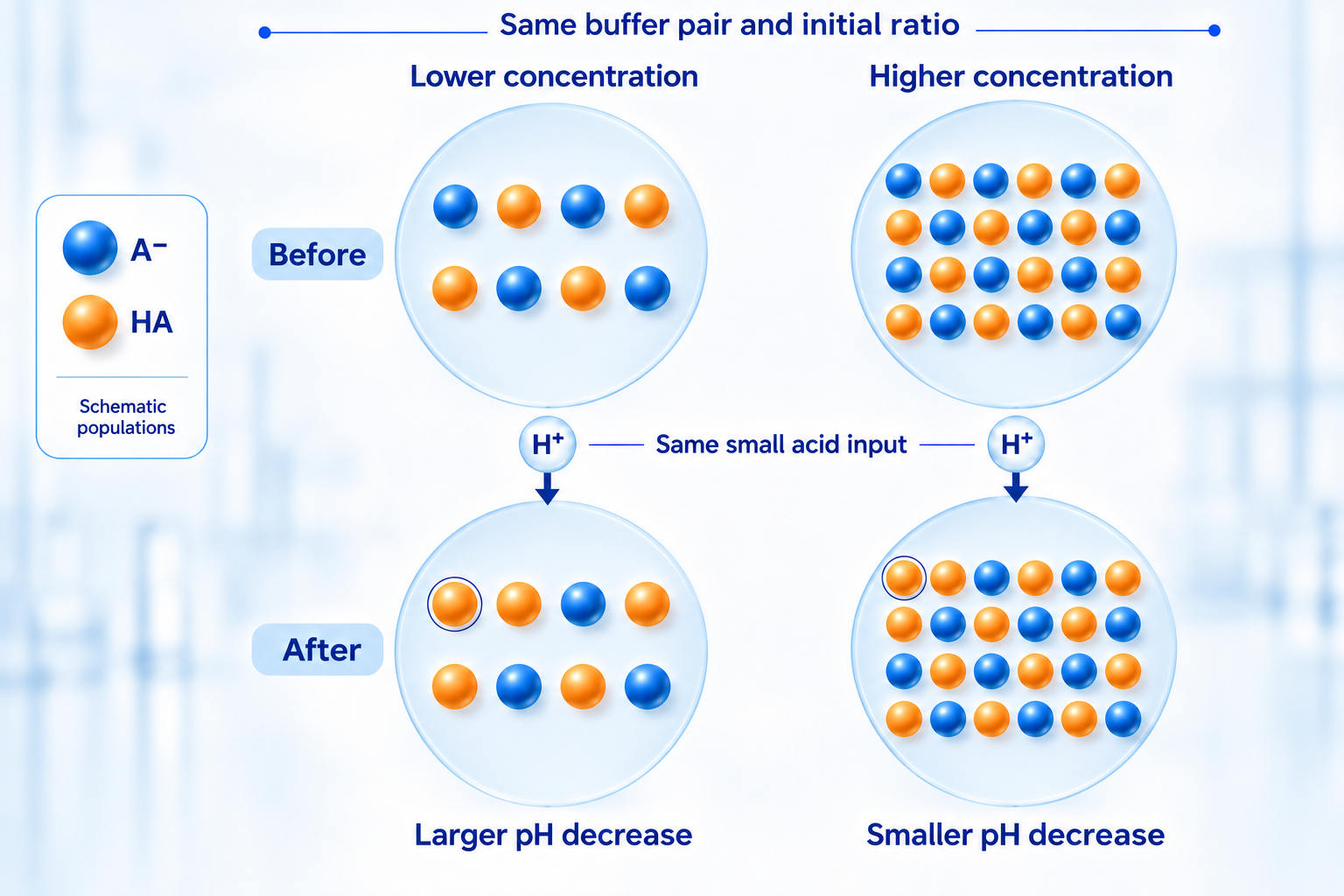
For the same small acid input, the component ratio changes more in the less concentrated solution, producing a larger pH decrease in this idealized comparison. Real solutions can depart from the approximation as activities, solvent composition and other equilibria matter. Equal pH alone cannot establish equal capacity.
How do concentration and pKa affect the result?
For a simple buffer pair at fixed total concentration and conditions, its buffering contribution is greatest near its pKa, where appreciable amounts of both members are present. Farther away, one member becomes less available to respond to the relevant acid or base input. A commonly used approximate working region is within about one pH unit of pKa; this is a screening guide, not a method acceptance limit.
Increasing concentration generally increases the buffer pair's capacity under comparable conditions. It does not automatically improve the method. Salt solubility, column compatibility and detector requirements can constrain the choice. A higher-concentration buffer is therefore not a universal correction for inconsistent results.
What does this mean for a laboratory method?
In liquid chromatography, a pH change can alter the ionization of susceptible analytes and affect retention or selectivity. The importance depends on the analytes and the separation conditions. Limited buffer capacity is one possible contributor to inconsistency, rather than a diagnosis based on a single symptom.
Changing concentration, diluting a solution or mixing an aqueous buffer with organic solvent changes the chemical system. In the dilute idealization, dilution may leave the component ratio and approximate pH similar while reducing capacity. Real pH can also shift. An aqueous pH reading should not be treated as an interchangeable measurement of an aqueous–organic mixture: document which solution was measured, its temperature and the procedure used.
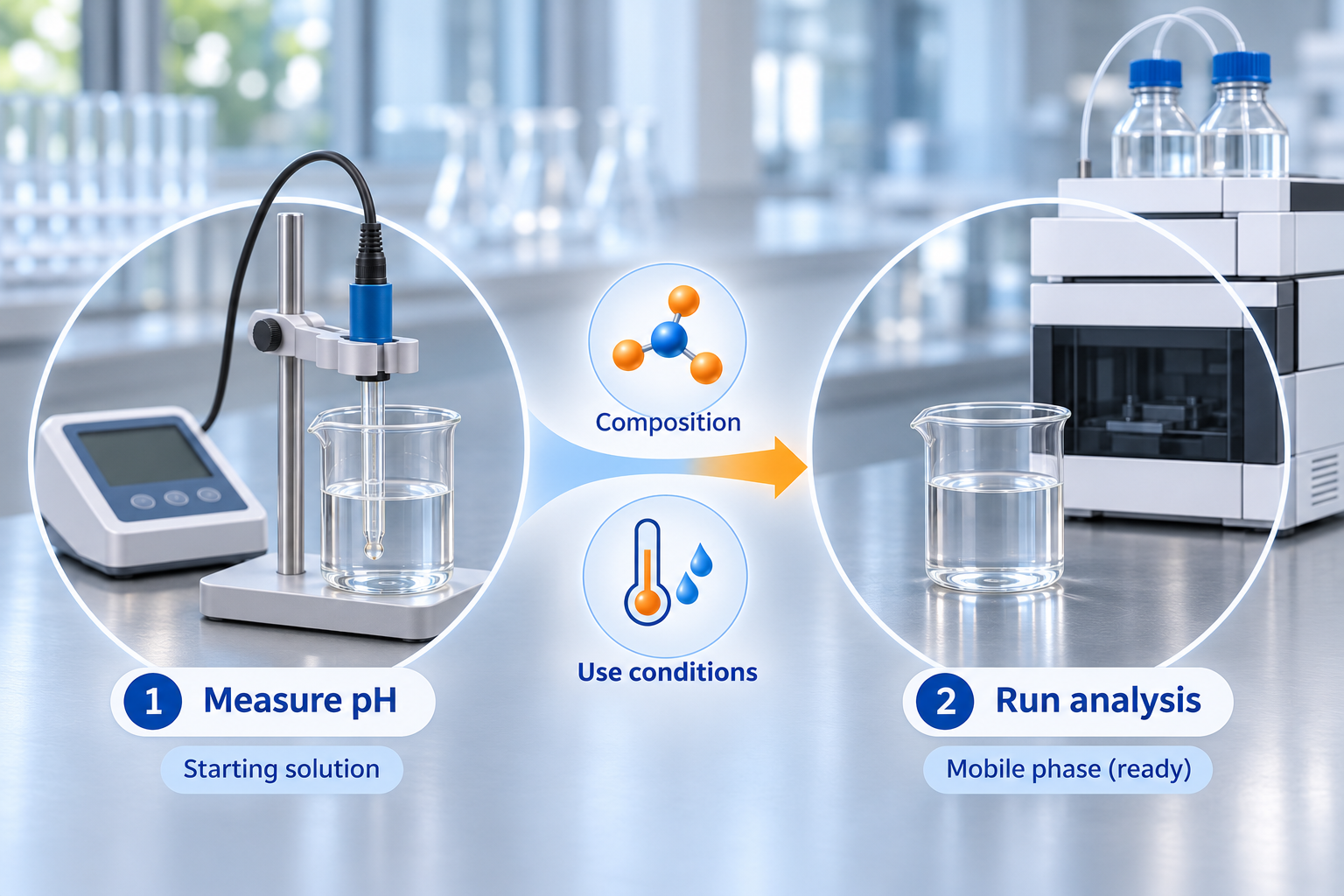
When reviewing a preparation record or discussing an unexpected result, keep these questions together:
- Does the record identify the buffer components and total concentration, as well as the target pH?
- Does the concentration refer to the aqueous component or the final mixed mobile phase?
- Were the measured solution, temperature and preparation sequence the ones specified by the procedure?
- Could the sample or a change in composition introduce a relevant acid–base load?
- Does the complete method provide evidence of acceptable performance under its intended conditions?
These are review questions, not instructions to change a validated method or perform an acid-addition experiment. Follow the approved method, applicable SDS, and column and instrument guidance for preparation, handling and any proposed change.
Practical conclusion
Record and assess pH together with buffer identity, concentration and solution conditions. A correct pH is useful evidence about the starting solution; it cannot by itself demonstrate adequate buffering or stable analytical performance. Ask the method owner to resolve an incomplete buffer description before treating two preparations as equivalent.
Sources and scope
- METTLER TOLEDO: pH Theory Guide, sections 4.1–4.3 and 4.7 — activity, buffer capacity and measurement conditions.
- Shimadzu: pKa and Dissociation Equilibrium — acid–base equilibrium and the component-ratio relationship.
- Shimadzu: Preparing Buffer Solutions — concentration, capacity and solubility considerations.
- Agilent: Control pH During Method Development for Better Chromatography — chromatographic relevance and buffer selection principles.
Related Reading
- How to Choose pH Calibration Buffers: pH 4.01, 7.00, and 10.01 — the separate task of checking the measurement system.
- Volatile vs Nonvolatile Mobile-Phase Additives in LC-MS — detector compatibility when considering mobile-phase additives.
Leave a comment!