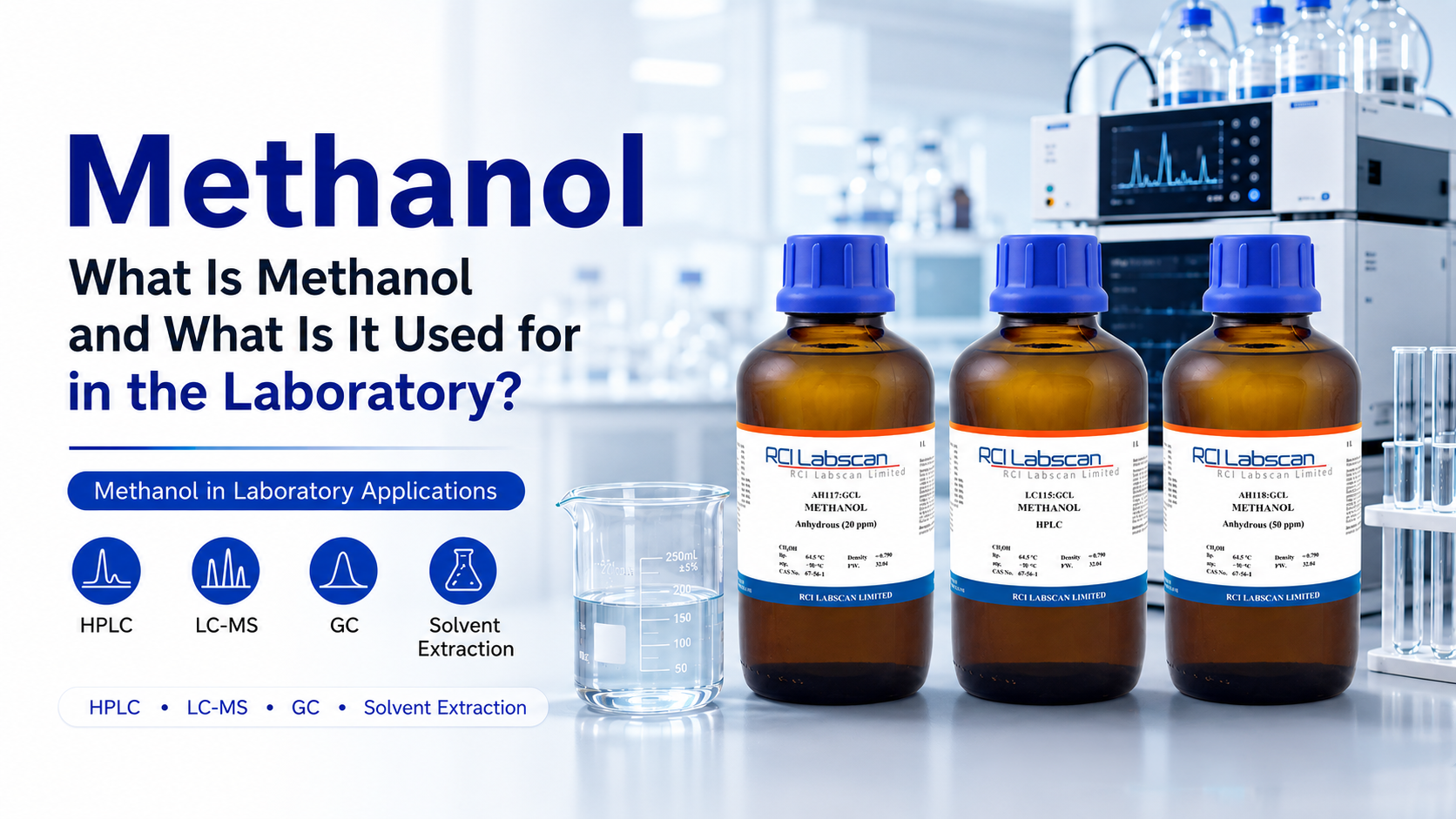

What Is Methanol and What Is It Used for in the Laboratory?
Direct Answer
Methanol is a simple alcohol with the chemical formula CH₃OH. It is a clear, colorless liquid that evaporates easily and mixes completely with water. Because methanol dissolves many types of compounds, laboratories use it for chemical analysis, chromatography—including HPLC, LC-MS, and GC—sample preparation, solution preparation, extraction, and equipment cleaning.
However, methanol is both highly flammable and toxic. Therefore, laboratory personnel should follow proper safety procedures, review the relevant Safety Data Sheet (SDS), and select a suitable solvent grade for their analytical method and laboratory requirements.
What Is Methanol?
Methanol, also known as methyl alcohol or wood alcohol, is the simplest type of alcohol. Its chemical structure contains one carbon atom, four hydrogen atoms, and one oxygen atom, which gives it the formula CH₃OH.
Analytical laboratories commonly use methanol as an organic solvent because it dissolves many compounds. In addition, suppliers offer it in several purity grades for different laboratory applications. Methanol also works with many modern analytical instruments when users select the correct grade and follow the approved method.
Properties of Methanol
| Property | Description |
|---|---|
| Chemical Formula | CH₃OH |
| Appearance | Clear, colorless liquid |
| Odor | Mild alcohol-like odor |
| Boiling Point | Approximately 64.7°C |
| Water Solubility | Completely miscible with water |
| Flammability | Highly flammable |
| Toxicity | Toxic if inhaled, swallowed, or absorbed through the skin |
Because methanol dissolves many compounds and evaporates quickly, it works well in many laboratory applications. However, users must also consider its toxicity and flammability during handling, storage, and use.
What Is Methanol Used for in the Laboratory?
Laboratories and research facilities use methanol in many analytical procedures. However, each application may require a different solvent grade. Therefore, users should always check the analytical method and instrument requirements before selecting a product.
1. Mobile Phase for HPLC
Methanol is one of the most common organic solvents used to prepare mobile phases for High Performance Liquid Chromatography (HPLC).
Its practical advantages include:
- Good chromatographic performance for many analytical methods
- Complete miscibility with water
- Compatibility with various mobile-phase compositions and selected buffer systems
- Suitability for many routine analytical applications
However, the correct mobile-phase composition depends on the validated analytical method. Therefore, laboratories should follow the approved method rather than select the solvent ratio based only on general guidance.
2. LC-MS Analysis
For Liquid Chromatography–Mass Spectrometry (LC-MS), laboratories commonly select LC-MS Grade Methanol. Manufacturers apply tighter quality controls to this grade to reduce contaminants that may interfere with mass spectrometric detection.
As a result, selecting a suitable methanol grade may help reduce:
- Background signals
- Unwanted peaks
- Ion suppression
- Instrument contamination
- Variability in analytical results
However, solvent grade alone does not guarantee analytical performance. Laboratories should also follow the validated method and review the product specification before use.
3. Gas Chromatography (GC)
Laboratories often use methanol as a sample-preparation solvent for Gas Chromatography (GC). However, its suitability depends on the analytical procedure, sample matrix, target compounds, column, and detector.
Therefore, users should confirm that methanol fits the specific GC method before preparing samples or standards.
4. Preparation of Standard Solutions
Many laboratories use methanol to prepare reference standards, calibration solutions, and working solutions for analytical testing.
For example, methanol may support testing in areas such as:
- Pharmaceutical analysis
- Environmental testing
- Food analysis
- General chemical analysis
Methanol can dissolve a broad range of organic compounds. Therefore, it often serves as a useful solvent for standard solution preparation. However, users should always follow the applicable analytical method and check the solubility and stability of the target compound.
5. Sample Extraction
Laboratories commonly use methanol as an extraction solvent for isolating compounds from several sample types, including:
- Plant materials
- Food products
- Cosmetics
- Pharmaceutical products
However, the correct extraction solvent, ratio, time, and procedure depend on the sample and target compound. Therefore, laboratories should follow a validated analytical method or applicable testing standard.
6. Cleaning Laboratory Equipment
Laboratories may also use methanol to clean selected equipment, such as:
- Glassware
- Syringes
- Sample vials
- Selected analytical instrument components
However, methanol may damage some plastics, seals, coatings, or other materials. Therefore, users should check the equipment manufacturer’s recommendations before using methanol as a cleaning solvent.
What Grades of Methanol Are Available?
Choosing the correct methanol grade can support reliable analytical results. However, a higher grade is not always necessary for every application. Instead, laboratories should select a grade that matches the method, detector, sensitivity, and quality requirements.
| Grade | Typical Application |
|---|---|
| AR Grade | General analytical laboratory work |
| HPLC Grade | High Performance Liquid Chromatography |
| LC-MS Grade | LC-MS applications that require tighter control of possible contaminants |
| ACS Grade | Applications that require applicable ACS specifications |
| Reagent Grade | General laboratory and reagent applications |
Therefore, laboratories should review the analytical method, instrument requirements, detector type, required sensitivity, and approved product specification before selecting a methanol grade.
Safety Considerations When Using Methanol
Methanol is a useful laboratory solvent. However, it is also a hazardous chemical. Therefore, users should handle it carefully and follow the instructions in the product Safety Data Sheet (SDS).
General safety practices include:
- Wear suitable personal protective equipment (PPE).
- Work in a well-ventilated area or inside a suitable chemical fume hood.
- Avoid breathing methanol vapors.
- Prevent contact with the skin and eyes.
- Keep methanol away from heat, sparks, open flames, and other ignition sources.
- Keep the container tightly closed when it is not in use.
- Follow laboratory procedures and review the product Safety Data Sheet (SDS).
- Follow applicable local rules for storage, handling, and disposal.
In addition, laboratories should complete an appropriate risk assessment before use. This general information does not replace the product SDS, laboratory emergency procedures, or local safety requirements.
What Should You Check Before Purchasing Methanol?
Before purchasing methanol, laboratories should review the intended application and required solvent grade. In addition, they should confirm that the supplier can provide suitable quality and safety documents.
| Selection Factor | Why It Matters |
|---|---|
| Grade | The grade should match the analytical application and method requirements. |
| Product Specification | It describes the quality characteristics that the manufacturer controls. |
| Certificate of Analysis (COA) | It provides analytical results for a specific product lot. |
| Safety Data Sheet (SDS) | It provides hazard, handling, storage, and safety information. |
| Analytical Method | It may define the required solvent grade and preparation conditions. |
| Manufacturer Reliability | A reliable manufacturer can support consistent quality, documentation, and traceability. |
For chromatography and other sensitive applications, users may also need to review quality factors such as purity, water content, residue, or optical properties. However, users should verify actual values from the approved product specification or Certificate of Analysis (COA).
Frequently Asked Questions (FAQ)
What is the difference between Methanol and Ethanol?
Methanol and ethanol are both alcohols. However, they have different chemical structures, properties, uses, and health risks. Methanol is much more toxic and is not suitable for human consumption. In contrast, ethanol may have uses in food, beverages, pharmaceuticals, laboratories, and industrial processes when users follow the correct grade, procedure, and regulations.
Can Methanol be used for HPLC?
Yes. Laboratories commonly use HPLC Grade Methanol as an organic part of the mobile phase or as a solvent for HPLC analysis. However, the analytical method should specify whether methanol is suitable and which grade to use.
Can Methanol be used for LC-MS?
Yes. Laboratories commonly select LC-MS Grade Methanol for LC-MS applications because manufacturers control possible contaminants more tightly. As a result, this grade may help reduce substances that could interfere with mass spectrometric detection.
Can HPLC Grade Methanol replace LC-MS Grade Methanol?
Not in every application. HPLC Grade Methanol may suit conventional HPLC methods. However, LC-MS methods may require tighter control of contaminants that affect mass spectrometric detection. Therefore, users should follow the validated method and review the product specification before selecting a grade.
Can Methanol be used to clean laboratory equipment?
Yes, methanol may be suitable for cleaning selected laboratory equipment. However, users should first check material compatibility and follow the equipment manufacturer’s recommendations.
What documents should be checked before purchasing Methanol?
Laboratories should review the product specification, Certificate of Analysis (COA), Safety Data Sheet (SDS), product grade, and any documents required by the analytical method or quality management system.
Conclusion
Methanol is one of the most widely used laboratory solvents because it supports many analytical and sample-preparation applications. For example, laboratories use it for HPLC mobile-phase preparation, LC-MS and GC analysis, standard solution preparation, sample extraction, and cleaning selected equipment.
However, the suitability of methanol depends on the analytical method, solvent grade, detector, instrument, sample type, and laboratory quality requirements. Therefore, laboratories should select the correct grade and review supporting documents such as the product specification, Certificate of Analysis (COA), and Safety Data Sheet (SDS).
By checking these factors before use, laboratories can select a methanol product that better matches their analytical and quality-management needs.
Explore related products:
- Methanol AR Grade
- Methanol HPLC Grade
- Methanol LC-MS Grade
- View all Methanol products
- View all HPLC Grade products
- View all LC-MS Grade products
Related articles:
- What Is HPLC Grade Solvent?
- HPLC Grade vs LC-MS Grade Solvents
- Acetonitrile vs Methanol in HPLC Analysis
For product information, Certificates of Analysis (COA), Safety Data Sheets (SDS), or technical assistance, please contact RCI Labscan or your authorized local distributor.
Leave a comment!