What Is Anhydrous-Grade Solvent? Understanding Water Limits in ppm
A practical introduction to low-moisture solvents, ppm water specifications, and the handling controls needed after opening

Direct Answer
An anhydrous-grade solvent is manufactured and specified to contain a low amount of water. “Anhydrous” does not normally mean absolutely zero water. The meaningful information is the product's stated water limit, the test method used, and the result for the supplied lot.
Water limits are often expressed in parts per million (ppm). For a mass-based specification, 100 ppm water means a maximum of 100 parts water per 1,000,000 parts of solvent by mass—equivalent to 0.01% by mass. Always confirm the basis because ppm may be defined differently in another context.
What Does “Anhydrous” Really Mean?
In laboratory purchasing, “anhydrous” indicates that water is controlled to a stated low limit. It is not a promise that no water molecule is present. Two products called anhydrous may have different water limits, test methods, packaging, or intended uses.
Before choosing a product, check:
- The numerical water specification
- The units and basis of the result
- The analytical method used to determine water
- The lot-specific COA result
- Package and closure suitability
- Storage and handling instructions in the SDS and product documentation
How to Read ppm Water
| Water value | Mass-percent equivalent | Plain-language interpretation |
|---|---|---|
| 10 ppm | 0.001% | 10 mass units of water per 1,000,000 mass units of solvent |
| 50 ppm | 0.005% | 50 mass units of water per 1,000,000 mass units of solvent |
| 100 ppm | 0.010% | 100 mass units of water per 1,000,000 mass units of solvent |
| 500 ppm | 0.050% | 500 mass units of water per 1,000,000 mass units of solvent |
These conversions assume a mass/mass basis. They do not directly tell you the volume of water in a bottle unless density and the exact measurement basis are considered.
Why Small Water Differences Can Matter
Moisture may affect:
- Water-sensitive reactions and reagents
- Reaction yield, rate, or selectivity
- Moisture-sensitive synthesis and sample preparation
- Electrochemical or materials workflows
- Processes where water changes solubility or phase behavior
- Tests in which water is itself a controlled impurity
The acceptable limit comes from the application—not from the word “anhydrous.” A method that tolerates 500 ppm may not benefit from a 10 ppm product, while a highly moisture-sensitive process may need a tighter limit and stronger handling controls.
How Is Low Water Content Measured?
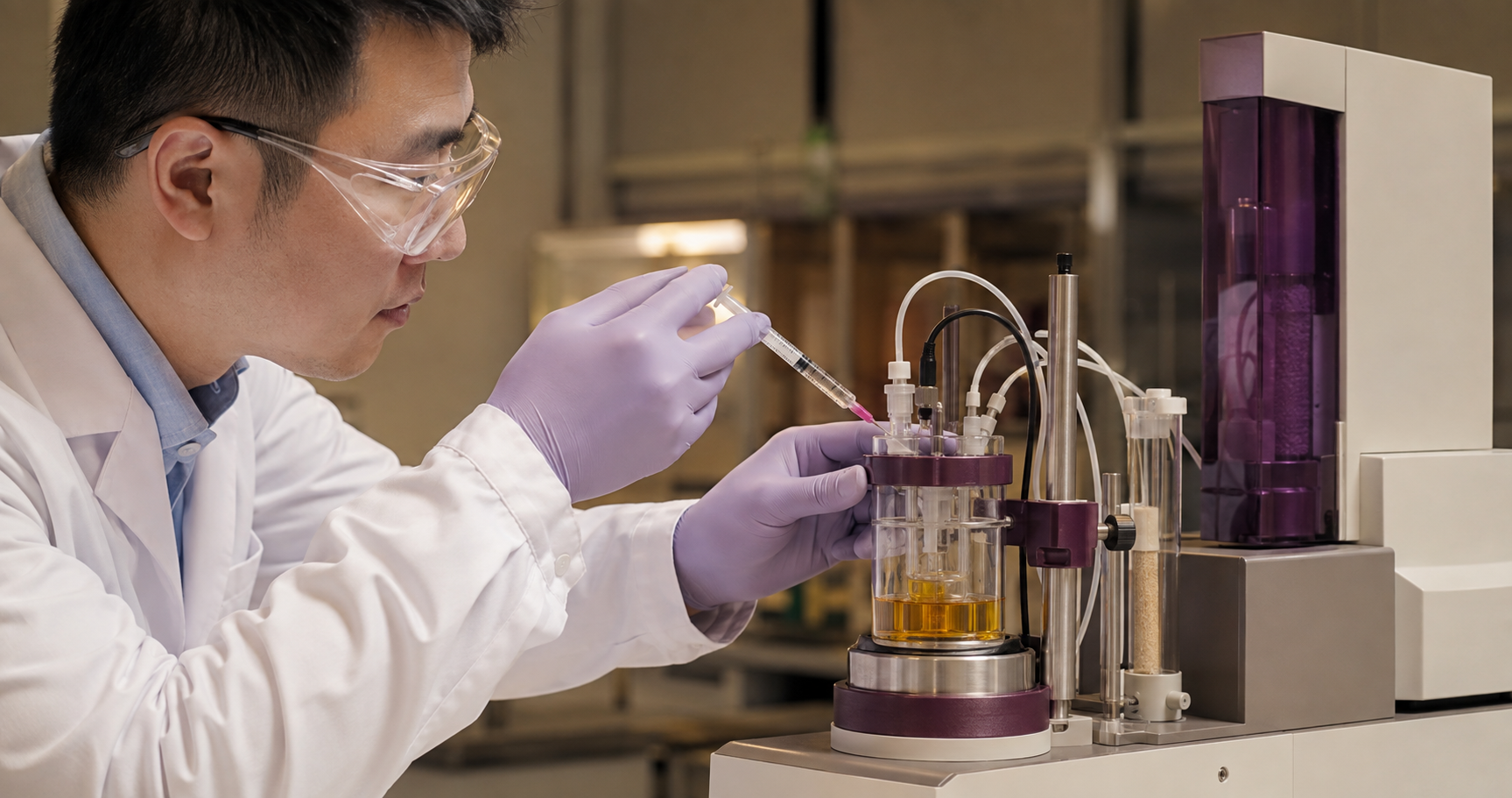
Karl Fischer titration is widely used for determining water in chemicals and solvents. Depending on the expected level and sample behavior, a laboratory may use volumetric or coulometric Karl Fischer measurement. The validated method must address sample solubility, side reactions, instrument condition, standardization, and blank correction.
A COA value should be interpreted together with the specification and test method. Results obtained with different sampling procedures or methods may not be directly comparable.
Why Water Can Increase After Opening
Many organic solvents can absorb moisture from humid laboratory air. Each time a bottle is opened, air enters the headspace. Wet transfer tools, poorly sealed caps, long dispensing times, and repeated use of a large container can further increase exposure.
This means the original COA describes the tested lot before normal laboratory use. It does not guarantee the water content remaining in an opened bottle after uncontrolled handling.
Handling Practices That Help Preserve Quality
- Select a package size that can be consumed within the laboratory's controlled use period.
- Keep the closure tightly secured when the bottle is not in use.
- Minimize the time the container is open.
- Use clean, dry, chemically compatible transfer equipment.
- Do not return unused solvent to the original bottle.
- Avoid unnecessary transfers into secondary containers.
- Store according to the current SDS and product instructions.
- Define an opened-container policy when moisture is critical.
- Retest water content when the method or risk assessment requires it.
For air- or moisture-sensitive dispensing systems, use only procedures and equipment approved by the laboratory. Solvents may also be flammable or present other hazards; low-moisture handling never replaces SDS-based safety controls.
Choosing an Anhydrous Solvent
- Define the maximum tolerable water. Use the method, reaction study, or process requirement.
- Compare numerical specifications. Do not compare grade names without the water limits.
- Review other impurities. Water may not be the only critical attribute.
- Evaluate packaging. Package size and closure affect exposure after opening.
- Plan handling and storage. The laboratory must be able to preserve the required quality.
- Verify the lot. Review the COA and perform incoming or in-use testing where required.
Relevant RCI Labscan Products
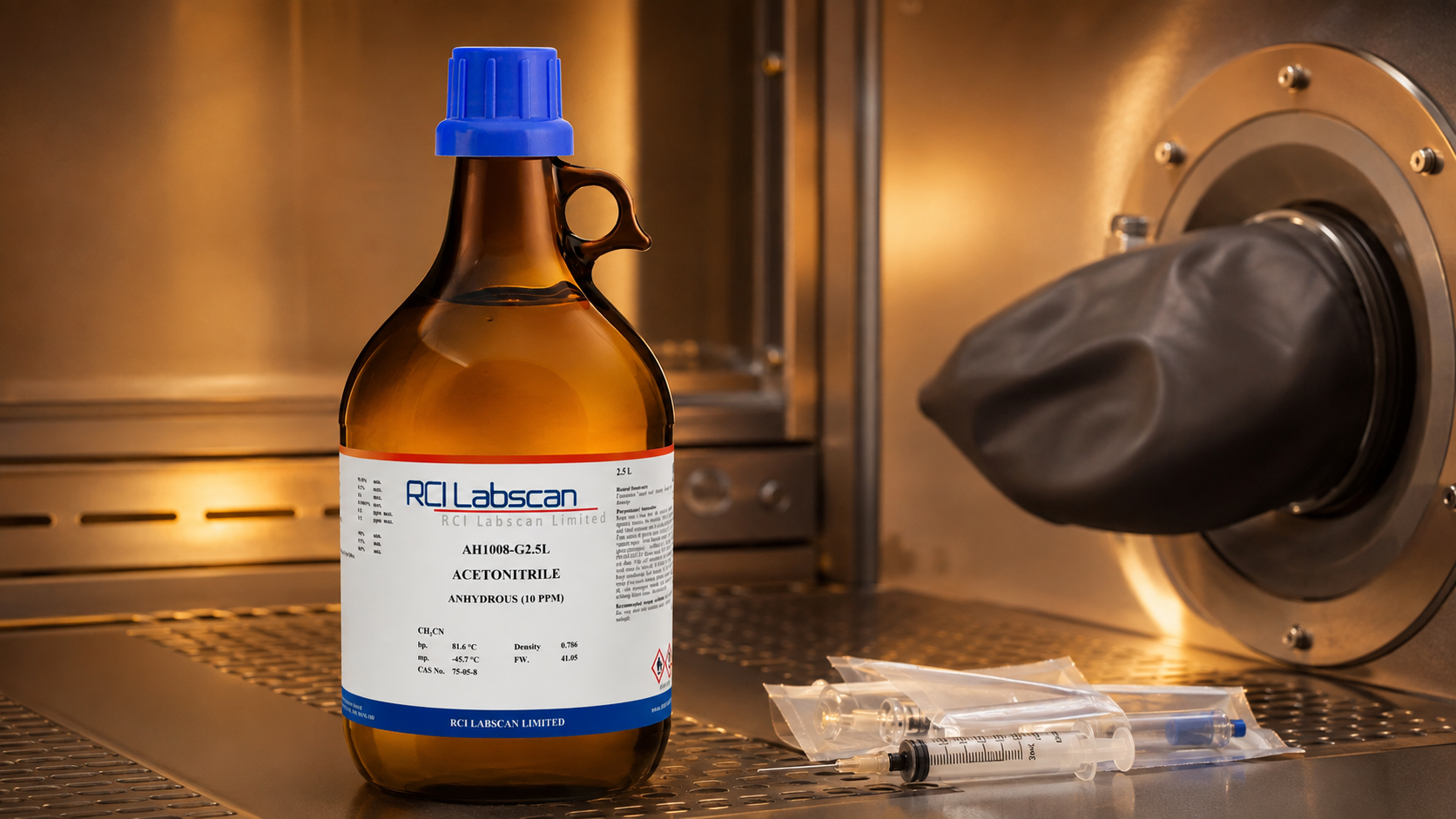
Examples currently listed by RCI Labscan include Acetonitrile, Anhydrous 10 ppm, n-Hexane 99%, Anhydrous, and Diethyl Ether, Anhydrous 50 ppm.
The numbers in product names should be checked against the current product specification and lot COA before use. Consult the SDS for hazards, storage, compatibility, and handling requirements.
FAQ
Does anhydrous mean water-free?
No. It normally means that water is controlled to a stated low limit. Check the numerical specification.
Is 10 ppm always better than 100 ppm?
It is a lower stated limit, but “better” depends on whether the application needs it and whether the laboratory can preserve that level after opening.
Can I convert ppm directly to milliliters of water?
Not without knowing the specification basis, solvent quantity, and relevant density information. For mass-based ppm, first calculate the water mass.
Why can my in-house result differ from the COA?
Possible causes include moisture uptake after opening, sampling technique, transfer tools, blank correction, instrument condition, and differences in the test method.
Should anhydrous solvent be stored over molecular sieves?
Do not add drying agents automatically. They may introduce impurities or be incompatible with the application. Use only a validated, safety-reviewed procedure.
Related Reading
- Water Content in Solvents: Why Is It Important?
- Shelf Life vs Expiry Date: What Is the Difference for Laboratory Chemicals?
- Packaging of Laboratory Chemicals: How Does It Affect Chemical Quality?
Conclusion
Anhydrous grade is useful only when translated into a numerical water requirement. Read the ppm basis, specification, method, and lot result, then protect the solvent from moisture during storage and use. Matching the water limit and package to the real application is more reliable than selecting by grade name alone.
Leave a comment!