
Extractables vs Leachables: How Study Purpose Shapes Solvent Selection
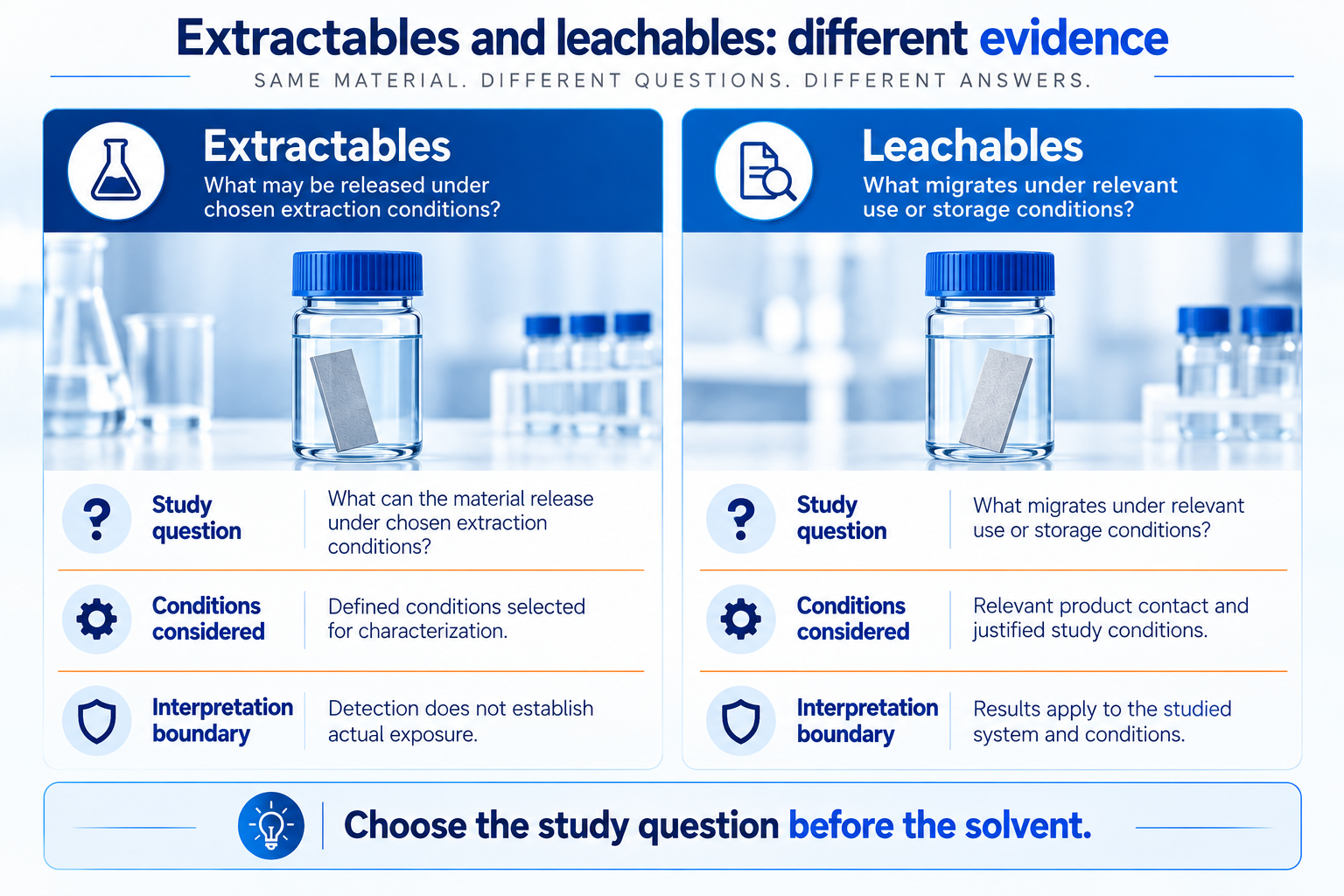
Choose the study question before choosing the solvent. Extractables studies characterize substances that a material can release under defined extraction conditions. Leachables studies investigate substances that migrate into a product under relevant storage and use conditions. Therefore, the same extraction result cannot automatically answer both questions.
For researchers, solvent selection is part of the study rationale. A solvent that reveals a broad material profile may help with characterization, yet poorly represent a particular formulation. By contrast, a formulation-relevant medium may answer a migration question without revealing every substance that stronger conditions could extract.
Two related questions, two kinds of evidence
| Aspect | Extractables | Leachables |
|---|---|---|
| Main question | What substances can this material release under the chosen extraction conditions? | What substances enter the product under relevant storage or use conditions? |
| Typical evidence role | Material characterization and identification of potential migrants | Evaluation of migration into the product and its evolution under relevant conditions |
| Solvent rationale | Defined characterization objective and extraction capability | Product/formulation relevance or a justified simulation |
| Interpretation boundary | Detection alone does not establish actual patient exposure | Results apply to the studied product, system and conditions |
The effective EMA guideline on plastic immediate packaging materials distinguishes extraction studies from migration and other interaction studies. However, its scope covers plastic immediate packaging for active substances and medicinal products. Therefore, do not automatically extend its provisions to elastomers, devices or other applications.
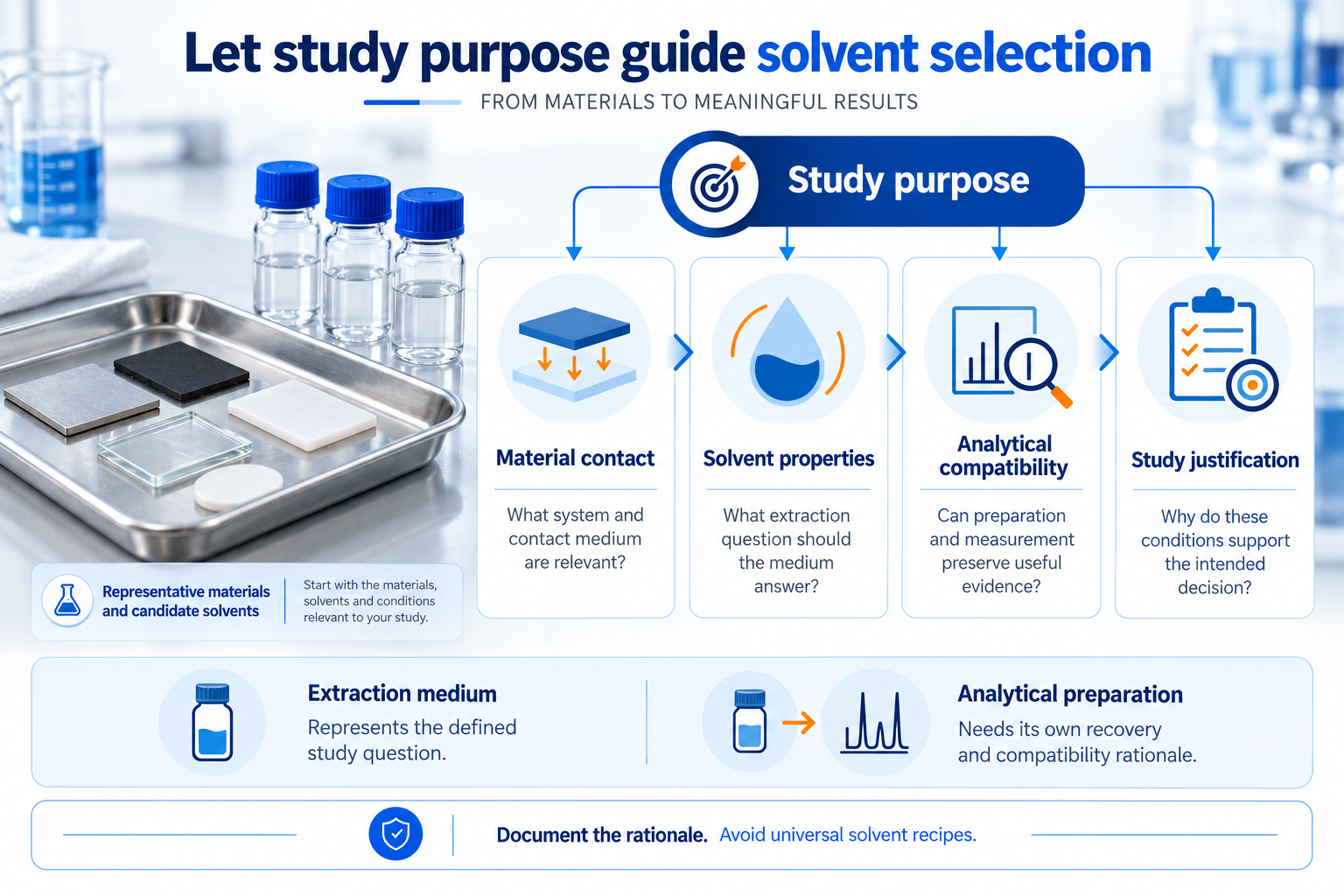
Define what the solvent is supposed to represent
Begin the protocol discussion with three questions:
- What system is being studied? Identify the component, assembled packaging or other contact system and its relevant history.
- What decision will the data support? Clarify whether the study focuses on material screening, characterization, formulation compatibility or actual migration.
- What conditions make the evidence relevant? State the contact medium, contact duration and other conditions. Also explain whether they represent normal use or an intentional extraction challenge.
FDA's final container-closure guidance, Attachment C, explains that extraction-solvent choice depends on study purpose. For example, a product or placebo vehicle can be appropriate when the objective is to reproduce the dosage form's extraction behavior. By contrast, stronger extraction can support a different characterization purpose. Therefore, laboratories should develop a study-specific rationale rather than treat this guidance as a ready-made solvent recipe for every material.
Write that rationale before experimentation. For example, “chosen because it was available” and “chosen because it represents the intended contact medium” provide very different foundations for interpreting the results.
A stronger solvent does not automatically give a more relevant answer
Separate the ability to extract a substance from the ability to represent its migration into a product. In a primary study of a model container-closure system, researchers found that both the medium and the migrating substances affected the observed profile. In addition, the study demonstrated migration from external label materials in that particular system. Therefore, the findings support consideration of the assembled system, but they do not prove that every external component will migrate in every package.
For protocol development, explain why each proposed medium belongs in the study. If several media are necessary, assign a clear purpose to each one. A wider list, however, is not inherently more informative when researchers cannot connect the results to the study decision.
Also distinguish the extraction medium from the solvent used later for dilution, transfer or analysis. FDA researchers have examined how evaporation during extract preparation can affect recovery. Therefore, analysts should justify the preparation step separately rather than treat it as invisible simply because extraction has already finished.
Keep solvent background separate from material-derived signals
Plan controls that help distinguish contributions from the extraction medium and preparation pathway from signals associated with the test material. In addition, record solvent identity and lot, preparation materials and processing steps. The control design should match the question that the control needs to answer. For example, a direct solvent injection cannot account for every contribution from later preparation.
Review the solvent specification and lot-specific COA information against the analytical application. However, neither document automatically proves that a solvent is suitable for the complete study. Researchers should assess background from these inputs within the measurement context, as discussed in how solvent impurities affect analytical results.
A useful result record connects each signal to its control comparisons and identification evidence. Therefore, avoid reporting every detected peak as a confirmed material-derived leachable. Instead, state clearly what the evidence supports and what remains tentative.
Document the connection between study stages
Use a short decision record to explain how characterization findings will inform subsequent work. For example, identify which potential migrants warrant further attention. Then consider whether material or formulation differences limit comparisons. Finally, note any analytical preparation steps that require additional recovery evidence. Together, these questions help readers understand the evidence without turning one extraction profile into a universal prediction.
As a bounded illustration, FDA research on blood-contacting devices investigates alternative media and extractable behavior in protein-containing solutions. Thus, the work shows why medium selection may require application-specific evidence. However, it does not prescribe solvents for pharmaceutical packaging.
FAQ
Are extractables necessarily leachables?
No. A characterization study identifies substances released under its own conditions. To establish actual migration, researchers need evidence from the relevant product or contact system under the conditions being evaluated.
Can one solvent be the default for every study?
No. A universal choice would ignore differences in materials, formulations, study purposes and analytical methods. Instead, use the applicable framework and document why the proposed medium answers the defined question.
Is ICH Q3E a finalized requirement?
No. The FDA Q3E page checked for this article identifies the November 2025 document as draft guidance, not for implementation. Therefore, its publication does not demonstrate a finalized requirement. Confirm the applicable guidance and jurisdiction when planning an actual study.
The practical takeaway is to retain a clear chain: study purpose, medium rationale, analytical evidence and bounded interpretation. However, specific protocols, toxicological conclusions and regulatory submissions require appropriate expert review. This article does not provide universal extraction conditions or safety thresholds.
Leave a comment!