


Nitrosamine Testing: Distinguishing Reagent Background from Sample Signals
A signal in a nitrosamine analysis does not automatically belong to the sample simply because it appears in the sample chromatogram. QA/QC teams need evidence that the method distinguishes the target compound from interference. They also need to show that reagents, preparation materials or carryover do not explain the observed response. Therefore, representative controls help locate potential sources, while the laboratory's validated procedure defines their design and acceptance criteria.
The aim is to establish a defensible analytical result before interpreting its significance. However, a blank is an investigation tool, not a substitute for specificity, validation or a quality decision.
Recent FDA context, with a clear boundary
On September 24, 2026, FDA published information on applying less-than-lifetime adjustments to nitrosamine impurities. That development concerns exposure assessment. However, it does not provide a universal chromatographic blank criterion or a new sample-preparation procedure.
Separately, FDA's current nitrosamine information page recommends sensitive, appropriately validated methods for confirmatory testing when a risk of formation is identified. The page also states that users must validate its example methods when using them to support specified quality assessments or regulatory submissions. Therefore, laboratories should keep method suitability and analytical evidence explicit. This article does not calculate intake limits or set product-release criteria.
Define what each control covers
Use the laboratory's terminology consistently. For example, laboratories may call both a diluent blank and a preparation blank a “blank,” even though they cover different parts of the workflow. Before interpreting a signal, identify what entered the control and which steps the control experienced.
| Control concept | Useful investigation question | What it cannot establish alone |
|---|---|---|
| Diluent or solvent blank | Does the diluent, vial or injection pathway produce a response under these conditions? | It does not cover all sample-preparation steps. |
| Preparation blank | Can the sample-free preparation workflow contribute a response? | It does not reproduce every effect of the sample matrix. |
| Blank following a high-response injection | Is residual response consistent with carryover? | One clean injection does not demonstrate that all sequence conditions are controlled. |
| Reference standard or method-defined identification evidence | Does the response satisfy the procedure's identification requirements? | Matching one feature alone may not establish identity. |
These examples illustrate control concepts rather than prescribe an injection order. For instance, FDA's published LC-ESI-HRMS method for eight nitrosamine impurities in metformin specifies methanol as both diluent and blank and includes blanks and standards in its sequence. However, that method provides a specific example rather than a template that laboratories should transfer unchanged to every drug product or nitrosamine.
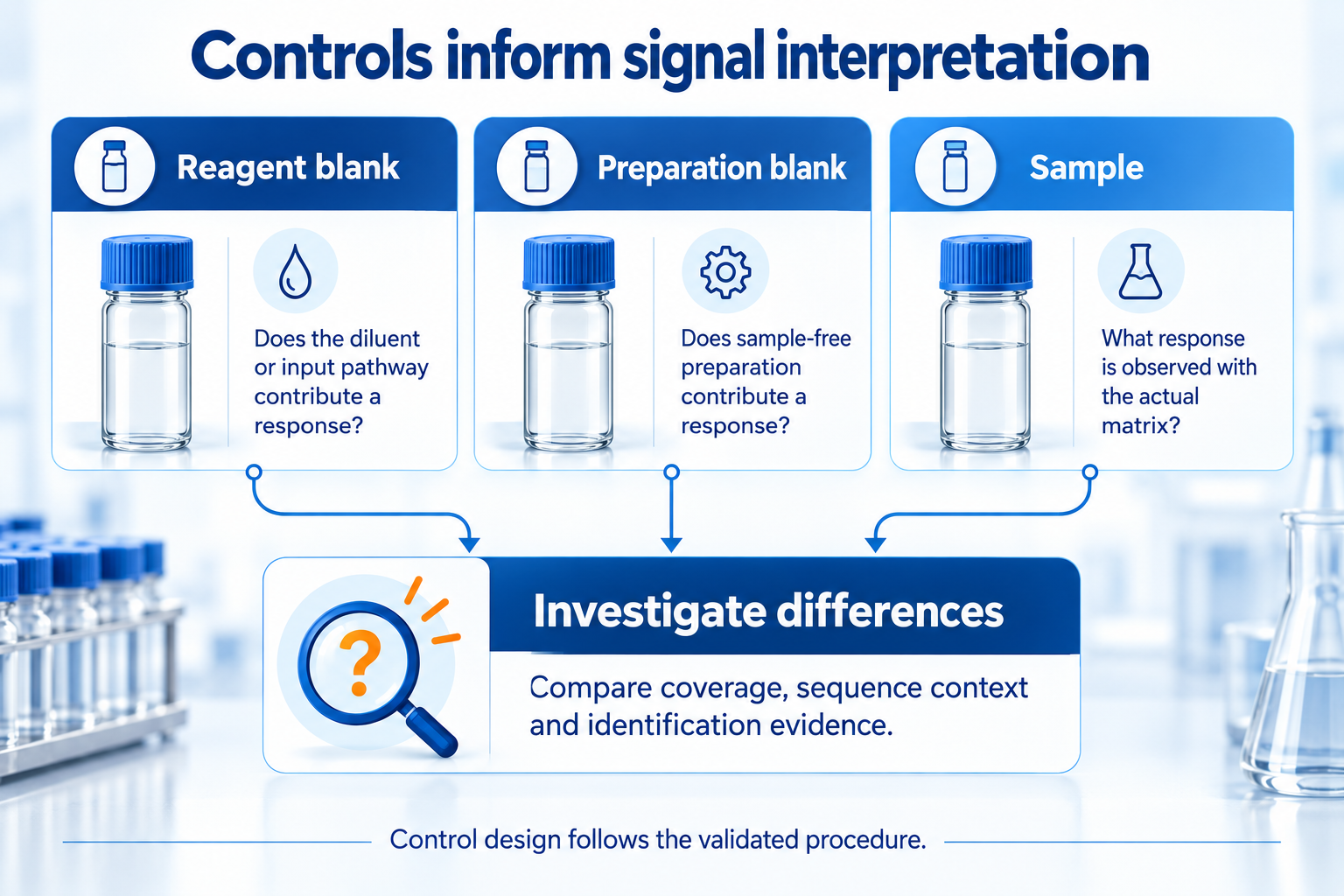
Start with traceable reagent information
Record the identity and lot of the extraction solvent, diluent, water and additives actually used. In addition, include working-solution preparation details and the associated vessels or filters when they matter to the investigation. The general guide to reviewing a chemical CoA can help organize supplier evidence. However, users should interpret the document only within its tested scope.
Do not assume that a grade name certifies the absence of every nitrosamine or interfering substance. Instead, use the documented reagent requirements and demonstrate suitability within the method. An overview of LC-MS solvent quality provides useful background, but it does not establish validated suitability for a particular nitrosamine assay.
When comparing reagent lots, retain the original observations and identify other differences between runs. As a result, lot traceability supports a controlled comparison rather than a conclusion based on memory.
Investigate the pattern, then test a bounded explanation
A response present in both the diluent and the sample suggests a shared contribution worth investigating. By contrast, a response that appears only after preparation may point toward an additional step or contact material. Meanwhile, a response linked to sequence position may justify a carryover investigation. These patterns generate hypotheses; however, they do not prove a source or establish that a sample is free of the target impurity.
Plan comparisons through the laboratory's approved investigation procedure. For example, determine whether an independently prepared control reproduces the observation. Then compare reagent lots under controlled conditions or check whether the identification evidence remains consistent. In addition, keep relevant method conditions stable and record any authorized deviations. Changing several inputs together can otherwise obscure the explanation.
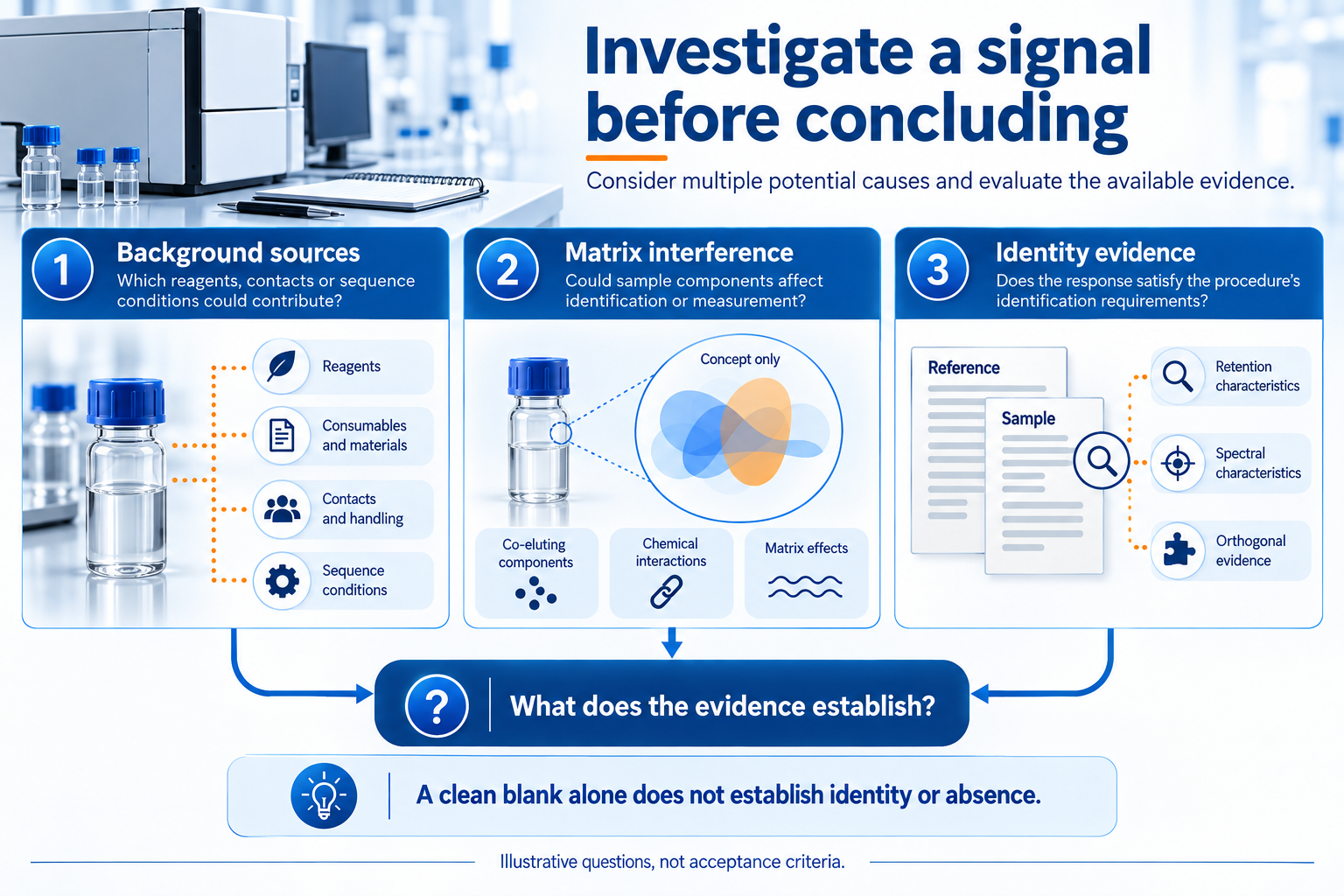
A clean blank does not resolve sample interference
Sample components can affect identification or measurement even when the reagent blank is clean. FDA's final ICH Q2(R2) analytical-validation guidance describes specificity/selectivity in terms of demonstrating that other substances do not affect identification or quantitation. In addition, it discusses comparisons with a second well-characterized procedure where appropriate.
For the analyst, the practical question is whether the validated evidence is sufficient for this matrix and target. Therefore, analysts should assess retention behavior, mass-spectrometric evidence and chromatographic separation according to the applicable procedure. The metformin method illustrates a combination of separation and high-resolution mass measurements. However, those features do not remove the need to evaluate the actual data.
Keep the analytical record and quality decision separate
Preserve the sequence, raw data, integration history, control results and preparation records. In addition, report observations using the method's units and established rules. Do not automatically subtract a blank response from a sample result or replace an unfavorable result with a repeat. Instead, follow the applicable validated procedure and approved quality investigation for any correction, repeat testing or reportability decision.
FAQ
Does a positive blank prove the sample result is false?
No. It identifies a contribution that requires investigation. Background and genuine sample content can coexist. Therefore, the laboratory must determine whether the available evidence supports a valid reportable result.
Does a clean blank prove there is no nitrosamine?
No. It supports one aspect of control performance under the tested conditions. However, detection capability, sample recovery, interference and identification remain separate questions.
Should every nitrosamine method use the same solvent?
No. Follow the applicable validated method and its reagent requirements. For example, a solvent named in one FDA method does not become a universal choice for other analytes or matrices.
A useful QA/QC handoff should state what analysts observed, which controls cover the workflow, what investigation supports the assignment and which quality decisions remain with authorized reviewers. Ultimately, reagent quality supports that evidence chain, but it cannot supply the conclusion on its own.
Leave a comment!