

How Solvent Purity Affects GC Baselines, Blank Runs, and Detection Limits
Direct Answer
Solvent purity affects GC performance when impurities create peaks, increase baseline noise, or leave residue in the inlet and column. These effects can make blank runs look contaminated, reduce signal-to-noise ratio, and make a low-level analyte harder to detect. A clean solvent helps, but detection limits also depend on the instrument, column, detector, method, sample matrix, and validated calculations.
How Solvent Contamination Appears in a GC Run
The solvent may be present at a much higher concentration than the target analyte. If it contains volatile impurities, they can appear as solvent-related peaks. If it contains less-volatile material, the residue may accumulate in the inlet or column and affect later runs.
- Discrete peaks in a solvent blank
- Elevated or unstable baseline
- Broad background near the solvent front
- Carryover after repeated injections
- Changing response between solvent lots
Why Blank Runs Matter
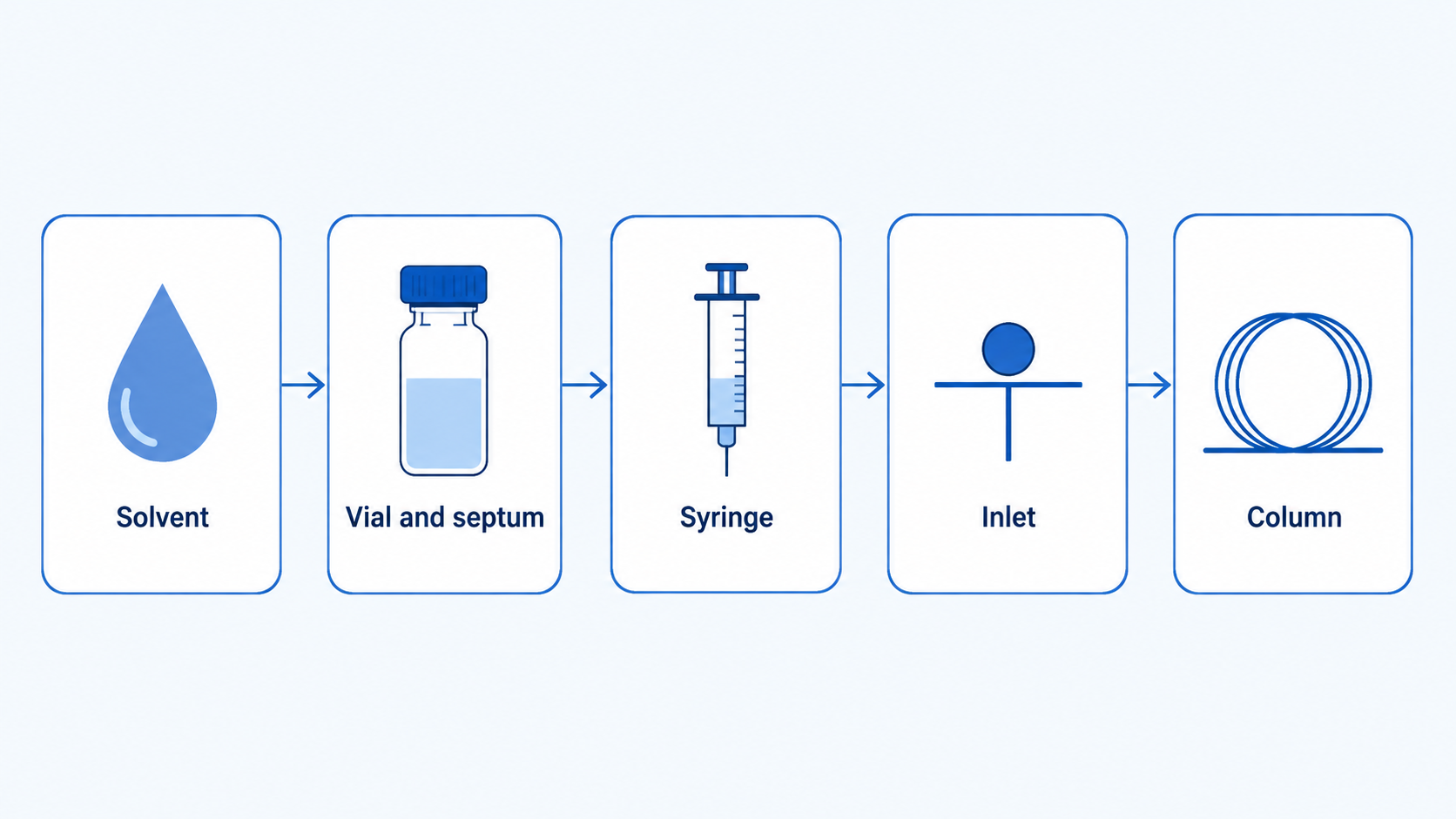
A blank run separates the contribution of the solvent and preparation process from the sample. A useful blank should represent the method: the same solvent, vial, septum, syringe, injection volume, inlet program, and temperature program should be used whenever practical.
If a peak appears in the solvent blank, do not immediately conclude that the bottle is contaminated. The source may be the vial, septum, syringe, inlet, carrier gas, column, detector, or a previous sample.
A Structured Blank Investigation
- Run a no-injection instrument blank when the procedure allows it.
- Run the solvent blank in a clean vial.
- Prepare a second blank from a new or different solvent bottle when appropriate.
- Compare retention times, peak areas, baseline shape, and repeatability.
- Check the inlet, liner, syringe, septum, carrier gas, column, and detector if the signal remains.
A sound troubleshooting sequence distinguishes an instrument blank from a solvent blank and moves through the sample path systematically. This avoids replacing a solvent when the contamination is actually in the instrument.
Baseline Noise and Signal-to-Noise
Baseline noise is the short-term variation around the chromatographic signal. Solvent impurities can add peaks or background, while residue and contamination can contribute to unstable baselines. When background increases, a small analyte peak becomes less distinct from the noise.
The effect is method-dependent. A contaminant may be irrelevant in a high-concentration assay but important in a trace method. Analysts should therefore assess the blank and the method’s signal-to-noise or detection criteria rather than treating purity as an isolated number.
Detection Limits: What Solvent Purity Can and Cannot Do
A cleaner solvent can reduce one source of background and may improve practical sensitivity. It cannot by itself establish a limit of detection. Detection limits require a defined procedure that considers variability, response, calibration, matrix, and the laboratory’s validation design.
| Observation | Possible interpretation | Next check |
|---|---|---|
| Peak in solvent blank | Solvent, vial, syringe, or instrument contamination | Compare new solvent and instrument blanks |
| Baseline rises during temperature program | Column bleed or normal temperature-related background | Compare with a known clean run and method expectation |
| Noise in both blank types | Detector gas, detector, inlet, or system contamination | Inspect the instrument sample path |
| Signal changes by solvent lot | Lot-specific impurity or handling difference | Review CoAs and run controlled lot comparison |
Practical Controls
- Use a grade appropriate for the detector and method.
- Keep containers closed and avoid unnecessary transfers.
- Use clean, compatible vials and septa.
- Record solvent lot, preparation date, and storage condition.
- Use a fresh blank when troubleshooting unexpected peaks.
- Do not filter or evaporate a solvent unless the validated method permits it.
FAQ
Can a high-purity solvent still show a blank peak?
Yes. The signal may come from the vial, syringe, inlet, carrier gas, column, detector, or a trace component that is relevant to the method even though the solvent meets its specification.
Should I replace the column when a blank is noisy?
Not as the first step. Compare no-injection and solvent blanks, check the inlet and gases, and follow the instrument manufacturer’s troubleshooting sequence before replacing major components.
Does a clean blank prove a lower detection limit?
No. A clean blank is useful evidence, but detection limits must be established using the validated method and appropriate statistical or performance criteria.
Key Takeaway
Solvent purity is one part of GC contamination control. Use representative blanks, investigate the entire sample path, and connect solvent selection to the method’s actual sensitivity and acceptance requirements.
Troubleshooting Pattern
| Blank observation | Most useful comparison | Interpretation to investigate |
|---|---|---|
| Peak appears only in the solvent blank | Run a fresh solvent lot in a clean vial. | Solvent, vial, septum, syringe, or preparation contamination. |
| Peak appears in no-injection and solvent blanks | Inspect the inlet, carrier gas, column, and detector path. | Instrument or gas-system contamination is more likely. |
| Baseline rises with oven temperature | Compare with a known clean column and historical blank. | Column bleed or temperature-related background may contribute. |
| Peak area grows through a sequence | Run a blank after cleaning or a sequence interruption. | Carryover, inlet contamination, or accumulation in the column. |
| Noise changes after a lot change | Compare CoAs and repeat both lots under identical conditions. | Lot-specific background or a handling difference. |
Separating Purity from Instrument Performance
Solvent purity should be assessed alongside system suitability. A clean solvent cannot correct a leaking septum, contaminated inlet, poor carrier gas, active sites, damaged column, or detector instability. Conversely, cleaning the instrument will not remove an impurity that is introduced with every solvent injection.
Use control charts or retained blank chromatograms when the method is routine. Recording representative baseline behavior makes it easier to recognize a gradual change rather than treating every unexpected peak as a new event. Any acceptance limits should come from the laboratory’s method or quality system.
Practical Link to Detection Capability
When a blank signal is close to the expected analyte response, the method may lose practical detection capability even if the instrument is functioning normally. The analyst should review the blank, calibration range, sample matrix, and signal-to-noise calculation together. Do not claim a new limit of detection from a single clean or noisy chromatogram.
Leave a comment!