
Selecting SPE Elution Solvents: Balancing Recovery and Matrix Cleanup
Select an SPE elution solvent by identifying how the analyte interacts with the sorbent. Then test conditions that release the analyte while limiting unwanted matrix in the collected fraction. Solvent identity, composition, modifiers and volume all contribute to that decision. Therefore, the strongest available solvent is not automatically the best choice.
For researchers, success means more than obtaining a large analyte peak. Instead, the method needs evidence that preparation recovery, final-extract quality and downstream measurement meet the intended purpose.
Identify the retention mechanism first
The relationship between solvent composition and elution depends on the sorbent. Waters' SPE method-development summary distinguishes hydrophobic, polar and ionic retention mechanisms. However, its examples provide starting points for the modes described rather than a universal solvent ranking.
| SPE mode | Retention question | Elution consideration |
|---|---|---|
| Reversed phase | How strongly does the analyte interact with the hydrophobic sorbent under the loading conditions? | Increasing organic content often promotes release; evaluate selectivity and analyte solubility. |
| Normal phase | Which polar interactions retain the analyte? | A change in the mixture's elution strength can displace retained species; reversed-phase rules do not transfer directly. |
| Ion exchange | Which analyte and sorbent charges support retention? | Charge state or competing ions may govern release; solvent strength alone may not be enough. |
| Mixed mode | How do hydrophobic and ionic interactions act together? | The eluent may need to address both mechanisms. |
Check the manufacturer's guidance for the actual sorbent, including its allowable solvent and pH conditions. In addition, remember that strong and weak ion exchangers behave differently. Waters' method-development primer explains how mixed-mode selection can use analyte or sorbent charge alongside reversed-phase retention. Therefore, do not choose a modifier solely because it worked with a different cartridge chemistry.
The elution decision begins before elution
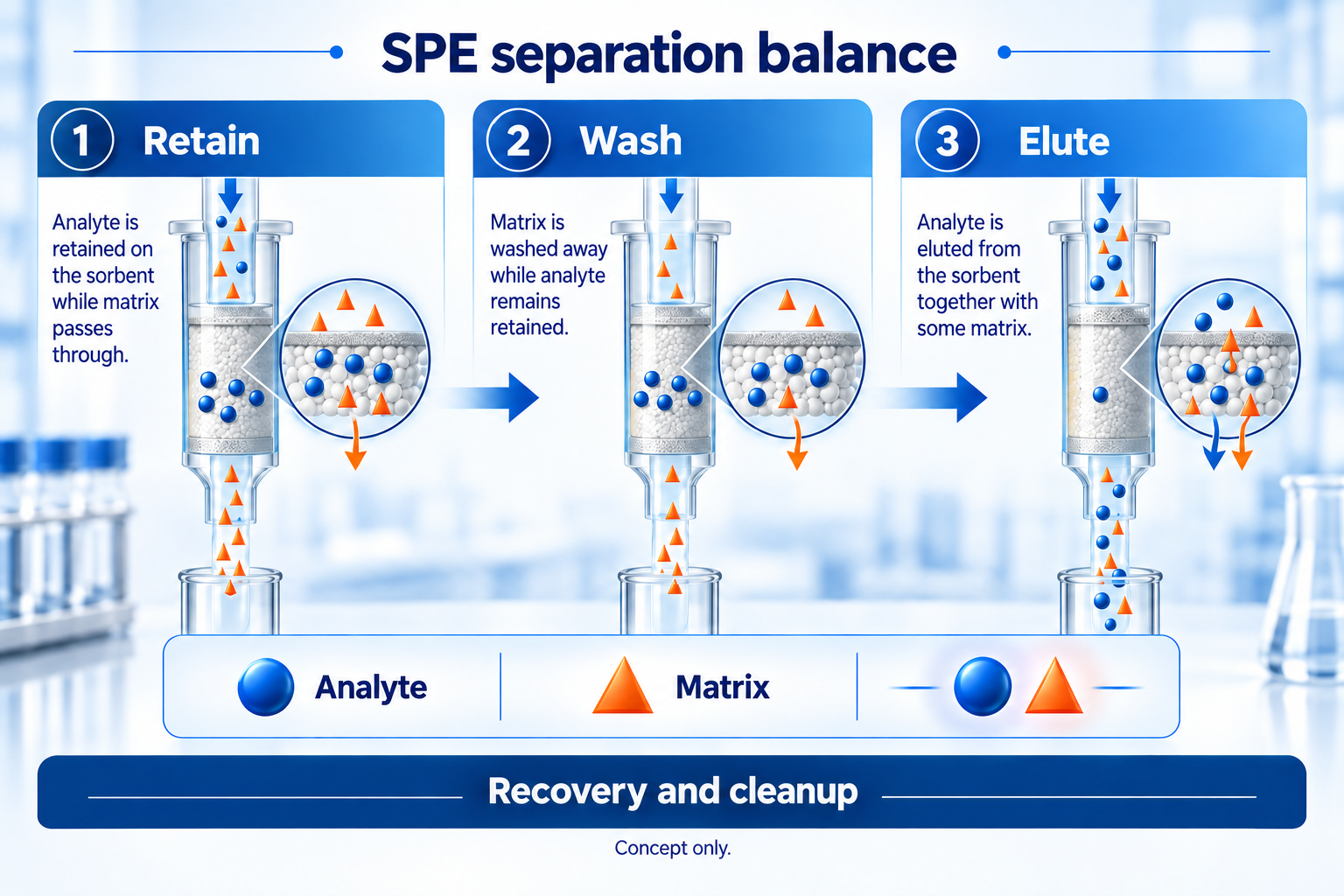
In a retain-and-elute workflow, the analyte must remain in the system through loading and washing before the final eluent can recover it. If the analyte escapes into the loading effluent or wash, changing only the final solvent cannot recover that loss. Therefore, where the approved development plan allows, examine the relevant fractions to locate the source of poor recovery rather than assuming incomplete elution.
Agilent's sample-preparation handbook, Chapter 9, discusses the wash/elution balance. For example, a wash that is too strong or too extensive can remove analyte. Conversely, stronger final elution can collect more strongly retained interferences. A less aggressive eluent may improve selectivity but require more volume. As a result, researchers need experimental evidence to evaluate these tradeoffs.
Also state the SPE strategy clearly. In pass-through cleanup, the workflow may collect the desired analyte during loading instead of retaining it for later elution. Therefore, researchers should not apply a retain-and-elute troubleshooting scheme uncritically to a pass-through product.
Compare candidates using separate evidence
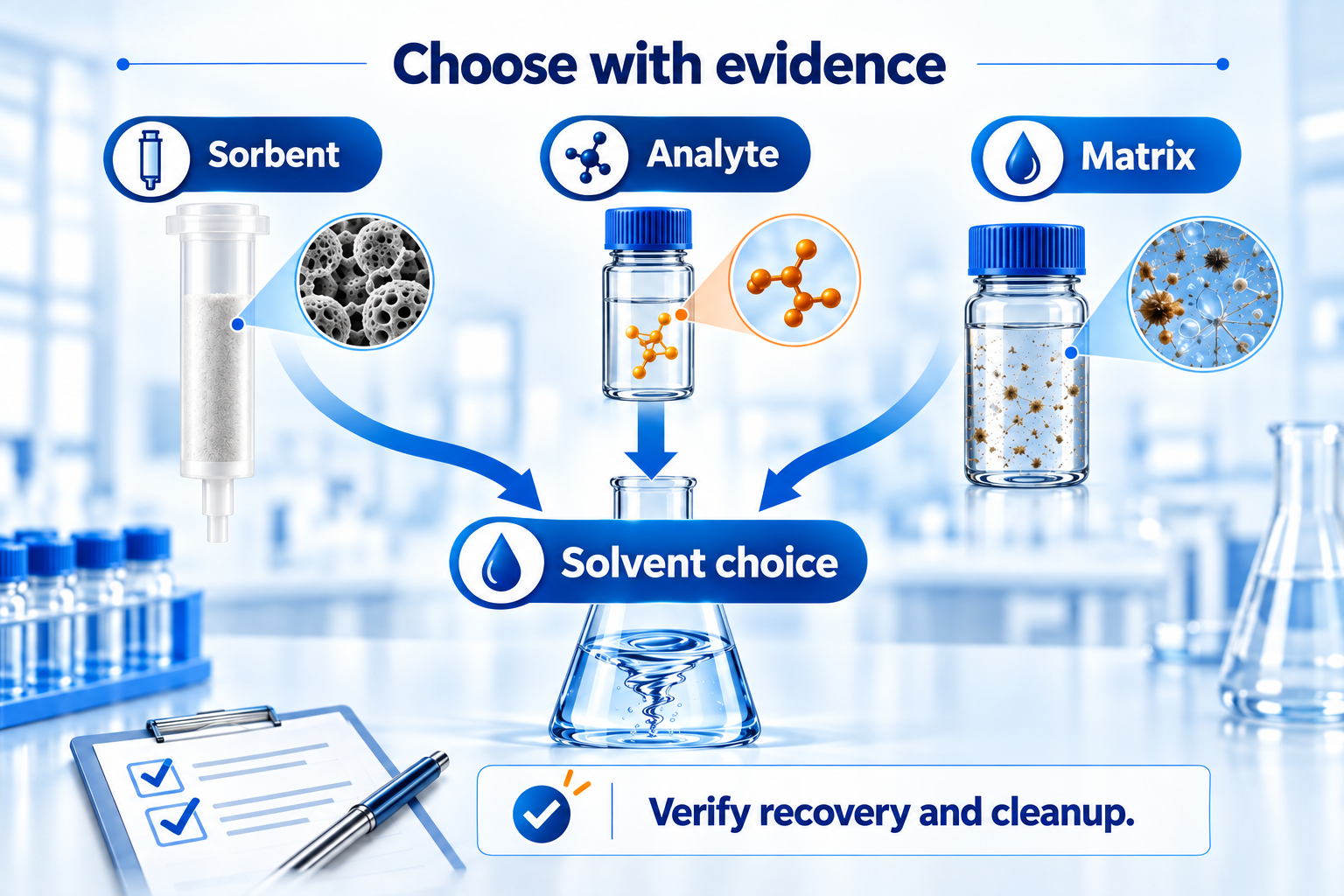
Define the candidate conditions and decision criteria before interpreting the data. Keep the sorbent, sample amount, upstream steps and analytical conditions consistent while evaluating the chosen elution variable. In addition, record the eluent composition, relevant modifiers, volume and final preparation details.
- Recovery: does the defined preparation recover the analyte consistently?
- Matrix contribution: does the final extract alter response or introduce relevant interference?
- Fraction distribution: where does the analyte appear across the collected fractions?
- Downstream behavior: do the collected solvent and additives remain compatible with the measurement?
For LC-MS, compare recovery and matrix effects separately. For example, a large peak may reflect enhanced response rather than greater analyte recovery. By contrast, a smaller peak may reflect suppression. A manufacturer study of mixed-mode sorbent selection used pre- and post-extraction comparisons in a defined plasma/analyte system. That approach illustrates how researchers can gather evidence; however, its named eluents and results do not provide universal recommendations.
Evaluate the final vial, not only the cartridge
An eluent that releases the analyte may still require an additional validated preparation step before analysis. Therefore, assess miscibility, analyte stability and solubility, injection-solvent behavior, detector compatibility and the effects of any additives. Concentration or solvent exchange can introduce another opportunity for loss. For that reason, include these steps within the defined recovery endpoint instead of treating them as neutral transfers.
Nonvolatile material can matter to LC-MS even when it serves a useful SPE function. Therefore, consult the relevant method and instrument guidance. The existing explanation of volatile and nonvolatile LC-MS additives provides background on that downstream distinction.
Likewise, LC-MS solvent grade addresses selected solvent-quality attributes. However, the grade alone does not establish that the solvent will elute a particular analyte or remove its matrix. Review lot-specific documentation together with method evidence when qualifying an input.
Questions worth answering before routine use
- Is the sorbent mechanism clear, including whether the method uses a retain-and-elute or pass-through strategy?
- Has the investigation distinguished apparent low recovery from response suppression?
- Does the chosen condition preserve performance across the relevant analytes and matrices?
- Do the solvent, modifier and subsequent preparation remain compatible with the sorbent and detector?
- Does the laboratory control changes under the applicable method and quality system?
There is no universal percentage-organic endpoint or preferred solvent for every SPE method. Instead, select the condition for which recovery, cleanup and measurement data support the actual analyte–matrix–sorbent combination. Finally, use the relevant SDS and approved laboratory procedures for handling and waste management. This article does not provide an operating recipe or numerical acceptance limits.
Related RCI Labscan Products
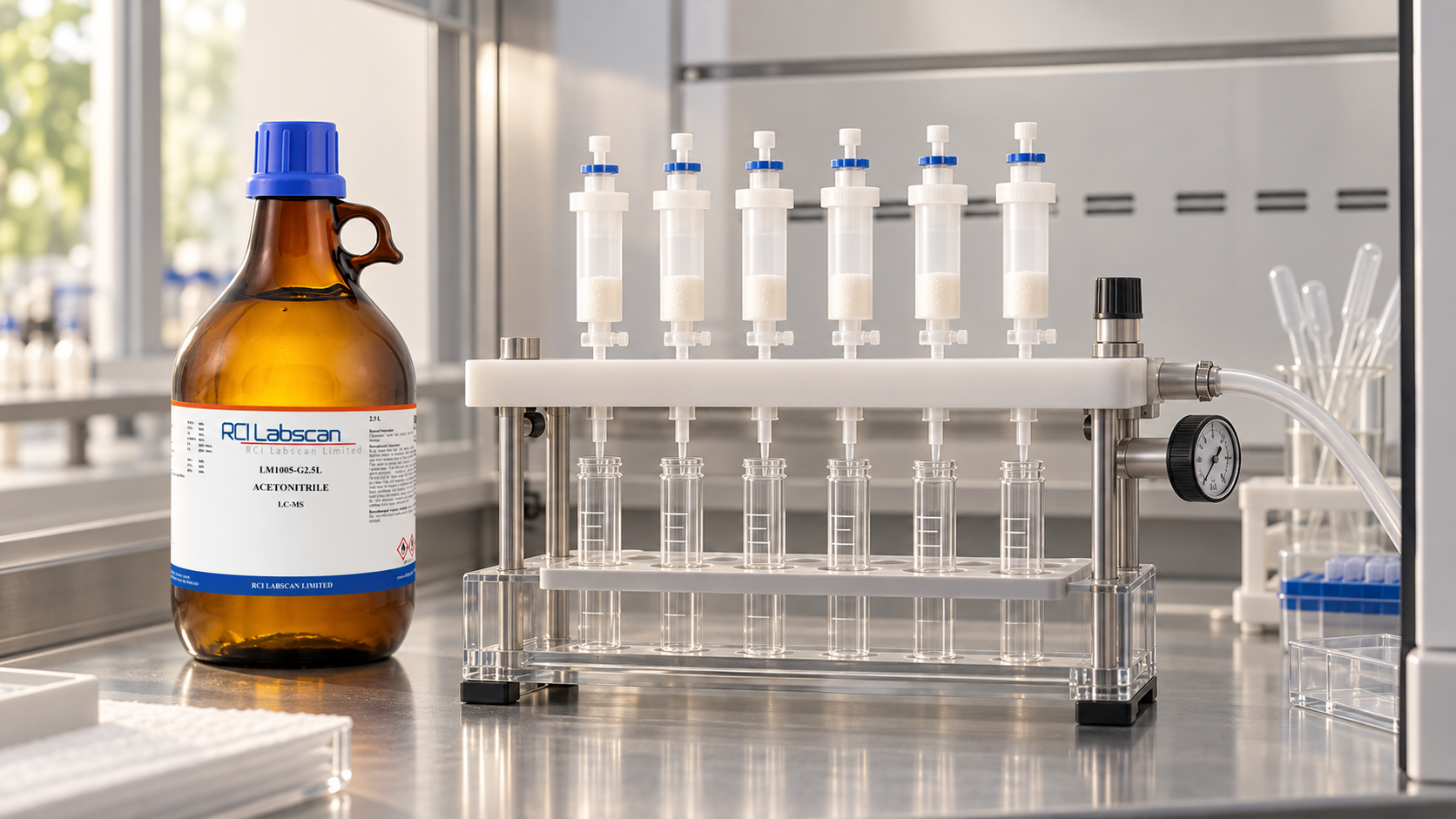
- Acetonitrile, LC-MS — Assess compatibility with the actual analyte, sorbent and downstream method; this listing is not an elution recipe or recovery guarantee.
Leave a comment!