
Ion Chromatography Eluents: Why Reagent and Water Background Matter
In ion chromatography (IC), water and eluent reagents can contribute ions that affect background, peak interpretation and separation. However, a conductivity baseline is also a property of the eluent and detection configuration. An elevated baseline alone does not identify contamination or justify changing the eluent.

Start with the detection configuration
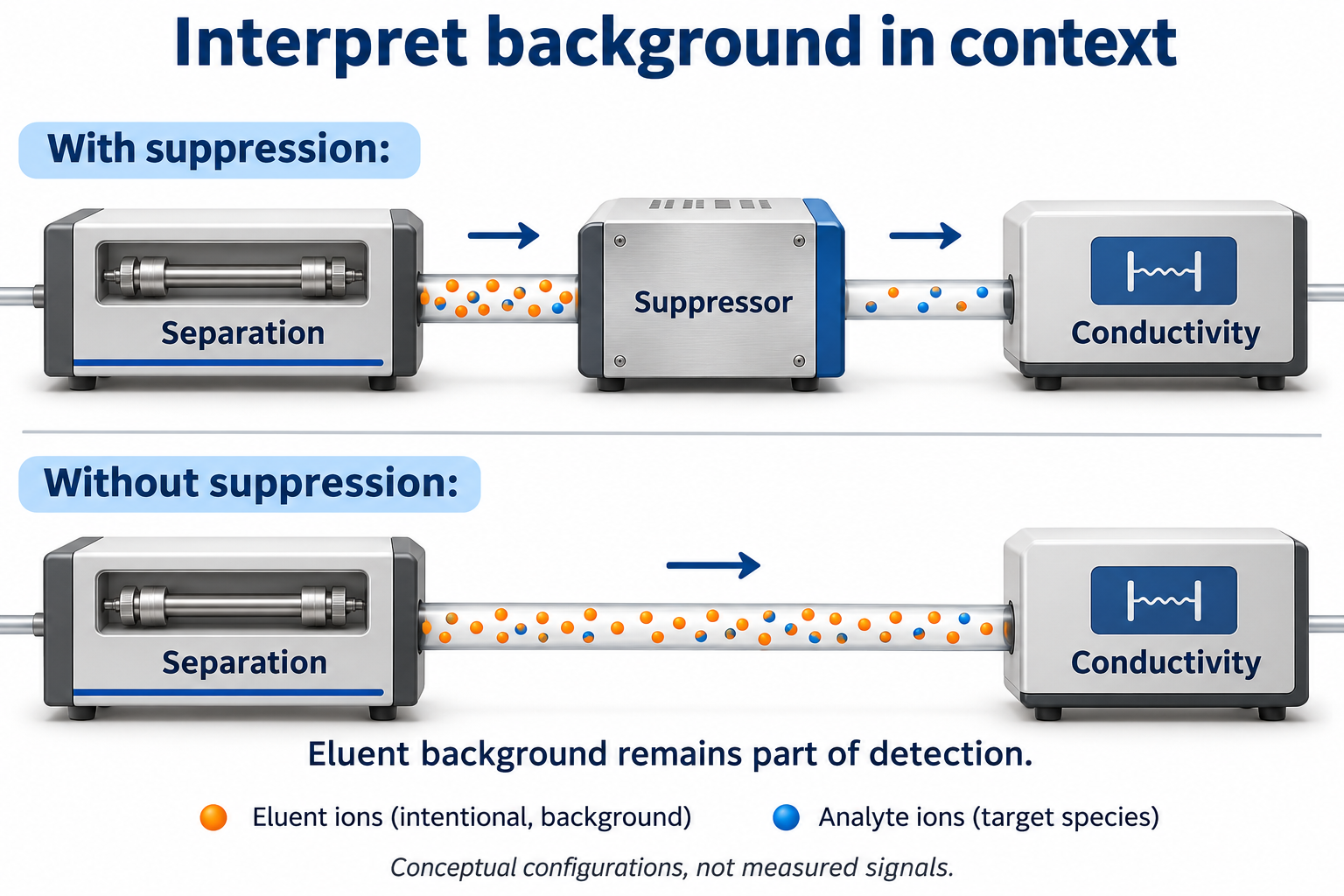
Conductivity detection responds to ionic species. In suppressed IC, a suppressor changes the eluent chemistry after separation to reduce its conductivity contribution and improve analyte detection. Nonsuppressed conductivity methods retain a different eluent background. Other IC detectors require their own interpretation. The manufacturer's explanation of suppression gives the underlying distinction.
Consequently, a background value from one method is not a general target for another. Record the column, eluent chemistry and concentration program, detector, suppression mode where applicable, temperature and operating state before comparing results. A transient during equilibration and a sustained change during a routine sequence are different observations.
Separate baseline, noise and unwanted peaks
Background is the underlying signal. Noise is short-term variation around that signal. An unwanted peak is a time-localized response. These can occur together, but they are not interchangeable evidence. A reagent impurity might contribute an interfering ion without producing an obvious overall conductivity increase. Conversely, an instrument condition can change background without adding the target analyte.
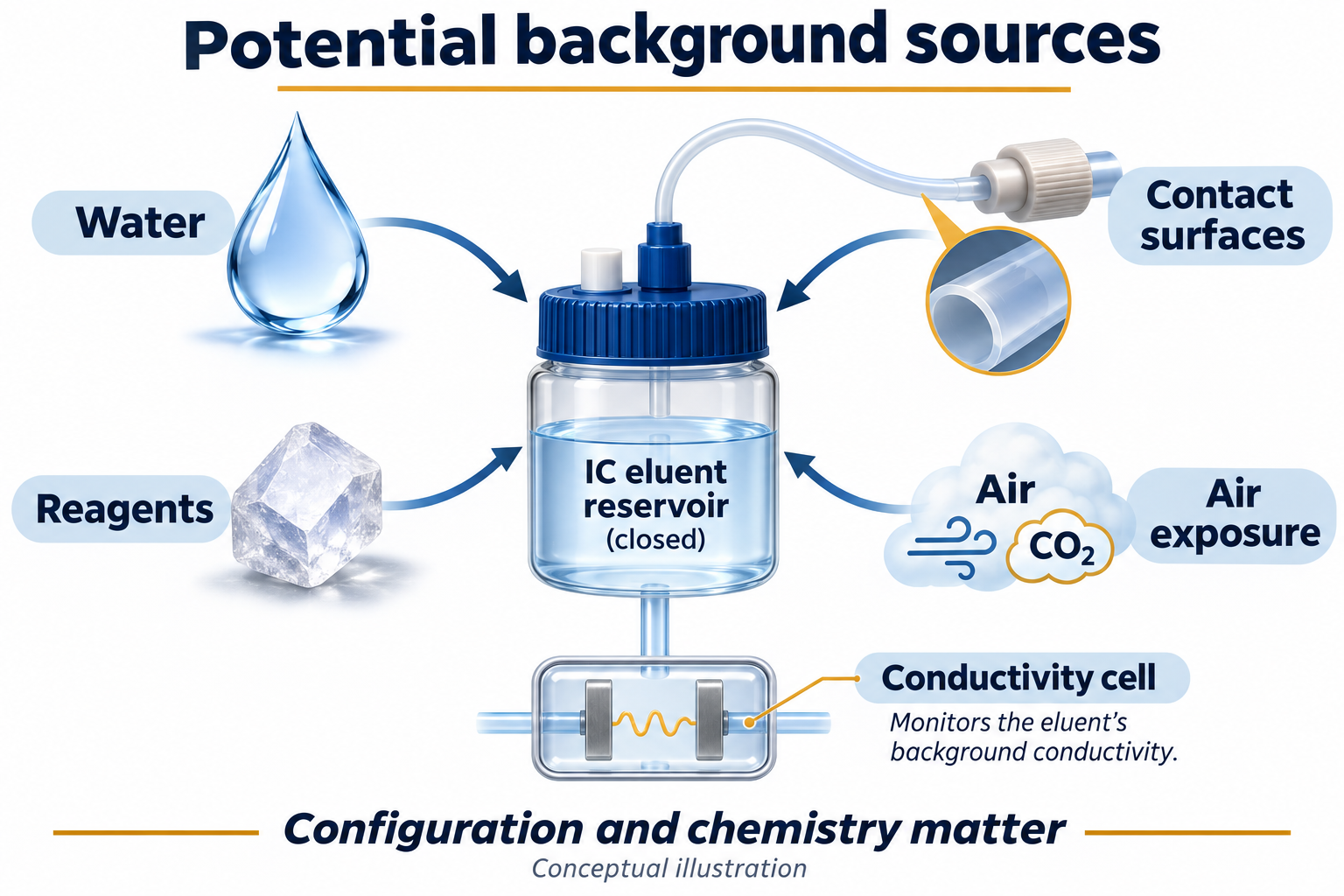
The Thermo Scientific IC troubleshooting guide identifies water, eluent reagents and contacting components among possible contamination sources. It also lists flow, temperature and suppression-related causes of baseline problems. Its model-specific service actions should not be treated as a universal troubleshooting sequence.
What the water history can explain
Water may enter as the eluent source, a diluent, a blank or another configuration-specific supply. Its quality at withdrawal does not fully describe what reaches the instrument after storage and contact with containers or tubing. MilliporeSigma's IC water discussion describes ionic contamination, airborne contributions and carbon dioxide uptake. Carbonate chemistry is particularly relevant to some anion methods, but it is not the explanation for every background change.
A useful record follows the water from source to point of use. Include collection time, container identity, storage conditions and the role of that water in the method. A bulk purity description cannot show that a particular analyte ion is absent at the concentration relevant to the analysis.
| Evidence to review | Question it helps answer |
|---|---|
| Eluent identity and preparation record | Was the intended chemistry used, with traceable reagent and water sources? |
| Comparable historical sequences | Is the change new under the same configuration and operating state? |
| Appropriate method blanks | Which parts of the water, reagent and sample pathway are represented? |
| Instrument and suppression records | Could operating conditions explain the signal independently of contamination? |
Reagent specifications need an IC context
Do not translate an HPLC or LC-MS grade name into an IC suitability claim. The relevant evidence concerns the specified ions, impurity profile and method requirements. The same caution applies to an eluent-generation system: generating eluent does not remove the need for suitable source water and documented system conditions.
Turn observations into a bounded review
Before a technical investigation, assemble comparable sequence data, blank identities, lot changes and maintenance history. Ask whether the signal changed after a documented input change, whether it affects all analytes or a local region, and whether the same behavior appears in the controls. These questions organize evidence; they do not establish a root cause.
Use the actual instrument and column guidance for any intervention, with the laboratory's authorized method and quality procedures. No universal background threshold, eluent recipe or suppressor adjustment follows from this article. The practical aim is to distinguish chemical inputs from configuration effects before the method owner selects an action.
Related Reading
- How Do Impurities in Solvents Affect Analytical Results? — broader context for input quality; IC-specific behavior still depends on the method.
Leave a comment!