
What Is Acetonitrile and What Is It Used for in the Laboratory?

Direct Answer
Acetonitrile is a clear, highly polar organic solvent that laboratories commonly use for chemical analysis, sample preparation, extraction, and chromatography. In analytical laboratories, many users know Acetonitrile as a mobile phase solvent for High Performance Liquid Chromatography, or HPLC.
Because Acetonitrile mixes well with water, has relatively low viscosity, and works well in many chromatographic methods, laboratories use it in research, quality control, pharmaceutical analysis, food testing, environmental testing, and other laboratory applications.
What Is Acetonitrile?
Acetonitrile is an organic chemical solvent with the chemical formula CH₃CN. It belongs to a group of compounds known as nitriles. Many laboratories use Acetonitrile because it can dissolve a wide range of compounds and works well with many analytical methods.
In practice, laboratory users use Acetonitrile to dissolve samples, prepare solvent mixtures, extract compounds, and support instrumental analysis. Moreover, Acetonitrile plays an important role in chromatography because solvent quality can affect analytical results.
Why Do Laboratories Commonly Use Acetonitrile?
Acetonitrile supports many laboratory workflows because it has several practical properties that make it suitable for analysis and sample preparation.
Key reasons include:
- It mixes well with water.
- It can dissolve many organic compounds.
- It has relatively low viscosity compared with some other solvents.
- Laboratories commonly use it in reversed-phase HPLC methods.
- It can support stable mobile phase preparation.
- It works with many analytical workflows.
As a result, Acetonitrile becomes a practical solvent for laboratories that need reliable and reproducible analytical results.
Common Uses of Acetonitrile in the Laboratory
1. HPLC Mobile Phase Preparation
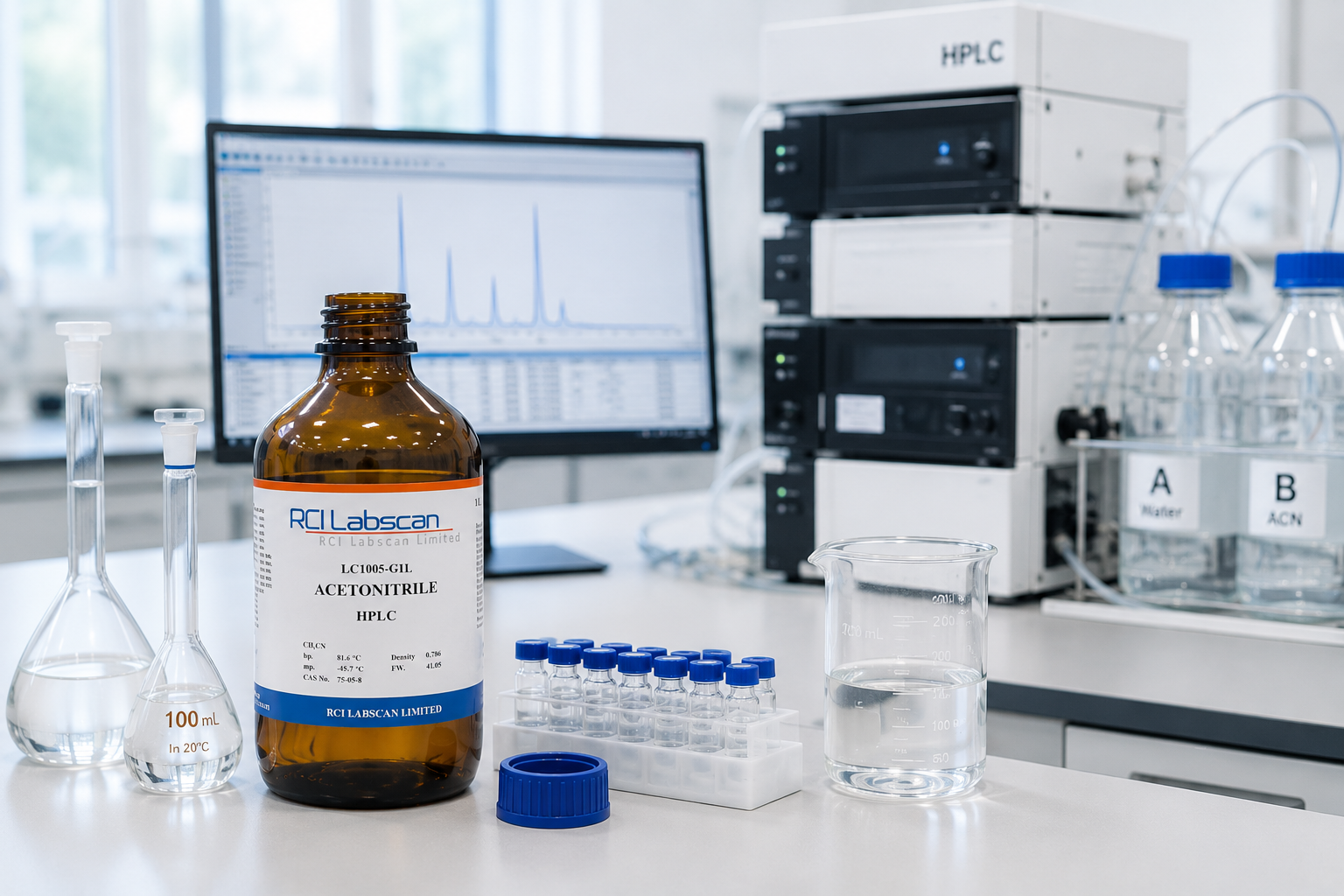
Laboratories commonly use Acetonitrile as a mobile phase solvent in HPLC. In reversed-phase HPLC, analysts often mix Acetonitrile with water or buffer to help separate compounds in a sample.
Solvent quality matters in HPLC because impurities, residue, or inconsistent solvent quality may affect the chromatogram. For example, poor solvent quality may contribute to baseline noise, unwanted peaks, peak shape problems, or retention time variation.
For this reason, laboratories usually select HPLC grade Acetonitrile rather than general-purpose solvent for HPLC analysis.
2. LC-MS Analysis
Laboratories also use Acetonitrile in LC-MS applications. However, LC-MS analysis usually requires more careful control of trace impurities than routine HPLC analysis.
Therefore, users should consider LC-MS grade Acetonitrile for LC-MS methods and review the product specification, SDS, and COA before use. Users should not automatically assume that HPLC grade Acetonitrile can replace LC-MS grade in sensitive mass spectrometry applications.
3. Sample Preparation
During sample preparation, Acetonitrile can help dissolve, dilute, or extract target compounds before analysis. Therefore, many laboratories use it before instrumental testing.
Examples of sample preparation uses include:
- Diluting samples before instrumental analysis
- Extracting organic compounds from complex matrices
- Preparing standard solutions
- Precipitating proteins in some analytical workflows
- Cleaning or rinsing laboratory glassware in suitable applications
However, the exact use depends on the analytical method, sample type, and laboratory procedure.
4. Extraction Applications
Some extraction methods use Acetonitrile because it can help separate certain organic compounds from samples. In many cases, laboratories select Acetonitrile when target compounds dissolve more easily in organic solvents than in water.
For example, food, environmental, pharmaceutical, and research laboratories may use Acetonitrile as part of extraction or cleanup steps before analysis. Even so, users should always check the suitability of Acetonitrile against the method requirements and the laboratory’s validated procedure.
5. Research and Quality Control Testing
Research and QA/QC laboratories widely use Acetonitrile for routine analytical testing, method development, and quality control workflows. In these environments, solvent consistency and documentation can play an important role.
Therefore, regulated or quality-focused laboratories should check product documentation such as the product specification, Safety Data Sheet, and Certificate of Analysis before use.
Acetonitrile in HPLC: Why Grade Matters
Not all Acetonitrile products fit the same application. Therefore, laboratories should check the solvent grade before using Acetonitrile for chromatographic analysis.
General laboratory grade Acetonitrile may support some basic laboratory uses. However, it may not provide the level of control that HPLC or LC-MS analysis requires.
Manufacturers produce and control HPLC grade Acetonitrile for chromatographic use. Important quality considerations may include:
- Purity
- UV absorbance
- Residue after evaporation
- Water content
- Lot-to-lot consistency
- Documentation availability
Before purchase or use, users should always verify actual product values from approved product specifications or COA.
Acetonitrile vs Methanol in Laboratory Use
Acetonitrile and Methanol are both common organic solvents in laboratory work and chromatographic analysis. However, they are not always interchangeable.
| Factor | Acetonitrile | Methanol |
|---|---|---|
| Common use | HPLC, LC-MS, extraction, sample preparation | HPLC, sample preparation, general laboratory use |
| Water miscibility | Miscible with water | Miscible with water |
| Chromatography role | Commonly used in reversed-phase HPLC | Also commonly used in reversed-phase HPLC |
| Method selection | Depends on separation, detector, and method requirements | Depends on separation, detector, and method requirements |
In practice, the best solvent depends on the analytical method, target compounds, detector type, and laboratory requirements.
What Should Users Check Before Using Acetonitrile?
Before using Acetonitrile in laboratory work, users should check:
- The required solvent grade
- The application or analytical method
- Product specification
- Safety Data Sheet
- Certificate of Analysis
- Compatibility with the instrument or method
- Storage and handling requirements
- Laboratory safety procedures
For sensitive analytical work, users should avoid choosing a solvent based only on the chemical name. Instead, they should also review the grade and supporting documentation.
Safety and Handling Considerations
Acetonitrile is a laboratory chemical, so users should handle it carefully. Before use, users should review the Safety Data Sheet and follow local safety regulations and laboratory procedures.
In general, users should wear suitable personal protective equipment, work in an appropriate laboratory environment, keep containers properly closed, and store the chemical according to the SDS and internal laboratory guidelines.
This article provides general educational information. Therefore, it does not replace the official SDS, product specification, or laboratory safety procedure.
Related RCI Labscan Products
RCI Labscan provides high-purity solvents for analytical laboratory applications, including Acetonitrile for HPLC and LC-MS applications.
For product selection, documentation requests, or availability, customers can review the relevant product page or contact RCI Labscan / authorized local distributors.
FAQ
What is Acetonitrile?
Acetonitrile is an organic solvent that laboratories commonly use for chromatography, sample preparation, extraction, and chemical analysis.
What is Acetonitrile used for in the laboratory?
Laboratories commonly use Acetonitrile for HPLC mobile phase preparation, LC-MS analysis, sample preparation, extraction, and research or quality control testing.
Why do laboratories use Acetonitrile in HPLC?
Laboratories use Acetonitrile in HPLC because it mixes well with water, has relatively low viscosity, and supports many reversed-phase chromatographic methods.
Can I use general Acetonitrile for HPLC?
Users should not use general Acetonitrile for HPLC analysis unless the method allows it. For HPLC applications, users should select HPLC grade Acetonitrile and review the product specification.
Is Acetonitrile the same as HPLC grade Acetonitrile?
No. Acetonitrile is the chemical name, while HPLC grade Acetonitrile refers to Acetonitrile that manufacturers produce and control for chromatographic analysis.
When should I use LC-MS grade Acetonitrile?
Users should consider LC-MS grade Acetonitrile when using mass spectrometry detection or when the method requires very low impurity levels for sensitive analysis.
Conclusion
Acetonitrile is one of the most important organic solvents in modern laboratories. Laboratories widely use it in HPLC, LC-MS, sample preparation, extraction, research, and quality control testing.
For analytical applications, users should choose the correct grade of Acetonitrile. Therefore, they should consider the method requirements, detector type, solvent grade, and supporting documentation such as product specification, SDS, and COA before use.
Explore related products:
Related article:
Leave a comment!