
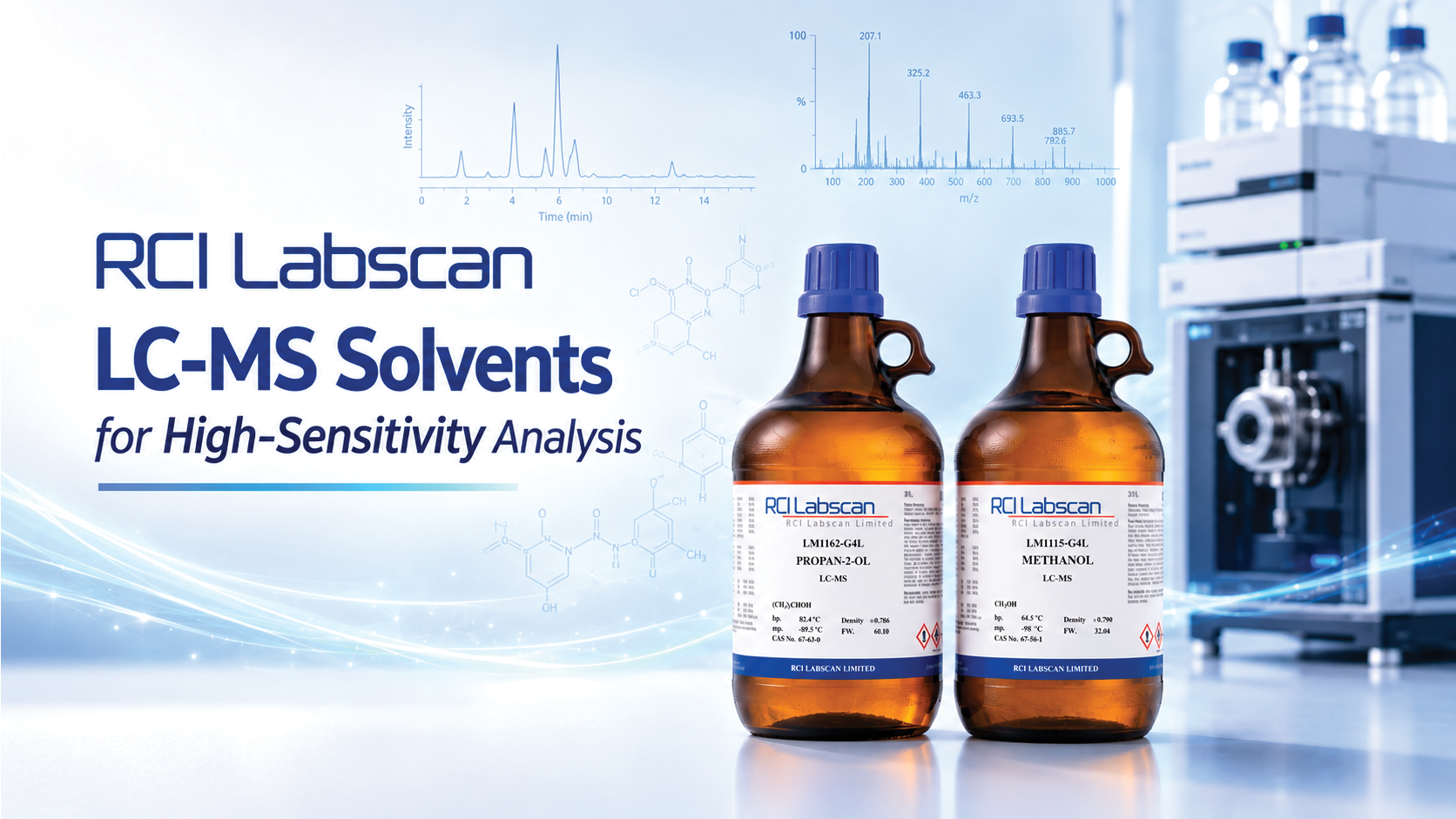
RCI Labscan LC-MS Solvents for High-Sensitivity Analysis
High-purity solvents designed to minimize background interference in sensitive LC-MS analysis

Direct Answer
LC-MS solvents are specially designed for liquid chromatography–mass spectrometry applications where trace-level impurities can affect analytical performance. Compared with solvents intended for general laboratory use, LC-MS grade solvents require tighter control of parameters such as trace metals, fluorescence, UV absorbance, acidity, alkalinity, particulates, and other potential sources of interference.
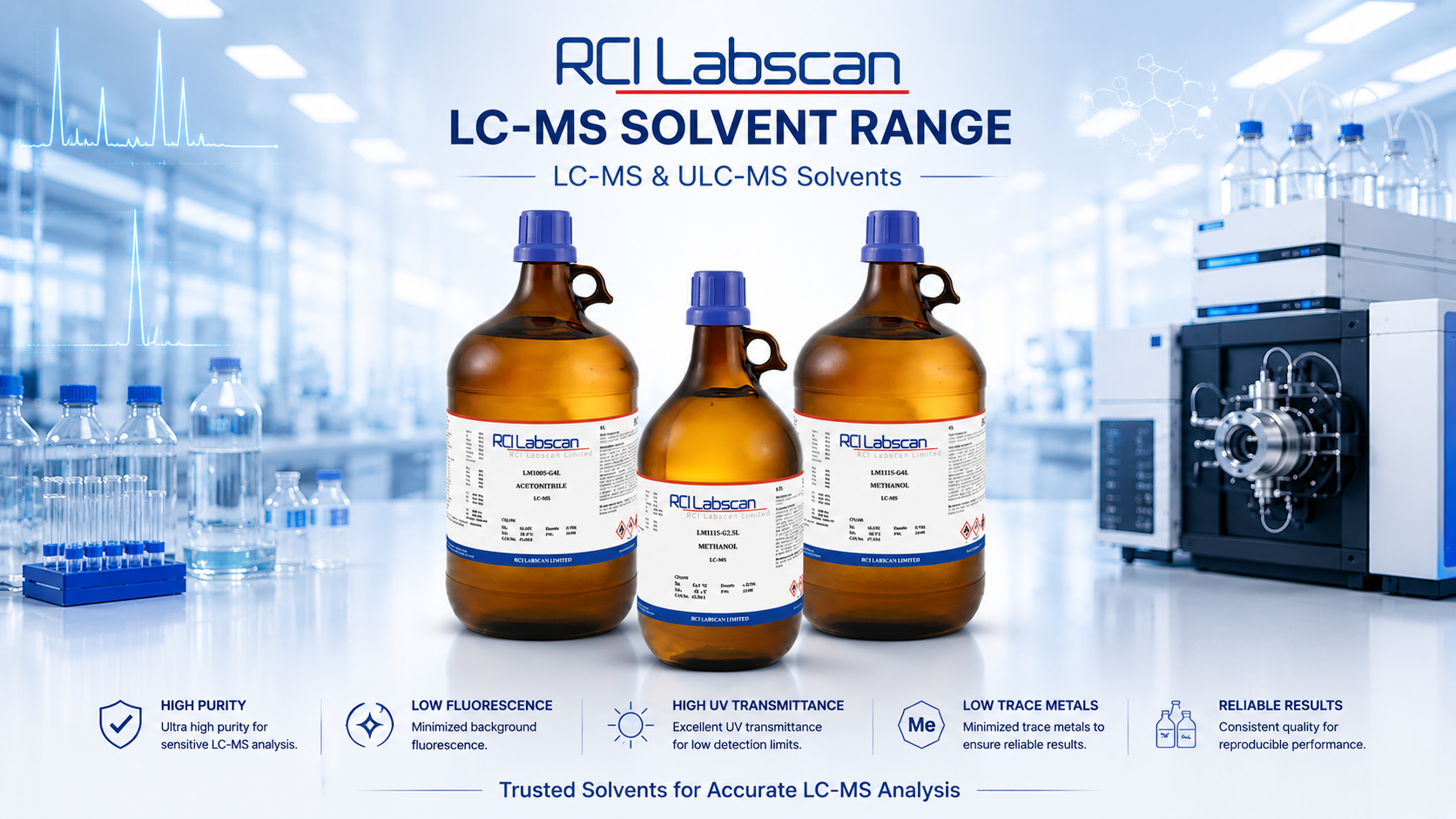
RCI Labscan offers dedicated LC-MS solvents including Acetonitrile, LC-MS (LM1005) and Methanol, LC-MS (LM1115). Both products are designed for analytical and preparative separation and are suitable for LC-MS analytical techniques. RCI Labscan describes these solvents as high-purity products with low levels of trace metals, low fluorescence, high UV transmittance, low acidity and alkalinity, and low particulate levels.
For laboratories performing high-sensitivity LC-MS or LC-MS/MS analysis, selecting a solvent specifically intended for mass spectrometry can help reduce potential sources of background interference and support reliable analytical performance.
Why LC-MS Solvent Purity Matters
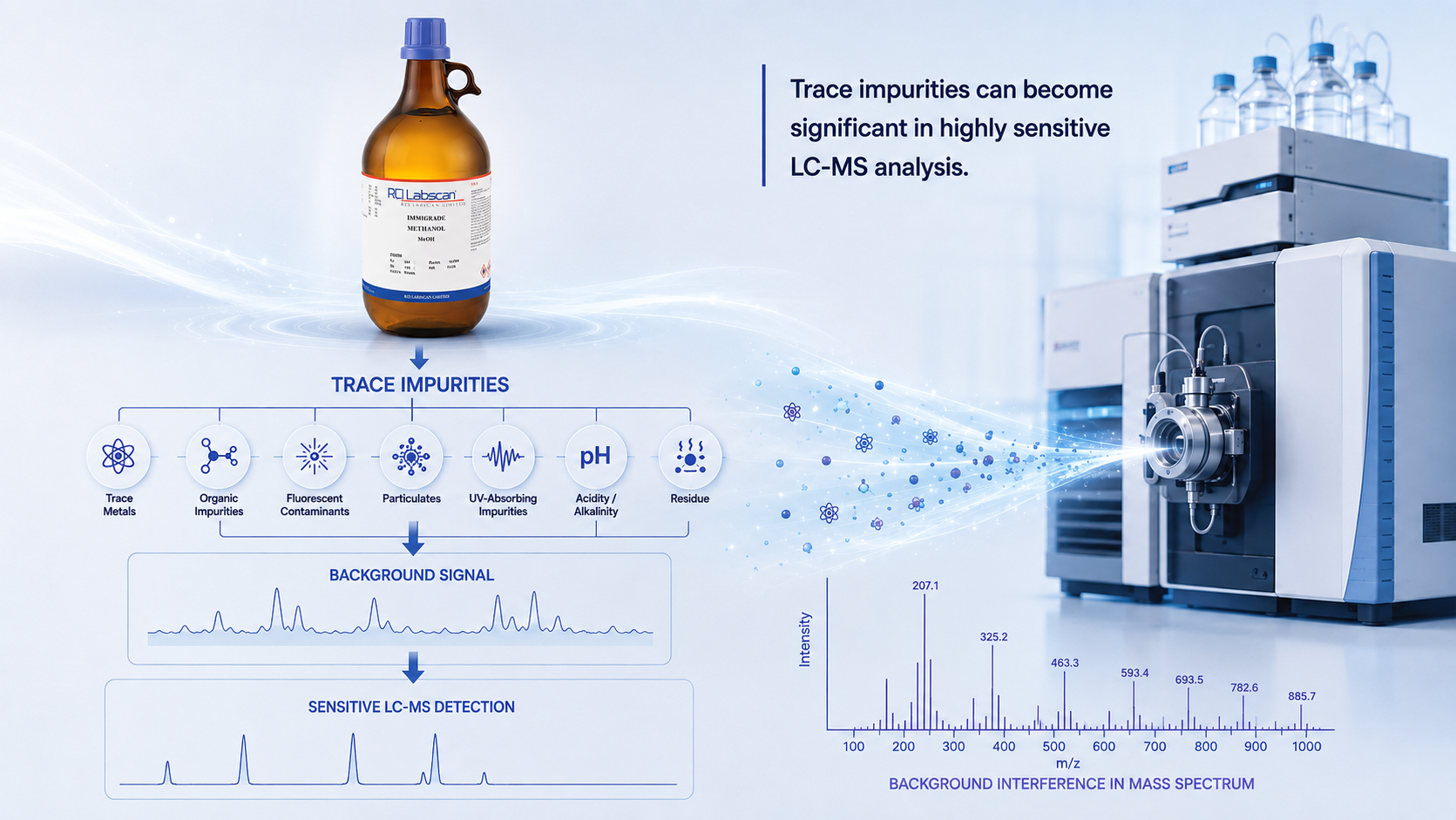
Mass spectrometry is highly sensitive to compounds present at very low concentrations. As a result, impurities originating from solvents can become significant when the analytical method requires low detection limits.
Potential sources of interference may include:
- Trace metals
- Organic impurities
- Fluorescent contaminants
- Particulates
- Excessive UV-absorbing impurities
- Acidity or alkalinity
- Residues after evaporation
These impurities may contribute to background signals or interfere with the detection of low-level analytes. Therefore, solvent selection becomes an important part of LC-MS method development and routine analysis.
RCI Labscan's LC-MS solvents are designed with specific controls intended to minimize these potential sources of interference. The product descriptions specifically highlight low trace-metal levels, low fluorescence, high UV transmittance, low acidity and alkalinity, and low particulates.
Key Characteristics of RCI Labscan LC-MS Solvents
| Parameter | Why It Matters in LC-MS | RCI Labscan LC-MS Solvents |
|---|---|---|
| Purity | Reduces potential interference from chemical impurities | High-purity solvent |
| Trace Metals | Metal contaminants may interfere with sensitive analysis | Low levels of trace metals |
| Fluorescence | Fluorescent impurities can contribute to background signals | Low fluorescence |
| UV Transmittance | Helps control UV-absorbing impurities, particularly when LC and UV detection are combined | High UV transmittance |
| Acidity & Alkalinity | Unwanted chemical variation can affect analytical conditions | Low acidity and alkalinity |
| Particulates | Particles can contribute to system contamination and analytical instability | Low particulate levels |
| Filtration | Helps control particulate contamination before use | Final filtration through 0.1 μm for the specified Acetonitrile LC-MS product |
Note: Exact specifications vary by product and batch. Users should always verify the current product specification and COA before use.
Why Choose LC-MS Grade Instead of General-Purpose Solvent?
A solvent can have high chemical purity and still not be the most appropriate choice for LC-MS. Mass spectrometry requires consideration of impurities that may be present at very low concentrations.
For example, RCI Labscan's Acetonitrile LC-MS specification includes controls for water, residue on evaporation, UV transmission, gradient performance, fluorescence, and multiple trace metals. The product is also tested for suitability for LC-MS using ESI positive mode with Reserpine.
This illustrates why solvent selection for LC-MS should consider more than the stated assay or chemical purity alone.
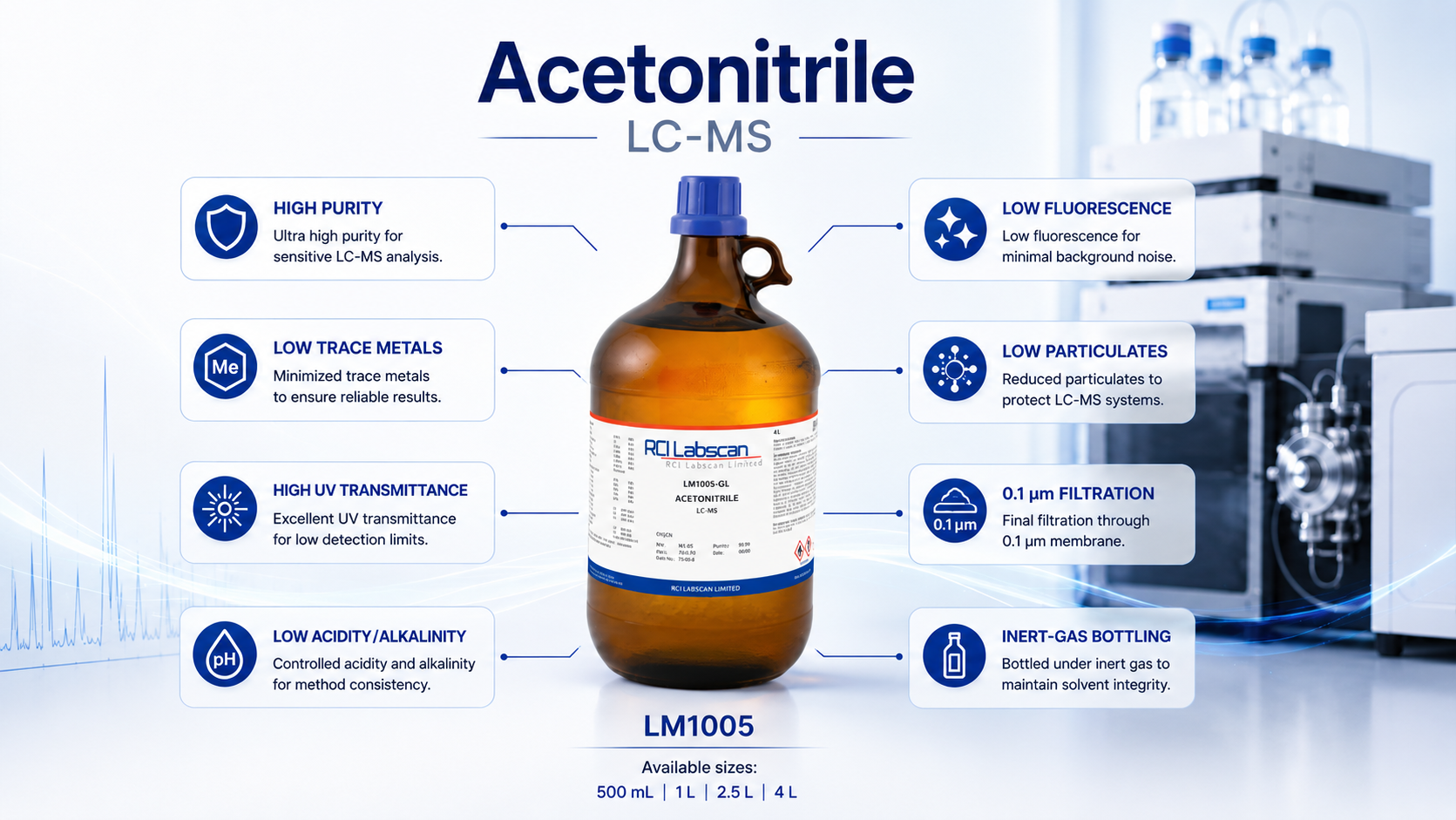
RCI Labscan Acetonitrile, LC-MS
Acetonitrile, LC-MS — LM1005 is designed for analytical and preparative separation and is suitable for LC-MS analytical techniques.
According to RCI Labscan, the product features:
- High-purity solvent
- Low levels of trace metals
- Low fluorescence
- High UV transmittance
- Low acidity and alkalinity
- Low particulate levels
- Final filtration through a 0.1 μm filter
- Bottling under inert gas
The product is available in 500 mL, 1 L, 2.5 L, and 4 L glass bottle formats.
A recent RCI Labscan COA for Acetonitrile LC-MS, code LM1005, specifies a minimum assay of 99.95% and includes requirements for water, UV transmission, gradient performance, fluorescence, trace metals, and LC-MS suitability.
RCI Labscan Methanol, LC-MS
Methanol, LC-MS — LM1115 is designed for analytical and preparative separation and is suitable for LC-MS analytical techniques.
RCI Labscan describes the product as a high-purity solvent with:
- Low levels of trace metals
- Low fluorescence
- High UV transmittance
- Low acidity and alkalinity
- Low particulate levels
- Filtration through 0.1 μm filters
Methanol LC-MS is available in 500 mL, 1 L, 2.5 L, and 4 L glass bottle formats.
Methanol is commonly used as an organic mobile-phase component in LC methods, making LC-MS grade Methanol an important option for laboratories that require solvent purity suitable for mass spectrometry workflows.

Acetonitrile vs Methanol for LC-MS
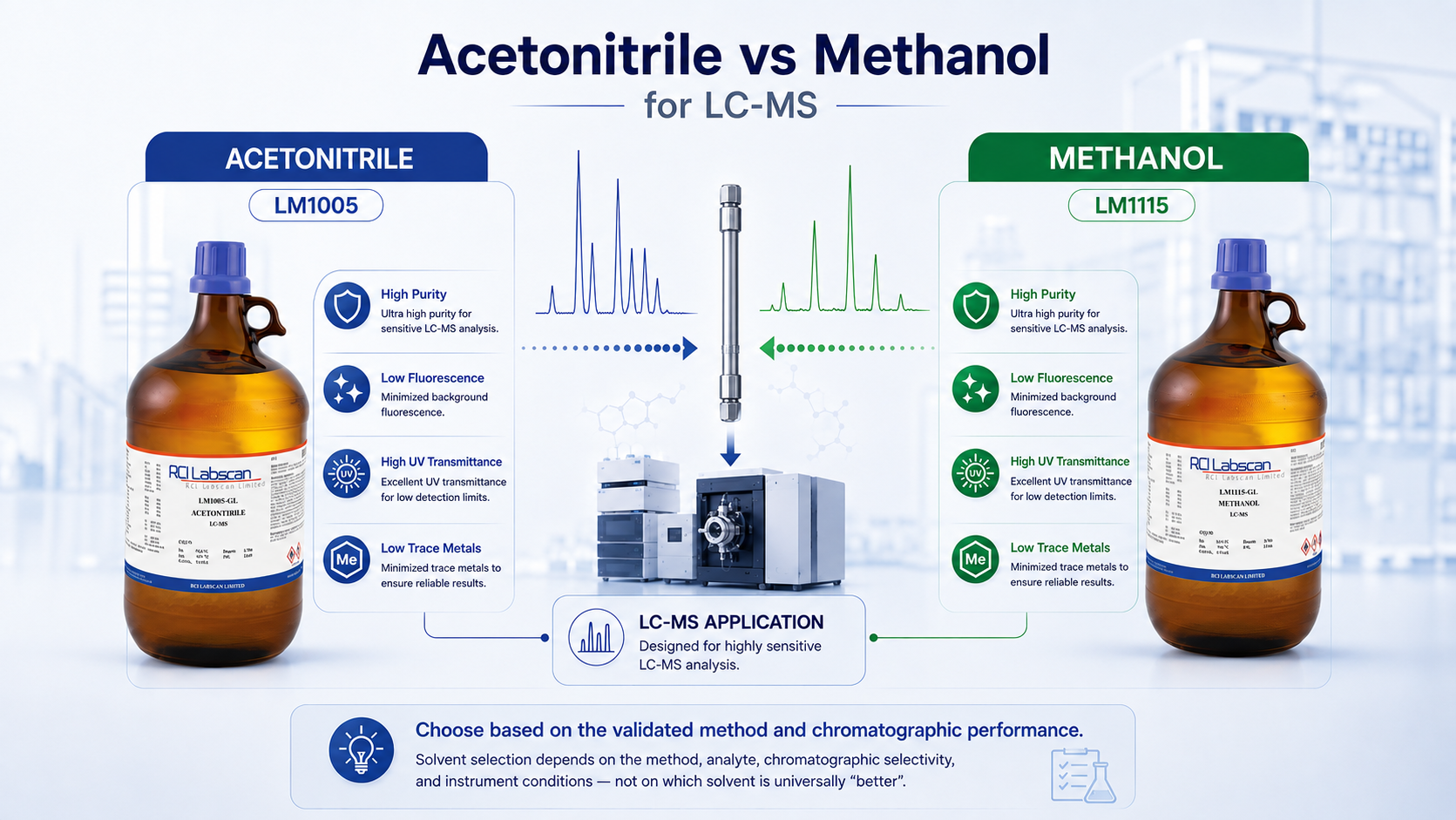
Both Acetonitrile and Methanol can be used as organic solvents in LC-MS, but the appropriate choice depends on the analytical method, analyte properties, chromatographic selectivity, and instrument conditions.
| Factor | Acetonitrile LC-MS | Methanol LC-MS |
|---|---|---|
| Product Code | LM1005 | LM1115 |
| LC-MS Application | Suitable for LC-MS analytical techniques | Suitable for LC-MS analytical techniques |
| Purity Control | High purity with trace-metal and other impurity controls | High purity with trace-metal and other impurity controls |
| Fluorescence | Low fluorescence | Low fluorescence |
| UV Transmittance | High | High |
| Trace Metals | Controlled at low levels | Controlled at low levels |
| Filtration | 0.1 μm final filtration | 0.1 μm filtration |
| Typical Role | Organic mobile-phase component for many LC-MS methods | Organic mobile-phase component for many LC-MS methods |
The choice between Acetonitrile and Methanol should be based on the validated method and chromatographic performance rather than assuming that one solvent is universally better than the other.
When Should You Consider LC-MS Grade Solvents?
LC-MS grade solvents are particularly relevant when:
- The method requires trace-level or low-level detection
- LC-MS or LC-MS/MS is used for detection
- Background interference must be minimized
- The method is sensitive to trace metals or organic impurities
- Low fluorescence and high UV transmittance are important
- The laboratory is developing or validating a highly sensitive analytical method
- The validated method specifically requires LC-MS grade solvent
For regulated or validated methods, laboratories should always follow the solvent grade and specifications defined by the approved method.
Practical Considerations When Using LC-MS Solvents
Selecting the correct solvent grade is only one part of maintaining LC-MS performance.
- Check the current product specification and COA. Confirm that the specific batch meets the requirements of your method.
- Use clean solvent lines and containers. Prevent contamination during solvent transfer and storage.
- Minimize exposure to contaminants. Keep solvent containers properly closed when not in use.
- Follow instrument recommendations. Use solvent handling and filtration practices appropriate for the LC-MS system.
- Monitor background signals. Unexpected background or changes in sensitivity may indicate contamination or other system-related issues.
- Avoid unnecessary solvent substitution. If the validated method specifies LC-MS grade, changing to another grade may require additional evaluation or validation.
- Consider the complete analytical system. Solvent quality, mobile-phase preparation, tubing, columns, sample preparation, and instrument cleanliness can all contribute to background signals.
Users should always verify actual product values through the current product specification and COA rather than relying only on general grade descriptions.
Why Choose RCI Labscan LC-MS Solvents?
RCI Labscan provides dedicated LC-MS solvents for laboratories requiring high-purity solvents for mass spectrometry applications.
The product range includes:
- Acetonitrile, LC-MS — LM1005
- Methanol, LC-MS — LM1115
RCI Labscan's product descriptions emphasize low levels of trace metals, low fluorescence, high UV transmittance, low acidity and alkalinity, and low particulates. These characteristics are relevant when minimizing potential solvent-related interference is important for sensitive analytical workflows.
RCI Labscan also offers ULC-MS grades for selected solvents, providing another option for laboratories with specific ultra-high-performance LC-MS requirements. The current product catalogue lists both Methanol ULC-MS (UM1115) and Acetonitrile ULC-MS (UM1005).
Related RCI Labscan Products
RCI Labscan's LC-MS solvent range includes:
- Acetonitrile, LC-MS — LM1005
- Methanol, LC-MS — LM1115
- Acetonitrile, ULC-MS — UM1005
- Methanol, ULC-MS — UM1115
Product availability, packaging, and specifications may vary. Always check the current product page and specification before ordering.
FAQ
What are LC-MS solvents used for?
LC-MS solvents are used as mobile-phase components and solvents in liquid chromatography–mass spectrometry applications. They are designed with impurity controls appropriate for analytical techniques where trace contaminants may affect detection.
Why are trace metals important in LC-MS solvents?
Trace metals can become relevant contaminants in highly sensitive analytical workflows. Controlling their levels can help reduce potential sources of interference and contamination.
What is the difference between HPLC Grade and LC-MS Grade solvent?
Both grades can be suitable for chromatographic applications, but LC-MS grade solvents are specifically designed for mass spectrometry workflows and typically include additional controls relevant to highly sensitive detection. The exact specifications depend on the product and manufacturer.
Is RCI Labscan Acetonitrile LC-MS suitable for LC-MS?
Yes. RCI Labscan lists Acetonitrile LC-MS, code LM1005, as suitable for LC-MS analytical techniques. Its product information specifies high purity, low trace metals, low fluorescence, high UV transmittance, low acidity and alkalinity, and low particulates.
Is RCI Labscan Methanol LC-MS suitable for LC-MS/MS?
Methanol LC-MS is listed by RCI Labscan as suitable for LC-MS analytical techniques. Whether it is appropriate for a specific LC-MS/MS method should be confirmed against the validated method and current product specification.
How do I choose between Acetonitrile and Methanol for LC-MS?
The choice depends on the validated method, analyte properties, chromatographic selectivity, retention, ionization behavior, and instrument conditions. Neither solvent is universally better for every LC-MS method.
How can I confirm that a specific LC-MS solvent is suitable for my method?
Review the current product specification and COA, then compare the documented parameters with your method requirements. For highly sensitive methods, laboratories may also evaluate solvent performance using their specific LC-MS system.
Explore related products:
- Acetonitrile, LC-MS – RCI Labscan
- Methanol, LC-MS – RCI Labscan
- RCI Labscan Acetonitrile Product Range
- RCI Labscan Methanol Product Range
Related article:
- HPLC Grade vs LC-MS Grade Solvents
- What Is HPLC Grade Solvent?
- Understanding Chemical Grades: Choosing the Right Solution with RCI Labscan
Product availability, specifications, packaging, and product codes may change. Always verify the latest information through the official RCI Labscan product page, current specification, and COA before use.
Leave a comment!