RCI Product Knowledge Update: Solvents, Grades, and Documentation
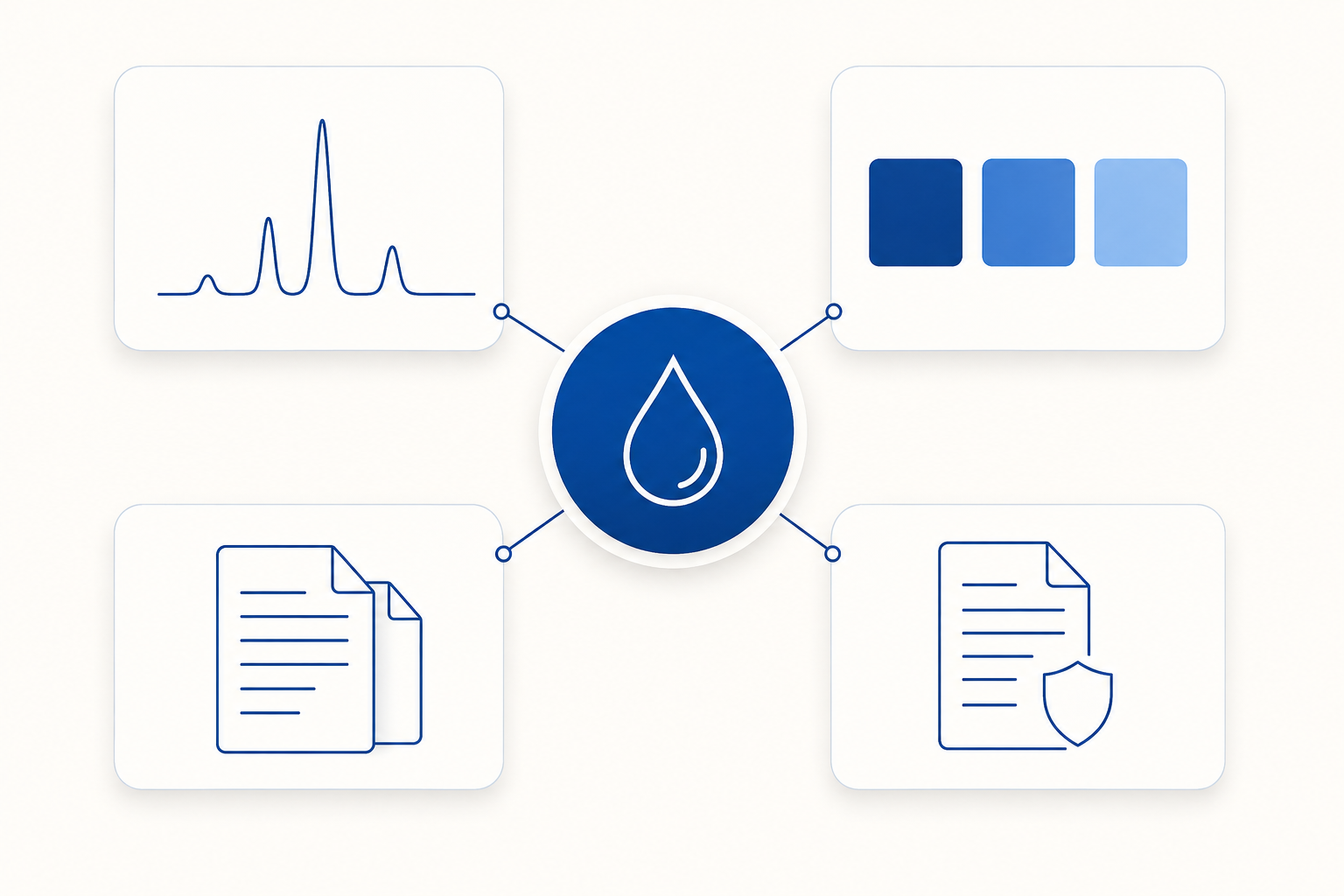
Distributors and business partners often need to translate a customer's laboratory request into three connected questions: which chemical the method requires, which grade fits the application, and which documents are needed for the exact product and supplied lot. This roundup brings together existing RCI Labscan learning resources to support those conversations without replacing the customer's technical or quality approval.
Use it when preparing a product enquiry, responding to a documentation request, or referring a customer to the right technical resource. Record the customer's application and detector, confirm the exact chemical and requested grade, and identify the current specification, SDS, and matching lot CoA needed for review. The customer's approved method and quality system determine acceptance.
Start With the Question You Need to Answer
| Your question | Start here | What to clarify |
|---|---|---|
| Which chemical does the method require? | Solvent comparison | The specified solvent and the effect of a proposed substitution |
| Which grade fits the application? | Grade overview and detector comparison | The application, detector, and method requirements |
| What quality limits should the product meet? | Product specification | The applicable tests, units, and acceptance limits |
| Does the document match the delivered lot? | Certificate of Analysis | Product identity, lot number, and reported results |
| What hazard information is needed before use? | Safety Data Sheet | Handling, storage, exposure controls, and emergency information |
1. Separate Solvent Identity From Solvent Grade
Acetonitrile and methanol are different chemicals, even when both carry an HPLC grade designation. Their effects on retention, selectivity, pressure, and UV detection can differ. A shared grade name does not make them interchangeable in an established method.
The useful starting point is the method's stated solvent. If a change is proposed, the technical team should assess it under the laboratory's procedures before procurement treats the alternative as an equivalent purchase.
For the practical comparison, read Acetonitrile vs Methanol: Which Solvent Should You Choose for HPLC?
2. Connect the Grade to the Application
Grade names help organize chemicals around intended applications and quality requirements. They are a useful first filter, but the name alone does not describe every test limit or establish suitability for every method. For a broad orientation to the terminology, start with Understanding Chemical Grades: Choosing the Right Solution with RCI Labscan.
For chromatography, add the detector to the discussion. HPLC and LC-MS applications have overlapping solvent-quality concerns, while mass spectrometry introduces particular sensitivity to background contamination and ion suppression. A product that performs adequately in one detection setup should not automatically be accepted for another.
The focused comparison, HPLC vs LC-MS Grade Solvents, helps readers frame that decision. Use the current specification and the method's requirements to evaluate the exact candidate product.

3. Read the Specification as a Set of Requirements
A product specification states the quality characteristics and acceptance limits the product is intended to meet. Depending on the chemical and grade, relevant entries may include assay, water content, residue after evaporation, or absorbance at stated wavelengths.
Compare like with like: check the parameter, unit, limit, and any stated test conditions. A purity percentage by itself does not answer every application question. If a method-critical parameter is missing or unclear, resolve that question before accepting the product.
Read What Is Product Specification and How Should You Read It? for a guide to the document's structure.
4. Match the CoA to the Supplied Lot
A Certificate of Analysis, or CoA, provides lot-specific quality information. First match the product name, code, grade, and lot number to the material received. Then review the reported results or conformity statements against the relevant acceptance limits.
A certificate for another lot cannot establish the quality of the container in front of you. Keep the matching record accessible through the laboratory's document system so that later questions can be traced to the material actually used.
The article What Is a COA and Which Values Should You Check Before Using Laboratory Chemicals? explains which fields deserve attention.
5. Keep Safety Information Alongside Quality Information
The Safety Data Sheet, or SDS, serves a different purpose from the specification and CoA. It communicates chemical hazards and information relevant to handling, storage, exposure controls, and emergencies. Passing a quality specification does not remove a chemical's hazards.
Use the current SDS for the exact product alongside the laboratory's risk assessment, procedures, and applicable local requirements. The overview What Is an SDS? Why Every Laboratory Should Take It Seriously is a useful starting point for colleagues learning the document.
Use the Resources in Customer Support
For a customer enquiry, record the intended application and detector first. Confirm the exact chemical and requested grade, then provide the current specification and SDS and, when available and relevant, the CoA that matches the supplied lot. A clear record helps prevent a missing lot number, an ambiguous grade, or an unsupported substitution.
Refer equivalence, method-suitability, or acceptance questions to qualified technical staff. A distributor or business partner can help assemble accurate product information, but should not approve a customer's analytical method or quality release.
FAQ
Is this a new product announcement?
No. This is a roundup of existing RCI Labscan educational resources. It does not announce a product launch or a change in product specifications.
Can a grade guide replace the product specification?
No. The guide provides orientation; the exact product specification supplies the applicable requirements.
Does the CoA replace the SDS?
No. The CoA supports lot-specific quality review, while the SDS provides hazard information. Both have a distinct role.
Prepare for a Product Enquiry
Explore the RCI Labscan grade catalogue to navigate products by application. Before contacting RCI Labscan, assemble the customer's chemical name, requested grade, application, detector, and documentation needs. Confirm the exact product details and current availability before ordering, and refer method-suitability questions to qualified technical staff.
Leave a comment!