
HPLC vs LC-MS Grade Solvents
(A Practical Guide to Choosing the Right Solvent Grade for Analytical Applications)
Direct Answer
HPLC grade solvents and LC-MS grade solvents are both high-purity solvents for analytical laboratories. However, each grade supports different detection requirements.
Laboratories use HPLC grade solvents for High Performance Liquid Chromatography, or HPLC, especially with UV, PDA, RI, fluorescence, or other common HPLC detectors. Manufacturers control these solvents for purity, low residue, low UV absorbance, and consistent quality.
Meanwhile, laboratories use LC-MS grade solvents for Liquid Chromatography–Mass Spectrometry applications. These methods require stricter control of impurities that may affect mass spectrometry detection, such as non-volatile residues, ion-suppressing contaminants, trace impurities, or background signals.
In simple terms, HPLC grade solvents support chromatographic separation, while LC-MS grade solvents support chromatography combined with mass spectrometry detection.
Why the Difference Matters
Choosing the correct solvent grade is important because solvent quality can directly affect analytical results. Although both HPLC and LC-MS methods rely on high-purity solvents, the detector type and sensitivity requirement are different.
In HPLC analysis, solvent impurities may cause several chromatographic problems, including:
- Baseline noise
- Ghost peaks
- Unstable retention time
- Poor peak shape
- Reduced method reproducibility
However, LC-MS analysis creates additional challenges because mass spectrometry detectors respond strongly to trace contaminants. Even very small amounts of non-volatile residue, salts, or ion-suppressing substances may reduce signal intensity, sensitivity, or mass accuracy.
Therefore, laboratories generally choose LC-MS grade solvents when the method uses mass spectrometry detection. On the other hand, they commonly choose HPLC grade solvents for routine HPLC analysis, quality control testing, and method development.

What is HPLC Grade Solvent?
HPLC grade solvent is a high-purity solvent for High Performance Liquid Chromatography. Laboratories commonly use it as a mobile phase component, sample preparation solvent, or cleaning solvent in HPLC workflows.
Typical quality characteristics of HPLC grade solvents include:
- High purity
- Low residue
- Low UV absorbance
- Controlled impurities
- Consistent lot-to-lot quality
- Suitability for chromatographic analysis
These characteristics help laboratories achieve stable baselines, clear peak separation, and reliable analytical results. As a result, many laboratories use HPLC grade solvents in research, QA/QC testing, pharmaceutical analysis, food and beverage testing, environmental testing, and industrial analysis.
What is LC-MS Grade Solvent?
LC-MS grade solvent is a high-purity solvent for Liquid Chromatography–Mass Spectrometry applications. Compared with standard HPLC grade solvents, LC-MS grade solvents usually have stricter limits for impurities that may interfere with mass spectrometry detection.
Important quality characteristics of LC-MS grade solvents may include:
- Very low residue
- Low background noise
- Low ion-suppressing contaminants
- Low non-volatile impurities
- Suitability for electrospray ionization or related MS techniques
- High consistency for sensitive analysis
Because LC-MS methods require high sensitivity and low background interference, laboratories commonly use LC-MS grade solvents in pharmaceutical analysis, bioanalysis, residue analysis, proteomics, metabolomics, and trace-level analytical work.
HPLC Grade vs LC-MS Grade Solvents
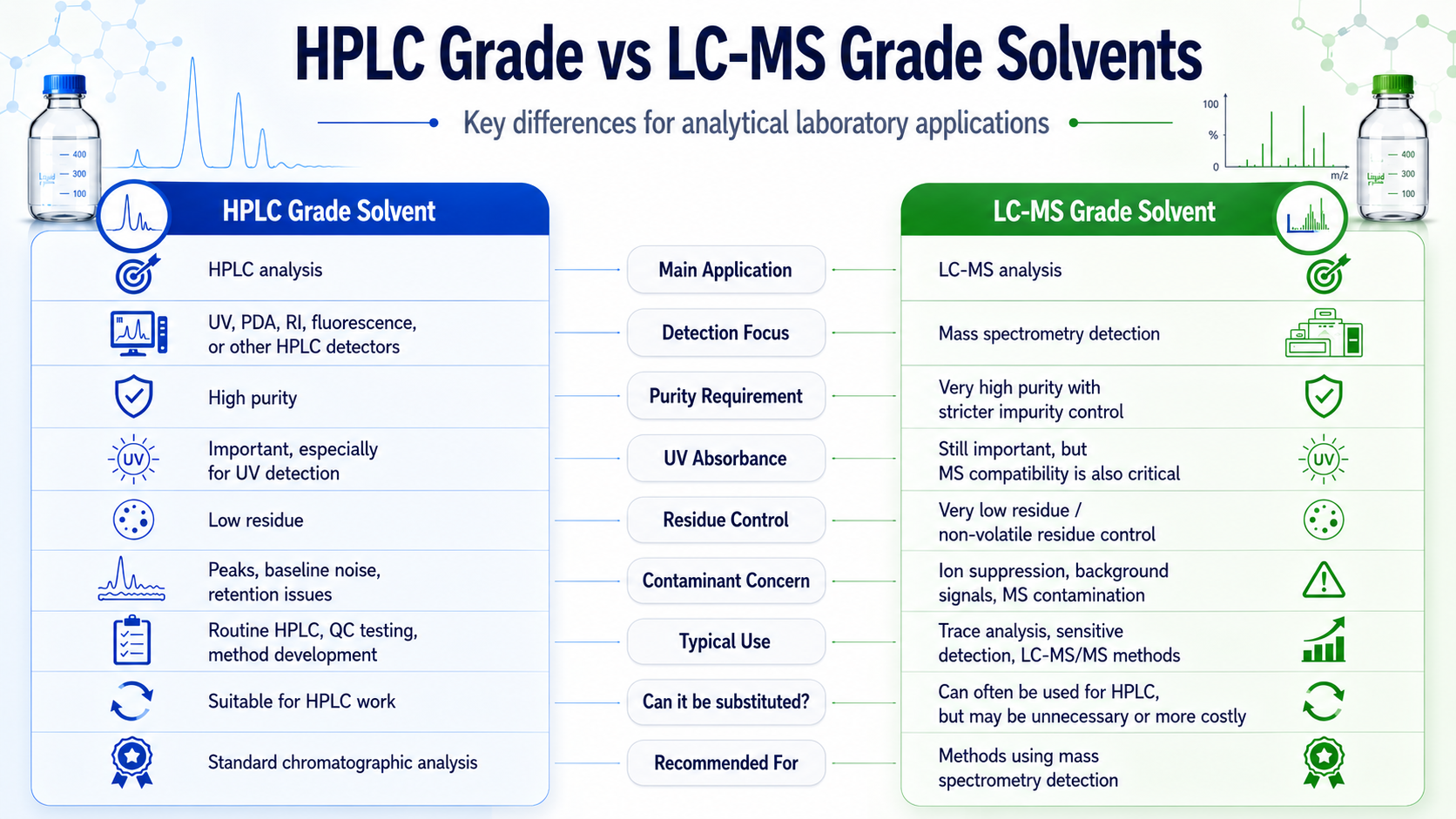
The main difference between HPLC grade and LC-MS grade solvents is the type of analytical detection they support. HPLC grade solvents focus on chromatographic performance, while LC-MS grade solvents also support sensitive mass spectrometry detection.
| Comparison Point | HPLC Grade Solvent | LC-MS Grade Solvent |
|---|---|---|
| Main Application | HPLC analysis | LC-MS analysis |
| Detection Focus | UV, PDA, RI, fluorescence, or other HPLC detectors | Mass spectrometry detection |
| Purity Requirement | High purity | Very high purity with stricter impurity control |
| UV Absorbance | Important, especially for UV detection | Still important, but MS compatibility is also critical |
| Residue Control | Low residue | Very low residue / non-volatile residue control |
| Contaminant Concern | Peaks, baseline noise, and retention issues | Ion suppression, background signals, and MS contamination |
| Typical Use | Routine HPLC, QC testing, and method development | Trace analysis, sensitive detection, and LC-MS/MS methods |
| Recommended For | Standard chromatographic analysis | Methods using mass spectrometry detection |
Can LC-MS Grade Solvent Be Used for HPLC?
Yes, laboratories can generally use LC-MS grade solvent for HPLC analysis because it meets high purity requirements.
However, routine HPLC work may not always need LC-MS grade solvent. If the method uses UV detection and does not require mass spectrometry compatibility, HPLC grade solvent is usually the more suitable and cost-effective choice.
Therefore, laboratories should consider LC-MS grade solvent when the method involves LC-MS or LC-MS/MS detection, trace-level analysis, or highly sensitive analytical work.
Can HPLC Grade Solvent Be Used for LC-MS?
Laboratories should not generally use HPLC grade solvent for LC-MS analysis unless the method, instrument requirement, or technical team confirms its suitability.
Although HPLC grade solvents offer high purity, they may not meet the specific impurity requirements for mass spectrometry detection.
For this reason, laboratories usually choose LC-MS grade solvents for LC-MS applications to reduce the risk of background noise, ion suppression, poor sensitivity, or instrument contamination.
How to Choose Between HPLC and LC-MS Grade Solvents
Laboratories should select the solvent grade according to the analytical method, detector type, sensitivity requirement, and instrument compatibility. In addition, choosing the correct grade helps reduce analytical problems and supports more reliable results.
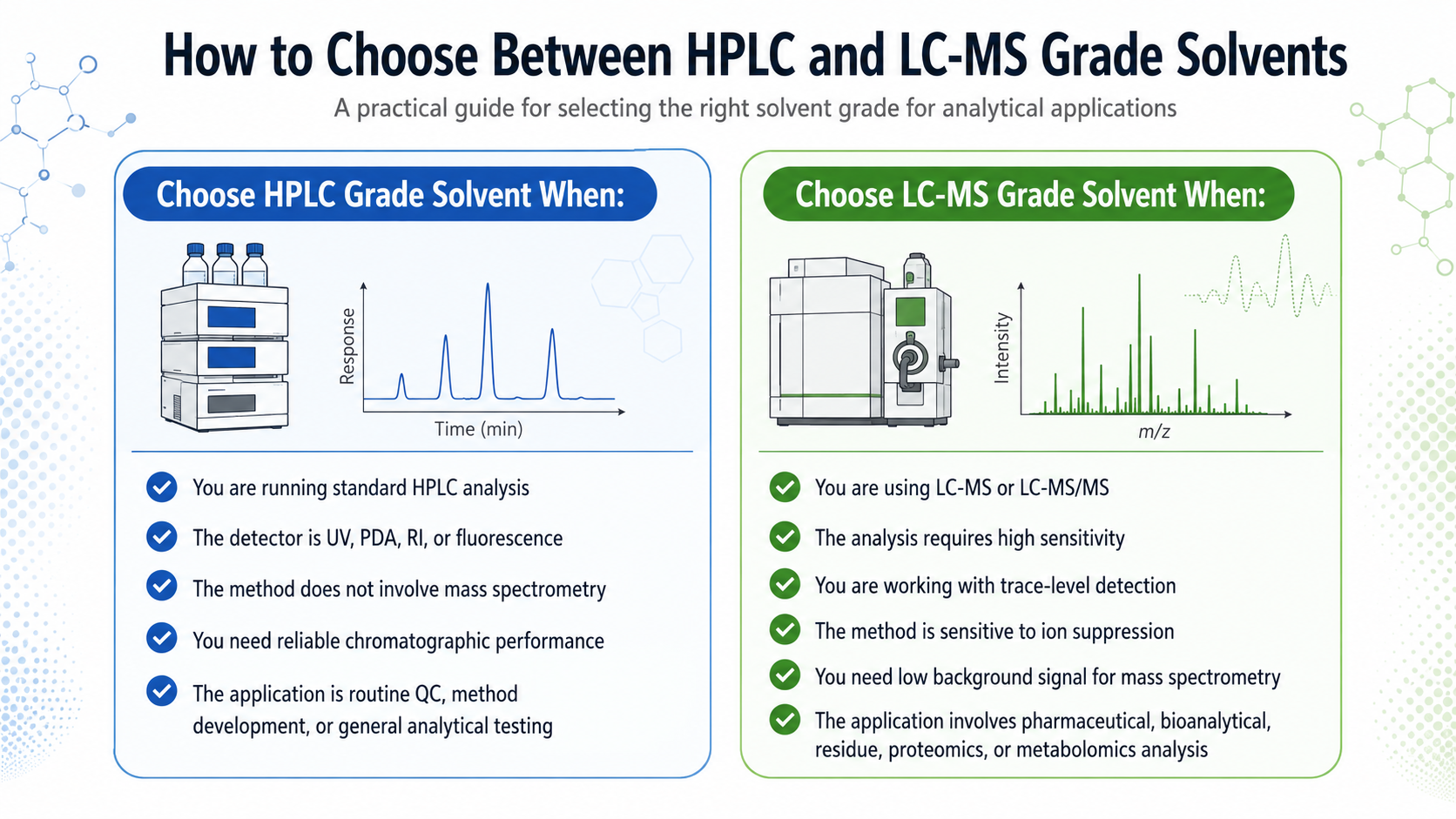
Choose HPLC grade solvent when:
- You are running standard HPLC analysis
- The detector is UV, PDA, RI, or fluorescence
- The method does not involve mass spectrometry
- You need reliable chromatographic performance
- The application is routine QC, method development, or general analytical testing
Choose LC-MS grade solvent when:
- You are using LC-MS or LC-MS/MS
- The analysis requires high sensitivity
- You are working with trace-level detection
- The method is sensitive to ion suppression
- You need low background signal for mass spectrometry
- The application involves pharmaceutical, bioanalytical, residue, proteomics, or metabolomics analysis
In addition, laboratories should always review the solvent specification and Certificate of Analysis, or CoA, before use. This step helps confirm that the solvent meets the requirements of the analytical method.
Common Solvents Available in HPLC and LC-MS Grades
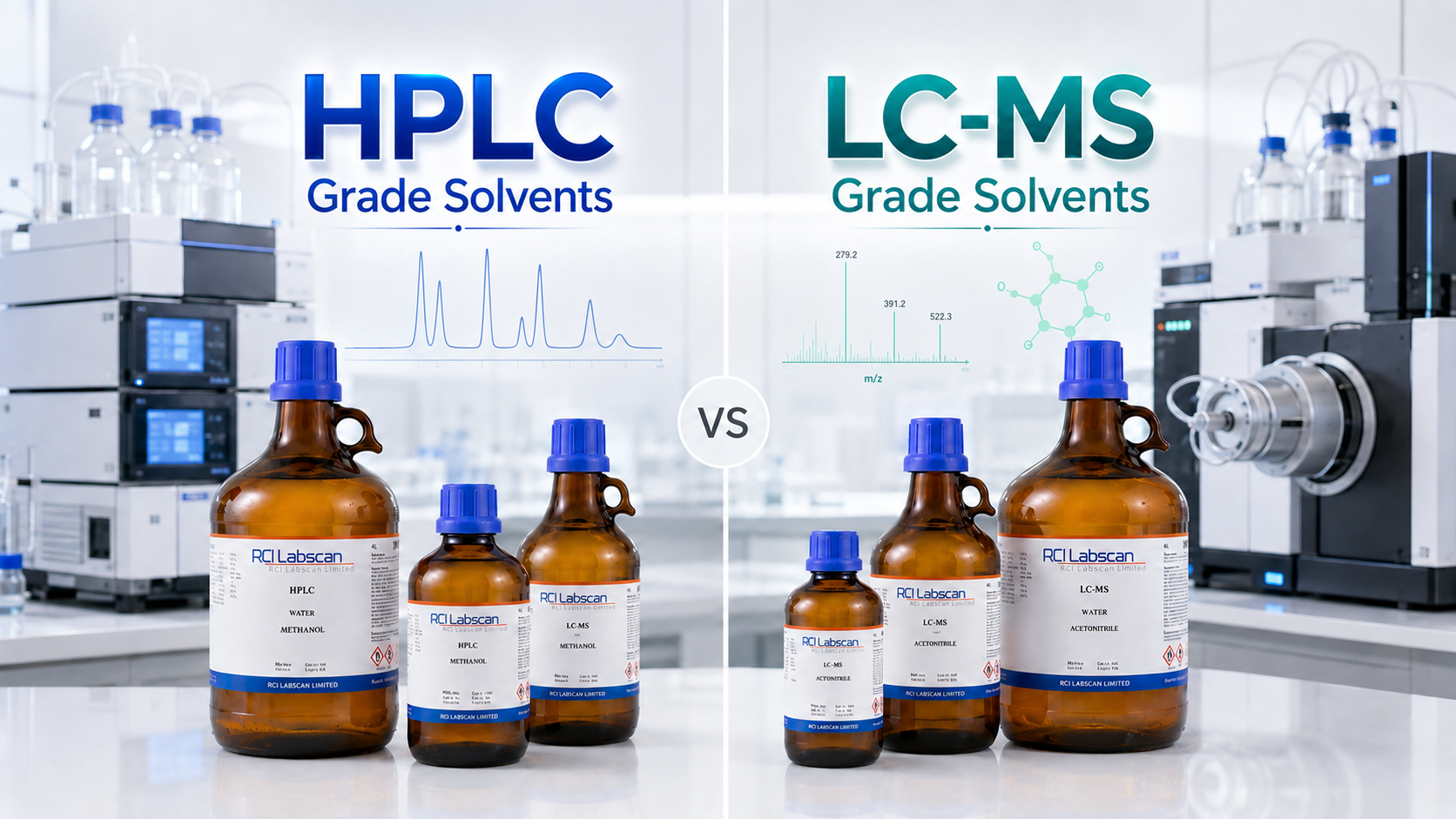
Several solvents may come in both HPLC grade and LC-MS grade depending on the application requirements. However, the correct selection depends on the method, detector, sensitivity requirement, and instrument compatibility.
Common examples include:
- Acetonitrile HPLC / Acetonitrile LC-MS
- Methanol HPLC / Methanol LC-MS
- Water HPLC / Water LC-MS
- Isopropanol HPLC / Isopropanol LC-MS
However, laboratories should not choose the solvent grade by solvent name alone. Instead, they should select the grade that matches the analytical workflow and detection requirement.
FAQ
What is the main difference between HPLC grade and LC-MS grade solvents?
HPLC grade solvents support High Performance Liquid Chromatography, while LC-MS grade solvents support Liquid Chromatography–Mass Spectrometry. LC-MS grade solvents usually require stricter impurity control because mass spectrometry detectors are highly sensitive to trace contaminants.
Is LC-MS grade better than HPLC grade?
LC-MS grade generally has stricter control for LC-MS applications. However, that does not always make it the better choice for every analysis. For routine HPLC work, HPLC grade solvent is often suitable and more cost-effective.
Can I use LC-MS grade solvent for HPLC?
Yes, laboratories can generally use LC-MS grade solvent for HPLC analysis. However, routine HPLC methods that do not require mass spectrometry compatibility may not need it.
Can I use HPLC grade solvent for LC-MS?
Laboratories should not generally use HPLC grade solvent for LC-MS unless the method confirms its suitability. LC-MS grade solvent usually offers a safer choice because it helps reduce the risk of background signal, ion suppression, or instrument contamination.
Which solvent grade should I choose for LC-MS/MS?
For LC-MS/MS, laboratories should choose LC-MS grade solvent because the method usually requires very low impurities, low background noise, and high sensitivity.
Choose the Right Solvent Grade with RCI Labscan
Selecting the right solvent grade is an important step in achieving reliable analytical performance. Therefore, laboratories should choose solvents that match their analytical method, detector, instrument, and documentation requirements.
RCI Labscan supports laboratories in research, quality control, pharmaceutical testing, environmental analysis, and industrial applications with consistent quality control, technical documentation, and a wide range of high-purity solvents.
Choose the right grade. Reduce interference. Analyze with confidence.
Explore related products:
- View all HPLC grade products
- View all LC-MS grade products
- Acetonitrile HPLC
- Methanol HPLC
- Acetonitrile LC-MS
- Methanol LC-MS
Related article:
Leave a comment!