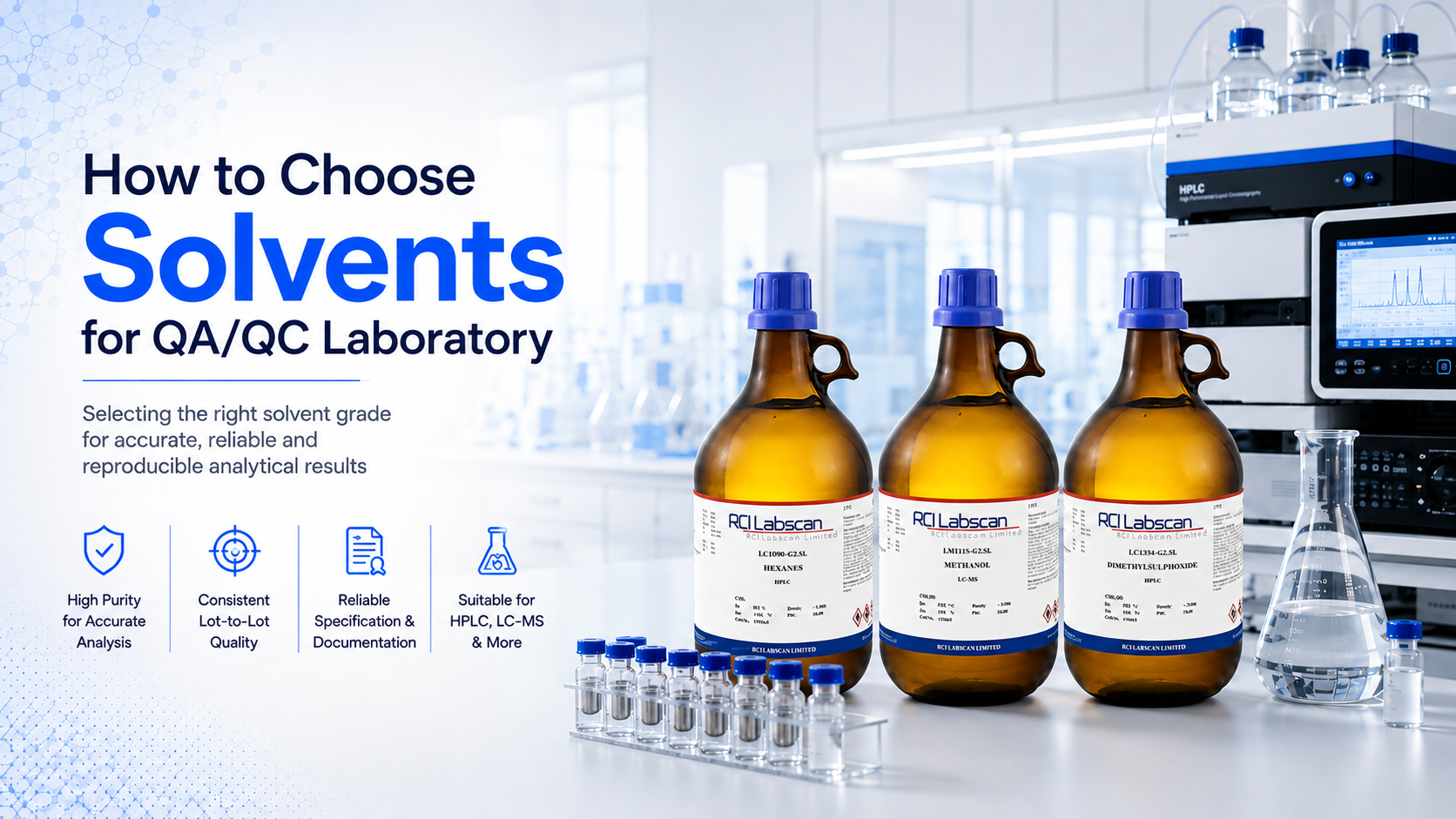

How to Choose Solvents for QA/QC Laboratory
(A Practical Guide to Selecting the Right Solvent for Quality Control and Analytical Applications)
Direct Answer
Choosing the right solvent for a QA/QC laboratory is not simply a matter of selecting the highest-purity solvent available. The appropriate solvent depends on the analytical method, instrument, detector, required sensitivity, application, and the level of impurity control required.
In quality assurance and quality control laboratories, solvents are commonly used for sample preparation, dilution, extraction, mobile phases, rinsing, cleaning, and other analytical procedures. The solvent quality can therefore directly affect analytical performance, reproducibility, and the reliability of test results.
For routine laboratory analysis, users should consider several key factors, including:
- Intended analytical application
- Instrument and detector
- Solvent grade
- Purity or assay
- UV absorbance
- Water content
- Residue after evaporation
- Specific impurities
- Non-volatile impurities
- Compatibility with the analytical method
- Certificate of Analysis (CoA)
- Cost and routine usage
In simple terms, the right solvent is not necessarily the most expensive or highest-grade solvent. It is the solvent that provides the quality and performance required by the analytical method.
Why Does Solvent Selection Matter in QA/QC Laboratories?
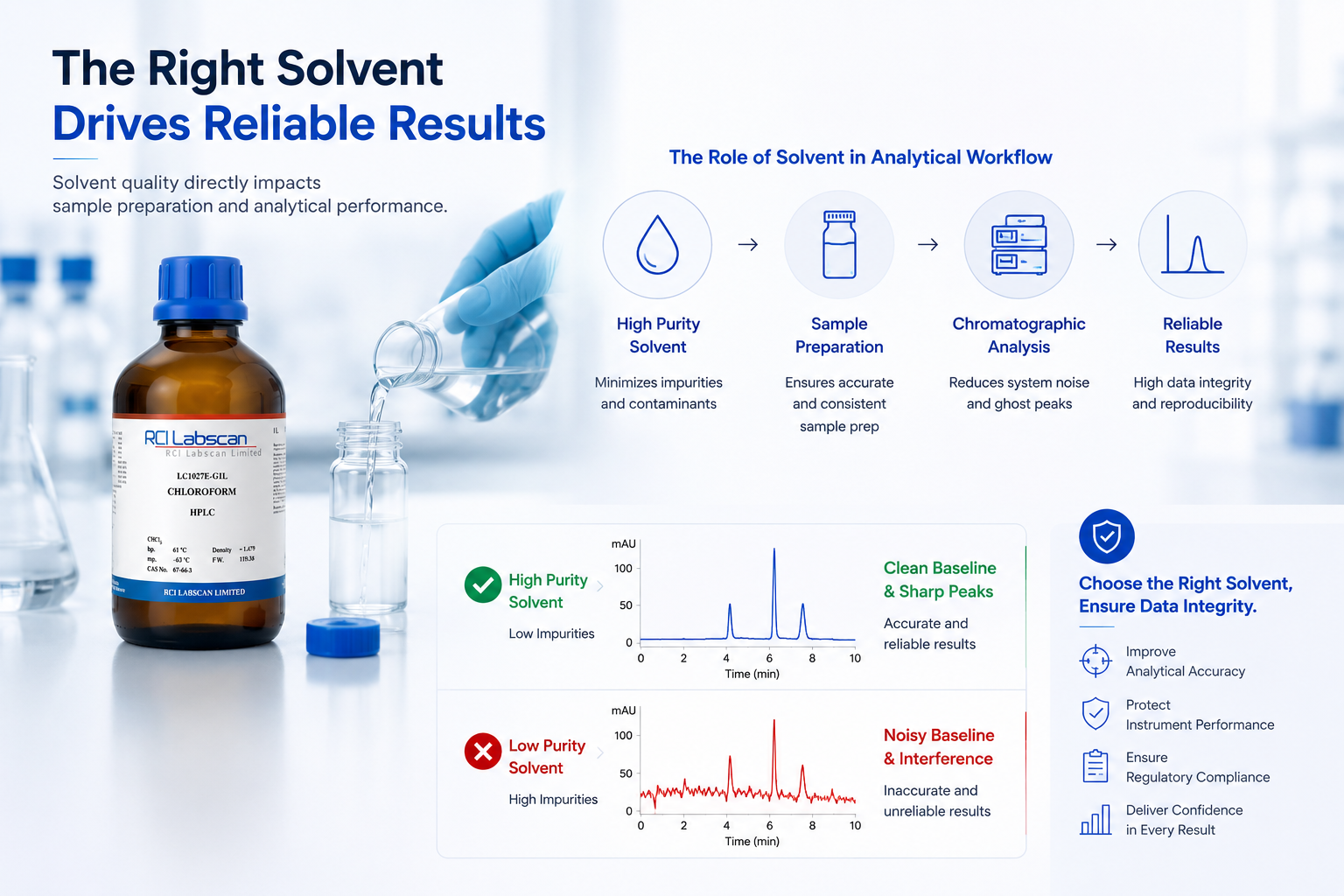
QA/QC laboratories require analytical results that are accurate, consistent, and reproducible. Because solvents are often directly involved in sample preparation and instrumental analysis, solvent quality can influence the final result.
For example, unsuitable solvent quality may contribute to:
- Background signals
- Unexpected peaks
- Baseline noise
- Poor peak shape
- Retention time variation
- Contamination
- Reduced sensitivity
- Poor method reproducibility
- Increased instrument maintenance
- Incorrect analytical results
These issues can become particularly important when laboratories perform routine testing on a large number of samples.
A solvent that appears suitable based only on its chemical name or purity percentage may still contain impurities that interfere with a specific analytical method.
Therefore, solvent selection should always consider the complete analytical workflow rather than purity alone.
What Should You Consider When Choosing a Solvent?
A practical approach is to evaluate the solvent according to several key factors.
1. Start With the Analytical Application
The first question should be: What will the solvent be used for?
Solvents may be used for different purposes in a QA/QC laboratory, including:
- HPLC mobile phase
- LC-MS mobile phase
- Sample preparation
- Sample dilution
- Extraction
- Cleaning
- Rinsing
- Spectroscopic analysis
- General laboratory procedures
The same solvent may be available in different grades depending on its intended application. For example, a solvent used as an HPLC mobile phase may require low UV absorbance and low residue, while a solvent used for LC-MS may require stricter control of trace impurities and non-volatile contaminants.
Therefore, identifying the application should be the first step in solvent selection.
2. Check the Instrument and Detector
The instrument and detector can significantly influence the solvent requirements. Different analytical techniques may have different solvent quality requirements.
| Analytical Technique | Typical Solvent Considerations |
|---|---|
| HPLC-UV | UV absorbance, purity, residue, impurities |
| HPLC-PDA | UV absorbance, purity, residue, impurities |
| HPLC-RI | Purity, refractive index, consistency |
| LC-MS | Trace impurities, low residue, MS compatibility |
| GC | Volatility, purity, residue, chromatographic performance |
| UV-Vis | UV absorbance and solvent background |
| Sample Preparation | Purity, compatibility, extraction performance |
The detector is particularly important because some impurities may not affect one analytical technique but may interfere strongly with another. For example, a solvent that performs adequately in a routine HPLC method may not necessarily be appropriate for a highly sensitive LC-MS application.
3. Select the Appropriate Solvent Grade
Solvent grade provides an important indication of the intended quality and application of the product. Common grades used in analytical laboratories may include:
- General reagent grade
- Analytical reagent grade
- HPLC grade
- LC-MS grade
- Spectroscopy grade
- Other application-specific grades
However, laboratories should not select a grade based on the grade name alone. Instead, users should review the actual Product Specification to determine which quality parameters are controlled and whether the solvent is suitable for the intended application.
4. Check Purity or Assay
Purity is one of the first specifications that users often check when selecting a solvent (e.g., Assay: ≥ 99.9%). This indicates that the target chemical meets a specified minimum assay requirement.
However, a high assay does not automatically mean that the solvent is suitable for every analytical application. A solvent may have high assay while still containing trace levels of impurities that could affect UV detection, chromatographic separation, mass spectrometry, baseline stability, sample analysis, or instrument performance.
5. Check UV Absorbance for UV-Based Analysis
UV absorbance can be an important parameter when solvents are used with UV or PDA detection. In HPLC-UV and HPLC-PDA analysis, unwanted UV-absorbing impurities may contribute to background signals or affect the chromatographic baseline.
For this reason, laboratories should review the UV absorbance specification when selecting solvents for methods that use UV-based detection. The required UV performance may also depend on the detection wavelength used by the analytical method.
6. Check Residue After Evaporation
Residue after evaporation is another important parameter for analytical solvents. This specification indicates the amount of non-volatile material remaining after the solvent is evaporated under the specified test conditions.
High levels of residue may indicate the presence of non-volatile substances that could contribute to background contamination, instrument contamination, unexpected peaks, deposits, or reduced analytical performance.
7. Consider Water Content
Water content can be an important specification depending on the analytical method and application. Excessive water may affect solvent composition, sample preparation, reaction conditions, chromatographic performance, and moisture-sensitive analytical procedures.
8. Review Specific Impurities
One of the most important considerations in QA/QC solvent selection is impurity control. Instead of asking only "How pure is the solvent?" laboratories should also ask "Which impurities are controlled, and are they relevant to my method?"
Different analytical techniques may be affected by different contaminants:
- UV-absorbing impurities may affect UV detection
- Non-volatile impurities may affect LC-MS analysis
- Trace contaminants may create additional peaks
- Ionic contaminants may contribute to ion suppression
- Residual contaminants may affect sensitive analytical methods
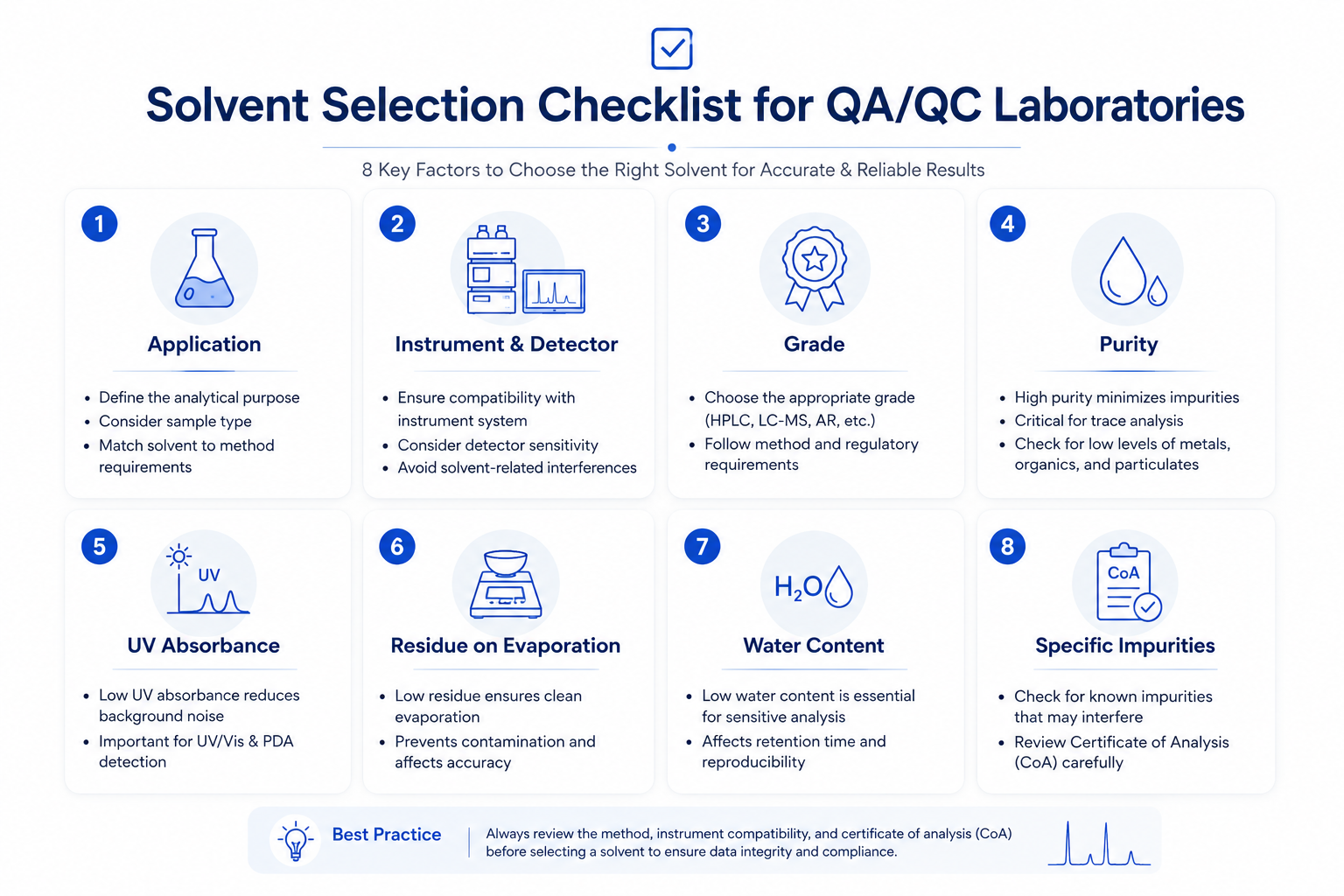
Solvent Selection Factors at a Glance
The following checklist can help QA/QC laboratories evaluate solvent suitability before purchase:
| Selection Factor | Why It Matters |
|---|---|
| Analytical application | Determines the required solvent quality |
| Instrument | Determines compatibility requirements |
| Detector | Influences impurity and background requirements |
| Solvent grade | Indicates intended application and quality level |
| Purity / Assay | Confirms the amount of target chemical |
| UV Absorbance | Important for UV/PDA-based analysis |
| Water Content | Important for moisture-sensitive methods |
| Residue | Helps assess non-volatile contamination |
| Specific Impurities | Helps identify potential analytical interference |
| Test Method | Shows how the specification is evaluated |
| CoA | Confirms actual results for a specific batch |
| Cost | Helps balance performance and routine operating cost |
HPLC Grade vs LC-MS Grade for QA/QC Applications
HPLC grade and LC-MS grade solvents are both commonly used in analytical laboratories. However, they are designed to support different analytical requirements.
| Comparison Point | HPLC Grade Solvent | LC-MS Grade Solvent |
|---|---|---|
| Main Application | HPLC analysis | LC-MS analysis |
| Detection Focus | UV, PDA, RI, fluorescence, or other HPLC detectors | Mass spectrometry detection |
| Purity | High purity | High purity with stricter impurity control |
| UV Absorbance | Important for UV-based analysis | Important, with additional MS compatibility requirements |
| Residue | Low residue | Very low residue / non-volatile impurity control |
| Contaminant Concern | Peaks, baseline noise, and chromatographic interference | Ion suppression, background signals, and MS contamination |
| Typical QA/QC Use | Routine HPLC and quality control testing | LC-MS and LC-MS/MS testing |
| Cost | Generally more cost-effective for routine HPLC | Generally higher due to stricter impurity control |
Should QA/QC Laboratories Always Choose the Highest Grade?
Not necessarily.
Choosing a higher-grade solvent does not automatically mean that it is the best choice for every application. For example, if a laboratory performs routine HPLC-UV analysis, using LC-MS grade solvent may provide additional impurity control, but the method may not require those additional specifications. In this situation, HPLC grade solvent may provide the required analytical performance while offering a more practical cost for routine testing.
On the other hand, if the laboratory performs LC-MS/MS analysis or trace-level testing, the additional impurity control provided by LC-MS grade solvent may be important.
Choose the grade that meets the method requirement — not simply the highest grade available.
How to Choose Solvent for Routine QA/QC Testing
For routine QA/QC testing, laboratories can use the following approach.
Choose HPLC Grade Solvent When:
- You are performing routine HPLC analysis
- The detector is UV or PDA
- The method requires low UV absorbance
- The method requires low residue
- The application is routine quality control
- Mass spectrometry is not involved
- The solvent specification meets the validated method requirements
Choose LC-MS Grade Solvent When:
- You are performing LC-MS or LC-MS/MS analysis
- The method requires high sensitivity
- Trace-level impurities are important
- Ion suppression is a concern
- Low background signal is required
- The method requires strict control of non-volatile impurities
- The analytical procedure specifies LC-MS grade solvent
The final decision should always be based on the analytical method, instrument requirements, and applicable laboratory specifications.
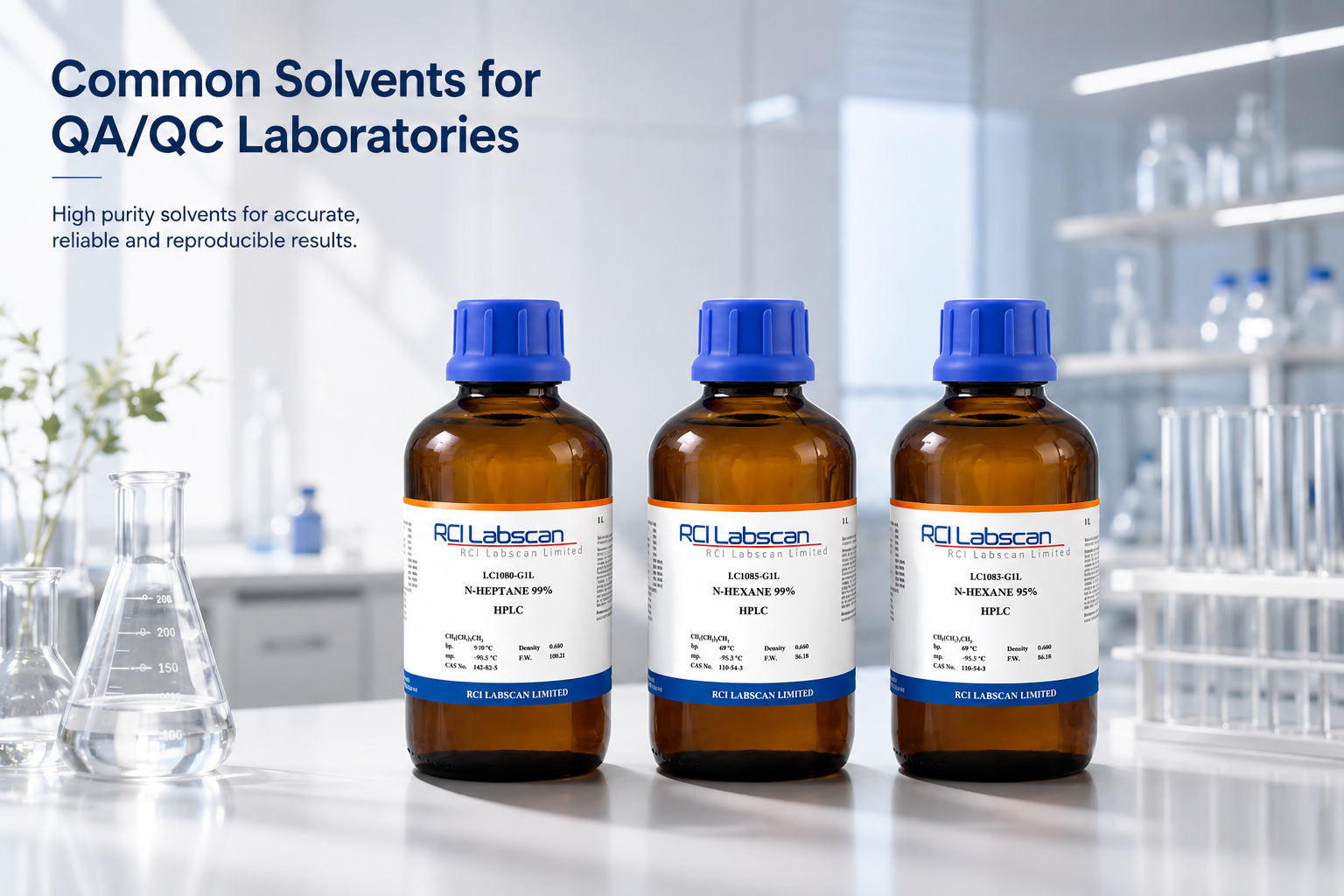
Common Solvents Used in QA/QC Laboratories
Several solvents are commonly used in QA/QC laboratories for analytical testing and sample preparation. Examples include:
- Methanol: Commonly used in HPLC, LC-MS, sample preparation, extraction, and other analytical procedures.
- Acetonitrile: Commonly used as an HPLC or LC-MS mobile phase component and in sample preparation.
- Isopropanol: Used in chromatographic applications, cleaning procedures, and sample preparation depending on the method.
- Water: High-purity water is commonly required for HPLC and LC-MS applications, particularly when water is used as a mobile phase component.
- Hexane: Commonly used for extraction and chromatographic applications where a non-polar solvent is required.
- Ethanol
- Acetone
- Tetrahydrofuran (THF)
Laboratories should always select the appropriate grade and specification for the intended method rather than selecting a solvent based only on its chemical name.
Why Should You Check the Product Specification Before Purchasing?
Reviewing the Product Specification before purchasing helps laboratories confirm whether the solvent meets the requirements of the analytical method. This is particularly important when establishing a new analytical method, changing suppliers, changing solvent brands, qualifying a new material, performing validated methods, investigating unexpected analytical results, or purchasing solvents for HPLC or LC-MS.
A Product Specification defines the quality requirements that the product is expected to meet. However, laboratories should also review the Certificate of Analysis (CoA) when required.
The difference is simple:
- Product Specification = What the product should meet
- CoA = What the specific batch actually achieved
Reviewing both documents can provide a more complete understanding of solvent quality.
Common Mistakes When Choosing Laboratory Solvents
- Choosing Based Only on Purity: A solvent with 99.9% purity is not automatically suitable for every analytical application. Parameters like UV absorbance, residue, and water content may be more important.
- Choosing Based Only on Price: The lowest-cost solvent may not provide the quality required, while choosing an unnecessarily high-grade solvent can increase operating costs without providing benefits.
- Choosing Based Only on the Solvent Name: Solvents like methanol and acetonitrile come in multiple grades; the chemical name alone does not define quality requirements.
- Ignoring the Detector: The same solvent may perform differently depending on whether the method uses UV, PDA, RI, fluorescence, or mass spectrometry.
- Not Reviewing the CoA: Specifications define requirements, while the CoA provides actual results for a specific batch. Both may need to be reviewed for critical applications.
A Practical Solvent Selection Checklist for QA/QC Laboratories
Before purchasing or using a solvent, ask the following questions:
- What is the solvent used for? Identify whether it will be used for HPLC, LC-MS, sample preparation, extraction, cleaning, or another application.
- What instrument and detector will be used? Check the analytical platform and detector requirements.
- What solvent grade does the method require? Confirm the grade specified by the analytical procedure or laboratory SOP.
- Are the important quality parameters controlled? Review purity, UV absorbance, residue, water, and specific impurities as applicable.
- Are the specification limits suitable? Check the acceptance criteria and units.
- Is the test method appropriate? Review the referenced analytical method or standard when required.
- Is the batch supported by a CoA? Check the actual analytical results for the specific batch when necessary.
- Does the solvent provide the right balance between performance and cost? Choose a solvent that meets the method requirements without unnecessary over-specification.
QA/QC Solvent Selection: A Simple Decision Process
A practical decision process can be summarized as follows:
Application → Instrument → Detector → Grade → Specification → CoA → Cost
- Step 1 — Identify the Application: Determine exactly how the solvent will be used.
- Step 2 — Check the Instrument: Identify the analytical platform and compatibility requirements.
- Step 3 — Check the Detector: Determine which impurities or solvent characteristics may affect detection.
- Step 4 — Select the Grade: Choose the appropriate solvent grade for the analytical application.
- Step 5 — Review the Specification: Check purity, UV absorbance, residue, water, impurities, and other relevant parameters.
- Step 6 — Review the CoA: Confirm the actual batch results when required.
- Step 7 — Evaluate Cost: Choose the most appropriate solvent that meets the method requirements and supports reliable routine testing.
This approach helps QA/QC laboratories make solvent selection more systematic and consistent.
FAQ
What is the most important factor when choosing a solvent for QA/QC?
The most important factor is whether the solvent meets the requirements of the analytical method. Laboratories should consider the application, instrument, detector, grade, specification, and impurity control rather than purity alone.
Is higher-purity solvent always better?
Not necessarily. A higher-purity solvent may not provide additional value if the analytical method does not require stricter impurity control. The solvent should be selected according to the requirements of the application.
Which solvent grade is suitable for routine HPLC testing?
HPLC grade solvent is commonly used for routine HPLC analysis, particularly when the method uses UV, PDA, RI, fluorescence, or other common HPLC detectors. The actual Product Specification should still be checked against the method requirements.
Which solvent grade should be used for LC-MS?
LC-MS grade solvent is generally preferred for LC-MS and LC-MS/MS applications because these methods require stricter control of impurities that may affect mass spectrometry detection.
Can LC-MS grade solvent be used for HPLC?
Yes, LC-MS grade solvent can generally be used for HPLC when it is compatible with the method. However, routine HPLC testing may not require the additional impurity control of LC-MS grade solvent.
Can HPLC grade solvent be used for LC-MS?
It should not be assumed that HPLC grade solvent is suitable for LC-MS. Laboratories should follow the analytical method and instrument requirements and confirm that the solvent meets the required specifications.
Should QA/QC laboratories check the CoA?
Yes. When batch-specific quality verification is required, the CoA can be used to review the actual test results of the specific solvent lot.
How can laboratories reduce solvent costs without compromising quality?
Laboratories can select the lowest grade that fully meets the analytical method requirements, standardize solvent selection where appropriate, compare specifications between suppliers, and avoid using unnecessarily high-grade solvents for routine applications.
What should I check besides solvent purity?
Depending on the application, laboratories may need to check UV absorbance, water content, residue after evaporation, specific impurities, non-volatile impurities, test methods, and other application-specific parameters.
Choose the Right Solvent for Reliable QA/QC Results
Selecting the right solvent is an important part of maintaining reliable QA/QC laboratory performance.
Rather than choosing a solvent based only on purity, laboratories should evaluate the complete analytical requirement — including the application, instrument, detector, solvent grade, specification, impurity control, CoA, and cost.
The right solvent can help reduce analytical interference, support reproducible results, and maintain consistent laboratory performance.
RCI Labscan provides a wide range of laboratory chemicals and high-purity solvents for analytical, research, quality control, pharmaceutical, environmental, and industrial applications.
Choose the right solvent. Match the method. Maintain analytical confidence.
Explore related products:
- View all HPLC grade products
- View all LC-MS grade products
- Acetonitrile HPLC
- Methanol HPLC
- Acetonitrile LC-MS
- Methanol LC-MS
Related articles:
- What Is HPLC Grade Solvent?
- HPLC vs LC-MS Grade Solvents
- What Is Product Specification and How Should You Read It?
Leave a comment!